For each integer \(n\ge 2\) let \(f_n\) be the continuous function on \([0,1]\) that equals \(0\) up to \(x=\tfrac12\) , climbs linearly to \(1\) over the next interval of length \(1/n\) , and equals \(1\) from there on. As \(n\) grows the ramp steepens, and the functions settle down in an obvious sense: the area between \(f_n\) and \(f_m\) is tiny when \(n\) and \(m\) are large. Yet the function they are settling toward is a step, which jumps at \(x=\tfrac12\) and so is not continuous. If our space of vectors is \(C[0,1]\) and distance is measured by area, the sequence \((f_n)\) behaves like a convergent sequence in every internal respect and has no limit.
Whether that counts as a defect depends on two choices: which functions are admitted as vectors, and how size is measured. This chapter makes both choices explicit. A norm measures size; completeness is the property that sequences which ought to converge do. A complete normed space is called a Banach space, and nearly every theorem in this book has completeness among its hypotheses. We shall see how to test for it, how it can fail, and why the unit ball of an infinite-dimensional space is never compact, which is the single fact most responsible for the difference between this subject and linear algebra.
1.1 Norms and the shape of a unit ball
Definition 1.1 (norm, normed space). Let \(X\) be a vector space over \(\mathbb K\) . A norm on \(X\) is a function \(\lVert\cdot\rVert:X\to[0,\infty)\) such that for all \(x,y\in X\) and \(\alpha\in\mathbb K\) :
The pair \((X,\lVert\cdot\rVert)\) is a normed space. Its metric is \(d(x,y)=\lVert x-y\rVert\) .
The three conditions are called definiteness, homogeneity, and the triangle inequality. A function satisfying the last two but possibly vanishing on nonzero vectors is a seminorm. From the triangle inequality one gets the reverse form \(\bigl\lvert\lVert x\rVert-\lVert y\rVert\bigr\rvert\le\lVert x-y\rVert\) , which says that the norm is a continuous function on \(X\) .
The same vector space can carry many norms. On \(\mathbb K^n\) , for \(1\le p<\infty\) ,
The infinite-dimensional versions are the sequence spaces. For \(1\le p<\infty\) , \(\ell^p\) is the set of scalar sequences \(x=(x_1,x_2,\dots)\) with \(\sum_k\lvert x_k\rvert^p<\infty\) , normed by \(\lVert x\rVert_p=(\sum_k\lvert x_k\rvert^p)^{1/p}\) ; \(\ell^\infty\) is the set of bounded sequences with \(\lVert x\rVert_\infty=\sup_k\lvert x_k\rvert\) . Inside \(\ell^\infty\) sit two subspaces that will serve as test cases throughout the book: \(c_0\) , the sequences that converge to \(0\) , and \(c_{00}\) , the sequences with only finitely many nonzero terms. For functions, \(C[a,b]\) denotes the continuous scalar functions on \([a,b]\) with the supremum norm \(\lVert f\rVert_\infty=\max_{a\le x\le b}\lvert f(x)\rvert\) , and \(L^p\) of a measure space carries \(\lVert f\rVert_p=(\int\lvert f\rvert^p)^{1/p}\) , where functions equal almost everywhere are identified.
Definiteness and homogeneity are evident in each case. The triangle inequality is not: for \(p\)
strictly between \(1\)
and \(\infty\)
it is Minkowski’s inequality. For measurable \(f,g\)
and \(1\le p\le\infty\)
with conjugate exponent \(q\)
defined by \(1/p+1/q=1\)
, Hölder’s inequality states \(\int\lvert fg\rvert\le\lVert f\rVert_p\lVert g\rVert_q\)
and Minkowski’s states \(\lVert f+g\rVert_p\le\lVert f\rVert_p+\lVert g\rVert_p\)
(math.measure-theory.holder-minkowski). Taking the measure to be counting measure on \(\{1,2,3,\dots\}\)
gives the inequalities for sequences: \(\sum_k\lvert x_ky_k\rvert\le\lVert x\rVert_p\lVert y\rVert_q\)
and \(\lVert x+y\rVert_p\le\lVert x\rVert_p+\lVert y\rVert_p\)
. These two inequalities are the only facts about \(\ell^p\)
and \(L^p\)
that we import; everything else is proved here.
A norm is determined by its closed unit ball \(B_X\) , since \(\lVert x\rVert=\inf\{t>0:x/t\in B_X\}\) . The triangle inequality has a geometric meaning in these terms: if \(x,y\in B_X\) and \(0\le t\le 1\) then \(\lVert tx+(1-t)y\rVert\le t+(1-t)=1\) , so \(B_X\) is convex. Convexity of the ball is in fact equivalent to the triangle inequality, given homogeneity, and it fails for exponents below \(1\) .
Example 1.1: Three norms of one vector, and a formula that is not a norm
Take \(x=(3,-4,12)\) in \(\mathbb R^3\) . Then
The values decrease as \(p\) increases, and this is general. For any \(x\in\mathbb K^n\) ,
The first inequality holds because the largest \(\lvert x_k\rvert^2\) is one term of the sum. The second follows by squaring: \((\sum_k\lvert x_k\rvert)^2\) contains every \(\lvert x_k\rvert^2\) plus nonnegative cross terms. The third is the Cauchy–Schwarz inequality applied to the vectors \((\lvert x_k\rvert)\) and \((1,\dots,1)\) , and the fourth holds because each of the \(n\) squares is at most \(\lVert x\rVert_\infty^2\) . For our vector the chain reads \(12\le 13\le 19\le 13\sqrt 3\approx 22.52\le 36\) .
Now try the exponent \(p=\tfrac12\) on \(\mathbb R^2\) , setting \(\varphi(x)=(\lvert x_1\rvert^{1/2}+\lvert x_2\rvert^{1/2})^2\) . This function is definite and homogeneous. But \(\varphi(e_1)=\varphi(e_2)=1\) while \(\varphi(e_1+e_2)=(1+1)^2=4\) , which exceeds \(\varphi(e_1)+\varphi(e_2)=2\) . The triangle inequality fails. Equivalently the set \(\{\varphi\le 1\}\) is not convex: it contains \(e_1\) and \(e_2\) but not their midpoint, where \(\varphi(\tfrac12,\tfrac12)=2\) .
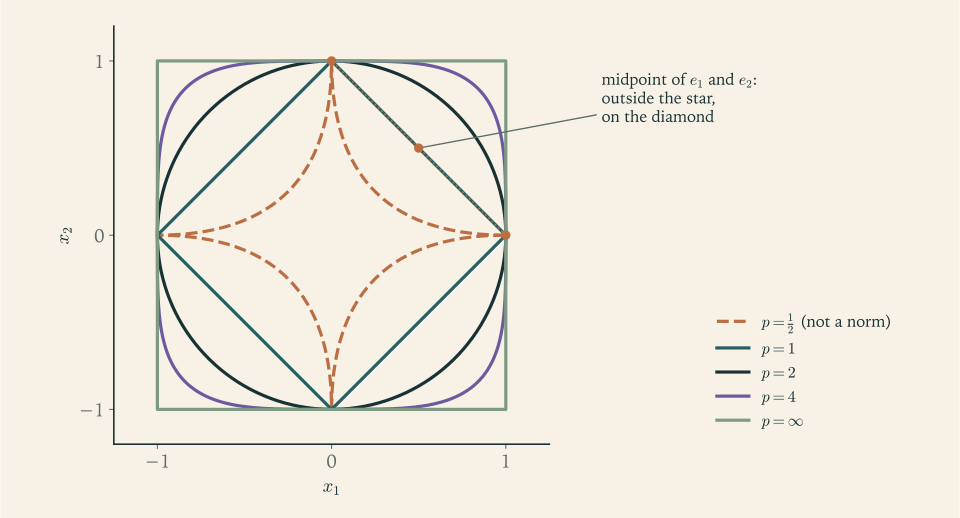
Figure 1.1 shows why all the norms \(\lVert\cdot\rVert_p\) on \(\mathbb R^2\) lead to the same convergent sequences: each unit ball contains a scaled copy of every other. In infinite dimensions that mutual containment can fail, and Section 1.4 takes up the consequences.
1.2 Cauchy sequences and Banach spaces
Definition 1.2 (convergence, Cauchy sequence, Banach space). A sequence \((x_n)\) in a normed space \(X\) converges to \(x\in X\) if \(\lVert x_n-x\rVert\to 0\) . It is a Cauchy sequence if for every \(\varepsilon>0\) there is \(N\) with \(\lVert x_n-x_m\rVert<\varepsilon\) whenever \(n,m\ge N\) . The space \(X\) is complete, and is called a Banach space, if every Cauchy sequence in \(X\) converges to an element of \(X\) .
Every convergent sequence is Cauchy, because \(\lVert x_n-x_m\rVert\le\lVert x_n-x\rVert+\lVert x-x_m\rVert\)
. Completeness is the converse, and it is a property of the pair consisting of the space and the norm, not of either alone. The scalars themselves are complete: every Cauchy sequence of real numbers converges (math.real-analysis.cauchy-completeness), and the complex case follows by taking real and imaginary parts. The proofs that familiar spaces are complete all follow one plan. Use completeness of \(\mathbb K\)
to produce a candidate limit one coordinate or one point at a time; then show that the candidate belongs to the space and that convergence holds in the norm, not merely coordinatewise.
Theorem 1.3 (completeness of the sequence spaces). For \(1\le p\le\infty\) the space \(\ell^p\) is a Banach space.
Proof. Take \(1\le p<\infty\) ; the case \(p=\infty\) is the same argument with suprema in place of sums. Let \((x^{(n)})\) be Cauchy in \(\ell^p\) . For each fixed \(k\) , \(\lvert x^{(n)}_k-x^{(m)}_k\rvert\le\lVert x^{(n)}-x^{(m)}\rVert_p\) , so the scalars \(x^{(n)}_k\) form a Cauchy sequence and converge to some \(x_k\) . Let \(x=(x_k)\) .
Given \(\varepsilon>0\) choose \(N\) with \(\lVert x^{(n)}-x^{(m)}\rVert_p\le\varepsilon\) for \(n,m\ge N\) . For any finite \(K\) and \(n,m\ge N\) ,
The sum is finite, so we may let \(m\to\infty\) term by term: \(\sum_{k=1}^{K}\lvert x^{(n)}_k-x_k\rvert^p\le\varepsilon^p\) . This holds for every \(K\) , so letting \(K\to\infty\) gives \(\lVert x^{(n)}-x\rVert_p\le\varepsilon\) for all \(n\ge N\) . In particular \(x^{(N)}-x\in\ell^p\) , hence \(x=x^{(N)}-(x^{(N)}-x)\in\ell^p\) , and \(x^{(n)}\to x\) in norm.
The order of the two limits in the proof matters. Coordinatewise convergence is obtained first and is weak information; the uniform bound \(\varepsilon^p\) on all finite sections is what upgrades it to convergence in norm.
Theorem 1.4 (completeness of continuous functions). The space \(C[a,b]\) with the supremum norm is a Banach space.
Proof. Let \((f_n)\)
be Cauchy. For each \(x\)
, \(\lvert f_n(x)-f_m(x)\rvert\le\lVert f_n-f_m\rVert_\infty\)
, so \(f_n(x)\)
converges to a number \(f(x)\)
. Given \(\varepsilon\)
, choose \(N\)
with \(\lVert f_n-f_m\rVert_\infty\le\varepsilon\)
for \(n,m\ge N\)
; letting \(m\to\infty\)
at each point gives \(\lvert f_n(x)-f(x)\rvert\le\varepsilon\)
for all \(x\)
and all \(n\ge N\)
. Thus \(f_n\to f\)
uniformly. A uniform limit of continuous functions on \([a,b]\)
is continuous (math.real-analysis.uniform-limit-continuity), so \(f\in C[a,b]\)
and \(\lVert f_n-f\rVert_\infty\to 0\)
.
For \(1\le p\le\infty\)
and any measure space, \(L^p\)
is complete; this is the Riesz–Fischer theorem, proved in Measure Theory (math.measure-theory.lp-completeness). Its proof needs the convergence theorems for the Lebesgue integral, which is one reason the Lebesgue integral displaced the Riemann integral: the Riemann-integrable functions do not form a complete space under \(\lVert\cdot\rVert_1\)
.
Example 1.2: Continuous ramps that converge to a step
Return to the ramps of the chapter opening, and measure size in \(C[0,1]\) by \(\lVert f\rVert_1=\int_0^1\lvert f\rvert\) . Explicitly, \(f_n(x)=0\) for \(x\le\tfrac12\) , \(f_n(x)=n(x-\tfrac12)\) for \(\tfrac12\le x\le\tfrac12+\tfrac1n\) , and \(f_n(x)=1\) afterwards. The region under \(f_n\) is a triangle of area \(1/(2n)\) less than the rectangle of area \(\tfrac12\) , so \(\int_0^1f_n=\tfrac12-\tfrac1{2n}\) . If \(m>n\) then \(f_m\ge f_n\) everywhere, hence
For instance \(\lVert f_8-f_4\rVert_1=\tfrac18-\tfrac1{16}=\tfrac1{16}\) . The right side is below \(1/(2n)\) , so \((f_n)\) is Cauchy for \(\lVert\cdot\rVert_1\) .
It has no limit in \(C[0,1]\) . Suppose \(f\) is continuous and \(\lVert f_n-f\rVert_1\to 0\) . Since every \(f_n\) vanishes on \([0,\tfrac12]\) , we get \(\int_0^{1/2}\lvert f\rvert\le\lVert f_n-f\rVert_1\to 0\) , and a continuous nonnegative function with zero integral is zero, so \(f=0\) on \([0,\tfrac12]\) . Fix \(\delta>0\) . For \(n\ge 1/\delta\) the function \(f_n\) equals \(1\) on \([\tfrac12+\delta,1]\) , and the same reasoning gives \(f=1\) there. As \(\delta\) was arbitrary, \(f=1\) on \((\tfrac12,1]\) , which contradicts continuity at \(\tfrac12\) . So \((C[0,1],\lVert\cdot\rVert_1)\) is not complete.
In the supremum norm the same sequence is not even Cauchy. For \(m>n\) the difference \(f_m-f_n\) is largest at \(x=\tfrac12+\tfrac1m\) , where \(f_m=1\) and \(f_n=n/m\) , so \(\lVert f_m-f_n\rVert_\infty=1-n/m\) ; in particular \(\lVert f_{2n}-f_n\rVert_\infty=\tfrac12\) for every \(n\) . There is no conflict with Theorem 1.4: one sequence, two norms, two different verdicts.
1.3 A series test for completeness
Checking completeness directly from Definition 1.2 requires handling an arbitrary Cauchy sequence. The following reformulation is often easier to use, because the series it mentions come with a quantitative hypothesis. A series \(\sum_kx_k\) in a normed space converges if its partial sums converge in norm, and converges absolutely if \(\sum_k\lVert x_k\rVert<\infty\) .
Theorem 1.5 (series test). A normed space \(X\) is complete if and only if every absolutely convergent series in \(X\) converges.
Proof. Suppose \(X\) is complete and \(\sum_k\lVert x_k\rVert<\infty\) . For \(m>n\) the partial sums satisfy \(\lVert s_m-s_n\rVert\le\sum_{k=n+1}^{m}\lVert x_k\rVert\) , which is a tail of a convergent series of numbers, so \((s_n)\) is Cauchy and converges.
Conversely, suppose absolutely convergent series converge, and let \((x_n)\) be Cauchy. Choose indices \(n_1<n_2<\cdots\) such that \(\lVert x_m-x_n\rVert\le 2^{-j}\) whenever \(m,n\ge n_j\) . The series \(\sum_j(x_{n_{j+1}}-x_{n_j})\) converges absolutely, since its terms have norm at most \(2^{-j}\) . Its \(J\) -th partial sum telescopes to \(x_{n_{J+1}}-x_{n_1}\) , so the subsequence \((x_{n_j})\) converges to some \(x\in X\) . Finally a Cauchy sequence with a convergent subsequence converges to the same limit: \(\lVert x_n-x\rVert\le\lVert x_n-x_{n_j}\rVert+\lVert x_{n_j}-x\rVert\) , and both terms are small once \(n\) and \(j\) are large.
In \(\mathbb R\)
this is the familiar statement that absolute convergence implies convergence (math.real-analysis.absolute-convergence); the theorem says that this implication is exactly what completeness means.
Example 1.3: Finitely supported sequences are not complete
Give \(c_{00}\) the norm \(\lVert\cdot\rVert_2\) and consider the series \(\sum_ke_k/k^2\) . It converges absolutely, because \(\sum_k\lVert e_k/k^2\rVert_2=\sum_k1/k^2=\pi^2/6\) . Its partial sums \(s_n=(1,\tfrac14,\tfrac19,\dots,\tfrac1{n^2},0,0,\dots)\) lie in \(c_{00}\) . If they converged in \(c_{00}\) to some \(s\) , then for each fixed \(k\) the \(k\) -th coordinate of \(s\) would be \(\lim_n(s_n)_k=1/k^2\) , because \(\lvert(s_n)_k-s_k\rvert\le\lVert s_n-s\rVert_2\) . So \(s\) would have every coordinate nonzero, and no such sequence is in \(c_{00}\) . By Theorem 1.5, \((c_{00},\lVert\cdot\rVert_2)\) is not complete.
The same phenomenon appears with the Cauchy sequence \(a^{(n)}=(1,\tfrac12,\dots,\tfrac1n,0,\dots)\) . For \(m>n\) ,
so the sequence is Cauchy, and in the larger space \(\ell^2\) it converges to \(a=(1/k)_{k\ge 1}\) , whose norm is \(\lVert a\rVert_2=\pi/\sqrt 6\approx 1.2825\) . After ten terms the distance still to go is \(\lVert a-a^{(10)}\rVert_2=(\pi^2/6-\sum_{k\le 10}k^{-2})^{1/2}\approx 0.3085\) . The limit exists; it simply lies outside \(c_{00}\) . The space \(\ell^2\) is what one obtains by adjoining all such missing limits.
1.4 When two norms agree about convergence
Definition 1.6 (equivalent norms). Two norms \(\lVert\cdot\rVert\) and \(\lVert\cdot\rVert'\) on the same vector space \(X\) are equivalent if there are constants \(0<c\le C\) with
Equivalent norms have the same convergent sequences, the same Cauchy sequences, the same open sets, and so the same answer to the question of completeness. In finite dimensions there is nothing to choose.
Theorem 1.7 (norms in finite dimensions). On a finite-dimensional vector space any two norms are equivalent.
Proof. Fix a basis \(v_1,\dots,v_n\) of \(X\) and define the reference norm \(\lVert\sum_ia_iv_i\rVert_E=(\sum_i\lvert a_i\rvert^2)^{1/2}\) . It suffices to show that an arbitrary norm \(\lVert\cdot\rVert\) is equivalent to \(\lVert\cdot\rVert_E\) . For \(x=\sum_ia_iv_i\) the triangle inequality and the Cauchy–Schwarz inequality give
Consequently \(\bigl\lvert\lVert x\rVert-\lVert y\rVert\bigr\rvert\le C\lVert x-y\rVert_E\)
, so the function \(a\mapsto\lVert\sum_ia_iv_i\rVert\)
is continuous on \(\mathbb K^n\)
with its Euclidean metric. The Euclidean unit sphere \(S=\{a:\sum_i\lvert a_i\rvert^2=1\}\)
is closed and bounded, hence compact by the Heine–Borel theorem (math.real-analysis.heine-borel), so the function attains a minimum \(c\)
on \(S\)
. Since the \(v_i\)
are linearly independent, \(\sum_ia_iv_i\ne 0\)
for \(a\in S\)
, hence \(c>0\)
. By homogeneity \(\lVert x\rVert\ge c\lVert x\rVert_E\)
for every \(x\)
.
Corollary 1.8 (finite-dimensional subspaces). Every finite-dimensional normed space is complete, and every finite-dimensional subspace of a normed space is closed.
Proof. With the reference norm of the previous proof, \(X\) is isometric to \(\mathbb K^n\) with the Euclidean norm, which is complete; an equivalent norm has the same Cauchy and convergent sequences. A complete subspace is closed, because a sequence in it that converges in the larger space is Cauchy and so has its limit in the subspace.
The compactness of \(S\) was the heart of that proof, and compactness of the unit sphere is exactly what infinite-dimensional spaces lack.
Example 1.4: Two inequivalent norms on continuous functions
On \(C[0,1]\) compare \(\lVert f\rVert_1=\int_0^1\lvert f\rvert\) with \(\lVert f\rVert_\infty\) . One inequality always holds: \(\lVert f\rVert_1\le\lVert f\rVert_\infty\) , since the integrand is at most \(\lVert f\rVert_\infty\) on an interval of length \(1\) . The reverse inequality fails for every constant. Take \(g_n(x)=x^n\) . Then
A constant \(C\) with \(\lVert f\rVert_\infty\le C\lVert f\rVert_1\) would have to exceed \(n+1\) for every \(n\) . The norms are not equivalent, and they disagree about convergence: \(g_n\to 0\) for \(\lVert\cdot\rVert_1\) , while for the supremum norm \((g_n)\) does not converge at all, since its pointwise limit is discontinuous at \(1\) . Notice that every \(g_n\) is a polynomial, so the two norms are already inequivalent on the subspace of polynomials. On the polynomials of degree at most \(d\) , a finite-dimensional space, Theorem 1.7 guarantees some constant \(C_d\) , and the sequence \(g_n\) shows \(C_d\ge d+1\) : the constants exist degree by degree but are not uniform.
Common mistake. Treating completeness as a property of the set of vectors. The phrase “\(C[0,1]\) is complete” is true for the supremum norm and false for \(\lVert\cdot\rVert_1\) , as Example 1.2 showed. Before quoting any theorem whose hypothesis is “let \(X\) be a Banach space”, name the norm and check completeness for that norm. A useful quick test: if you can exhibit a sequence in the space that converges, in the given norm, to something outside the space, the space is not complete in that norm.
1.5 The unit ball is never compact in infinite dimensions
In \(\mathbb R^n\) a bounded sequence has a convergent subsequence. The next lemma is the tool for showing that this fails in every infinite-dimensional normed space. It says that a proper closed subspace always leaves room for a unit vector that stays almost at distance \(1\) from it. For a set \(M\) write \(\operatorname{dist}(x,M)=\inf_{m\in M}\lVert x-m\rVert\) .
Lemma 1.9 (Riesz). Let \(M\) be a closed proper subspace of a normed space \(X\) and let \(0<\theta<1\) . Then there is \(x\in X\) with \(\lVert x\rVert=1\) and \(\operatorname{dist}(x,M)\ge\theta\) .
Proof. Pick \(y\in X\setminus M\) and put \(d=\operatorname{dist}(y,M)\) . Since \(M\) is closed, \(d>0\) . Because \(d/\theta>d\) , there is \(m_0\in M\) with \(\lVert y-m_0\rVert\le d/\theta\) . Let \(x=(y-m_0)/\lVert y-m_0\rVert\) . For any \(m\in M\) the vector \(m_0+\lVert y-m_0\rVert\,m\) lies in \(M\) , so
Theorem 1.10 (compactness of the unit ball). The closed unit ball of a normed space \(X\) is compact if and only if \(X\) is finite-dimensional.
Proof. If \(X\) has finite dimension \(n\) , the reference norm of Theorem 1.7 identifies \(X\) with Euclidean \(\mathbb K^n\) and \(B_X\) with a closed bounded subset of it, which is compact by Heine–Borel; equivalence of norms transfers this to the given norm.
Suppose \(X\) is infinite-dimensional. Choose \(x_1\) with \(\lVert x_1\rVert=1\) . If \(x_1,\dots,x_n\) have been chosen, their span \(M_n\) is finite-dimensional, hence closed by Corollary 1.8, and proper because \(X\) is infinite-dimensional. Lemma 1.9 with \(\theta=\tfrac12\) gives \(x_{n+1}\) with \(\lVert x_{n+1}\rVert=1\) and \(\operatorname{dist}(x_{n+1},M_n)\ge\tfrac12\) . The resulting sequence lies in \(B_X\) and satisfies \(\lVert x_n-x_m\rVert\ge\tfrac12\) for \(n\ne m\) , so no subsequence is Cauchy and \(B_X\) is not compact.
Example 1.5: Bounded sequences with no convergent subsequence
In \(\ell^p\) with \(1\le p<\infty\) the unit vectors satisfy \(\lVert e_m-e_n\rVert_p=(1+1)^{1/p}=2^{1/p}\) for \(m\ne n\) : the distance is \(2\) in \(\ell^1\) and \(\sqrt2\approx 1.414\) in \(\ell^2\) , and in \(\ell^\infty\) it is \(1\) . In each space \((e_n)\) is a sequence of unit vectors whose terms stay a fixed distance apart, so it has no convergent subsequence. Here the construction in Theorem 1.10 is visible directly, and with a better constant than \(\tfrac12\) .
In \(C[0,1]\) with the supremum norm, the powers \(g_n(x)=x^n\) give another instance. For fixed \(n\) put \(t=x^n\) , which runs over \([0,1]\) ; then \(g_n-g_{2n}=t-t^2\) , whose maximum is \(\tfrac14\) at \(t=\tfrac12\) . Hence \(\lVert g_n-g_{2n}\rVert_\infty=\tfrac14\) for every \(n\) . If a subsequence \((g_{n_j})\) converged uniformly, its limit would be the pointwise limit, which is \(0\) on \([0,1)\) and \(1\) at \(x=1\) and is not continuous. So the closed unit ball of \(C[0,1]\) contains a sequence with no uniformly convergent subsequence, although every \(g_n\) is bounded by \(1\) .
Theorem 1.10 is the reason the later chapters need new ideas. Existence arguments in \(\mathbb R^n\) usually run: take a bounded sequence of approximate solutions, pass to a convergent subsequence, and show that the limit solves the problem. In a Banach space the second step is unavailable for the norm. Chapter 6 recovers it by weakening the notion of convergence, and Chapter 9 by restricting attention to operators that compress bounded sets into compact ones.
1.6 Subspaces, quotients, separability, and completion
Three constructions produce new normed spaces from old, and it is worth knowing when each preserves completeness.
Subspaces. A subspace \(M\) of a Banach space \(X\) , with the norm of \(X\) , is complete if and only if it is closed in \(X\) . If \(M\) is closed, a Cauchy sequence in \(M\) converges in \(X\) and the limit lies in \(M\) ; if \(M\) is complete, the argument of Corollary 1.8 shows it is closed. Thus \(c_0\) , which is closed in \(\ell^\infty\) (Exercise 4), is a Banach space, while \(c_{00}\) , which is not closed in \(\ell^\infty\) or in any \(\ell^p\) , is not.
Quotients. Let \(M\) be a closed subspace of a normed space \(X\) . The quotient vector space \(X/M\) consists of the cosets \(x+M\) , and
defines a norm on it. Homogeneity and the triangle inequality follow from those of \(X\) by taking infima; definiteness is where closedness is used, since \(\operatorname{dist}(x,M)=0\) means that \(x\) is a limit of elements of \(M\) , and so \(x\in M\) and \(x+M\) is the zero coset. The quotient map \(\pi:x\mapsto x+M\) is linear and satisfies \(\lVert\pi(x)\rVert\le\lVert x\rVert\) .
Theorem 1.11 (quotients of Banach spaces). If \(X\) is a Banach space and \(M\) is a closed subspace, then \(X/M\) is a Banach space.
Proof. We use the series test. Let \(\sum_k\xi_k\) be an absolutely convergent series in \(X/M\) . By definition of the quotient norm each coset \(\xi_k\) contains a representative \(x_k\) with \(\lVert x_k\rVert\le\lVert\xi_k\rVert+2^{-k}\) . Then \(\sum_k\lVert x_k\rVert<\infty\) , and since \(X\) is complete the series \(\sum_kx_k\) converges to some \(x\in X\) . Because \(\pi\) is linear and does not increase norms,
So \(\sum_k\xi_k\) converges to \(\pi(x)\) , and \(X/M\) is complete by Theorem 1.5.
Example 1.6: A quotient norm is a best-approximation problem
Let \(M\) be the line spanned by \(u=(1,1,1)\) in \(\mathbb R^3\) , and take \(x=(3,-4,12)\) again. The norm of the coset \(x+M\) is the smallest value of \(\lVert x-tu\rVert\) over real \(t\) , and the answer depends on the norm placed on \(\mathbb R^3\) .
With \(\lVert\cdot\rVert_2\) we minimize \((3-t)^2+(-4-t)^2+(12-t)^2\) ; the minimizer is the mean \(t=\tfrac{11}3\) and the minimum is \(169-\tfrac{121}{3}=\tfrac{386}{3}\) , so \(\lVert x+M\rVert=\sqrt{386/3}\approx 11.343\) . With \(\lVert\cdot\rVert_1\) we minimize \(\lvert 3-t\rvert+\lvert-4-t\rvert+\lvert 12-t\rvert\) , a piecewise linear function whose slope changes sign at the middle value \(t=3\) , giving \(\lVert x+M\rVert=0+7+9=16\) . With \(\lVert\cdot\rVert_\infty\) we minimize the largest of the three deviations, which is achieved by balancing the extreme entries at \(t=4\) , giving \(\lVert x+M\rVert=8\) .
Each value is a distance from \(x\) to the line \(M\) , in three different geometries. Computing a quotient norm always means solving such an approximation problem, and Chapter 3 will show how a well-chosen linear functional certifies the answer without any minimization.
Separability. A normed space is separable if it has a countable dense subset. For \(1\le p<\infty\) the space \(\ell^p\) is separable: the finitely supported sequences with rational coordinates (rational real and imaginary parts in the complex case) are countable, and they are dense because the tail \(\sum_{k>K}\lvert x_k\rvert^p\) of any \(x\in\ell^p\) can be made small and the first \(K\) coordinates approximated by rationals. The space \(\ell^\infty\) is not separable. The sequences whose entries are all \(0\) or \(1\) form an uncountable family, and two different members are at distance exactly \(1\) ; the balls of radius \(\tfrac12\) about them are disjoint, and a dense set must meet every one of them, so it cannot be countable. Separability will matter in Chapter 6, where it lets a diagonal argument stand in for compactness, and in Chapter 7, where it is equivalent to the existence of a countable orthonormal basis.
Completion. An incomplete space can always be enlarged to a complete one in an essentially unique way, just as \(\mathbb Q\) is enlarged to \(\mathbb R\) .
Theorem 1.12 (completion). For every normed space \(X\) there are a Banach space \(\widehat X\) and a linear map \(\iota:X\to\widehat X\) with \(\lVert\iota(x)\rVert=\lVert x\rVert\) for all \(x\) and with \(\iota(X)\) dense in \(\widehat X\) . If \((\widehat X_1,\iota_1)\) and \((\widehat X_2,\iota_2)\) are two such pairs, there is a unique surjective linear isometry \(U:\widehat X_1\to\widehat X_2\) with \(U\iota_1=\iota_2\) .
The classical proof builds \(\widehat X\) out of equivalence classes of Cauchy sequences. We postpone the proof to Section 3.5, where the Hahn–Banach theorem yields the existence part in a few lines, and uniqueness follows from the extension principle of Section 2.4. For now the theorem should be read as a licence: the completion of \((c_{00},\lVert\cdot\rVert_p)\) is \(\ell^p\) , the completion of \((c_{00},\lVert\cdot\rVert_\infty)\) is \(c_0\) , and the completion of \((C[0,1],\lVert\cdot\rVert_1)\) is \(L^1[0,1]\) , in which the step function of Example 1.2 is an honest element.
The definitions are now in place, and one question has been left conspicuously open. Linear maps between finite-dimensional spaces are automatically continuous. Between infinite-dimensional normed spaces they need not be, and the next chapter finds the condition that distinguishes those that are.
Exercises
-
Compute \(\lVert x\rVert_1\) , \(\lVert x\rVert_2\) , and \(\lVert x\rVert_\infty\) for \(x=(1,-2,2,4)\) in \(\mathbb R^4\) , and verify each inequality of the chain \(\lVert x\rVert_\infty\le\lVert x\rVert_2\le\lVert x\rVert_1\le\sqrt n\,\lVert x\rVert_2\le n\lVert x\rVert_\infty\) numerically for this vector.
Answer
\(\lVert x\rVert_1=1+2+2+4=9\) , \(\lVert x\rVert_2=\sqrt{1+4+4+16}=5\) , \(\lVert x\rVert_\infty=4\) . With \(n=4\) the chain reads \(4\le 5\le 9\le 2\cdot 5=10\le 16\) .
-
Let \(x\in\mathbb K^n\) be nonzero. Prove that \(\lVert x\rVert_q\le\lVert x\rVert_p\) whenever \(1\le p\le q<\infty\) , and that \(\lVert x\rVert_p\to\lVert x\rVert_\infty\) as \(p\to\infty\) .
Solution
Monotonicity. Let \(1\le p\le q<\infty\) . Both sides of \(\lVert x\rVert_q\le\lVert x\rVert_p\) are homogeneous of degree one, so after dividing \(x\) by \(\lVert x\rVert_p\) we may assume \(\lVert x\rVert_p=1\) . Then \(\sum_k\lvert x_k\rvert^p=1\) , so each \(\lvert x_k\rvert\le 1\) , and raising a number in \([0,1]\) to a larger power makes it smaller: \(\lvert x_k\rvert^q\le\lvert x_k\rvert^p\) . Summing, \(\sum_k\lvert x_k\rvert^q\le 1\) , that is, \(\lVert x\rVert_q\le 1=\lVert x\rVert_p\) .
The limit. The largest coordinate is one term of the sum, and every term is at most the largest, so
\[ \lVert x\rVert_\infty^p\le\sum_{k=1}^n\lvert x_k\rvert^p\le n\,\lVert x\rVert_\infty^p,\qquad\text{hence}\qquad\lVert x\rVert_\infty\le\lVert x\rVert_p\le n^{1/p}\lVert x\rVert_\infty . \]Since \(n^{1/p}\to 1\) as \(p\to\infty\) , the squeeze gives \(\lVert x\rVert_p\to\lVert x\rVert_\infty\) . The first argument did not use that the sum is finite, so \(\lVert x\rVert_q\le\lVert x\rVert_p\) also holds in \(\ell^p\) , which shows \(\ell^p\subseteq\ell^q\) for \(p\le q\) .
-
Let \(\varphi:X\to[0,\infty)\) be definite and homogeneous. Prove that \(\varphi\) satisfies the triangle inequality if and only if the set \(\{x:\varphi(x)\le 1\}\) is convex.
Hint
If \(\varphi\) satisfies the triangle inequality, convexity of \(\{\varphi\le 1\}\) is the computation in Section 1.1. For the converse, take nonzero \(x,y\) , put \(a=\varphi(x)\) , \(b=\varphi(y)\) , and write
\[ \frac{x+y}{a+b}=\frac{a}{a+b}\cdot\frac{x}{a}+\frac{b}{a+b}\cdot\frac{y}{b}, \]a convex combination of two points of \(\{\varphi\le 1\}\) . Apply \(\varphi\) and use homogeneity.
-
Prove that \(c_0\) is a closed subspace of \(\ell^\infty\) , and conclude that \(c_0\) with the supremum norm is a Banach space.
Solution
\(c_0\) is a subspace because sums and scalar multiples of null sequences are null. To see that it is closed, let \(x^{(n)}\in c_0\) and \(x^{(n)}\to x\) in \(\ell^\infty\) , and let \(\varepsilon>0\) . Choose \(n\) with \(\lVert x^{(n)}-x\rVert_\infty\le\varepsilon/2\) . Since \(x^{(n)}\in c_0\) there is \(K\) with \(\lvert x^{(n)}_k\rvert\le\varepsilon/2\) for all \(k\ge K\) . For those \(k\) ,
\[ \lvert x_k\rvert\le\lvert x_k-x^{(n)}_k\rvert+\lvert x^{(n)}_k\rvert\le\tfrac{\varepsilon}{2}+\tfrac{\varepsilon}{2}=\varepsilon . \]So \(x_k\to 0\) , that is, \(x\in c_0\) . A closed subspace of the Banach space \(\ell^\infty\) (Theorem 1.3) is complete, by the remark on subspaces in Section 1.6, so \(c_0\) is a Banach space. The point of the argument is that the bound \(\varepsilon/2\) on \(x-x^{(n)}\) is uniform in \(k\) ; coordinatewise convergence alone would not suffice, as the sequences \(x^{(n)}=(1,\dots,1,0,0,\dots)\) show.
-
Show that \(c_{00}\) is dense in \(\ell^p\) for \(1\le p<\infty\) and dense in \(c_0\) , but not dense in \(\ell^\infty\) ; find the distance in \(\ell^\infty\) from the constant sequence \((1,1,1,\dots)\) to \(c_{00}\) .
Solution
Density in \(\ell^p\) , \(p<\infty\) . Let \(x\in\ell^p\) and let \(x^{[K]}=(x_1,\dots,x_K,0,0,\dots)\in c_{00}\) . Then \(\lVert x-x^{[K]}\rVert_p^p=\sum_{k>K}\lvert x_k\rvert^p\) , a tail of a convergent series, which tends to \(0\) as \(K\to\infty\) .
Density in \(c_0\) . For \(x\in c_0\) , \(\lVert x-x^{[K]}\rVert_\infty=\sup_{k>K}\lvert x_k\rvert\to 0\) because \(x_k\to 0\) .
Failure in \(\ell^\infty\) . Let \(\mathbf 1=(1,1,1,\dots)\) and let \(y\in c_{00}\) . Some coordinate of \(y\) is zero, say \(y_k=0\) , so \(\lVert\mathbf 1-y\rVert_\infty\ge\lvert 1-y_k\rvert=1\) . Thus every element of \(c_{00}\) is at distance at least \(1\) from \(\mathbf 1\) , and \(y=0\) achieves distance exactly \(1\) . Therefore \(\operatorname{dist}(\mathbf 1,c_{00})=1\) and \(c_{00}\) is not dense in \(\ell^\infty\) . The closure of \(c_{00}\) in \(\ell^\infty\) is \(c_0\) : it contains \(c_0\) by the second part and is contained in \(c_0\) because \(c_0\) is closed (Exercise 4).
-
For \(g_n(x)=x^n\) on \([0,1]\) compute \(\lVert g_n\rVert_1\) , \(\lVert g_n\rVert_2\) , \(\lVert g_n\rVert_\infty\) , and \(\lVert g_n-g_{2n}\rVert_\infty\) , and decide for each of the three norms whether \((g_n)\) converges in \(C[0,1]\) and to what.
Solution
The norms are
\[ \lVert g_n\rVert_1=\int_0^1x^n\,dx=\frac1{n+1},\qquad\lVert g_n\rVert_2=\Bigl(\int_0^1x^{2n}\,dx\Bigr)^{1/2}=\frac1{\sqrt{2n+1}},\qquad\lVert g_n\rVert_\infty=1 . \]For the last quantity substitute \(t=x^n\in[0,1]\) : \(g_n-g_{2n}=t-t^2\) , maximal at \(t=\tfrac12\) , so \(\lVert g_n-g_{2n}\rVert_\infty=\tfrac14\) .
In \(\lVert\cdot\rVert_1\) and in \(\lVert\cdot\rVert_2\) the sequence converges to the zero function, since the norms \(1/(n+1)\) and \(1/\sqrt{2n+1}\) tend to \(0\) and the zero function is in \(C[0,1]\) . In the supremum norm the sequence does not converge: a convergent sequence is Cauchy, but \(\lVert g_n-g_{2n}\rVert_\infty=\tfrac14\) for every \(n\) . One can also argue from the limit: uniform convergence implies pointwise convergence, and the pointwise limit is \(0\) on \([0,1)\) and \(1\) at \(x=1\) , which is not continuous. The zero function is not the uniform limit either, since \(\lVert g_n-0\rVert_\infty=1\) .
-
Prove that every Cauchy sequence in a normed space is bounded, and that a Cauchy sequence which has a convergent subsequence converges to the limit of that subsequence.
Hint
For boundedness, take \(\varepsilon=1\) in the definition to get \(N\) with \(\lVert x_n-x_N\rVert<1\) for \(n\ge N\) ; then \(\lVert x_n\rVert\le\max\{\lVert x_1\rVert,\dots,\lVert x_{N-1}\rVert,\lVert x_N\rVert+1\}\) . For the second statement use \(\lVert x_n-x\rVert\le\lVert x_n-x_{n_j}\rVert+\lVert x_{n_j}-x\rVert\) and choose \(j\) large first.
-
Let \(C^1[0,1]\) be the continuously differentiable functions on \([0,1]\) with the norm \(\lVert f\rVert_{C^1}=\lVert f\rVert_\infty+\lVert f'\rVert_\infty\) . Prove that \(C^1[0,1]\) is a Banach space, using the formula \(f(x)=f(0)+\int_0^xf'(t)\,dt\) .
Solution
Let \((f_n)\) be Cauchy in \(C^1[0,1]\) . Since \(\lVert f_n-f_m\rVert_\infty\le\lVert f_n-f_m\rVert_{C^1}\) and \(\lVert f_n'-f_m'\rVert_\infty\le\lVert f_n-f_m\rVert_{C^1}\) , both \((f_n)\) and \((f_n')\) are Cauchy in \(C[0,1]\) for the supremum norm. By Theorem 1.4 there are continuous functions \(f\) and \(g\) with \(f_n\to f\) and \(f_n'\to g\) uniformly.
We must show that \(f\) is differentiable with \(f'=g\) . For each \(n\) and \(x\) ,
\[ f_n(x)=f_n(0)+\int_0^xf_n'(t)\,dt . \]The left side tends to \(f(x)\) and \(f_n(0)\to f(0)\) . For the integral, \(\bigl\lvert\int_0^xf_n'-\int_0^xg\bigr\rvert\le\lVert f_n'-g\rVert_\infty\to 0\) . Hence \(f(x)=f(0)+\int_0^xg(t)\,dt\) . As \(g\) is continuous, the fundamental theorem of calculus shows that \(f\) is differentiable with \(f'=g\) , which is continuous. So \(f\in C^1[0,1]\) , and
\[ \lVert f_n-f\rVert_{C^1}=\lVert f_n-f\rVert_\infty+\lVert f_n'-g\rVert_\infty\to 0 . \]Every Cauchy sequence converges, so \(C^1[0,1]\) is a Banach space in this norm. With the supremum norm alone it is not: it is a dense proper subspace of \(C[0,1]\) , hence not closed.
-
A student writes: “The sequence \(a^{(n)}\) of Example 1.3 is Cauchy in \(c_{00}\) and converges coordinatewise to \(a=(1/k)\) , so \(c_{00}\) is complete and \(a\) is the limit.” Identify every error in this sentence.
Answer
Three errors. Coordinatewise convergence is not convergence in norm, so it does not identify a limit in the normed space. The proposed limit \(a\) has infinitely many nonzero terms and is not an element of \(c_{00}\) , so it cannot be the limit of anything in \(c_{00}\) . And one Cauchy sequence having a limit would not prove completeness, which is a statement about every Cauchy sequence. The correct conclusion is the opposite one: the sequence is Cauchy and has no limit in \(c_{00}\) , so \(c_{00}\) is not complete.
-
On \(\mathbb R^n\) find the smallest constant \(C\) and the largest constant \(c\) such that \(c\lVert x\rVert_1\le\lVert x\rVert_2\le C\lVert x\rVert_1\) for all \(x\) , exhibiting vectors at which each bound is attained, and say what happens to \(c\) as \(n\to\infty\) .
Answer
\(C=1\) , attained at \(x=e_1\) , and \(c=1/\sqrt n\) , attained at \(x=(1,\dots,1)\) , where \(\lVert x\rVert_1=n\) and \(\lVert x\rVert_2=\sqrt n\) . As \(n\to\infty\) , \(c\to 0\) : there is no dimension-free lower bound, which is why \(\lVert\cdot\rVert_1\) and \(\lVert\cdot\rVert_2\) are inequivalent on \(c_{00}\) .
-
Prove that \(\lVert f\rVert_1\le\lVert f\rVert_2\le\lVert f\rVert_\infty\) for \(f\in C[0,1]\) , and show that no two of these three norms are equivalent on \(C[0,1]\) by computing all three norms of the tent functions \(h_n(x)=\max\{0,\,n-n^2x\}\) .
Solution
By the Cauchy–Schwarz inequality for integrals, \(\lVert f\rVert_1=\int_0^1\lvert f\rvert\cdot 1\le(\int_0^1\lvert f\rvert^2)^{1/2}(\int_0^11)^{1/2}=\lVert f\rVert_2\) . Also \(\lvert f\rvert^2\le\lVert f\rVert_\infty^2\) pointwise, so \(\lVert f\rVert_2\le\lVert f\rVert_\infty\) .
The tent \(h_n\) is continuous, equals \(n-n^2x\) on \([0,1/n]\) , and vanishes on \([1/n,1]\) . Its graph is a triangle of base \(1/n\) and height \(n\) , so
\[ \lVert h_n\rVert_\infty=n,\qquad\lVert h_n\rVert_1=\tfrac12,\qquad\lVert h_n\rVert_2^2=\int_0^{1/n}(n-n^2x)^2\,dx=\frac{n}{3} . \]For the last integral substitute \(u=n-n^2x\) , which gives \(\frac1{n^2}\int_0^nu^2\,du=\frac{n}{3}\) . The three ratios are
\[ \frac{\lVert h_n\rVert_2}{\lVert h_n\rVert_1}=2\sqrt{n/3},\qquad\frac{\lVert h_n\rVert_\infty}{\lVert h_n\rVert_2}=\sqrt{3n},\qquad\frac{\lVert h_n\rVert_\infty}{\lVert h_n\rVert_1}=2n, \]and each is unbounded in \(n\) . So none of the reverse inequalities \(\lVert f\rVert_2\le C\lVert f\rVert_1\) , \(\lVert f\rVert_\infty\le C\lVert f\rVert_2\) , \(\lVert f\rVert_\infty\le C\lVert f\rVert_1\) can hold with a fixed constant, and no two of the norms are equivalent.
-
Show that in a finite-dimensional normed space Riesz’s lemma holds with \(\theta=1\) : for every proper subspace \(M\) there is a unit vector \(x\) with \(\operatorname{dist}(x,M)=1\) . Which step of your argument is unavailable in infinite dimensions?
Hint
Pick \(y\notin M\) . The function \(m\mapsto\lVert y-m\rVert\) is continuous on \(M\) and it suffices to minimize it over the bounded closed subset \(\{m\in M:\lVert m\rVert\le 2\lVert y\rVert\}\) of the finite-dimensional space \(M\) , which is compact. So the infimum \(d\) is attained at some \(m_0\) ; put \(x=(y-m_0)/d\) and repeat the computation in the proof of Lemma 1.9 with \(\theta=1\) . In infinite dimensions the bounded closed set need not be compact, and the infimum need not be attained.
-
Let \(M\) be the span of \((1,1,1)\) in \(\mathbb R^3\) and \(x=(1,5,2)\) . Compute the quotient norm \(\lVert x+M\rVert\) when \(\mathbb R^3\) carries \(\lVert\cdot\rVert_1\) , \(\lVert\cdot\rVert_2\) , and \(\lVert\cdot\rVert_\infty\) , giving the minimizing multiple of \((1,1,1)\) in each case.
Answer
With \(\lVert\cdot\rVert_1\) : \(t=2\) (the median), \(\lVert x+M\rVert=1+3+0=4\) . With \(\lVert\cdot\rVert_2\) : \(t=\tfrac83\) (the mean), \(\lVert x+M\rVert=\sqrt{26/3}\approx 2.944\) . With \(\lVert\cdot\rVert_\infty\) : \(t=3\) (the midrange), \(\lVert x+M\rVert=2\) .
-
Let \(M\) be a subspace of a normed space \(X\) that is not closed. Show that there is \(x\notin M\) with \(\operatorname{dist}(x,M)=0\) , and explain why the formula \(\lVert x+M\rVert=\operatorname{dist}(x,M)\) then fails to define a norm on \(X/M\) .
Hint
Take \(x\) in the closure of \(M\) but not in \(M\) . Then \(\operatorname{dist}(x,M)=0\) while the coset \(x+M\) is not the zero coset, so definiteness fails; the formula gives only a seminorm.
-
Using the Weierstrass approximation theorem, that every continuous function on \([0,1]\) is a uniform limit of polynomials, prove that \(C[0,1]\) with the supremum norm is separable.
Hint
The polynomials with rational coefficients (rational real and imaginary parts in the complex case) are countable. Given \(f\) and \(\varepsilon\) , first choose a polynomial \(p\) with \(\lVert f-p\rVert_\infty<\varepsilon/2\) , then perturb each coefficient of \(p\) to a rational; the perturbation changes \(p\) by at most the sum of the coefficient errors, since \(\lvert x^k\rvert\le 1\) on \([0,1]\) .
-
Construct a sequence \((h_n)\) in the closed unit ball of \(C[0,1]\) with \(\lVert h_n-h_m\rVert_\infty=1\) for all \(n\ne m\) , by using functions with disjoint supports.
Answer
Let \(h_n\) be the continuous piecewise linear function that is \(0\) outside \([2^{-n},2^{-n+1}]\) and rises to \(1\) at the midpoint of that interval. The supports overlap only at endpoints, where both functions vanish, so at every point at most one of \(h_n,h_m\) is nonzero and \(\lVert h_n-h_m\rVert_\infty=1\) .
-
Let \(X\) be a finite-dimensional normed space and \(T:X\to Y\) a linear map into any normed space. Prove that there is a constant \(C\) with \(\lVert Tx\rVert\le C\lVert x\rVert\) for all \(x\in X\) .
Solution
Choose a basis \(v_1,\dots,v_n\) of \(X\) and let \(\lVert\cdot\rVert_E\) be the reference norm from the proof of Theorem 1.7, so that \(\lVert\sum_ia_iv_i\rVert_E=(\sum_i\lvert a_i\rvert^2)^{1/2}\) . For \(x=\sum_ia_iv_i\) , linearity, the triangle inequality in \(Y\) , and the Cauchy–Schwarz inequality give
\[ \lVert Tx\rVert\le\sum_{i=1}^n\lvert a_i\rvert\,\lVert Tv_i\rVert\le\Bigl(\sum_{i=1}^n\lVert Tv_i\rVert^2\Bigr)^{1/2}\lVert x\rVert_E . \]By Theorem 1.7 the given norm on \(X\) is equivalent to \(\lVert\cdot\rVert_E\) , so there is \(c>0\) with \(c\lVert x\rVert_E\le\lVert x\rVert\) . Therefore \(\lVert Tx\rVert\le C\lVert x\rVert\) with \(C=c^{-1}(\sum_i\lVert Tv_i\rVert^2)^{1/2}\) . Only the domain needs to be finite-dimensional; nothing was assumed about \(Y\) . The proof uses finite-dimensionality twice, once to expand \(x\) in a finite basis and once for the equivalence of norms, and Chapter 2 shows that the conclusion fails for differentiation on the polynomials.
-
Find the flaw: “Since \(\lVert f\rVert_1\le\lVert f\rVert_\infty\) on \(C[0,1]\) , every sequence that is Cauchy for \(\lVert\cdot\rVert_1\) is Cauchy for \(\lVert\cdot\rVert_\infty\) , hence converges uniformly by Theorem 1.4; therefore \((C[0,1],\lVert\cdot\rVert_1)\) is complete.”
Answer
The inequality \(\lVert f\rVert_1\le\lVert f\rVert_\infty\) shows that a sequence which is Cauchy for the larger norm \(\lVert\cdot\rVert_\infty\) is Cauchy for \(\lVert\cdot\rVert_1\) , not the other way round. The ramps of Example 1.2 are Cauchy for \(\lVert\cdot\rVert_1\) and not for \(\lVert\cdot\rVert_\infty\) .
-
Show that \(\ell^1\subseteq\ell^2\) with \(\lVert x\rVert_2\le\lVert x\rVert_1\) , that \(\ell^1\) is not closed in \(\ell^2\) , and that therefore \(\ell^1\) is not complete in the norm \(\lVert\cdot\rVert_2\) although it is complete in its own norm.
Solution
If \(x\in\ell^1\) then \(\lVert x\rVert_2\le\lVert x\rVert_1\) by the argument of Exercise 2, which did not use finiteness of the index set: normalise so that \(\sum_k\lvert x_k\rvert=1\) , note \(\lvert x_k\rvert\le 1\) , and deduce \(\sum_k\lvert x_k\rvert^2\le\sum_k\lvert x_k\rvert=1\) . In particular \(\ell^1\subseteq\ell^2\) .
To see that \(\ell^1\) is not closed in \(\ell^2\) , use the sequence of Example 1.3. Each \(a^{(n)}=(1,\tfrac12,\dots,\tfrac1n,0,\dots)\) lies in \(c_{00}\subseteq\ell^1\) , and \(a^{(n)}\to a=(1/k)\) in \(\ell^2\) because \(\lVert a-a^{(n)}\rVert_2^2=\sum_{k>n}k^{-2}\to 0\) . But \(a\notin\ell^1\) , since the harmonic series diverges. So a sequence in \(\ell^1\) converges in \(\ell^2\) to a point outside \(\ell^1\) .
Consequently \((\ell^1,\lVert\cdot\rVert_2)\) is not complete: \((a^{(n)})\) is Cauchy in that space, and if it converged there to some \(b\in\ell^1\) , then \(b\) would also be its limit in \(\ell^2\) , forcing \(b=a\notin\ell^1\) . There is no contradiction with Theorem 1.3, which asserts completeness of \(\ell^1\) in the norm \(\lVert\cdot\rVert_1\) ; the two norms on \(\ell^1\) are not equivalent.