A bounded functional is a measurement: it assigns to each vector a number, linearly and continuously. In \(\mathbb R^n\) the coordinate functionals are enough to identify a vector, to compute its norm, and to tell whether it lies in a given subspace. Does an arbitrary normed space have enough bounded functionals to do the same? The question is not idle. Nothing in the definition of a normed space mentions functionals, and for spaces that fail the triangle inequality, such as the analogue of \(L^p\) with \(0<p<1\) , the only continuous linear functional is zero.
Here is the difficulty in its simplest form. Given a nonzero vector \(x_0\) , we would like a functional \(F\) of norm \(1\) with \(F(x_0)=\lVert x_0\rVert\) . On the line through \(x_0\) there is no choice: \(F(tx_0)=t\lVert x_0\rVert\) . The problem is to extend this functional from the line to the whole space without increasing its norm. In an inner product space one would compose with the orthogonal projection onto the line. A general normed space has no orthogonal projections, and the Hahn–Banach theorem is what replaces them. It is the one major theorem of this book that does not need completeness; it needs convexity.
3.1 Functionals that can be written down
Before the abstract theorem it helps to see what dual spaces look like when they can be computed. For \(1\le p<\infty\) let \(q\) be the conjugate exponent, \(1/p+1/q=1\) , with \(q=\infty\) when \(p=1\) .
Theorem 3.1 (duals of the sequence spaces). Let \(1\le p<\infty\) . For each \(y\in\ell^q\) the formula
defines a bounded functional on \(\ell^p\) with \(\lVert\varphi_y\rVert=\lVert y\rVert_q\) , and every bounded functional on \(\ell^p\) equals \(\varphi_y\) for exactly one \(y\in\ell^q\) . The same statement holds with \(c_0\) in place of \(\ell^p\) and \(\ell^1\) in place of \(\ell^q\) .
Proof. Hölder’s inequality gives \(\lvert\varphi_y(x)\rvert\le\lVert x\rVert_p\lVert y\rVert_q\) , so \(\varphi_y\) is bounded with \(\lVert\varphi_y\rVert\le\lVert y\rVert_q\) ; the same bound on \(c_0\) with \(q=1\) is elementary.
Conversely let \(\varphi\) be a bounded functional and put \(y_k=\varphi(e_k)\) . We show \(y\in\ell^q\) with \(\lVert y\rVert_q\le\lVert\varphi\rVert\) by testing \(\varphi\) on well-chosen vectors. Suppose \(1<p<\infty\) . For each \(n\) let \(x^{(n)}\) have coordinates \(x_k=\overline{y_k}\lvert y_k\rvert^{q-2}\) for \(k\le n\) with \(y_k\ne 0\) , and \(0\) otherwise. Then \(\varphi(x^{(n)})=\sum_{k\le n}\lvert y_k\rvert^q\) , and since \((q-1)p=q\) ,
From \(\lvert\varphi(x^{(n)})\rvert\le\lVert\varphi\rVert\lVert x^{(n)}\rVert_p\) and \(1-1/p=1/q\) we get \((\sum_{k\le n}\lvert y_k\rvert^q)^{1/q}\le\lVert\varphi\rVert\) for every \(n\) . If \(p=1\) , simply \(\lvert y_k\rvert=\lvert\varphi(e_k)\rvert\le\lVert\varphi\rVert\) . For \(c_0\) , take \(x_k=\overline{y_k}/\lvert y_k\rvert\) for \(k\le n\) with \(y_k\ne 0\) and \(0\) otherwise; then \(\lVert x^{(n)}\rVert_\infty\le 1\) and \(\varphi(x^{(n)})=\sum_{k\le n}\lvert y_k\rvert\le\lVert\varphi\rVert\) .
In every case \(y\) lies in the claimed space and \(\lVert y\rVert_q\le\lVert\varphi\rVert\) . The bounded functionals \(\varphi\) and \(\varphi_y\) agree on each \(e_k\) , hence on \(c_{00}\) , which is dense in \(\ell^p\) for \(p<\infty\) and in \(c_0\) (Exercise 5 of Chapter 1Chapter 1); being continuous they agree everywhere. Thus \(\varphi=\varphi_y\) and \(\lVert\varphi\rVert\le\lVert y\rVert_q\le\lVert\varphi\rVert\) . Uniqueness holds because \(y_k=\varphi_y(e_k)\) .
So \((\ell^p)^*\) is \(\ell^q\) and \(c_0^*\) is \(\ell^1\) , as normed spaces. The proof used density of \(c_{00}\) , which fails in \(\ell^\infty\) , and indeed \((\ell^\infty)^*\) is strictly larger than \(\ell^1\) (Exercise 12). For function spaces the corresponding fact, that \((L^p)^*\) is \(L^q\) for \(1\le p<\infty\) on a \(\sigma\) -finite measure space, is proved in Measure Theory by means of the Radon–Nikodym theorem; we shall quote it when needed.
Example 3.1: One formula, three spaces, three norms
Let \(y=(\tfrac12,\tfrac14,\tfrac18,\dots)\) and \(\varphi(x)=\sum_kx_k/2^k\) . The sequence \(y\) belongs to \(\ell^1\) , \(\ell^2\) , and \(\ell^\infty\) , so the formula defines a bounded functional on \(c_0\) , on \(\ell^2\) , and on \(\ell^1\) , and Theorem 3.1 gives its norm in each case.
On \(\ell^1\) : \(\lVert\varphi\rVert=\lVert y\rVert_\infty=\tfrac12\) , attained at \(e_1\) . On \(\ell^2\) : \(\lVert\varphi\rVert=\lVert y\rVert_2=(\sum_k4^{-k})^{1/2}=1/\sqrt3\approx 0.5774\) , attained at the unit vector \(\sqrt3\,y\) , where Hölder’s inequality becomes an equality. On \(c_0\) : \(\lVert\varphi\rVert=\lVert y\rVert_1=\sum_k2^{-k}=1\) , and here the norm is not attained. If \(x\in c_0\) with \(\lVert x\rVert_\infty\le 1\) , then \(\lvert x_k\rvert<1\) for all large \(k\) , and since every \(y_k\) is positive,
The only candidates for equality are sequences with \(\lvert x_k\rvert=1\) for every \(k\) , and none of them tends to \(0\) . The vectors \((1,\dots,1,0,0,\dots)\) with \(n\) ones give \(\varphi=1-2^{-n}\) , which approaches \(1\) .
3.2 Extending by one dimension
The proof of the Hahn–Banach theorem has an analytic part and a set-theoretic part. The analytic part is the extension of a functional to a subspace one dimension larger, and it is cleanest when the bound on the functional is expressed not by a norm but by something more flexible.
Definition 3.2 (sublinear functional). A function \(p:X\to\mathbb R\) on a real vector space is sublinear if \(p(x+y)\le p(x)+p(y)\) and \(p(tx)=tp(x)\) for all \(x,y\in X\) and all \(t\ge 0\) .
Every norm and every seminorm is sublinear, and so is \(x\mapsto C\lVert x\rVert\) . A sublinear functional need not be symmetric or nonnegative: on the bounded real sequences, \(p(x)=\limsup_nx_n\) is sublinear. This extra generality costs nothing in the proof and is what later yields separation of convex sets.
Lemma 3.3 (one-step extension). Let \(p\) be sublinear on a real vector space \(X\) , let \(M\) be a subspace, and let \(f:M\to\mathbb R\) be linear with \(f\le p\) on \(M\) . Let \(x_0\notin M\) . A linear extension \(F\) of \(f\) to \(M\oplus\mathbb Rx_0\) satisfies \(F\le p\) if and only if \(c=F(x_0)\) lies in the interval \([a,b]\) , where
and this interval is not empty.
Proof. For \(m,m'\in M\) ,
Rearranged, \(-p(-m'-x_0)-f(m')\le p(m+x_0)-f(m)\) . Taking the supremum over \(m'\) and the infimum over \(m\) gives \(a\le b\) , with both finite.
Every linear extension has the form \(F(m+tx_0)=f(m)+tc\) . Suppose \(a\le c\le b\) . If \(t>0\) , then \(c\le b\le p(m/t+x_0)-f(m/t)\) , and multiplying by \(t\) gives \(f(m)+tc\le p(m+tx_0)\) . If \(t<0\) , write \(t=-s\) with \(s>0\) ; then \(c\ge a\ge-p(m/s-x_0)+f(m/s)\) , taking \(-m/s\) for the element of \(M\) in the supremum, and multiplying by \(s\) gives \(f(m)-sc\le p(m-sx_0)\) . For \(t=0\) the bound is the hypothesis. So \(F\le p\) . Conversely, if \(F\le p\) then the cases \(t=1\) and \(t=-1\) of \(F(m+tx_0)\le p(m+tx_0)\) say exactly that \(c\le b\) and \(c\ge a\) .
The lemma is constructive: it tells us precisely which values are allowed, and so it tells us when the extension is unique.
Example 3.2: The interval of extensions, computed
In \(\mathbb R^2\) let \(M\) be the first coordinate axis and \(f(t,0)=t\) . For each of the norms \(\lVert\cdot\rVert_1\) , \(\lVert\cdot\rVert_2\) , \(\lVert\cdot\rVert_\infty\) on \(\mathbb R^2\) the functional \(f\) has norm \(1\) on \(M\) , and an extension \(F(x)=x_1+cx_2\) has norm \(1\) exactly when \(F\le p\) for \(p\) equal to the norm. Take \(x_0=e_2\) and compute the interval of Lemma 3.3, where \(m=(t,0)\) .
For \(\lVert\cdot\rVert_1\) : \(p(m+x_0)-f(m)=\lvert t\rvert+1-t\) , whose infimum over \(t\) is \(b=1\) , attained for all \(t\ge 0\) ; and \(-p(-m-x_0)-f(m)=-\lvert t\rvert-1-t\) , whose supremum is \(a=-1\) , attained for \(t\le 0\) . Every \(c\in[-1,1]\) is allowed. Indeed the norm of \(F\) on \((\mathbb R^2,\lVert\cdot\rVert_1)\) is \(\max\{1,\lvert c\rvert\}\) by Theorem 3.1 in two dimensions.
For \(\lVert\cdot\rVert_2\) : \(b=\inf_t(\sqrt{t^2+1}-t)=0\) , approached as \(t\to\infty\) , and \(a=\sup_t(-\sqrt{t^2+1}-t)=0\) , approached as \(t\to-\infty\) . Only \(c=0\) is allowed. For \(\lVert\cdot\rVert_\infty\) : \(b=\inf_t(\max\{\lvert t\rvert,1\}-t)=0\) , attained for \(t\ge 1\) , and \(a=0\) likewise; again only \(c=0\) .
So the norm-preserving extension is unique for two of the norms and there is a whole interval of them for the third.
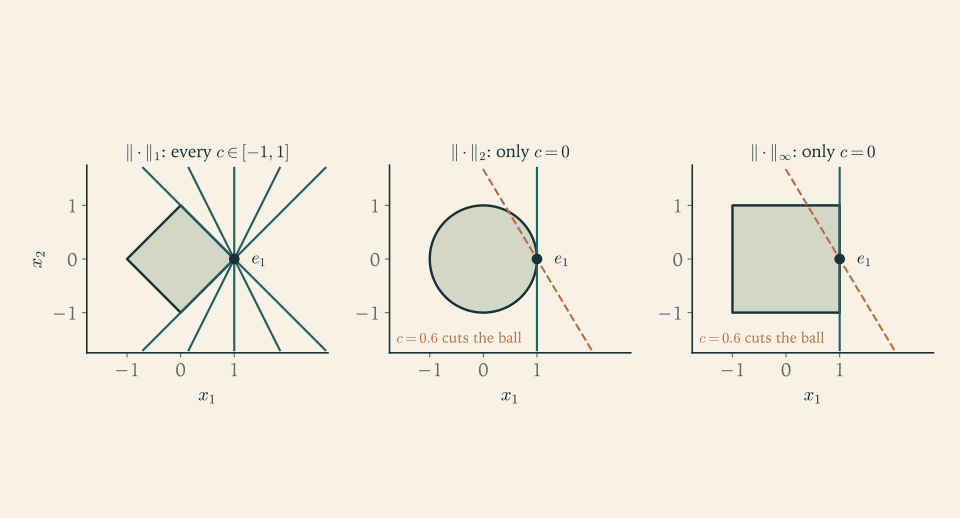
Figure 3.1 translates the lemma into geometry. The set where a norm-one functional \(F\) equals \(1\) is a line that touches the unit ball without cutting it, because \(F\le 1\) on the ball. Counting extensions is counting supporting lines at the point \(e_1\) .
3.3 The Hahn–Banach theorem
Repeating the one-step extension finitely many times handles finite-dimensional spaces. To reach an arbitrary space the standard tool is Zorn’s lemma: if every totally ordered subset of a nonempty partially ordered set has an upper bound, then the set has a maximal element. Zorn’s lemma is equivalent to the axiom of choice, and we take it as part of the set-theoretic background.
Theorem 3.4 (Hahn–Banach, sublinear form). Let \(X\) be a real vector space, \(p\) a sublinear functional on \(X\) , \(M\) a subspace, and \(f:M\to\mathbb R\) a linear functional with \(f(m)\le p(m)\) for all \(m\in M\) . Then there is a linear functional \(F:X\to\mathbb R\) with \(F=f\) on \(M\) and \(F(x)\le p(x)\) for all \(x\in X\) .
Proof. Consider the set \(\mathcal E\) of all pairs \((N,g)\) in which \(N\) is a subspace containing \(M\) and \(g:N\to\mathbb R\) is a linear extension of \(f\) with \(g\le p\) on \(N\) . It contains \((M,f)\) . Order it by declaring \((N,g)\preceq(N',g')\) when \(N\subseteq N'\) and \(g'\) extends \(g\) . If \(\{(N_i,g_i)\}\) is a totally ordered subset, then \(N=\bigcup_iN_i\) is a subspace, because any two of its elements lie in a common \(N_i\) ; the function \(g\) equal to \(g_i\) on \(N_i\) is well defined, linear, extends \(f\) , and satisfies \(g\le p\) . So \((N,g)\) is an upper bound in \(\mathcal E\) . By Zorn’s lemma \(\mathcal E\) has a maximal element \((N,g)\) . If \(N\ne X\) , choose \(x_0\notin N\) ; Lemma 3.3 extends \(g\) to \(N\oplus\mathbb Rx_0\) with the bound by \(p\) preserved, contradicting maximality. Hence \(N=X\) and \(F=g\) is the required functional.
Theorem 3.5 (Hahn–Banach, normed form). Let \(M\) be a subspace of a normed space \(X\) over \(\mathbb R\) or \(\mathbb C\) , and let \(f\in M^*\) . Then there is \(F\in X^*\) with \(F=f\) on \(M\) and \(\lVert F\rVert=\lVert f\rVert\) .
Proof. Real scalars. Apply Theorem 3.4 with \(p(x)=\lVert f\rVert\lVert x\rVert\) . The extension satisfies \(F(x)\le\lVert f\rVert\lVert x\rVert\) and \(-F(x)=F(-x)\le\lVert f\rVert\lVert x\rVert\) , so \(\lvert F(x)\rvert\le\lVert f\rVert\lVert x\rVert\) and \(\lVert F\rVert\le\lVert f\rVert\) ; the reverse inequality holds because \(F\) extends \(f\) .
Complex scalars. Regard \(X\) as a real vector space and let \(u=\operatorname{Re}f\) , a real-linear functional on \(M\) with \(\lvert u\rvert\le\lVert f\rVert\lVert\cdot\rVert\) . Since \(f(ix)=if(x)\) , the imaginary part of \(f\) is recovered from \(u\) : \(f(x)=u(x)-iu(ix)\) . By the real case \(u\) extends to a real-linear \(U\) on \(X\) with \(\lvert U(x)\rvert\le\lVert f\rVert\lVert x\rVert\) . Define \(F(x)=U(x)-iU(ix)\) . It extends \(f\) , it is real-linear, and \(F(ix)=U(ix)-iU(-x)=i\bigl(U(x)-iU(ix)\bigr)=iF(x)\) , so it is complex-linear. For the norm, given \(x\) choose a real \(\theta\) with \(e^{i\theta}F(x)=\lvert F(x)\rvert\) . Then \(\lvert F(x)\rvert=F(e^{i\theta}x)\) is real, hence equals \(U(e^{i\theta}x)\le\lVert f\rVert\lVert e^{i\theta}x\rVert=\lVert f\rVert\lVert x\rVert\) .
Two remarks on the hypotheses. Completeness plays no part: \(X\) may be any normed space, and \(M\) any subspace, closed or not. And the theorem is about scalar-valued maps. For operators into a general Banach space, norm-preserving extension can fail and even bounded extension can fail: it is a theorem of Phillips that the identity map of \(c_0\) has no bounded linear extension from \(\ell^\infty\) to \(c_0\) .
When \(X\) is separable, Zorn’s lemma can be avoided. Extend \(f\) one dimension at a time along a countable dense sequence, which defines a bounded functional on a dense subspace, and then extend to the whole space by Theorem 2.6 (Exercise 7).
Common mistake. Speaking of “the” Hahn–Banach extension. Example 3.2 shows that extensions need not be unique, and when they are not, different choices can give different values at the same vector. Any argument that begins “let \(F\) be the extension” and then uses a value of \(F\) off the original subspace needs either a uniqueness proof or a formulation that holds for every admissible extension.
3.4 What the theorem buys
The corollaries are used far more often than the theorem. Each one constructs a functional with prescribed behaviour on a small subspace and then extends it.
Corollary 3.6 (norming functionals). For every nonzero \(x_0\) in a normed space \(X\) there is \(F\in X^*\) with \(\lVert F\rVert=1\) and \(F(x_0)=\lVert x_0\rVert\) . Consequently
and if \(F(x)=F(y)\) for all \(F\in X^*\) then \(x=y\) .
Proof. On the line \(M=\mathbb Kx_0\) define \(f(tx_0)=t\lVert x_0\rVert\) ; then \(\lvert f(tx_0)\rvert=\lVert tx_0\rVert\) , so \(\lVert f\rVert=1\) , and Theorem 3.5 extends it. The displayed formula follows since \(\lvert F(x)\rvert\le\lVert x\rVert\) whenever \(\lVert F\rVert\le 1\) , with equality for the norming functional. If \(F(x-y)=0\) for all \(F\) , the formula gives \(\lVert x-y\rVert=0\) .
The formula is dual to the definition of the operator norm: \(\lVert F\rVert\) is a supremum over vectors, which may not be attained (Example 3.1), whereas \(\lVert x\rVert\) is a supremum over functionals, which always is.
Corollary 3.7 (functionals that measure distance). Let \(M\) be a subspace of a normed space \(X\) and let \(x_0\in X\) with \(d=\operatorname{dist}(x_0,M)>0\) . Then there is \(F\in X^*\) with \(\lVert F\rVert=1\) , \(F=0\) on \(M\) , and \(F(x_0)=d\) .
Proof. On \(N=M\oplus\mathbb Kx_0\) define \(f(m+tx_0)=td\) . For \(t\ne 0\) , \(\lVert m+tx_0\rVert=\lvert t\rvert\,\lVert x_0-(-m/t)\rVert\ge\lvert t\rvert d\) , so \(\lvert f(m+tx_0)\rvert\le\lVert m+tx_0\rVert\) and \(\lVert f\rVert\le 1\) . Choose \(m_n\in M\) with \(\lVert x_0-m_n\rVert\to d\) ; then \(f(x_0-m_n)=d\) shows \(\lVert f\rVert\ge d/\lVert x_0-m_n\rVert\to 1\) . Extend \(f\) by Theorem 3.5.
Corollary 3.8 (annihilators and distance). Let \(M\) be a subspace of a normed space \(X\) and \(x_0\in X\) . Then
In particular \(M\) is dense in \(X\) if and only if the only \(F\in X^*\) vanishing on \(M\) is \(F=0\) ; and if \(g\in X^*\) is nonzero, then \(\operatorname{dist}(x_0,\ker g)=\lvert g(x_0)\rvert/\lVert g\rVert\) .
Proof. If \(\lVert F\rVert\le 1\) and \(F\) vanishes on \(M\) , then \(\lvert F(x_0)\rvert=\lvert F(x_0-m)\rvert\le\lVert x_0-m\rVert\) for every \(m\in M\) , so \(\lvert F(x_0)\rvert\le\operatorname{dist}(x_0,M)\) . Corollary 3.7 supplies an \(F\) with equality when the distance is positive, and \(F=0\) does when it is zero. For density: \(M\) is dense exactly when every \(x_0\) has distance \(0\) , which by the formula happens exactly when no nonzero functional vanishes on \(M\) . For the last statement, a functional vanishing on \(\ker g\) is a scalar multiple of \(g\) , since both are determined by their values at one vector outside the kernel; the admissible ones are \(\lambda g\) with \(\lvert\lambda\rvert\le 1/\lVert g\rVert\) .
The displayed formula turns a minimization over \(M\) into a maximization over functionals. A minimizer need not exist, but a maximizing functional always does, and any admissible \(F\) gives a lower bound on the distance: exhibiting an approximant and a functional with matching values proves optimality with no search.
Example 3.3: Distance to a hyperplane in three geometries
In \(\mathbb R^3\) let \(g(x)=x_1+x_2+x_3\) , \(M=\ker g\) , and \(x_0=(1,2,3)\) , so \(g(x_0)=6\) . By Corollary 3.8 the distance from \(x_0\) to \(M\) is \(6/\lVert g\rVert\) , where \(\lVert g\rVert\) is the dual norm of the coefficient vector \((1,1,1)\) .
If \(\mathbb R^3\) carries \(\lVert\cdot\rVert_1\) , the dual norm is \(\lVert(1,1,1)\rVert_\infty=1\) and the distance is \(6\) ; the point \((1,2,-3)\in M\) achieves it. If it carries \(\lVert\cdot\rVert_2\) , the dual norm is \(\sqrt3\) and the distance is \(6/\sqrt3=2\sqrt3\approx 3.464\) , achieved at \((-1,0,1)\) . If it carries \(\lVert\cdot\rVert_\infty\) , the dual norm is \(\lVert(1,1,1)\rVert_1=3\) and the distance is \(2\) , achieved again at \((-1,0,1)\) , which differs from \(x_0\) by \(2\) in every coordinate. In each case one formula and one explicit point settle the matter, where Example 1.6 needed a minimization.
Example 3.4: A functional that certifies a best uniform approximation
In \(C[0,1]\) with the supremum norm let \(M\) be the two-dimensional subspace of affine functions \(a+bx\) , and let \(f_0(x)=x^2\) . How well can a parabola be approximated by a straight line?
Try \(\ell(x)=x-\tfrac18\) . The error \(f_0-\ell=x^2-x+\tfrac18\) equals \(\tfrac18\) at \(x=0\) , falls to \(-\tfrac18\) at \(x=\tfrac12\) , and returns to \(\tfrac18\) at \(x=1\) ; between these points it is monotone, so \(\lVert f_0-\ell\rVert_\infty=\tfrac18\) and \(\operatorname{dist}(f_0,M)\le\tfrac18\) .
To prove that no line does better, consider
It is bounded with \(\lVert F\rVert\le\tfrac14+\tfrac12+\tfrac14=1\) . It vanishes on \(M\) : \(F(1)=\tfrac14-\tfrac12+\tfrac14=0\) and \(F(x)=0-\tfrac14+\tfrac14=0\) . And \(F(f_0)=0-\tfrac12\cdot\tfrac14+\tfrac14=\tfrac18\) . By Corollary 3.8, \(\operatorname{dist}(f_0,M)\ge\lvert F(f_0)\rvert=\tfrac18\) . The two bounds agree, so the distance is exactly \(\tfrac18\) and \(x-\tfrac18\) is a best approximation. The functional is a second difference; it was found by putting weights of alternating sign at the three points where the error is extreme.
3.5 The second dual and the completion
Since \(X^*\) is a normed space it has a dual of its own, the second dual \(X^{\ast\ast}=(X^*)^*\) . Each \(x\in X\) defines an element \(Jx\) of \(X^{\ast\ast}\) by evaluation:
Clearly \(J\) is linear and \(\lvert(Jx)(f)\rvert\le\lVert f\rVert\lVert x\rVert\) , so \(\lVert Jx\rVert\le\lVert x\rVert\) . Corollary 3.6 gives a functional of norm \(1\) with \(f(x)=\lVert x\rVert\) , hence \(\lVert Jx\rVert=\lVert x\rVert\) : the canonical embedding \(J:X\to X^{\ast\ast}\) is a linear isometry.
Definition 3.9 (reflexive space). A normed space \(X\) is reflexive if the canonical embedding \(J:X\to X^{\ast\ast}\) is surjective.
A reflexive space is isometric to the dual space \(X^{\ast\ast}\) and is therefore complete, by Theorem 2.5. For \(1<p<\infty\) the space \(\ell^p\) is reflexive: by Theorem 3.1 a functional on \((\ell^p)^*=\ell^q\) is given by pairing with some \(x\in\ell^p\) , and that functional is exactly \(Jx\) . The space \(c_0\) is not reflexive. Its dual is \(\ell^1\) and its second dual is \((\ell^1)^*=\ell^\infty\) ; under these identifications \(J\) is the inclusion of \(c_0\) into \(\ell^\infty\) , which is not onto. Likewise \(\ell^1\) is not reflexive, because \((\ell^\infty)^*\) contains functionals that do not come from \(\ell^1\) .
The embedding \(J\) also delivers the completion promised in Chapter 1.
Proof of Theorem 1.12. Let \(\widehat X\) be the closure of \(J(X)\) in \(X^{\ast\ast}\) , and \(\iota=J\) . The space \(X^{\ast\ast}\) is a Banach space, being a dual, and a closed subspace of a Banach space is complete; so \(\widehat X\) is a Banach space in which \(\iota(X)\) is dense, and \(\iota\) is an isometry. For uniqueness, let \((\widehat X_1,\iota_1)\) and \((\widehat X_2,\iota_2)\) be two completions. The map \(\iota_2\iota_1^{-1}\) is a linear isometry from the dense subspace \(\iota_1(X)\) of \(\widehat X_1\) into the Banach space \(\widehat X_2\) . By Theorem 2.6 it extends uniquely to a linear isometry \(U:\widehat X_1\to\widehat X_2\) with \(U\iota_1=\iota_2\) . Its range is complete, hence closed, and contains the dense set \(\iota_2(X)\) , so \(U\) is onto.
3.6 Separating convex sets
The sublinear form of the theorem has a geometric reading. A nonzero \(F\in X^*\) and a real number \(\gamma\) determine the closed hyperplane \(\{x:\operatorname{Re}F(x)=\gamma\}\) , which divides \(X\) into two half-spaces. To separate two sets is to find a hyperplane with one set on each side. In this section \(X\) is a real normed space; for complex scalars one applies the results to the real part of a functional.
The link between convex sets and sublinear functionals is the gauge. If \(C\) is an open convex set containing \(0\) , define
Because \(C\) contains a ball \(B(0,r)\) , we have \(p_C(x)\le\lVert x\rVert/r\) . Convexity of \(C\) makes \(p_C\) subadditive, by the same convex-combination identity as in Exercise 3 of Chapter 1Chapter 1, and \(p_C\) is positively homogeneous by construction, so \(p_C\) is sublinear. Finally \(C=\{x:p_C(x)<1\}\) : if \(x\in C\) then, \(C\) being open, \((1+\varepsilon)x\in C\) for small \(\varepsilon\) , so \(p_C(x)<1\) ; and if \(p_C(x)<1\) then \(x/t\in C\) for some \(t<1\) , and \(x=t(x/t)+(1-t)0\in C\) .
Theorem 3.10 (separation of convex sets). Let \(A\) and \(B\) be disjoint nonempty convex subsets of a real normed space \(X\) . (a) If \(A\) is open, there are \(F\in X^*\) and \(\gamma\in\mathbb R\) with \(F(a)<\gamma\le F(b)\) for all \(a\in A\) and \(b\in B\) . (b) If \(A\) is compact and \(B\) is closed, there are \(F\in X^*\) and real numbers \(\gamma_1<\gamma_2\) with \(F(a)\le\gamma_1<\gamma_2\le F(b)\) for all \(a\in A\) and \(b\in B\) .
Proof. (a) First let \(C\) be an open convex set with \(0\in C\) and \(x_0\notin C\) . On the line \(\mathbb Rx_0\) put \(f(tx_0)=t\) . Since \(x_0\notin C\) , \(p_C(x_0)\ge 1\) , so for \(t>0\) we have \(f(tx_0)=t\le p_C(tx_0)\) , and for \(t\le 0\) we have \(f(tx_0)\le 0\le p_C(tx_0)\) . Theorem 3.4 gives a linear \(F\) on \(X\) with \(F\le p_C\) and \(F(x_0)=1\) . From \(F(x)\le\lVert x\rVert/r\) and \(-F(x)=F(-x)\le\lVert x\rVert/r\) we see that \(F\) is bounded, and for \(c\in C\) , \(F(c)\le p_C(c)<1=F(x_0)\) .
In general, fix \(a_0\in A\) , \(b_0\in B\) and let \(C=A-B+(b_0-a_0)\) . This set is convex, it is open because it is a union of translates of \(A\) , it contains \(0\) , and it does not contain \(x_0=b_0-a_0\) because \(A\) and \(B\) are disjoint. The first part gives \(F\in X^*\) with \(F(a-b+x_0)<F(x_0)\) , that is, \(F(a)<F(b)\) , for all \(a\in A\) , \(b\in B\) . Let \(\gamma=\inf_{b\in B}F(b)\) ; then \(F(a)\le\gamma\le F(b)\) . Strictness on \(A\) : choose \(v\) with \(F(v)>0\) ; for \(a\in A\) and small \(\varepsilon>0\) the point \(a+\varepsilon v\) is in the open set \(A\) , so \(F(a)<F(a+\varepsilon v)\le\gamma\) .
(b) The distance \(d=\inf\{\lVert a-b\rVert:a\in A,b\in B\}\) is positive: otherwise there are \(a_n\in A\) , \(b_n\in B\) with \(\lVert a_n-b_n\rVert\to 0\) ; by compactness a subsequence of \((a_n)\) converges to some \(a\in A\) , the corresponding \(b_n\) converge to \(a\) as well, and \(a\in B\) since \(B\) is closed, contradicting disjointness. The set \(A'=A+B(0,d/2)\) is open, convex, and disjoint from \(B\) . By (a) there are \(F\) and \(\gamma\) with \(F(a+z)<\gamma\le F(b)\) whenever \(a\in A\) , \(\lVert z\rVert<d/2\) , \(b\in B\) . Taking the supremum over \(z\) gives \(F(a)+\tfrac d2\lVert F\rVert\le\gamma\) . Put \(\gamma_2=\gamma\) and \(\gamma_1=\gamma-\tfrac d2\lVert F\rVert\) , which is smaller because \(F\ne 0\) .
Corollary 3.11 (closed convex sets and half-spaces). A closed convex subset \(K\) of a real normed space is the intersection of the closed half-spaces \(\{x:F(x)\le\gamma\}\) that contain it.
Proof. If \(x_0\notin K\) , apply part (b) to the compact convex set \(\{x_0\}\) and the closed convex set \(K\) , with the roles of the two sides exchanged by replacing \(F\) with \(-F\) : there are \(F\) and \(\gamma\) with \(F(x)\le\gamma<F(x_0)\) for all \(x\in K\) . So some closed half-space containing \(K\) omits \(x_0\) .
Example 3.5: A separating line in the plane
In \(\mathbb R^2\) with the Euclidean norm let \(A\) be the closed unit disc and \(B=\{x:x_1>0,\ x_1x_2\ge 4\}\) , the region on and above one branch of a hyperbola. Both are convex, \(A\) is compact, \(B\) is closed, and they are disjoint. Take \(F(x)=(x_1+x_2)/\sqrt2\) , which has norm \(1\) . On \(A\) , \(F(a)\le\lVert a\rVert\le 1\) . On \(B\) , the inequality between arithmetic and geometric means gives
So \(F\le 1\) on \(A\) and \(F\ge 2\sqrt2\) on \(B\) : any line \(x_1+x_2=\sqrt2\,\gamma\) with \(1<\gamma<2\sqrt2\) separates them strictly. The bounds are attained at \((1,1)/\sqrt2\in A\) and \((2,2)\in B\) , and since \(\lVert F\rVert=1\) the gap \(2\sqrt2-1\approx 1.828\) is the distance between the two sets.
Compactness in part (b) cannot be replaced by closedness. The closed half-plane \(A_1=\{x:x_2\le 0\}\) is convex and disjoint from \(B\) , and the line \(x_2=0\) separates them in the weak sense \(F(a)\le 0\le F(b)\) with \(F(x)=x_2\) . But points \((t,4/t)\) of \(B\) come within \(4/t\) of \(A_1\) , so the distance between the sets is \(0\) and no pair \(\gamma_1<\gamma_2\) exists.
The Hahn–Banach theorem guarantees that the dual space is rich. The next two chapters turn to what completeness guarantees, and the contrast is instructive: Hahn–Banach produces objects by extension and needs no limits, while the theorems that follow produce uniform bounds from pointwise information and fail without completeness.
Exercises
-
Let \(\varphi(x)=\sum_kx_k/k\) . Find \(\lVert\varphi\rVert\) as a functional on \(\ell^1\) and on \(\ell^2\) , say at which unit vectors the norm is attained, and explain why the formula does not define a bounded functional on \(c_0\) .
Answer
Here \(y=(1/k)\) . On \(\ell^1\) : \(\lVert\varphi\rVert=\lVert y\rVert_\infty=1\) , attained at \(e_1\) . On \(\ell^2\) : \(\lVert\varphi\rVert=\lVert y\rVert_2=\pi/\sqrt6\approx 1.2825\) , attained at \(y/\lVert y\rVert_2\) . On \(c_0\) a bounded functional must come from some \(y\in\ell^1\) by Theorem 3.1, and \((1/k)\notin\ell^1\) ; concretely the series diverges at \(x=(1/\ln(k+1))\in c_0\) .
-
Let \(\varphi(x)=x_1-2x_2+3x_3\) on \(\mathbb R^3\) . Compute \(\lVert\varphi\rVert\) when \(\mathbb R^3\) carries \(\lVert\cdot\rVert_\infty\) , \(\lVert\cdot\rVert_1\) , and \(\lVert\cdot\rVert_2\) , giving a unit vector that attains the norm in each case.
Answer
With \(\lVert\cdot\rVert_\infty\) : \(\lVert\varphi\rVert=1+2+3=6\) , attained at \((1,-1,1)\) . With \(\lVert\cdot\rVert_1\) : \(\lVert\varphi\rVert=\max\{1,2,3\}=3\) , attained at \(e_3\) . With \(\lVert\cdot\rVert_2\) : \(\lVert\varphi\rVert=\sqrt{14}\approx 3.742\) , attained at \((1,-2,3)/\sqrt{14}\) .
-
Write out the proof that every bounded functional \(\varphi\) on \(c_0\) has the form \(\varphi(x)=\sum_kx_ky_k\) with \(y\in\ell^1\) and \(\lVert\varphi\rVert=\lVert y\rVert_1\) , including the step that shows the series for \(\varphi(x)\) converges to \(\varphi(x)\) .
Solution
Let \(\varphi\in c_0^*\) and \(y_k=\varphi(e_k)\) . For each \(n\) define \(x^{(n)}\in c_{00}\) by \(x^{(n)}_k=\overline{y_k}/\lvert y_k\rvert\) if \(k\le n\) and \(y_k\ne 0\) , and \(x^{(n)}_k=0\) otherwise. Then \(\lVert x^{(n)}\rVert_\infty\le 1\) and by linearity
\[ \varphi(x^{(n)})=\sum_{k\le n}x^{(n)}_k\,y_k=\sum_{k\le n}\lvert y_k\rvert . \]Hence \(\sum_{k\le n}\lvert y_k\rvert\le\lVert\varphi\rVert\) for every \(n\) , so \(y\in\ell^1\) and \(\lVert y\rVert_1\le\lVert\varphi\rVert\) .
Now let \(x\in c_0\) and let \(x^{[K]}=(x_1,\dots,x_K,0,\dots)=\sum_{k\le K}x_ke_k\) . Linearity gives \(\varphi(x^{[K]})=\sum_{k\le K}x_ky_k\) . Since \(x\in c_0\) , \(\lVert x-x^{[K]}\rVert_\infty=\sup_{k>K}\lvert x_k\rvert\to 0\) , and \(\varphi\) is continuous, so \(\varphi(x^{[K]})\to\varphi(x)\) . Therefore the series \(\sum_kx_ky_k\) converges and its sum is \(\varphi(x)\) . It converges absolutely, in fact, since \(\lvert x_ky_k\rvert\le\lVert x\rVert_\infty\lvert y_k\rvert\) . The same estimate gives \(\lvert\varphi(x)\rvert\le\lVert x\rVert_\infty\lVert y\rVert_1\) , hence \(\lVert\varphi\rVert\le\lVert y\rVert_1\) . Together with the first paragraph, \(\lVert\varphi\rVert=\lVert y\rVert_1\) . The step that would fail for \(\ell^\infty\) is \(\lVert x-x^{[K]}\rVert_\infty\to 0\) , which is exactly the statement \(x\in c_0\) .
-
Show that \(\varphi(f)=\int_0^{1/2}f-\int_{1/2}^1f\) is a bounded functional on \(C[0,1]\) with the supremum norm, that \(\lVert\varphi\rVert=1\) , and that there is no \(f\) with \(\lVert f\rVert_\infty=1\) and \(\lvert\varphi(f)\rvert=1\) .
Solution
For any \(f\in C[0,1]\) ,
\[ \lvert\varphi(f)\rvert\le\int_0^{1/2}\lvert f\rvert+\int_{1/2}^1\lvert f\rvert=\int_0^1\lvert f\rvert\le\lVert f\rVert_\infty , \]so \(\varphi\) is bounded and \(\lVert\varphi\rVert\le 1\) . For the lower bound let \(f_n\) equal \(1\) on \([0,\tfrac12-\tfrac1n]\) , equal \(-1\) on \([\tfrac12+\tfrac1n,1]\) , and be linear in between, passing through \(0\) at \(x=\tfrac12\) . Then \(\lVert f_n\rVert_\infty=1\) , and on each half the integral falls short of \(\tfrac12\) by the area of a triangle of base \(\tfrac1n\) and height \(1\) :
\[ \varphi(f_n)=\Bigl(\tfrac12-\tfrac1{2n}\Bigr)+\Bigl(\tfrac12-\tfrac1{2n}\Bigr)=1-\tfrac1n . \]Hence \(\lVert\varphi\rVert\ge 1-\tfrac1n\) for all \(n\) , and \(\lVert\varphi\rVert=1\) .
Suppose \(\lVert f\rVert_\infty=1\) and \(\lvert\varphi(f)\rvert=1\) . Multiplying \(f\) by a scalar of modulus \(1\) we may assume \(\varphi(f)=1\) . Let \(u=\operatorname{Re}f\) , so \(-1\le u\le 1\) . Taking real parts, \(\int_0^{1/2}u-\int_{1/2}^1u=1\) , which can be rewritten as
\[ \int_0^{1/2}(1-u)+\int_{1/2}^1(1+u)=0 . \]Both integrands are continuous and nonnegative, so both vanish identically: \(u=1\) on \([0,\tfrac12]\) and \(u=-1\) on \([\tfrac12,1]\) . At \(x=\tfrac12\) this demands \(u(\tfrac12)=1\) and \(u(\tfrac12)=-1\) , a contradiction. The extremal function would be a step, and steps are not in \(C[0,1]\) .
-
In \(\mathbb R^2\) let \(M\) be the span of \((1,1)\) and \(f(t,t)=t\) . Find \(\lVert f\rVert\) and all norm-preserving extensions \(F(x)=\alpha x_1+\beta x_2\) of \(f\) when \(\mathbb R^2\) carries \(\lVert\cdot\rVert_\infty\) , and again when it carries \(\lVert\cdot\rVert_1\) .
Solution
Supremum norm. On \(M\) , \(\lVert(t,t)\rVert_\infty=\lvert t\rvert=\lvert f(t,t)\rvert\) , so \(\lVert f\rVert=1\) . An extension \(F(x)=\alpha x_1+\beta x_2\) must satisfy \(F(1,1)=1\) , that is \(\alpha+\beta=1\) . The norm of \(F\) on \((\mathbb R^2,\lVert\cdot\rVert_\infty)\) is the row sum \(\lvert\alpha\rvert+\lvert\beta\rvert\) (Proposition 2.3). We need \(\lvert\alpha\rvert+\lvert\beta\rvert=1=\alpha+\beta\) , which holds exactly when \(\alpha\ge 0\) and \(\beta\ge 0\) . The norm-preserving extensions are
\[ F(x)=\alpha x_1+(1-\alpha)x_2,\qquad 0\le\alpha\le 1 , \]a whole segment of them.
The \(1\) -norm. Now \(\lVert(t,t)\rVert_1=2\lvert t\rvert\) , so \(\lVert f\rVert=\tfrac12\) . The norm of \(F\) on \((\mathbb R^2,\lVert\cdot\rVert_1)\) is \(\max\{\lvert\alpha\rvert,\lvert\beta\rvert\}\) . We need \(\alpha+\beta=1\) and \(\max\{\lvert\alpha\rvert,\lvert\beta\rvert\}=\tfrac12\) ; then \(\alpha\le\tfrac12\) and \(\beta\le\tfrac12\) with sum \(1\) force \(\alpha=\beta=\tfrac12\) . The extension is unique.
The geometry explains the difference. The point \((1,1)\) is a corner of the unit ball of \(\lVert\cdot\rVert_\infty\) , where many supporting lines exist, whereas \((\tfrac12,\tfrac12)\) lies in the interior of an edge of the unit ball of \(\lVert\cdot\rVert_1\) , where the edge itself is the only supporting line. This is Example 3.2 with the roles of the two norms exchanged.
-
On the real space \(\ell^\infty\) let \(p(x)=\limsup_n\frac1n(x_1+\dots+x_n)\) . Show that \(p\) is sublinear, and use Theorem 3.4 to prove that there is a linear functional \(\Lambda\) on \(\ell^\infty\) with \(\liminf_nx_n\le\Lambda(x)\le\limsup_nx_n\) and \(\Lambda(Lx)=\Lambda(x)\) for all \(x\) , where \(L\) is the left shift; then compute \(\Lambda(0,1,0,1,\dots)\) .
Solution
Write \(\sigma_n(x)=\frac1n(x_1+\dots+x_n)\) . Each \(\sigma_n\) is linear, so \(\sigma_n(x+y)=\sigma_n(x)+\sigma_n(y)\) and the limit superior of a sum is at most the sum of the limits superior; also \(\sigma_n(tx)=t\sigma_n(x)\) and \(\limsup\) commutes with multiplication by \(t\ge 0\) . Hence \(p\) is sublinear, and it is finite because \(\lvert\sigma_n(x)\rvert\le\lVert x\rVert_\infty\) .
Apply Theorem 3.4 to the subspace \(\{0\}\) and the zero functional, which is dominated by \(p\) there. We get a linear \(\Lambda\) on \(\ell^\infty\) with \(\Lambda\le p\) . Averages of a sequence cannot exceed its limit superior in the limit: if \(x_n\le s+\varepsilon\) for \(n\ge N\) , then \(\sigma_n(x)\le\frac1n\sum_{k<N}x_k+(s+\varepsilon)\) up to a term tending to \(0\) , so \(p(x)\le\limsup_nx_n\) . Thus \(\Lambda(x)\le\limsup_nx_n\) . Replacing \(x\) by \(-x\) gives \(-\Lambda(x)\le\limsup_n(-x_n)=-\liminf_nx_n\) , which is the lower bound.
For shift invariance, the averages of \(x-Lx\) telescope:
\[ \sigma_n(x-Lx)=\frac{x_1-x_{n+1}}{n}\to 0 , \]so \(p(x-Lx)=0\) and likewise \(p(Lx-x)=0\) . Therefore \(\Lambda(x-Lx)\le 0\) and \(-\Lambda(x-Lx)\le 0\) , that is, \(\Lambda(Lx)=\Lambda(x)\) .
For \(x=(0,1,0,1,\dots)\) the averages \(\sigma_n(x)\) equal \(\tfrac12\) for even \(n\) and \(\tfrac12-\tfrac1{2n}\) for odd \(n\) , so \(p(x)=\tfrac12\) and \(p(-x)=-\tfrac12\) . Hence \(\Lambda(x)\le\tfrac12\) and \(-\Lambda(x)\le-\tfrac12\) : \(\Lambda(0,1,0,1,\dots)=\tfrac12\) . Such a functional is called a Banach limit. It assigns a “limit” to every bounded sequence, agrees with the ordinary limit when that exists, and is not given by any element of \(\ell^1\) .
-
Let \(X\) be a separable normed space, \(M\) a subspace, and \(f\in M^*\) . Prove Theorem 3.5 for real scalars without Zorn’s lemma, using Lemma 3.3 countably many times and then Theorem 2.6.
Hint
Let \(\{z_1,z_2,\dots\}\) be dense in \(X\) and put \(M_0=M\) , \(M_n=M_{n-1}+\mathbb Rz_n\) . Extend \(f\) from \(M_{n-1}\) to \(M_n\) by Lemma 3.3 with \(p(x)=\lVert f\rVert\lVert x\rVert\) (if \(z_n\in M_{n-1}\) do nothing). The extensions are consistent, so they define a functional of norm \(\lVert f\rVert\) on \(\bigcup_nM_n\) , which is dense. Finish with Theorem 2.6, whose target \(\mathbb R\) is complete.
-
Prove that if the dual \(X^*\) of a normed space is separable then \(X\) is separable, by choosing for each member \(f_n\) of a dense sequence in \(X^*\) a unit vector \(x_n\) with \(\lvert f_n(x_n)\rvert\ge\tfrac12\lVert f_n\rVert\) and applying Corollary 3.8 to the span of the \(x_n\) .
Hint
Let \(N\) be the closed span of the \(x_n\) ; it is separable, since rational combinations of the \(x_n\) are dense in it. If \(N\ne X\) , Corollary 3.7 gives \(F\) with \(\lVert F\rVert=1\) vanishing on \(N\) . Choose \(f_n\) with \(\lVert F-f_n\rVert<\tfrac14\) ; then \(\lVert f_n\rVert>\tfrac34\) but \(\lvert f_n(x_n)\rvert=\lvert(f_n-F)(x_n)\rvert<\tfrac14\) , contradicting \(\lvert f_n(x_n)\rvert\ge\tfrac12\lVert f_n\rVert\) .
-
Compute the distance from \(e_1\) to the hyperplane \(\{x:\sum_kx_k=0\}\) in \(\ell^1\) , and the distance from \(e_1\) to the hyperplane \(\{x:\sum_kx_k/2^k=0\}\) in \(\ell^2\) , using Corollary 3.8.
Answer
In \(\ell^1\) the functional is \(\varphi_y\) with \(y=(1,1,1,\dots)\) , of norm \(\lVert y\rVert_\infty=1\) , and its value at \(e_1\) is \(1\) ; the distance is \(1\) . In \(\ell^2\) the functional has norm \(1/\sqrt3\) (Example 3.1) and value \(\tfrac12\) at \(e_1\) ; the distance is \(\tfrac12\sqrt3\approx 0.866\) .
-
For \(f\in C[0,1]\) real-valued, prove that the distance in the supremum norm from \(f\) to the subspace of constant functions is \(\tfrac12(\max f-\min f)\) , by exhibiting a best constant and a functional of norm \(1\) that vanishes on constants.
Solution
Let \(m=\min f\) and \(M=\max f\) , attained at points \(s\) and \(t\) of \([0,1]\) , and let \(c_0=\tfrac12(m+M)\) . For every \(x\) , \(m-c_0\le f(x)-c_0\le M-c_0\) , and both extremes have absolute value \(\tfrac12(M-m)\) . So \(\lVert f-c_0\rVert_\infty=\tfrac12(M-m)\) , and the distance from \(f\) to the constants is at most \(\tfrac12(M-m)\) .
For the lower bound define
\[ F(g)=\tfrac12\bigl(g(t)-g(s)\bigr),\qquad g\in C[0,1]. \]Then \(\lvert F(g)\rvert\le\tfrac12(\lvert g(t)\rvert+\lvert g(s)\rvert)\le\lVert g\rVert_\infty\) , so \(\lVert F\rVert\le 1\) ; \(F\) vanishes on constant functions; and \(F(f)=\tfrac12(M-m)\) . By Corollary 3.8 the distance from \(f\) to the subspace of constants is at least \(\lvert F(f)\rvert=\tfrac12(M-m)\) . The two bounds coincide. If \(f\) is constant the formula gives \(0\) , correctly. For \(f(x)=x\) this gives distance \(\tfrac12\) , best constant \(\tfrac12\) , and certificate \(F(g)=\tfrac12(g(1)-g(0))\) . Notice that the proof never minimized over constants; one candidate and one functional were enough.
-
Prove that a reflexive normed space is a Banach space, and deduce that \(c_{00}\) with any norm that makes it a normed space is not reflexive if it is incomplete in that norm.
Hint
If \(J\) is onto, \(X\) is isometrically isomorphic to \(X^{\ast\ast}\) , which is complete by Theorem 2.5; use Exercise 17 of Chapter 2Chapter 2. An incomplete space therefore cannot be reflexive, whatever its norm.
-
Use Corollary 3.7 with \(M=c_0\) and \(x_0=(1,1,1,\dots)\) to produce a bounded functional on \(\ell^\infty\) that is not of the form \(\varphi_y\) for any \(y\in\ell^1\) .
Solution
The subspace \(c_0\) is closed in \(\ell^\infty\) , and by Exercise 5 of Chapter 1Chapter 1 the vector \(\mathbf 1=(1,1,1,\dots)\) satisfies \(\operatorname{dist}(\mathbf 1,c_0)=1\) : every \(y\in c_0\) has coordinates tending to \(0\) , so \(\lVert\mathbf 1-y\rVert_\infty\ge 1\) , and \(y=0\) gives equality. Corollary 3.7 yields \(F\in(\ell^\infty)^*\) with \(\lVert F\rVert=1\) , \(F=0\) on \(c_0\) , and \(F(\mathbf 1)=1\) .
Suppose \(F=\varphi_y\) for some \(y\in\ell^1\) , meaning \(F(x)=\sum_kx_ky_k\) for all \(x\in\ell^\infty\) . Each \(e_k\) belongs to \(c_0\) , so \(y_k=F(e_k)=0\) for every \(k\) . Then \(y=0\) and \(F=0\) , contradicting \(F(\mathbf 1)=1\) . Hence \(F\) is a bounded functional on \(\ell^\infty\) that is not represented by any element of \(\ell^1\) . It follows that the canonical embedding of \(\ell^1\) into \((\ell^1)^{\ast\ast}=(\ell^\infty)^*\) is not onto, so \(\ell^1\) is not reflexive.
-
A student claims: “By the Hahn–Banach theorem the identity operator on \(c_0\) extends to a bounded operator from \(\ell^\infty\) to \(c_0\) of norm \(1\) .” Identify the hypothesis of Theorem 3.5 that does not hold, and say what is actually true.
Answer
Theorem 3.5 extends linear maps with values in the scalar field. The identity of \(c_0\) takes values in \(c_0\) . Extending each coordinate functional \(x\mapsto x_k\) separately is possible, but the extensions assemble into a map from \(\ell^\infty\) to \(\ell^\infty\) , not into \(c_0\) . In fact no bounded linear map from \(\ell^\infty\) to \(c_0\) restricts to the identity on \(c_0\) (Phillips).
-
In \(\mathbb R^2\) with the Euclidean norm, let \(K=\{x:x_2\ge x_1^2\}\) and \(x_0=(0,-1)\) . Find a functional \(F\) and numbers \(\gamma_1<\gamma_2\) that separate \(x_0\) from \(K\) strictly, and determine the largest possible gap \(\gamma_2-\gamma_1\) for \(F\) of norm \(1\) .
Answer
\(F(x)=x_2\) has norm \(1\) , \(F(x_0)=-1\) , and \(F\ge 0\) on \(K\) ; take \(\gamma_1=-1\) and \(\gamma_2=0\) . The gap of a norm-one separating functional cannot exceed \(\operatorname{dist}(x_0,K)\) , and the squared distance from \(x_0\) to a point \((s,s^2)\) of the parabola is \(s^2+(s^2+1)^2\ge 1\) , so the distance is \(1\) and the gap \(1\) is the largest possible.
-
Let \(A_1=\{x\in\mathbb R^2:x_2\le 0\}\) and \(B=\{x:x_1>0,\ x_1x_2\ge 1\}\) . Show that these closed convex sets are disjoint, that \(\inf\{\lVert a-b\rVert_2:a\in A_1,b\in B\}=0\) , and that no functional separates them strictly; which hypothesis of Theorem 3.10(b) is absent?
Hint
For \(b=(t,1/t)\in B\) the point \(a=(t,0)\in A_1\) has \(\lVert a-b\rVert_2=1/t\) . A strictly separating \(F\) of norm \(1\) would give \(\gamma_2-\gamma_1\le F(b)-F(a)\le\lVert b-a\rVert_2\) for all such pairs. Neither set is compact.
-
Let \(M\) be the span of the vectors \(e_k+e_{k+1}\) , \(k\ge 1\) . Use Corollary 3.8 and Theorem 3.1 to show that \(M\) is dense in \(\ell^2\) but not dense in \(\ell^1\) , and find the distance from \(e_1\) to \(M\) in \(\ell^1\) .
Solution
By Corollary 3.8, \(M\) is dense in a normed space \(X\) exactly when no nonzero \(F\in X^*\) vanishes on \(M\) , and \(F\) vanishes on \(M\) exactly when \(F(e_k+e_{k+1})=0\) for every \(k\) .
In \(\ell^2\) . By Theorem 3.1 every \(F\in(\ell^2)^*\) is \(\varphi_y\) with \(y\in\ell^2\) , and \(F(e_k+e_{k+1})=y_k+y_{k+1}\) . If this vanishes for all \(k\) then \(y_k=(-1)^{k-1}y_1\) , so \(\lvert y_k\rvert=\lvert y_1\rvert\) for all \(k\) . A sequence of constant modulus is square-summable only if it is zero. Hence \(F=0\) and \(M\) is dense in \(\ell^2\) .
In \(\ell^1\) . Now \(F=\varphi_y\) with \(y\in\ell^\infty\) , and the same computation allows the bounded sequence \(y=(1,-1,1,-1,\dots)\) . So \(\varphi_y\) is a nonzero bounded functional on \(\ell^1\) vanishing on \(M\) , and \(M\) is not dense in \(\ell^1\) .
The distance. The functionals on \(\ell^1\) that vanish on \(M\) are the multiples \(\lambda\varphi_y\) of this one, with norm \(\lvert\lambda\rvert\lVert y\rVert_\infty=\lvert\lambda\rvert\) . By Corollary 3.8,
\[ \operatorname{dist}(e_1,M)=\max_{\lvert\lambda\rvert\le 1}\lvert\lambda\varphi_y(e_1)\rvert=\lvert y_1\rvert=1 . \]So \(\operatorname{dist}(e_1,M)=1\) in \(\ell^1\) : the zero vector is already a best approximation to \(e_1\) from \(M\) . In \(\ell^2\) , by contrast, the distance from \(e_1\) to the span of the first \(n\) generators is \(1/\sqrt{n+1}\) , which tends to \(0\) .
-
Let \(x_1,\dots,x_n\) be linearly independent vectors in a normed space \(X\) and \(c_1,\dots,c_n\) scalars. Prove that there is \(F\in X^*\) with \(F(x_j)=c_j\) for each \(j\) , using Exercise 17 of Chapter 1Chapter 1 and Theorem 3.5.
Hint
On the finite-dimensional subspace \(N\) spanned by the \(x_j\) define \(f(\sum_ja_jx_j)=\sum_ja_jc_j\) . It is linear, and bounded by Exercise 17 of Chapter 1Chapter 1. Extend it by Theorem 3.5.
-
Let \(x=(1-\tfrac1k)_{k\ge 1}\in\ell^\infty\) . Show that \(\sup\{\lvert\varphi_y(x)\rvert:y\in\ell^1,\ \lVert y\rVert_1\le 1\}=1=\lVert x\rVert_\infty\) but that no \(y\in\ell^1\) with \(\lVert y\rVert_1\le 1\) attains the supremum, and reconcile this with Corollary 3.6, which asserts that a maximizing functional exists.
Answer
For \(\lVert y\rVert_1\le 1\) , \(\lvert\varphi_y(x)\rvert\le\sum_k(1-\tfrac1k)\lvert y_k\rvert<\sum_k\lvert y_k\rvert\le 1\) unless \(y=0\) , so the value \(1\) is never attained, while \(y=e_k\) gives \(1-\tfrac1k\to 1\) . Corollary 3.6 asserts a maximum over all of \((\ell^\infty)^*\) , which is larger than \(\ell^1\) : a norming functional for \(x\) exists but is not of the form \(\varphi_y\) . A Banach limit (Exercise 6) is one, since \(\Lambda(x)=\lim_k(1-\tfrac1k)=1\) .