In the nineteenth century it was widely expected that the Fourier series of a continuous periodic function converges to the function at every point. In 1873 du Bois-Reymond constructed a continuous function whose Fourier series diverges at a point. His construction is intricate, a careful superposition of oscillations tuned to resonate with the partial sums. This chapter proves the existence of such functions in a few lines, without constructing any of them, and shows moreover that they are typical among continuous functions.
The method is a principle about families of bounded operators on a complete space: if the family is bounded at each individual vector, it is bounded uniformly on the unit ball. Read contrapositively, operators whose norms are unbounded must blow up at some single vector. The partial-sum operators of Fourier series have unbounded norms, and that is all one needs to know. Behind the principle stands a statement about complete metric spaces, the Baire category theorem, which is the common source of this chapter’s results and the next chapter’s.
4.1 Nowhere dense sets and the category theorem
Definition 4.1 (nowhere dense, meagre, residual). A subset \(E\) of a metric space is nowhere dense if its closure contains no open ball. A set is meagre if it is a countable union of nowhere dense sets, and residual if its complement is meagre.
A line in the plane is nowhere dense; so is the Cantor set in \(\mathbb R\) . The rationals are not nowhere dense in \(\mathbb R\) , since their closure is everything, but they are meagre, being a countable union of points. Meagre sets are small in a topological sense that is independent of, and sometimes at odds with, smallness in the sense of measure. A closed set is nowhere dense exactly when its complement, an open set, is dense. This reformulation is how the theorem is usually stated and proved.
Theorem 4.2 (Baire category theorem). In a complete metric space, the intersection of countably many dense open sets is dense.
Proof. Let \(U_1,U_2,\dots\) be dense open sets in the complete metric space \(X\) and let \(W\) be a nonempty open set. We must find a point of \(W\) lying in every \(U_n\) . Since \(U_1\) is dense and open, \(W\cap U_1\) is a nonempty open set and contains a closed ball \(\overline B(x_1,r_1)\) with \(0<r_1<1\) . Inductively, \(B(x_n,r_n)\cap U_{n+1}\) is nonempty and open, so it contains a closed ball \(\overline B(x_{n+1},r_{n+1})\) with \(0<r_{n+1}<1/(n+1)\) . The balls are nested, so \(x_m\in B(x_n,r_n)\) whenever \(m\ge n\) , and therefore \(d(x_m,x_k)<2/n\) for \(m,k\ge n\) . The centres form a Cauchy sequence; by completeness they converge to some \(x\) . For each \(n\) the points \(x_m\) with \(m\ge n\) lie in the closed set \(\overline B(x_n,r_n)\) , hence so does \(x\) . Thus \(x\in\overline B(x_n,r_n)\subseteq U_n\) for every \(n\) , and \(x\in\overline B(x_1,r_1)\subseteq W\) .
Corollary 4.3 (a complete space is not meagre). If a nonempty complete metric space \(X\) is a countable union of closed sets \(F_1,F_2,\dots\) , then at least one \(F_n\) contains an open ball.
Proof. If no \(F_n\) contained a ball, each complement \(U_n=X\setminus F_n\) would be open and dense, and by Theorem 4.2 the intersection \(\bigcap_nU_n=X\setminus\bigcup_nF_n\) would be dense, in particular nonempty. That contradicts \(X=\bigcup_nF_n\) .
Completeness is essential. The space \(\mathbb Q\) with its usual metric is the union of its countably many one-point subsets, each closed with empty interior. The corollary is the form used in applications, always in the same way: write the space as a countable union of closed sets defined by a quantitative condition with parameter \(n\) , and conclude that the condition holds uniformly on some ball.
Example 4.1: No Banach space has a countably infinite algebraic basis
Let \(X\) be an infinite-dimensional normed space with a countable Hamel basis \(v_1,v_2,\dots\) , meaning that every vector is a finite linear combination of the \(v_k\) . The space \(c_{00}\) , with basis \(e_1,e_2,\dots\) , and the space of polynomials, with basis \(1,x,x^2,\dots\) , are examples. Let \(F_n\) be the span of \(v_1,\dots,v_n\) . Then \(X=\bigcup_nF_n\) . Each \(F_n\) is finite-dimensional, hence closed (Corollary 1.8), and it is a proper subspace. A proper subspace contains no ball: if \(B(x,r)\subseteq F_n\) then for any \(z\in X\) the vector \(x+\tfrac{r}{2\lVert z\rVert}z\) lies in \(F_n\) , and subtracting \(x\in F_n\) and rescaling gives \(z\in F_n\) . So every \(F_n\) is closed with empty interior, and by Corollary 4.3 the space \(X\) is not complete.
This is much stronger than Example 1.3, which showed that \(c_{00}\) is incomplete for one particular norm. There is no norm at all under which \(c_{00}\) , or the space of polynomials, is a Banach space. The algebraic dimension of an infinite-dimensional Banach space is always uncountable.
4.2 From pointwise bounds to a uniform bound
Theorem 4.4 (uniform boundedness principle). Let \(X\) be a Banach space, \(Y\) a normed space, and \(\mathcal T\subseteq\mathcal B(X,Y)\) a family of bounded operators. If
then \(\sup_{T\in\mathcal T}\lVert T\rVert<\infty\) .
Proof. For \(n=1,2,\dots\) let
Each set in the intersection is closed because \(T\) and the norm are continuous, so \(F_n\) is closed. The hypothesis says that every \(x\) belongs to some \(F_n\) . By Corollary 4.3 some \(F_N\) contains a ball, and shrinking it we may take a closed ball \(\overline B(x_0,r)\subseteq F_N\) with \(r>0\) . If \(\lVert z\rVert\le r\) then \(x_0+z\) and \(x_0\) both lie in \(F_N\) , so for every \(T\in\mathcal T\) ,
By homogeneity \(\lVert Tx\rVert\le(2N/r)\lVert x\rVert\) for all \(x\) , so \(\lVert T\rVert\le 2N/r\) for every \(T\in\mathcal T\) .
The family may be uncountable, and the target \(Y\) need not be complete. What must be complete is the domain, because the category theorem is applied there. Linearity is used in the last step to move a bound from a ball centred at \(x_0\) to a ball centred at the origin.
Example 4.2: Pointwise bounded, not uniformly bounded, on an incomplete space
On \(c_{00}\) with the norm \(\lVert\cdot\rVert_2\) define functionals \(f_n(x)=nx_n\) . Then \(\lvert f_n(x)\rvert\le n\lVert x\rVert_2\) with equality at \(e_n\) , so \(\lVert f_n\rVert=n\) and the norms are unbounded. Yet for each fixed \(x\in c_{00}\) only finitely many coordinates are nonzero, so \(f_n(x)=0\) for all large \(n\) and \(\sup_n\lvert f_n(x)\rvert=\max_kk\lvert x_k\rvert<\infty\) . For \(x=(1,1,1,0,0,\dots)\) , for instance, the values \(f_n(x)\) are \(1,2,3,0,0,\dots\) with supremum \(3\) . The family is bounded at every vector and not uniformly bounded. The conclusion of Theorem 4.4 fails, and the hypothesis that fails is completeness of the domain.
The same formula defines bounded functionals on the complete space \(\ell^2\) , still with \(\lVert f_n\rVert=n\) . There the theorem applies, and its contrapositive predicts a vector at which the family is unbounded. One such vector is \(x=(k^{-3/4})_{k\ge 1}\) . It belongs to \(\ell^2\) because \(\sum_kk^{-3/2}<\infty\) ; numerically \(\lVert x\rVert_2^2\approx 2.612\) . And \(f_n(x)=n\cdot n^{-3/4}=n^{1/4}\) , which is unbounded; at \(n=10^4\) it equals \(10\) . This vector is not in \(c_{00}\) . Completing the space adjoined exactly the kind of element on which the family misbehaves.
4.3 Limits of operators and a test for strong convergence
The principle is most often applied to sequences that converge pointwise.
Corollary 4.5 (Banach–Steinhaus). Let \(X\) be a Banach space, \(Y\) a normed space, and \((T_n)\) a sequence in \(\mathcal B(X,Y)\) such that \(\lim_nT_nx\) exists in \(Y\) for every \(x\in X\) . Then \(\sup_n\lVert T_n\rVert<\infty\) , the map \(Tx=\lim_nT_nx\) is a bounded linear operator, and
Proof. A convergent sequence in \(Y\) is bounded, so \(\sup_n\lVert T_nx\rVert<\infty\) for each \(x\) , and Theorem 4.4 gives \(\sup_n\lVert T_n\rVert<\infty\) . Linearity of \(T\) is inherited from the \(T_n\) . By continuity of the norm, \(\lVert Tx\rVert=\lim_n\lVert T_nx\rVert\le\liminf_n\lVert T_n\rVert\,\lVert x\rVert\) .
So a pointwise limit of bounded operators on a Banach space is automatically bounded. Compare Theorem 2.5, where convergence in the operator norm was assumed; here only pointwise convergence is assumed and completeness of \(X\) does the rest. The inequality for \(\lVert T\rVert\) can be strict: the powers \(L^n\) of the left shift on \(\ell^2\) converge strongly to \(0\) while \(\lVert L^n\rVert=1\) (Exercise 14 of Chapter 2Chapter 2).
The converse direction gives a practical criterion. To prove strong convergence on the whole space, it is enough to check it on a dense set, provided the norms are bounded.
Proposition 4.6 (strong convergence from a dense set). Let \(X\) and \(Y\) be Banach spaces and \((T_n)\) a sequence in \(\mathcal B(X,Y)\) . Then \((T_nx)\) converges for every \(x\in X\) if and only if (i) \(\sup_n\lVert T_n\rVert<\infty\) and (ii) \((T_nd)\) converges for every \(d\) in some dense subset \(D\) of \(X\) .
Proof. If \((T_nx)\) converges for all \(x\) , then (ii) is trivial and (i) is Corollary 4.5. Conversely assume (i) and (ii), with \(C=\sup_n\lVert T_n\rVert\) . Given \(x\in X\) and \(\varepsilon>0\) choose \(d\in D\) with \(\lVert x-d\rVert\le\varepsilon\) . Then
and the last term is at most \(\varepsilon\) for large \(n,m\) . So \((T_nx)\) is Cauchy in the complete space \(Y\) and converges.
Both conditions are needed. On \(\ell^2\) the operators \(T_nx=nx_ne_1\) satisfy \(T_nd\to 0\) for every \(d\) in the dense subspace \(c_{00}\) , but \(\lVert T_n\rVert=n\) , and at the vector \(x=(k^{-3/4})\) of Example 4.2 the sequence \(T_nx=n^{1/4}e_1\) diverges.
A second standard consequence concerns sets that are bounded when viewed through each functional.
Corollary 4.7 (weakly bounded sets are bounded). Let \(A\) be a subset of a normed space \(X\) such that \(\sup_{a\in A}\lvert f(a)\rvert<\infty\) for every \(f\in X^*\) . Then \(\sup_{a\in A}\lVert a\rVert<\infty\) .
Proof. Regard each \(a\in A\) as the functional \(Ja\) on \(X^*\) , where \(J\) is the canonical embedding of Section 3.5. The family \(\{Ja:a\in A\}\subseteq\mathcal B(X^*,\mathbb K)\) is pointwise bounded on \(X^*\) by hypothesis, and \(X^*\) is a Banach space by Theorem 2.5, whether or not \(X\) is complete. Theorem 4.4 gives \(\sup_a\lVert Ja\rVert<\infty\) , and \(\lVert Ja\rVert=\lVert a\rVert\) because \(J\) is an isometry.
This proof uses both of the preceding chapters’ main results: Hahn–Banach, through the isometry of \(J\) , and completeness of the dual.
Example 4.3: An unbounded sequence must be detected by some functional
In \(\ell^2\) let \(x^{(n)}=\sqrt n\,e_n\) . Against most familiar vectors \(y\in\ell^2\) the pairings \(\langle x^{(n)},y\rangle=\sqrt n\,y_n\) are bounded; for \(y=(k^{-3/4})\) they equal \(n^{-1/4}\) and tend to \(0\) . But \(\lVert x^{(n)}\rVert_2=\sqrt n\) is unbounded, so Corollary 4.7 guarantees a functional on which the sequence is unbounded, and by Theorem 3.1 that functional is some \(y\in\ell^2\) . One can be built by placing weight on a sparse set of coordinates: let \(y_k=j\,2^{-j}\) when \(k=4^j\) for some \(j\ge 1\) , and \(y_k=0\) otherwise. Then
So \(y\in\ell^2\) with \(\lVert y\rVert_2=\sqrt{20/27}\approx 0.861\) , and along the indices \(n=4^j\) the pairings grow without bound. The sparse placement is the point: the weights must be large enough at infinitely many coordinates to see \(\sqrt n\) , and rare enough to remain square-summable.
4.4 Divergent Fourier series
Let \(C(\mathbb T)\) be the space of continuous \(2\pi\) -periodic complex functions on \(\mathbb R\) with the supremum norm; it is a Banach space, being a closed subspace of \(C[-\pi,\pi]\) . The \(n\) -th partial sum of the Fourier series of \(f\) is
Inserting the formula for \(c_k\) and summing the geometric progression gives an integral representation,
where \(D_n\) is the Dirichlet kernel. It is real and even, so the value of the partial sum at \(x=0\) is the functional
Example 4.4: The Lebesgue constants
The norm of \(\phi_n\) on \(C(\mathbb T)\) is the Lebesgue constant
The upper bound \(\lvert\phi_n(f)\rvert\le L_n\lVert f\rVert_\infty\) is immediate. For the lower bound one wants to test on \(f=\operatorname{sgn}D_n\) , which is not continuous; but \(D_n\) changes sign only at finitely many points of \([-\pi,\pi]\) , so for any \(\delta>0\) there is a continuous periodic \(g\) with \(\lvert g\rvert\le 1\) that equals \(\operatorname{sgn}D_n\) outside intervals of total length \(\delta\) around those points. Since \(\lvert D_n\rvert\le 2n+1\) , we get \(\lvert\phi_n(g)-L_n\rvert\le\frac1{2\pi}\cdot 2(2n+1)\delta\) , which is as small as we please. Hence \(\lVert\phi_n\rVert=L_n\) .
The Lebesgue constants are unbounded. Using \(D_n\) even, \(\sin(t/2)\le t/2\) for \(0\le t\le\pi\) , and the substitution \(u=(n+\tfrac12)t\) ,
The harmonic sum diverges, so \(L_n\to\infty\) , at the rate of a logarithm. Numerical integration gives \(L_1\approx 1.436\) , \(L_{10}\approx 2.223\) , and \(L_{100}\approx 3.139\) , against the lower bounds \(0.405\) , \(1.187\) , and \(2.102\) from the inequality. The growth is slow, and it is still fatal.
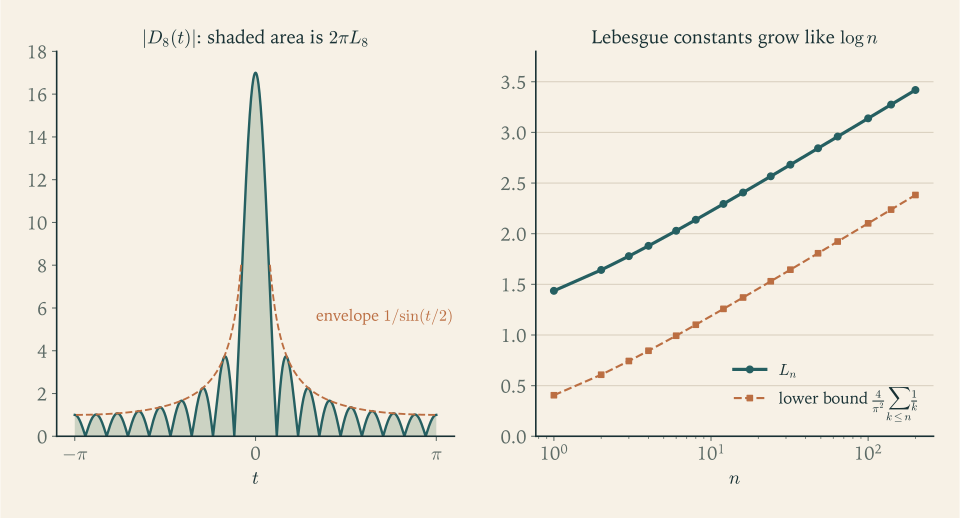
Theorem 4.8 (a continuous function with divergent Fourier series). There is \(f\in C(\mathbb T)\) such that the partial sums \(S_nf(0)\) are unbounded; in particular the Fourier series of \(f\) diverges at \(0\) .
Proof. Suppose not. Then \(\sup_n\lvert\phi_n(f)\rvert<\infty\) for every \(f\) in the Banach space \(C(\mathbb T)\) , and Theorem 4.4 gives \(\sup_n\lVert\phi_n\rVert<\infty\) . But \(\lVert\phi_n\rVert=L_n\to\infty\) by Example 4.4.
The proof exhibits no such \(f\) , and it does not need to. What it does use is exactly two facts about the Dirichlet kernel, the formula for \(\lVert\phi_n\rVert\) and the divergence of \(L_n\) , together with completeness of \(C(\mathbb T)\) .
4.5 Convergence of quadrature rules
The same reasoning decides when a family of numerical integration rules converges for every continuous integrand. A quadrature rule on \([0,1]\) is a functional
with distinct nodes \(x_k\in[0,1]\)
and real weights \(w_k\)
. On \(C[0,1]\)
with the supremum norm its norm is \(\lVert Q\rVert=\sum_k\lvert w_k\rvert\)
: the upper bound is clear, and a continuous piecewise linear \(f\)
with \(f(x_k)=\operatorname{sgn}w_k\)
and \(\lvert f\rvert\le 1\)
attains it (Exercise 7). The rules themselves, and their exactness on polynomials, are developed in Numerical Analysis (math.numerical-analysis.quadrature); the question of convergence for all continuous functions is a question about operator norms.
Theorem 4.9 (convergence criterion for quadrature rules). Let \((Q_n)\) be a sequence of quadrature rules on \([0,1]\) with weights \(w_{n,k}\) . Then \(Q_n(f)\to\int_0^1f\) for every \(f\in C[0,1]\) if and only if (i) \(Q_n(p)\to\int_0^1p\) for every polynomial \(p\) , and (ii) \(\sup_n\sum_k\lvert w_{n,k}\rvert<\infty\) .
Proof. The polynomials are dense in \(C[0,1]\) by the Weierstrass approximation theorem, and \(\lVert Q_n\rVert=\sum_k\lvert w_{n,k}\rvert\) . If (i) and (ii) hold, Proposition 4.6 shows that \(Q_n(f)\) converges for every \(f\) , to a bounded functional that agrees with the bounded functional \(f\mapsto\int_0^1f\) on the dense set of polynomials and hence everywhere. Conversely, convergence for every \(f\) gives (i) trivially and (ii) by Corollary 4.5.
If all weights are nonnegative, then \(\sum_k\lvert w_{n,k}\rvert=Q_n(1)\) , which converges to \(1\) under (i). So a sequence of rules with nonnegative weights that converges on polynomials converges on every continuous function. This covers the composite trapezoid and Simpson rules and Gaussian quadrature.
Example 4.5: Newton–Cotes weights turn negative
The closed Newton–Cotes rule of order \(n\) uses the \(n+1\) equally spaced nodes \(k/n\) and is exact for polynomials of degree at most \(n\) , so condition (i) holds for the sequence of these rules. For \(n=2\) it is Simpson’s rule with weights \((\tfrac16,\tfrac46,\tfrac16)\) , and for \(n=4\) the weights are \((7,32,12,32,7)/90\) ; all are positive and \(\sum_k\lvert w_k\rvert=1\) . For \(n=8\) the weights are
They sum to \(1\) , as they must since the rule integrates the constant \(1\) exactly, but three of them are negative, and
The negative weights grow rapidly with the order: the sum of absolute values is about \(3.065\) for \(n=10\) and about \(544.2\) for \(n=20\) , and it is known to be unbounded. Condition (ii) fails, so by Theorem 4.9 there is a continuous function for which the Newton–Cotes approximations do not converge to its integral. High-order interpolation at equally spaced nodes is unreliable for the same reason that Fourier partial sums are: the norms of the approximating functionals are not bounded.
4.6 Bad behaviour is typical
The uniform boundedness principle yields a single vector on which an unbounded family blows up. The category theorem says more: such vectors form a large set.
Theorem 4.10 (condensation of singularities). Let \(X\) be a Banach space, \(Y\) a normed space, and \((T_n)\) a sequence in \(\mathcal B(X,Y)\) with \(\sup_n\lVert T_n\rVert=\infty\) . Then the set
is residual in \(X\) ; in particular it is dense.
Proof. For \(m=1,2,\dots\) let \(V_m=\{x:\lVert T_nx\rVert>m\text{ for some }n\}\) . It is a union of open sets, so it is open. It is dense: otherwise some closed ball \(\overline B(x_0,r)\) misses \(V_m\) , which means \(\lVert T_nx\rVert\le m\) for all \(n\) and all \(x\) in the ball, and the last step of the proof of Theorem 4.4 then gives \(\lVert T_n\rVert\le 2m/r\) for all \(n\) , contrary to hypothesis. The set in the statement is \(\bigcap_mV_m\) . Its complement is the union of the closed nowhere dense sets \(X\setminus V_m\) , so it is residual, and it is dense by Theorem 4.2.
Applied to the functionals \(\phi_n\) of Section 4.4, the theorem says that the continuous functions whose Fourier series diverges at \(0\) form a residual subset of \(C(\mathbb T)\) . In the sense of category, divergence at a given point is the rule and convergence the exception, although every function one can easily write down is an exception. Category and measure tell different stories here. A deep theorem of Carleson states that the Fourier series of a continuous function converges at almost every point; the set of divergence of a single function is small in measure, while the set of functions that diverge at a given point is large in category.
Common mistake. Checking a pointwise bound, or pointwise convergence, on a dense subspace and concluding it for the whole space. Example 4.2 and the operators \(T_nx=nx_ne_1\) show that a family can be perfectly well behaved on \(c_{00}\) and unbounded on \(\ell^2\) . A dense set carries the conclusion to the whole space only in the presence of a uniform bound on the norms, as in Proposition 4.6, and the uniform boundedness principle derives that uniform bound only from information at every point of a complete space.
The category theorem has been applied here to sets of the form “all operators in the family are at most \(n\) at \(x\) ”. In the next chapter it is applied to the images of balls under a single operator, and the outcome is a theorem about inverses.
Exercises
-
For each subset of \(\mathbb R\) decide whether it is nowhere dense, meagre but not nowhere dense, or not meagre: the integers, the rationals, the interval \([0,1]\) , the irrationals, and the set \(\{1/n:n\ge 1\}\) .
Answer
The integers and the set \(\{1/n\}\) are nowhere dense: their closures, \(\mathbb Z\) and \(\{1/n\}\cup\{0\}\) , contain no interval. The rationals are meagre, as a countable union of points, but not nowhere dense, since their closure is \(\mathbb R\) . The interval \([0,1]\) is not meagre: it is a complete metric space, and a meagre subset of \(\mathbb R\) contained in it would make it a countable union of sets nowhere dense in itself. The irrationals are not meagre, since otherwise \(\mathbb R\) , the union of the irrationals and the rationals, would be meagre, contradicting Corollary 4.3.
-
Prove that a proper closed subspace of a normed space is nowhere dense, and deduce that a Banach space is not a countable union of proper closed subspaces.
Solution
Let \(M\) be a proper closed subspace of a normed space \(X\) . Since \(M\) is closed, it equals its closure, so we must show that \(M\) contains no open ball. Suppose \(B(x,r)\subseteq M\) . Take any nonzero \(z\in X\) . The vector \(x+\tfrac{r}{2\lVert z\rVert}z\) lies in \(B(x,r)\) , hence in \(M\) ; subtracting \(x\in M\) leaves \(\tfrac{r}{2\lVert z\rVert}z\in M\) , and multiplying by \(2\lVert z\rVert/r\) gives \(z\in M\) . So \(M=X\) , contradicting properness. Therefore \(M\) is nowhere dense.
Now let \(X\) be a Banach space and suppose \(X=\bigcup_nM_n\) with each \(M_n\) a proper closed subspace. Each \(M_n\) is closed with empty interior by the first part. Corollary 4.3 says that a nonempty complete metric space cannot be a countable union of closed sets with empty interior. This contradiction shows that no such decomposition exists. Example 4.1 is the special case where the \(M_n\) are the finite-dimensional spans of initial segments of a Hamel basis.
-
Prove that in a complete metric space without isolated points every countable set is meagre and no residual set is countable; conclude that \([0,1]\) is uncountable.
Hint
A one-point set \(\{x\}\) is closed, and it has empty interior exactly when \(x\) is not isolated. A countable set is a countable union of such points. If a residual set were countable, the whole space would be the union of two meagre sets, hence meagre, contradicting Corollary 4.3. Apply this to \([0,1]\) , which is residual in itself.
-
Let \(\lVert\cdot\rVert\) be any norm on the vector space of all real polynomials. Explain why this normed space is not complete, and why Example 1.4 could not have established that.
Answer
The monomials \(1,x,x^2,\dots\) form a countably infinite Hamel basis, so Example 4.1 applies to every norm: the space is a countable union of the closed, nowhere dense subspaces of polynomials of degree at most \(n\) . Example 1.4 only compared two specific norms on \(C[0,1]\) and showed them inequivalent; it said nothing about other norms on the polynomials.
-
On \(c_{00}\) with the supremum norm define \(T_nx=(x_1,2x_2,\dots,nx_n,0,0,\dots)\) . Compute \(\lVert T_n\rVert\) , show that \(\sup_n\lVert T_nx\rVert_\infty<\infty\) for each \(x\) , and say which hypothesis of Theorem 4.4 is violated.
Answer
\(\lVert T_n\rVert=n\) , attained at \(e_n\) . For fixed \(x\in c_{00}\) , \(\sup_n\lVert T_nx\rVert_\infty=\max_kk\lvert x_k\rvert\) , a maximum over finitely many nonzero terms. The domain \(c_{00}\) is not complete.
-
Compute the Lebesgue constant \(L_1=\frac1{2\pi}\int_{-\pi}^{\pi}\lvert 1+2\cos t\rvert\,dt\) exactly.
Solution
The integrand \(1+2\cos t\) is even, and on \([0,\pi]\) it is nonnegative exactly when \(\cos t\ge-\tfrac12\) , that is, for \(0\le t\le\tfrac{2\pi}3\) . So
\[ \int_{-\pi}^{\pi}\lvert 1+2\cos t\rvert\,dt=2\Bigl[\int_0^{2\pi/3}(1+2\cos t)\,dt-\int_{2\pi/3}^{\pi}(1+2\cos t)\,dt\Bigr]. \]An antiderivative is \(t+2\sin t\) , with \(\sin\tfrac{2\pi}3=\tfrac{\sqrt3}2\) . The first integral is \(\tfrac{2\pi}3+\sqrt3\) . The second is \((\pi+0)-(\tfrac{2\pi}3+\sqrt3)=\tfrac\pi3-\sqrt3\) , which is negative, as expected. The bracket equals \(\tfrac{2\pi}3+\sqrt3-\tfrac\pi3+\sqrt3=\tfrac\pi3+2\sqrt3\) , and
\[ L_1=\frac1{2\pi}\cdot 2\Bigl(\frac\pi3+2\sqrt3\Bigr)=\frac13+\frac{2\sqrt3}{\pi}\approx 1.436 . \]This agrees with the numerical value quoted in Example 4.4. Already for \(n=1\) the functional \(f\mapsto S_1f(0)\) can amplify the supremum norm by more than forty percent.
-
Let \(x_0<x_1<\dots<x_m\) be points of \([0,1]\) , \(w_0,\dots,w_m\) real numbers, and \(Q(f)=\sum_kw_kf(x_k)\) on \(C[0,1]\) with the supremum norm. Prove that \(\lVert Q\rVert=\sum_k\lvert w_k\rvert\) and that the norm is attained.
Solution
For any \(f\in C[0,1]\) , \(\lvert Q(f)\rvert\le\sum_k\lvert w_k\rvert\lvert f(x_k)\rvert\le\bigl(\sum_k\lvert w_k\rvert\bigr)\lVert f\rVert_\infty\) , so \(\lVert Q\rVert\le\sum_k\lvert w_k\rvert\) .
For the reverse inequality let \(s_k=1\) if \(w_k\ge 0\) and \(s_k=-1\) if \(w_k<0\) , so that \(w_ks_k=\lvert w_k\rvert\) . Define \(f\) on \([0,1]\) to be the piecewise linear function with \(f(x_k)=s_k\) for each \(k\) , linear on each interval \([x_{k-1},x_k]\) , constant equal to \(s_0\) on \([0,x_0]\) and constant equal to \(s_m\) on \([x_m,1]\) . Because the nodes are distinct and ordered, this is well defined and continuous. On each interval \(f\) takes values between its endpoint values, which are \(\pm 1\) , so \(\lvert f\rvert\le 1\) everywhere, and \(\lVert f\rVert_\infty=1\) . Then
\[ Q(f)=\sum_kw_ks_k=\sum_k\lvert w_k\rvert . \]Hence \(\lVert Q\rVert\ge\sum_k\lvert w_k\rvert\) , the norm equals \(\sum_k\lvert w_k\rvert\) , and it is attained at \(f\) . Finiteness of the node set is what allows a continuous function to follow the signs exactly; for the integral functional of Exercise 4 of Chapter 3Chapter 3 the analogous sign pattern would be a discontinuous step.
-
Verify from the weights printed in Example 4.5 that the Newton–Cotes rule of order \(8\) integrates \(f=1\) exactly, compute its norm as a functional on \(C[0,1]\) , and find a bound for \(\lvert Q(f)-Q(g)\rvert\) when \(\lVert f-g\rVert_\infty\le 10^{-3}\) .
Solution
The positive weights sum to \(2(989+5888+10496)=34746\) and the negative ones to \(-(928+4540+928)=-6396\) , all over \(28350\) . Therefore
\[ Q(1)=\sum_kw_k=\frac{34746-6396}{28350}=\frac{28350}{28350}=1=\int_0^11\,dx , \]so the constant function is integrated exactly. By Exercise 7 the norm of the rule is
\[ \lVert Q\rVert=\sum_k\lvert w_k\rvert=\frac{34746+6396}{28350}=\frac{41142}{28350}\approx 1.451 . \]For two integrands with \(\lVert f-g\rVert_\infty\le 10^{-3}\) , linearity gives \(\lvert Q(f)-Q(g)\rvert=\lvert Q(f-g)\rvert\le\lVert Q\rVert\lVert f-g\rVert_\infty\le 1.451\times 10^{-3}\) . A rule with nonnegative weights would give the bound \(10^{-3}\) . The norm of a quadrature rule is thus its worst-case amplification of errors in the data, and for Newton–Cotes rules that amplification grows without bound as the order increases.
-
Let \((x_k)\) be a scalar sequence such that \(\sum_kx_ky_k\) converges for every \(y\in\ell^2\) . Prove that \(x\in\ell^2\) .
Solution
For each \(n\) define \(f_n(y)=\sum_{k\le n}x_ky_k\) on \(\ell^2\) . By Theorem 3.1, \(f_n\) is a bounded functional with \(\lVert f_n\rVert=(\sum_{k\le n}\lvert x_k\rvert^2)^{1/2}\) , since it is the functional represented by the truncated sequence \((x_1,\dots,x_n,0,\dots)\in\ell^2\) . The hypothesis says that \(\lim_nf_n(y)\) exists for every \(y\in\ell^2\) . The space \(\ell^2\) is complete, so Corollary 4.5 gives
\[ \sup_n\Bigl(\sum_{k\le n}\lvert x_k\rvert^2\Bigr)^{1/2}=\sup_n\lVert f_n\rVert<\infty . \]The partial sums of \(\sum_k\lvert x_k\rvert^2\) are bounded, so the series converges and \(x\in\ell^2\) . No formula for \(x\) was needed, and no clever choice of \(y\) : the principle converts “the pairing makes sense against every \(y\) ” into a quantitative bound. A direct proof would have to construct, for \(x\notin\ell^2\) , a specific \(y\in\ell^2\) with divergent pairing, as was done by hand in Example 4.3.
-
Let \(X\) be a Banach space, \(Y\) and \(Z\) normed spaces, and \(\beta:X\times Y\to Z\) a bilinear map that is continuous in each variable separately. Prove that there is a constant \(C\) with \(\lVert\beta(x,y)\rVert\le C\lVert x\rVert\lVert y\rVert\) .
Hint
For \(y\) with \(\lVert y\rVert\le 1\) let \(T_y=\beta(\cdot,y)\in\mathcal B(X,Z)\) . For fixed \(x\) , continuity of \(y\mapsto\beta(x,y)\) gives \(\sup_{\lVert y\rVert\le 1}\lVert T_yx\rVert<\infty\) . Apply Theorem 4.4 to the family \(\{T_y\}\) ; only \(X\) needs to be complete.
-
A student argues: “The operators \(T_nx=nx_ne_1\) on \(\ell^2\) satisfy \(T_nd\to 0\) for all \(d\in c_{00}\) , and \(c_{00}\) is dense, so \(T_n\to 0\) strongly.” Name the missing hypothesis, and give a vector at which \(T_nx\) does not converge.
Answer
The missing hypothesis is the uniform bound \(\sup_n\lVert T_n\rVert<\infty\) of Proposition 4.6; here \(\lVert T_n\rVert=n\) . At \(x=(k^{-3/4})\in\ell^2\) , \(T_nx=n^{1/4}e_1\) , which is unbounded.
-
Give an example of bounded operators \(T_n\to T\) strongly on a Banach space with \(\lVert T\rVert<\liminf_n\lVert T_n\rVert\) , and prove that if in addition \(\lVert T_n\rVert\le\lVert T\rVert\) for all \(n\) then \(\lVert T_n\rVert\to\lVert T\rVert\) .
Answer
The powers \(L^n\) of the left shift on \(\ell^2\) converge strongly to \(T=0\) with \(\lVert L^n\rVert=1\) . If \(\lVert T_n\rVert\le\lVert T\rVert\) for all \(n\) , then \(\limsup_n\lVert T_n\rVert\le\lVert T\rVert\le\liminf_n\lVert T_n\rVert\) by Corollary 4.5, so the limit exists and equals \(\lVert T\rVert\) .
-
Let \(X\) be a Banach space, \(T_n\to T\) strongly in \(\mathcal B(X,Y)\) , and \(x_n\to x\) in norm in \(X\) . Prove that \(T_nx_n\to Tx\) , and show by an example on \(c_{00}\) that the conclusion can fail when \(X\) is not complete.
Solution
Since \(T_nx\) converges for every \(x\) in the Banach space \(X\) , Corollary 4.5 gives \(C=\sup_n\lVert T_n\rVert<\infty\) . Then
\[ \lVert T_nx_n-Tx\rVert\le\lVert T_n(x_n-x)\rVert+\lVert T_nx-Tx\rVert\le C\lVert x_n-x\rVert+\lVert T_nx-Tx\rVert . \]The first term tends to \(0\) because \(x_n\to x\) , and the second because \(T_n\to T\) strongly. Hence \(T_nx_n\to Tx\) .
Completeness was used to obtain \(C\) . On \(c_{00}\) with \(\lVert\cdot\rVert_2\) let \(f_n(x)=nx_n\) as in Example 4.2. For each \(x\in c_{00}\) , \(f_n(x)=0\) for large \(n\) , so \(f_n\to 0\) strongly. Let \(x_n=n^{-1/2}e_n\) ; then \(\lVert x_n\rVert_2=n^{-1/2}\to 0\) , so \(x_n\to 0\) in norm. But \(f_n(x_n)=n\cdot n^{-1/2}=\sqrt n\to\infty\) , which does not converge to \(0\) . The diagonal sequence escapes because the norms \(\lVert f_n\rVert=n\) are unbounded, which is possible only because the domain is incomplete.
-
Let \((x_n)\) be a sequence in \(\ell^2\) with \(\langle x_n,y\rangle\to 0\) for every \(y\in\ell^2\) . Prove that \(\sup_n\lVert x_n\rVert_2<\infty\) , and give an example in which \(\lVert x_n\rVert_2\) does not tend to \(0\) .
Answer
Each \(x_n\) defines the functional \(y\mapsto\langle y,x_n\rangle\) on \(\ell^2\) , of norm \(\lVert x_n\rVert_2\) ; these functionals converge pointwise, so Corollary 4.5 bounds their norms. The unit vectors \(x_n=e_n\) satisfy \(\langle e_n,y\rangle=\overline{y_n}\to 0\) while \(\lVert e_n\rVert_2=1\) .
-
Let \(X\) and \(Y\) be Banach spaces and \(S:X\to Y\) a linear map such that \(f\circ S\in X^*\) for every \(f\in Y^*\) . Prove that \(S\) is bounded.
Solution
Consider the subset \(A=\{Sx:\lVert x\rVert\le 1\}\) of \(Y\) . For \(f\in Y^*\) the functional \(f\circ S\) is bounded on \(X\) by hypothesis, so
\[ \sup_{a\in A}\lvert f(a)\rvert=\sup_{\lVert x\rVert\le 1}\lvert(f\circ S)(x)\rvert=\lVert f\circ S\rVert<\infty . \]Thus \(A\) is bounded when tested against each functional in \(Y^*\) . By Corollary 4.7, \(A\) is bounded in norm: \(\sup_{\lVert x\rVert\le 1}\lVert Sx\rVert<\infty\) . That is the statement that \(S\) is a bounded operator.
Notice which completeness was used. Corollary 4.7 rests on the uniform boundedness principle applied on the dual space \(Y^*\) , which is always complete; neither \(X\) nor \(Y\) needed to be a Banach space for this argument. The result says that continuity of a linear map can be tested one functional at a time, and Chapter 6 will rephrase it: a linear map is continuous for the norms if and only if it is continuous for the weak topologies.
-
Use Theorem 4.10 to show that there is a single \(f\in C(\mathbb T)\) whose Fourier series diverges at every rational multiple of \(\pi\) , by considering for each such point \(x\) the functionals \(f\mapsto S_nf(x)\) .
Hint
For a fixed point \(x\) , \(S_nf(x)=\phi_n(f_x)\) where \(f_x(t)=f(t+x)\) , and translation is an isometry of \(C(\mathbb T)\) , so the functionals \(f\mapsto S_nf(x)\) have norms \(L_n\to\infty\) . Theorem 4.10 makes the set of \(f\) with \(\sup_n\lvert S_nf(x)\rvert=\infty\) residual for each \(x\) . A countable intersection of residual sets is residual, hence nonempty by Theorem 4.2.
-
Using the inequality \(L_n\ge\frac4{\pi^2}\sum_{k=1}^n\frac1k\) and the estimate \(\sum_{k=1}^n\frac1k>\ln(n+1)\) , find an \(n\) for which \(L_n>3\) is guaranteed, and compare with the numerical value \(L_{100}\approx 3.139\) .
Answer
We need \(\frac4{\pi^2}\ln(n+1)\ge 3\) , that is \(\ln(n+1)\ge\tfrac{3\pi^2}{4}\approx 7.402\) , so \(n+1\ge e^{7.402}\approx 1640\) ; \(n=1640\) is certainly enough. The true constants pass \(3\) much earlier, since \(L_{100}\approx 3.139\) already: the inequality captures the logarithmic rate but loses an additive constant of about \(1\) .
-
In the setting of Example 4.2, describe the sets \(F_N\) from the proof of Theorem 4.4 for the family \(f_n(x)=nx_n\) on \(c_{00}\) , and show directly that each \(F_N\) is closed with empty interior, so that the proof breaks at the appeal to Corollary 4.3.
Solution
Here \(\mathcal T=\{f_n\}\) with \(f_n(x)=nx_n\) , so
\[ F_N=\{x\in c_{00}:n\lvert x_n\rvert\le N\ \text{for all }n\}. \]Closed. If \(x^{(j)}\in F_N\) and \(x^{(j)}\to x\) in \(\lVert\cdot\rVert_2\) , then each coordinate converges, so \(n\lvert x_n\rvert=\lim_jn\lvert x^{(j)}_n\rvert\le N\) for every \(n\) , and \(x\in F_N\) .
Empty interior. Let \(x\in F_N\) and \(\varepsilon>0\) . Choose an index \(m\) beyond the support of \(x\) with \(m\varepsilon>2N\) , and put \(x'=x+\tfrac\varepsilon2e_m\) . Then \(x'\in c_{00}\) and \(\lVert x'-x\rVert_2=\tfrac\varepsilon2<\varepsilon\) , so \(x'\) lies in the open ball \(B(x,\varepsilon)\) , but \(m\lvert x'_m\rvert=\tfrac12m\varepsilon>N\) , so \(x'\notin F_N\) . Every ball about a point of \(F_N\) contains points outside \(F_N\) .
Union. Every \(x\in c_{00}\) lies in \(F_N\) once \(N\ge\max_kk\lvert x_k\rvert\) . So \(c_{00}=\bigcup_NF_N\) is a countable union of closed sets with empty interior. In a complete space Corollary 4.3 forbids this; in \(c_{00}\) nothing does, and the proof of Theorem 4.4 stops at the sentence “some \(F_N\) contains a ball”. The example shows concretely what incompleteness means in the language of category: \(c_{00}\) is meagre in itself.