Suppose the equation \(Tx=y\) has exactly one solution \(x\) for every right-hand side \(y\) . In practice \(y\) is known only approximately, so the useful question is whether a small change in \(y\) produces a small change in \(x\) ; that is, whether \(T^{-1}\) is continuous. For a square matrix this is automatic. In infinite dimensions it is not. The identity map from \(C[0,1]\) with the supremum norm to \(C[0,1]\) with the norm \(\lVert f\rVert_1=\int_0^1\lvert f\rvert\) is linear, bijective, and bounded, since \(\lVert f\rVert_1\le\lVert f\rVert_\infty\) ; its inverse is unbounded, since a tall thin spike has small integral and large maximum.
The remedy is again completeness, this time of both spaces. A bounded bijection between Banach spaces has a bounded inverse. This chapter proves that statement in a stronger form, the open mapping theorem, and derives its two standard companions. All three say that for linear maps between Banach spaces a purely algebraic or set-theoretic property, such as being onto or having a closed graph, forces a quantitative estimate. All three fail when either space is incomplete, and the counterexamples are as much part of the theory as the proofs.
5.1 Surjective operators are open
A map between metric spaces is open if it sends open sets to open sets. For a linear map this reduces to one condition at the origin: \(T:X\to Y\) is open if and only if the image \(T(B_X(0,1))\) of the open unit ball contains some ball \(B_Y(0,\delta)\) . Indeed, if that holds and \(U\subseteq X\) is open with \(x\in U\) , then \(B_X(x,\varepsilon)\subseteq U\) for some \(\varepsilon\) , and by linearity \(T(U)\supseteq Tx+\varepsilon T(B_X(0,1))\supseteq B_Y(Tx,\varepsilon\delta)\) . The converse is immediate. An open linear map is necessarily surjective, because its range is a subspace containing a ball.
Theorem 5.1 (open mapping theorem). Let \(X\) and \(Y\) be Banach spaces and let \(T\in\mathcal B(X,Y)\) be surjective. Then \(T\) is open. Equivalently, there is a constant \(C\) such that every \(y\in Y\) has a preimage \(x\) with \(Tx=y\) and \(\lVert x\rVert\le C\lVert y\rVert\) .
Proof. Step 1: the closure of the image of a ball contains a ball. Since \(T\) is onto, \(Y=\bigcup_{n\ge 1}\overline{T(B_X(0,n))}\) . The space \(Y\) is complete, so by Corollary 4.3 some set \(W=\overline{T(B_X(0,N))}\) contains a ball \(B_Y(y_0,\eta)\) . The set \(W\) is convex and symmetric about the origin, being the closure of the image of a convex symmetric set under a linear map. If \(\lVert y\rVert<\eta\) , then \(y_0+y\in W\) , and \(y_0-y\in W\) so by symmetry \(-y_0+y\in W\) ; by convexity
Thus \(B_Y(0,\eta)\subseteq\overline{T(B_X(0,N))}\) . Put \(\delta=\eta/(2N)\) . Scaling, we obtain for every \(s>0\)
Step 2: the closure can be removed. We claim \(B_Y(0,\delta)\subseteq T(B_X(0,1))\) . Let \(\lVert y\rVert<\delta\) . By Step 1 with \(s=\tfrac12\) , \(y\) lies in the closure of \(T(B_X(0,\tfrac12))\) , so there is \(x_1\) with \(\lVert x_1\rVert<\tfrac12\) and \(\lVert y-Tx_1\rVert<\delta/2\) . Now \(y-Tx_1\) lies in \(B_Y(0,\delta/2)\) , which by Step 1 with \(s=\tfrac14\) is contained in the closure of \(T(B_X(0,\tfrac14))\) ; so there is \(x_2\) with \(\lVert x_2\rVert<\tfrac14\) and \(\lVert y-Tx_1-Tx_2\rVert<\delta/4\) . Continuing, we obtain \(x_k\) with
The series \(\sum_kx_k\) converges absolutely, and \(X\) is complete, so it converges to some \(x\) with \(\lVert x\rVert\le\sum_k\lVert x_k\rVert<1\) . By continuity of \(T\) , \(Tx=y\) . This proves the claim, and with it openness.
The constant. For nonzero \(y\) , the vector \(y'=\tfrac{\delta}{2\lVert y\rVert}y\) has norm less than \(\delta\) , so \(y'=Tx'\) with \(\lVert x'\rVert<1\) ; then \(x=\tfrac{2\lVert y\rVert}{\delta}x'\) satisfies \(Tx=y\) and \(\lVert x\rVert\le\tfrac2\delta\lVert y\rVert\) .
The two steps use the two completeness hypotheses separately. Step 1 is the category theorem in \(Y\) . Step 2 is the series test in \(X\) : an approximate solution is corrected by a smaller approximate solution of the residual equation, and the corrections are summed. That scheme of successive approximation, with errors halving at each stage, is worth remembering independently of the theorem.
Corollary 5.2 (bounded inverse theorem). If \(X\) and \(Y\) are Banach spaces and \(T\in\mathcal B(X,Y)\) is bijective, then \(T^{-1}\) is bounded.
Proof. By Theorem 5.1 every \(y\) has a preimage of norm at most \(C\lVert y\rVert\) , and since \(T\) is injective that preimage is \(T^{-1}y\) .
Corollary 5.3 (comparable complete norms are equivalent). Let \(\lVert\cdot\rVert\) and \(\lVert\cdot\rVert'\) be two norms on a vector space \(X\) , each making \(X\) a Banach space. If \(\lVert x\rVert'\le C\lVert x\rVert\) for all \(x\) , then the two norms are equivalent.
Proof. The identity map from \((X,\lVert\cdot\rVert)\) to \((X,\lVert\cdot\rVert')\) is a bounded bijection between Banach spaces. By Corollary 5.2 its inverse is bounded, which is the reverse inequality.
Example 5.1: Two norms on continuous functions, revisited
On \(C[0,1]\) we have \(\lVert f\rVert_1\le\lVert f\rVert_\infty\) , and \(C[0,1]\) is complete for \(\lVert\cdot\rVert_\infty\) . If it were also complete for \(\lVert\cdot\rVert_1\) , Corollary 5.3 would make the norms equivalent. They are not: the tent functions \(h_n(x)=\max\{0,n-n^2x\}\) of Exercise 11 in Chapter 1 have \(\lVert h_n\rVert_1=\tfrac12\) and \(\lVert h_n\rVert_\infty=n\) , so
Therefore \((C[0,1],\lVert\cdot\rVert_1)\) is not complete. This is a second proof of the conclusion of Example 1.2, and a different kind of proof: no Cauchy sequence without a limit was exhibited. Incompleteness was deduced from the failure of an inequality. The same argument applies to any norm on \(C[0,1]\) that is dominated by the supremum norm without being equivalent to it.
Example 5.2: A bounded injective operator whose inverse is unbounded
On \(\ell^2\) let \((Dx)_k=x_k/k\) . This is a diagonal operator with \(\lVert D\rVert=\sup_k1/k=1\) , and it is injective. Its inverse, defined on the range of \(D\) , multiplies the \(k\) -th coordinate by \(k\) , and is unbounded: \(\lVert De_k\rVert_2=1/k\) , so \(\lVert D^{-1}(De_k)\rVert_2/\lVert De_k\rVert_2=k\) .
There is no conflict with Corollary 5.2, because \(D\) is not surjective. The vector \(y=(1/k)_{k\ge 1}\) lies in \(\ell^2\) , with \(\lVert y\rVert_2=\pi/\sqrt6\approx 1.2825\) , but its only possible preimage is \((1,1,1,\dots)\) , which is not in \(\ell^2\) . One can watch the estimate fail along the truncations: \(y^{(n)}=(1,\tfrac12,\dots,\tfrac1n,0,\dots)=Du^{(n)}\) with \(u^{(n)}=(1,\dots,1,0,\dots)\) , and
At \(n=100\) the right-hand side has norm about \(1.279\) and the solution has norm \(10\) . The range of \(D\) contains \(c_{00}\) , so it is dense in \(\ell^2\) ; it is not all of \(\ell^2\) ; hence it is not closed. For an injective operator between Banach spaces, a non-closed range and an unbounded inverse always occur together, as the next section shows; that the range here is also dense is a feature of this example.
5.2 Closed range and operators bounded below
Proposition 5.4 (bounded below). Let \(X\) and \(Y\) be Banach spaces and \(T\in\mathcal B(X,Y)\) . The following are equivalent: (a) \(T\) is injective and \(\operatorname{ran}T\) is closed in \(Y\) ; (b) there is \(c>0\) with \(\lVert Tx\rVert\ge c\lVert x\rVert\) for all \(x\in X\) .
Proof. Assume (b). Then \(Tx=0\) forces \(x=0\) . If \(Tx_n\to y\) , then \(\lVert x_n-x_m\rVert\le c^{-1}\lVert Tx_n-Tx_m\rVert\) shows that \((x_n)\) is Cauchy; it converges to some \(x\) , and \(Tx=\lim Tx_n=y\) by continuity, so \(y\in\operatorname{ran}T\) . Assume (a). A closed subspace of a Banach space is a Banach space, so \(T\) is a bounded bijection from \(X\) onto the Banach space \(\operatorname{ran}T\) . By Corollary 5.2 its inverse is bounded: \(\lVert x\rVert\le C\lVert Tx\rVert\) , which is (b) with \(c=1/C\) .
An operator satisfying (b) is called bounded below. The proposition is the working form of the theory for injective operators: to prove that an equation \(Tx=y\) is stably solvable on the range of \(T\) , prove an estimate \(\lVert x\rVert\le C\lVert Tx\rVert\) ; to prove that the range fails to be closed, exhibit unit vectors \(x_n\) with \(Tx_n\to 0\) . The Lax–Milgram theorem of Chapter 8 is proved exactly this way.
When \(T\) is not injective, one divides out the kernel. If \(T\in\mathcal B(X,Y)\) has closed range, the induced map \(\widetilde T:X/\ker T\to\operatorname{ran}T\) , \(\widetilde T(x+\ker T)=Tx\) , is a bounded bijection between Banach spaces, by Theorem 1.11, and so an isomorphism.
5.3 Operators with closed graph
The product \(X\times Y\) of two normed spaces is a normed space under \(\lVert(x,y)\rVert=\lVert x\rVert+\lVert y\rVert\) , complete when \(X\) and \(Y\) are. The graph of a linear map \(T\) defined on a subspace \(\mathcal D(T)\subseteq X\) with values in \(Y\) is the subspace \(\{(x,Tx):x\in\mathcal D(T)\}\) of \(X\times Y\) .
Definition 5.5 (closed operator). A linear map \(T:\mathcal D(T)\subseteq X\to Y\) is closed if its graph is a closed subset of \(X\times Y\) ; that is, whenever \(x_n\in\mathcal D(T)\) , \(x_n\to x\) in \(X\) , and \(Tx_n\to y\) in \(Y\) , it follows that \(x\in\mathcal D(T)\) and \(Tx=y\) .
Compare this with continuity. For continuity one assumes \(x_n\to x\) and must prove two things: that \((Tx_n)\) converges, and that its limit is \(Tx\) . For closedness one is given that \((Tx_n)\) converges and has only to identify the limit. Closedness is therefore much easier to verify. A bounded operator defined on all of \(X\) is closed. The converse is the theorem.
Theorem 5.6 (closed graph theorem). Let \(X\) and \(Y\) be Banach spaces and \(T:X\to Y\) a linear map defined on all of \(X\) . If the graph of \(T\) is closed, then \(T\) is bounded.
Proof. Define a second norm on \(X\) , the graph norm \(\lVert x\rVert_T=\lVert x\rVert+\lVert Tx\rVert\) . We show \(X\) is complete for it. If \((x_n)\) is Cauchy for \(\lVert\cdot\rVert_T\) , then \((x_n)\) is Cauchy in \(X\) and \((Tx_n)\) is Cauchy in \(Y\) , so \(x_n\to x\) and \(Tx_n\to y\) for some \(x\in X\) , \(y\in Y\) . Since the graph is closed, \(y=Tx\) , and so \(\lVert x_n-x\rVert_T=\lVert x_n-x\rVert+\lVert Tx_n-Tx\rVert\to 0\) . Now \(\lVert x\rVert\le\lVert x\rVert_T\) and both norms are complete, so by Corollary 5.3 there is \(C\) with \(\lVert x\rVert_T\le C\lVert x\rVert\) . In particular \(\lVert Tx\rVert\le C\lVert x\rVert\) .
Three hypotheses are in play: \(X\) complete, \(Y\) complete, and \(T\) defined on all of \(X\) . The next two examples show a closed operator that is unbounded because its domain is not the whole of a Banach space, and a linear map that is not even closed.
Example 5.3: Differentiation is closed and unbounded
Let \(X=Y=C[-1,1]\) with the supremum norm and let \(T=d/dx\) with domain \(\mathcal D(T)=C^1[-1,1]\) . By Example 2.1, transplanted to this interval, \(T\) is unbounded. It is closed: if \(f_n\in C^1\) , \(f_n\to f\) uniformly, and \(f_n'\to g\) uniformly, then passing to the limit in \(f_n(x)=f_n(-1)+\int_{-1}^xf_n'\) gives \(f(x)=f(-1)+\int_{-1}^xg\) , so \(f\in C^1\) and \(f'=g\) , exactly as in Exercise 8 of Chapter 1Chapter 1.
Closedness makes no promise when the derivatives fail to converge. Take \(f_n(x)=\sqrt{x^2+n^{-2}}\) . Each \(f_n\) is in \(C^1[-1,1]\) , and \(0\le f_n(x)-\lvert x\rvert\le\tfrac1n\) with equality at \(x=0\) , so \(f_n\to\lvert x\rvert\) uniformly with \(\lVert f_n-\lvert x\rvert\rVert_\infty=\tfrac1n\) . The limit \(\lvert x\rvert\) is not in the domain. This does not contradict closedness, because the derivatives \(f_n'(x)=x/\sqrt{x^2+n^{-2}}\) do not converge uniformly: substituting \(t=nx\) one finds
so \((f_n')\) is not Cauchy. The hypothesis of Definition 5.5 is not met, and nothing is claimed.
Why does Theorem 5.6 not make \(T\) bounded? Because \(\mathcal D(T)=C^1[-1,1]\) is not all of \(X\) , and with the supremum norm it is not complete. With the graph norm \(\lVert f\rVert_\infty+\lVert f'\rVert_\infty\) it is complete, and for that norm \(T\) is bounded. The closed graph theorem implies that this is the only way out: a closed operator between Banach spaces that is unbounded cannot be defined everywhere.
Example 5.4: A linear map whose graph is not closed
On \(X=C[0,1]\) with the norm \(\lVert\cdot\rVert_1\) let \(T\) be evaluation at \(0\) , \(Tf=f(0)\) , with values in \(\mathbb R\) . For \(h_n(x)=\max\{0,1-nx\}\) we have \(\lVert h_n\rVert_1=\tfrac1{2n}\to 0\) , so \(h_n\to 0\) in \(X\) , while \(Th_n=1\) for all \(n\) . Thus \((h_n,Th_n)\to(0,1)\) in \(X\times\mathbb R\) , and \((0,1)\) is not in the graph because \(T0=0\) . The graph is not closed. Here the limit of \(Th_n\) exists and is simply the wrong number: this is the failure that closedness rules out and that the previous example did not exhibit.
5.4 Three applications
Symmetric operators. Write \(\langle x,y\rangle=\sum_kx_k\overline{y_k}\) for \(x,y\in\ell^2\) ; by Hölder’s inequality with \(p=q=2\) this converges and \(\lvert\langle x,y\rangle\rvert\le\lVert x\rVert_2\lVert y\rVert_2\) , so the pairing is continuous in each variable.
Theorem 5.7 (Hellinger–Toeplitz). Let \(T:\ell^2\to\ell^2\) be a linear map defined on all of \(\ell^2\) such that \(\langle Tx,y\rangle=\langle x,Ty\rangle\) for all \(x,y\) . Then \(T\) is bounded.
Proof. By Theorem 5.6 it suffices to show that the graph is closed. Let \(x_n\to x\) and \(Tx_n\to y\) . For every \(z\in\ell^2\) ,
Taking \(z=y-Tx\) gives \(\lVert y-Tx\rVert_2^2=0\) , so \(y=Tx\) .
The proof works verbatim in any Hilbert space, once Chapter 7 has defined one. The theorem has a striking consequence for mathematical physics: an unbounded symmetric operator, such as multiplication of the \(k\) -th coordinate by \(k\) , cannot be defined on the whole space. Domains are unavoidable.
Complementary subspaces. In linear algebra every subspace has a complement and the associated projection is a linear map. In a Banach space the projection is continuous exactly when both subspaces are closed.
Theorem 5.8 (projections onto complemented subspaces). Let \(M\) and \(N\) be closed subspaces of a Banach space \(X\) with \(M\cap N=\{0\}\) and \(M+N=X\) . Then the projection \(P\) onto \(M\) along \(N\) , defined by \(P(m+n)=m\) , is bounded, and there is a constant \(C\) with \(\lVert m\rVert+\lVert n\rVert\le C\lVert m+n\rVert\) for all \(m\in M\) , \(n\in N\) .
Proof. \(P\) is a well-defined linear map on all of \(X\) . Suppose \(x_k\to x\) and \(Px_k\to y\) . Since \(Px_k\in M\) and \(M\) is closed, \(y\in M\) . Since \(x_k-Px_k\in N\) and \(N\) is closed, \(x-y\in N\) . Then \(x=y+(x-y)\) is the decomposition of \(x\) , so \(Px=y\) . The graph is closed, and \(P\) is bounded by Theorem 5.6. Finally \(\lVert m\rVert+\lVert n\rVert=\lVert Px\rVert+\lVert x-Px\rVert\le(2\lVert P\rVert+1)\lVert x\rVert\) for \(x=m+n\) .
Example 5.5: The norm of an oblique projection
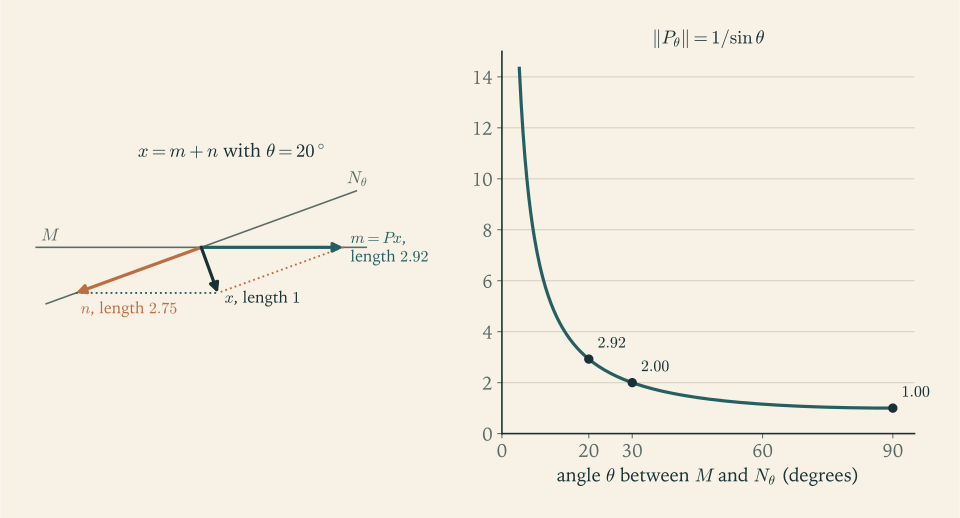
In \(\mathbb R^2\) with the Euclidean norm let \(M\) be the first coordinate axis and \(N_\theta\) the line through the origin in the direction \((\cos\theta,\sin\theta)\) , with \(0<\theta<\pi\) . Writing \(x=a(1,0)+b(\cos\theta,\sin\theta)\) gives \(b=x_2/\sin\theta\) and \(a=x_1-x_2\cot\theta\) , so the projection onto \(M\) along \(N_\theta\) is
The norm is the Euclidean length of the single nonzero row. For \(\theta=90^\circ\) the projection is orthogonal and has norm \(1\) . For \(\theta=30^\circ\) the norm is \(2\) . As the two lines close up, the norm grows without bound: a unit vector lying nearly along both lines is the difference of two very long vectors, one in each subspace.
Example 5.6: Two closed subspaces whose sum is not closed
In infinite dimensions the angle between two closed subspaces can be \(0\) without the subspaces meeting. In \(\ell^2\) let \(M\) be the closed span of the vectors \(e_{2k-1}\) , and \(N\) the closed span of the vectors \(v_k=e_{2k-1}+\tfrac1ke_{2k}\) , for \(k\ge 1\) . Each lives in its own pair of coordinates, and within the \(k\) -th pair the configuration is that of Example 5.5 with \(\cot\theta_k=k\) . So the projection onto \(M\) along \(N\) , restricted to the \(k\) -th coordinate pair, has norm
which is \(\sqrt{10}\approx 3.162\) for \(k=3\) and exceeds \(10\) for \(k=10\) . Explicitly, \(e_{2k}=k\,v_k-k\,e_{2k-1}\) is a unit vector whose components in \(N\) and \(M\) have norms \(\sqrt{k^2+1}\) and \(k\) .
One checks that \(M\cap N=\{0\}\) . If \(M+N\) were closed, it would be a Banach space in which \(M\) and \(N\) are complementary closed subspaces, and Theorem 5.8 would give a bounded projection; but its norm would be at least \(\sqrt{1+k^2}\) for every \(k\) . Hence \(M+N\) is not closed. It is dense in \(\ell^2\) , since it contains every \(e_j\) , so it is a proper dense subspace. A vector outside it is \(z=\sum_k\tfrac1ke_{2k}\) : writing \(z=m+n\) would force \(n=\sum_kv_k\) , and that series does not converge in \(\ell^2\) because its coordinates along \(e_{2k-1}\) are all equal to \(1\) .
The Fourier coefficient map. For an integrable \(2\pi\) -periodic function \(f\) the Fourier coefficients \(c_k(f)\) are bounded by \(\lVert f\rVert_1/(2\pi)\) and tend to \(0\) as \(\lvert k\rvert\to\infty\) , so \(f\mapsto(c_k(f))_{k\in\mathbb Z}\) is a bounded operator from \(L^1\) into the null sequences indexed by \(\mathbb Z\) , and it is injective. Is every null sequence the sequence of Fourier coefficients of some integrable function? If so, the operator would be a bounded bijection between Banach spaces and its inverse would be bounded: \(\lVert f\rVert_1\le C\sup_k\lvert c_k(f)\rvert\) . The Dirichlet kernels refute this, since all their coefficients are \(0\) or \(1\) while \(\lVert D_n\rVert_1=2\pi L_n\to\infty\) . So the map is not onto (Exercise 16). No explicit null sequence that fails to be a coefficient sequence was needed.
Common mistake. Applying the closed graph theorem, or the bounded inverse theorem, to an operator that is not defined on an entire Banach space or does not map onto one. Differentiation on \(C^1\) inside \(C[0,1]\) has a closed graph and is unbounded; the diagonal operator of Example 5.2 is a bounded injection with unbounded inverse. Before invoking any theorem of this chapter, state the two spaces with their norms, confirm that each is complete, and confirm that the operator is defined on all of the first and, for the inverse theorem, onto all of the second.
The four main theorems proved so far divide cleanly. Hahn–Banach needs no completeness and rests on convexity and Zorn’s lemma. Uniform boundedness, open mapping, and closed graph all rest on the Baire category theorem and need completeness in the precise places their proofs reveal. With these in hand we can return to the loss recorded in Theorem 1.10, the failure of compactness, and repair it.
Exercises
-
Prove that a linear map \(T:X\to Y\) between normed spaces is open if and only if \(T(B_X(0,1))\) contains a ball \(B_Y(0,\delta)\) , and that an open linear map is surjective.
Hint
The “if” direction is the computation at the start of Section 5.1. For “only if”, \(T(B_X(0,1))\) is an open set containing \(T0=0\) . For surjectivity, the range is a subspace containing \(B_Y(0,\delta)\) , and every vector of \(Y\) is a multiple of a vector in that ball.
-
Show that the projection \(\pi(x_1,x_2)=x_1\) from \(\mathbb R^2\) to \(\mathbb R\) is an open map that sends the closed set \(\{x:x_1x_2=1\}\) to a set that is not closed. Explain why this does not conflict with the fact that \(\pi\) is a closed operator in the sense of Definition 5.5.
Answer
\(\pi\) is linear, bounded, and onto \(\mathbb R\) , so it is open by Theorem 5.1 (or directly: the image of a disc is an interval). The image of the hyperbola is \(\mathbb R\setminus\{0\}\) , which is not closed. “Closed operator” refers to the graph of \(\pi\) being a closed subset of \(\mathbb R^2\times\mathbb R\) , which holds for every continuous map; it does not mean that \(\pi\) sends closed sets to closed sets.
-
For the operator \((Dx)_k=x_k/k\) on \(\ell^2\) , prove that the range is dense, prove directly from the definition that it is not closed, and exhibit a vector of \(\ell^2\) that is not in the range.
Solution
Dense. For each \(k\) , \(e_k=D(ke_k)\) , so the range contains every \(e_k\) and hence \(c_{00}\) , which is dense in \(\ell^2\) by Exercise 5 of Chapter 1Chapter 1.
A vector outside the range. Let \(y=(1/k)_{k\ge 1}\in\ell^2\) . If \(y=Dx\) then \(x_k/k=1/k\) for every \(k\) , so \(x=(1,1,1,\dots)\) , which is not square-summable. Hence \(y\notin\operatorname{ran}D\) .
Not closed. Let \(y^{(n)}=(1,\tfrac12,\dots,\tfrac1n,0,\dots)\) . Then \(y^{(n)}=D(1,\dots,1,0,\dots)\in\operatorname{ran}D\) , and
\[ \lVert y-y^{(n)}\rVert_2^2=\sum_{k>n}\frac1{k^2}\to 0 . \]So \(y\) is a limit of elements of the range and is not in the range: the range is not closed. This is consistent with Proposition 5.4. The operator \(D\) is injective, and it is not bounded below, since \(\lVert De_k\rVert_2=1/k\to 0\) with \(\lVert e_k\rVert_2=1\) ; so its range cannot be closed. Equivalently, a dense subspace that is closed must be the whole space, and the range is dense without being everything.
-
Let \(T:\ell^1\to\ell^2\) be the inclusion map. Show that \(T\) is bounded and injective, that its range is dense and not closed, and verify directly that there is no \(c>0\) with \(\lVert x\rVert_2\ge c\lVert x\rVert_1\) by computing both norms of \((1,\dots,1,0,0,\dots)\) .
Solution
By Exercise 19 of Chapter 1Chapter 1, \(\lVert x\rVert_2\le\lVert x\rVert_1\) for \(x\in\ell^1\) , so \(T\) is bounded with \(\lVert T\rVert\le 1\) , and \(\lVert Te_1\rVert_2=\lVert e_1\rVert_1=1\) shows \(\lVert T\rVert=1\) . It is injective because it is an inclusion. Its range is \(\ell^1\) regarded as a subspace of \(\ell^2\) ; it contains \(c_{00}\) and is therefore dense, and it is not all of \(\ell^2\) because \((1/k)\in\ell^2\setminus\ell^1\) . A dense proper subspace is not closed.
For the direct verification let \(u^{(n)}=(1,\dots,1,0,0,\dots)\) with \(n\) ones. Then
\[ \lVert u^{(n)}\rVert_1=n,\qquad\lVert u^{(n)}\rVert_2=\sqrt n,\qquad\frac{\lVert Tu^{(n)}\rVert_2}{\lVert u^{(n)}\rVert_1}=\frac1{\sqrt n}\to 0 . \]So no constant \(c>0\) satisfies \(\lVert x\rVert_2\ge c\lVert x\rVert_1\) on \(\ell^1\) . This agrees with Proposition 5.4: both \(\ell^1\) and \(\ell^2\) are Banach spaces, \(T\) is injective, and its range is not closed, so \(T\) cannot be bounded below. Read the other way, the failure of the lower bound proves that the range is not closed without exhibiting a limit point outside it.
-
Let \(\lVert\cdot\rVert\) and \(\lVert\cdot\rVert'\) be complete norms on a vector space \(X\) such that every sequence converging for \(\lVert\cdot\rVert\) also converges for \(\lVert\cdot\rVert'\) to the same limit. Prove that the norms are equivalent.
Hint
The hypothesis says the identity from \((X,\lVert\cdot\rVert)\) to \((X,\lVert\cdot\rVert')\) is sequentially continuous, hence bounded by Theorem 2.2. Then apply Corollary 5.3.
-
Let \(\lVert\cdot\rVert'\) be a norm on \(C[0,1]\) under which \(C[0,1]\) is complete and each point evaluation \(f\mapsto f(t)\) is continuous. Prove that \(\lVert\cdot\rVert'\) is equivalent to the supremum norm.
Solution
Consider the identity map \(I\) from \((C[0,1],\lVert\cdot\rVert_\infty)\) to \((C[0,1],\lVert\cdot\rVert')\) . Both are Banach spaces, the first by Theorem 1.4 and the second by hypothesis, and \(I\) is linear and defined everywhere. We show that its graph is closed.
Suppose \(f_n\to f\) in \(\lVert\cdot\rVert_\infty\) and \(f_n=If_n\to g\) in \(\lVert\cdot\rVert'\) . Fix \(t\in[0,1]\) . Uniform convergence gives \(f_n(t)\to f(t)\) . Continuity of the evaluation at \(t\) for \(\lVert\cdot\rVert'\) gives \(f_n(t)\to g(t)\) . Limits of numerical sequences are unique, so \(f(t)=g(t)\) . As \(t\) was arbitrary, \(g=f=If\) . The graph is closed.
By Theorem 5.6, \(I\) is bounded: there is \(C\) with \(\lVert f\rVert'\le C\lVert f\rVert_\infty\) . Now two complete norms are comparable, and Corollary 5.3 yields the reverse inequality \(\lVert f\rVert_\infty\le C'\lVert f\rVert'\) . So the norms are equivalent. In words: among complete norms on \(C[0,1]\) for which pointwise evaluation makes sense continuously, the supremum norm is the only one up to equivalence. The norm \(\lVert\cdot\rVert_1\) is excluded twice over, being neither complete nor compatible with evaluations.
-
Let \(S\) be the right shift on \(\ell^2\) . Show that \(I-S\) is injective, that it is not bounded below by evaluating it on \(u^{(n)}=n^{-1/2}(1,\dots,1,0,\dots)\) with \(n\) ones, and conclude that its range is not closed.
Solution
We have \((I-S)x=(x_1,\,x_2-x_1,\,x_3-x_2,\,\dots)\) . If this is \(0\) , then \(x_1=0\) and \(x_{k+1}=x_k\) for all \(k\) , so \(x=0\) : the operator is injective.
For \(u^{(n)}=n^{-1/2}(1,\dots,1,0,\dots)\) with \(n\) ones, \(\lVert u^{(n)}\rVert_2=1\) , and the differences of consecutive coordinates vanish except at the two ends of the block:
\[ (I-S)u^{(n)}=n^{-1/2}(1,0,\dots,0,-1,0,\dots),\qquad\lVert(I-S)u^{(n)}\rVert_2=\sqrt{2/n}, \]the entry \(-1\) standing in position \(n+1\) . For \(n=50\) this norm is \(0.2\) , and it tends to \(0\) . So there is no \(c>0\) with \(\lVert(I-S)x\rVert_2\ge c\lVert x\rVert_2\) .
By Proposition 5.4, an injective bounded operator on a Banach space with closed range is bounded below. Since \(I-S\) is injective and not bounded below, its range is not closed. The vectors \(u^{(n)}\) are approximate solutions of \(Sx=x\) that never become exact, a phenomenon Chapter 10 will describe by saying that \(1\) belongs to the spectrum of \(S\) without being an eigenvalue.
-
Let \(\mathcal D=\{f\in C^1[0,1]:f(0)=0\}\) and \(T=d/dx:\mathcal D\to C[0,1]\) , with the supremum norm on both spaces. Show that \(T\) is closed, unbounded, and bijective, and that \(T^{-1}\) is the Volterra operator; is \(T^{-1}\) bounded?
Hint
Closedness follows as in Example 5.3, noting that \(f_n(0)=0\) passes to the limit. For bijectivity use \(f(x)=\int_0^xf'\) for \(f\in\mathcal D\) and the fundamental theorem of calculus: \(T(Vg)=g\) and \(V(Tf)=f\) . The inverse \(V\) is bounded with norm \(1\) (Example 2.5). An unbounded closed operator can have a bounded inverse.
-
On \(c_{00}\) with the norm \(\lVert\cdot\rVert_2\) let \((Tx)_k=kx_k\) . Show that \(T\) is defined on the whole space, has closed graph, and is unbounded, and explain which hypothesis of Theorem 5.6 fails.
Answer
\(T\) maps \(c_{00}\) to itself. If \(x^{(n)}\to x\) and \(Tx^{(n)}\to y\) in \(c_{00}\) , then coordinatewise \(kx^{(n)}_k\to kx_k\) and \(kx^{(n)}_k\to y_k\) , so \(y=Tx\) : the graph is closed. \(\lVert Te_k\rVert_2=k\) , so \(T\) is unbounded. The spaces are not complete, so Theorem 5.6 does not apply.
-
Find the matrix and the Euclidean operator norm of the projection of \(\mathbb R^2\) onto the span of \((1,0)\) along the span of \((3,4)\) , and find a unit vector at which the norm is attained.
Solution
The direction of \(N\) is \((\cos\theta,\sin\theta)=(\tfrac35,\tfrac45)\) , so \(\cot\theta=\tfrac34\) . To decompose \(x=a(1,0)+b(3,4)\) we need \(4b=x_2\) and \(a+3b=x_1\) , so \(a=x_1-\tfrac34x_2\) . The projection onto the span of \((1,0)\) along the span of \((3,4)\) is
\[ P=\begin{pmatrix}1&-\tfrac34\\0&0\end{pmatrix}. \]Check: \(P(1,0)=(1,0)\) and \(P(3,4)=(3-3,0)=(0,0)\) . For the norm, \(\lVert Px\rVert_2=\lvert x_1-\tfrac34x_2\rvert\le\sqrt{1+\tfrac9{16}}\,\lVert x\rVert_2\) by the Cauchy–Schwarz inequality, with equality when \(x\) is proportional to \((1,-\tfrac34)\) . Hence
\[ \lVert P\rVert=\sqrt{\tfrac{25}{16}}=\tfrac54=\frac1{\sin\theta}, \]attained at the unit vector \((\tfrac45,-\tfrac35)\) , for which \(Px=(\tfrac45+\tfrac9{20},0)=(\tfrac54,0)\) . That unit vector is perpendicular to \(N\) : the projection along \(N\) stretches most the direction that \(N\) is least able to absorb.
-
Let \(P\in\mathcal B(X)\) satisfy \(P^2=P\) . Prove that \(\operatorname{ran}P=\ker(I-P)\) and \(\ker P\) are closed, that \(X\) is their direct sum, and that \(\lVert P\rVert\ge 1\) unless \(P=0\) .
Hint
\(x\in\operatorname{ran}P\) if and only if \(Px=x\) , so \(\operatorname{ran}P=\ker(I-P)\) , a kernel of a bounded operator. Write \(x=Px+(x-Px)\) and note \(P(x-Px)=0\) . For the norm, \(\lVert P\rVert=\lVert P^2\rVert\le\lVert P\rVert^2\) .
-
Show that the formula \((Tx)_k=kx_k\) does not map \(\ell^2\) into \(\ell^2\) , and explain how Theorem 5.7 shows, without any computation, that no linear map defined on all of \(\ell^2\) and satisfying \(\langle Tx,y\rangle=\langle x,Ty\rangle\) can agree with this formula on \(c_{00}\) .
Answer
For \(x=(1/k)\in\ell^2\) the sequence \((kx_k)=(1,1,1,\dots)\) is not in \(\ell^2\) . A map \(T\) on all of \(\ell^2\) with \(\langle Tx,y\rangle=\langle x,Ty\rangle\) would be bounded by Theorem 5.7, yet agreement with the formula on \(c_{00}\) would give \(\lVert Te_k\rVert_2=k\) , which is unbounded.
-
Let \(M\) and \(N\) be closed subspaces of a Banach space \(X\) with \(M\cap N=\{0\}\) . Prove that \(M+N\) is closed if and only if there is \(c>0\) with \(\lVert m+n\rVert\ge c(\lVert m\rVert+\lVert n\rVert)\) for all \(m\in M\) and \(n\in N\) .
Solution
Suppose the estimate holds and let \(x\) be in the closure of \(M+N\) , say \(m_k+n_k\to x\) with \(m_k\in M\) , \(n_k\in N\) . Applying the estimate to differences,
\[ \lVert m_k-m_j\rVert+\lVert n_k-n_j\rVert\le c^{-1}\lVert(m_k+n_k)-(m_j+n_j)\rVert\to 0 , \]so \((m_k)\) and \((n_k)\) are Cauchy. As \(X\) is complete and \(M\) , \(N\) are closed, \(m_k\to m\in M\) and \(n_k\to n\in N\) , and \(x=m+n\in M+N\) . So \(M+N\) is closed.
Conversely suppose \(M+N\) is closed. Then \(Z=M+N\) is a Banach space, and \(M\) , \(N\) are closed subspaces of \(Z\) with \(M\cap N=\{0\}\) and \(M+N=Z\) . Theorem 5.8 applied in \(Z\) gives a constant \(C\) with \(\lVert m\rVert+\lVert n\rVert\le C\lVert m+n\rVert\) , which is the estimate with \(c=1/C\) .
The estimate says that \(M\) and \(N\) meet at a positive angle: a sum \(m+n\) cannot be small unless both terms are. In Example 5.6 it fails, because \(k\,v_k-k\,e_{2k-1}=e_{2k}\) has norm \(1\) while the two terms have norms about \(k\) .
-
Let \(T\in\mathcal B(X,Y)\) be a surjection between Banach spaces and let \(y_n\to y\) in \(Y\) . Prove that there are \(x_n\to x\) in \(X\) with \(Tx_n=y_n\) and \(Tx=y\) .
Hint
Pick any \(x\) with \(Tx=y\) . By Theorem 5.1 there are \(z_n\) with \(Tz_n=y_n-y\) and \(\lVert z_n\rVert\le C\lVert y_n-y\rVert\) . Put \(x_n=x+z_n\) .
-
Prove that \(\ell^1\) and \(\ell^2\) are not isomorphic as normed spaces, by showing that an isomorphism \(T:X\to Y\) induces an isomorphism \(f\mapsto f\circ T\) of \(Y^*\) onto \(X^*\) and comparing separability of the duals.
Hint
If \(T:X\to Y\) is an isomorphism, then \(f\mapsto f\circ T\) is linear from \(Y^*\) to \(X^*\) , bounded by \(\lVert T\rVert\) , with inverse \(g\mapsto g\circ T^{-1}\) . So \(X^*\) and \(Y^*\) are isomorphic, and separability is preserved by isomorphisms. But \((\ell^2)^*=\ell^2\) is separable and \((\ell^1)^*=\ell^\infty\) is not (Section 1.6).
-
Let \(\mathcal F:L^1(\mathbb T)\to c_0(\mathbb Z)\) send \(f\) to its sequence of Fourier coefficients. Taking for granted that \(\mathcal F\) is bounded and injective, use Corollary 5.2 and the Lebesgue constants of Example 4.4 to prove that \(\mathcal F\) is not surjective.
Solution
Suppose \(\mathcal F\) were surjective. Then it would be a bounded bijection between the Banach spaces \(L^1(\mathbb T)\) and \(c_0(\mathbb Z)\) , the latter with the supremum norm, and by Corollary 5.2 its inverse would be bounded: there would be a constant \(C\) with
\[ \lVert f\rVert_1\le C\,\sup_{k}\lvert c_k(f)\rvert\qquad\text{for all }f\in L^1(\mathbb T). \]Test this on the Dirichlet kernel \(D_n(t)=\sum_{\lvert k\rvert\le n}e^{ikt}\) . Since \(\frac1{2\pi}\int_{-\pi}^{\pi}e^{ijt}e^{-ikt}\,dt\) equals \(1\) if \(j=k\) and \(0\) otherwise, the coefficients of \(D_n\) are \(c_k(D_n)=1\) for \(\lvert k\rvert\le n\) and \(0\) for \(\lvert k\rvert>n\) . So \(\sup_k\lvert c_k(D_n)\rvert=1\) . On the other hand, by Example 4.4,
\[ \lVert D_n\rVert_1=\int_{-\pi}^{\pi}\lvert D_n(t)\rvert\,dt=2\pi L_n\ge\frac8\pi\sum_{k=1}^n\frac1k\to\infty . \]The inequality would give \(2\pi L_n\le C\) for all \(n\) , which is false. Hence \(\mathcal F\) is not surjective: some sequence tending to \(0\) in both directions is not the sequence of Fourier coefficients of any integrable function. The proof names no such sequence; it shows that if every null sequence were attained, the attainment would have to be stable, and the Dirichlet kernels show it is not.
-
Let \(X\) and \(Y\) be Banach spaces and \(T:\mathcal D(T)\subseteq X\to Y\) linear. Prove that \(T\) is closed if and only if \(\mathcal D(T)\) is complete in the graph norm \(\lVert x\rVert_T=\lVert x\rVert+\lVert Tx\rVert\) .
Hint
A sequence is Cauchy for the graph norm exactly when \((x_n)\) is Cauchy in \(X\) and \((Tx_n)\) is Cauchy in \(Y\) , that is, when \((x_n,Tx_n)\) is Cauchy in \(X\times Y\) . So the graph norm makes \(\mathcal D(T)\) isometric to the graph, and a subspace of the Banach space \(X\times Y\) is complete exactly when it is closed.
-
For each operator decide whether the hypotheses of Theorem 5.1 hold and whether the operator is open: (a) the left shift on \(\ell^2\) ; (b) \((Dx)_k=x_k/k\) on \(\ell^2\) ; (c) the identity from \((C[0,1],\lVert\cdot\rVert_\infty)\) to \((C[0,1],\lVert\cdot\rVert_1)\) ; (d) the Volterra operator from \(C[0,1]\) onto \(\{f\in C^1[0,1]:f(0)=0\}\) with the \(C^1\) norm.
Answer
(a) Hypotheses hold (bounded, surjective, Banach spaces); open. (b) Not surjective; not open, since its range is a proper subspace. (c) The target is not complete; not open, since the inverse is unbounded. (d) A bounded bijection between Banach spaces, hence open; its inverse is differentiation, bounded for the \(C^1\) norm.