We know the length of an interval and want the length of an arbitrary Borel set. A Borel set can be extremely complicated, and there is no formula that produces its length from the lengths of the intervals used to build it, because there is no usable description of how it was built. Lebesgue’s idea was to stop building from inside and to approximate from outside instead. Cover the set by countably many intervals, add up their lengths, and take the smallest total that any cover achieves. This assigns a number to every subset of the line.
The price is that the number so obtained, the outer measure, is not additive on arbitrary sets. It cannot be: Chapter 1 opened with the fact that no translation-invariant, countably additive length exists on all subsets. Carathéodory found the way out. He gave a criterion, stated purely in terms of the outer measure, that singles out a family of sets on which the outer measure is countably additive, and he proved that this family is always a \(\sigma\) -algebra. For length, the family contains every Borel set.
The chapter has two layers. The concrete layer constructs Lebesgue measure on \(\mathbb R\) . The abstract layer shows that the same construction turns any reasonable assignment of mass on an algebra into a measure on the generated \(\sigma\) -algebra, and that the result is unique under a finiteness condition. It closes with the set that cannot be measured.
2.1 Covering a set by intervals
Definition 2.1 (Lebesgue outer measure). For an open interval \(I=(a,b)\) write \(\ell(I)=b-a\) , with \(\ell(\emptyset)=0\) . The Lebesgue outer measure of a set \(E\subseteq\mathbb R\) is
Because the empty interval is allowed, finite covers are included. The infimum is over a nonempty collection, since the intervals \((-k,k)\) cover everything, and it may be \(\infty\) . Three properties of \(\lambda^*\) are all that the general theory uses, and they are worth isolating.
Definition 2.2 (outer measure). An outer measure on a set \(X\) is a function \(\mu^*:\mathcal P(X)\to[0,\infty]\) such that \(\mu^*(\emptyset)=0\) ; \(\mu^*(A)\le\mu^*(B)\) whenever \(A\subseteq B\) ; and \(\mu^*\bigl(\bigcup_nA_n\bigr)\le\sum_n\mu^*(A_n)\) for every sequence of subsets of \(X\) .
Proposition 2.3 (outer measures from covers). Let \(\mathcal E\) be a family of subsets of \(X\) containing \(\emptyset\) , and let \(\rho:\mathcal E\to[0,\infty]\) satisfy \(\rho(\emptyset)=0\) . For \(E\subseteq X\) define
with the convention that the infimum of the empty collection is \(\infty\) . Then \(\mu^*\) is an outer measure.
Proof. The empty set is covered by \(E_k=\emptyset\) for all \(k\) , at cost \(0\) . If \(A\subseteq B\) , every cover of \(B\) is a cover of \(A\) , so the infimum for \(A\) is over a larger collection and is no larger. For subadditivity let \(\varepsilon>0\) and assume each \(\mu^*(A_n)\) is finite, since otherwise there is nothing to prove. For each \(n\) choose a cover \(\{E_{n,k}\}_k\) of \(A_n\) with \(\sum_k\rho(E_{n,k})\le\mu^*(A_n)+\varepsilon 2^{-n}\) . The doubly indexed family \(\{E_{n,k}\}_{n,k}\) is countable and covers \(\bigcup_nA_n\) , so
Since \(\varepsilon\) was arbitrary, the inequality holds without it.
The trick of spending \(\varepsilon2^{-n}\) on the \(n\) -th set, so that countably many small errors total \(\varepsilon\) , appears in almost every argument of this chapter. Taking \(\mathcal E\) to be the open intervals and \(\rho=\ell\) shows that \(\lambda^*\) is an outer measure. What is not yet clear is that it gives the right answer on the one kind of set whose length we already know. A cover might, conceivably, be cleverer than the interval it covers.
Theorem 2.4 (outer measure of an interval). For every interval \(I\subseteq\mathbb R\) , whether open, closed, or half-open, bounded or unbounded, \(\lambda^*(I)\) equals the length of \(I\) .
Proof. A compact interval. Let \(I=[a,b]\) . The single interval \((a-\varepsilon,b+\varepsilon)\) covers it, so \(\lambda^*([a,b])\le b-a+2\varepsilon\) for every \(\varepsilon>0\) , hence \(\lambda^*([a,b])\le b-a\) .
For the reverse inequality let \(\{I_k\}\)
be any cover of \([a,b]\)
by open intervals. A closed bounded interval is compact, by the Heine–Borel theorem (math.real-analysis.heine-borel), so finitely many of the \(I_k\)
already cover it. It therefore suffices to prove: if finitely many open intervals cover \([a,b]\)
, the sum of their lengths exceeds \(b-a\)
. Choose one of them, \((a_1,b_1)\)
, containing \(a\)
. If \(b_1>b\)
, stop. Otherwise \(b_1\in[a,b]\)
, so some interval \((a_2,b_2)\)
of the cover contains \(b_1\)
. If \(b_2>b\)
, stop; otherwise choose \((a_3,b_3)\)
containing \(b_2\)
, and continue. The right endpoints increase strictly, so no interval is chosen twice, and since the cover is finite the process stops, at some \((a_m,b_m)\)
with \(b_m>b\)
. By construction \(a_1<a\)
and \(a_{i+1}<b_i\)
for each \(i\)
. Therefore
The lengths of the whole cover sum to at least this much, so \(\lambda^*([a,b])\ge b-a\) .
A bounded interval. If \(I\) has endpoints \(a<b\) , then \([a+\varepsilon,b-\varepsilon]\subseteq I\subseteq[a,b]\) for small \(\varepsilon>0\) , and monotonicity gives \(b-a-2\varepsilon\le\lambda^*(I)\le b-a\) .
An unbounded interval contains compact intervals of every length, so its outer measure is \(\infty\) .
The only non-formal ingredient is compactness, and it enters at exactly one point: to replace a countable cover by a finite one, for which lengths can be compared by elementary means. Every construction of Lebesgue measure contains this step in some guise.
Example 2.1: The rationals have outer measure zero
Let \(q_1,q_2,q_3,\dots\) be an enumeration of \(\mathbb Q\) and let \(\varepsilon>0\) . Cover \(q_k\) by the open interval \(I_k\) centred at \(q_k\) of length \(\varepsilon2^{-k}\) . Then \(\mathbb Q\subseteq\bigcup_kI_k\) and
so \(\lambda^*(\mathbb Q)\le\varepsilon\) for every \(\varepsilon\) , that is, \(\lambda^*(\mathbb Q)=0\) . The same argument shows that every countable set has outer measure zero.
The cover deserves a second look. Take \(\varepsilon=\tfrac1{10}\) : the first three intervals have lengths \(\tfrac1{20}\) , \(\tfrac1{40}\) , \(\tfrac1{80}\) , and the union \(U=\bigcup_kI_k\) is an open set containing every rational number, hence dense in \(\mathbb R\) . Yet \(\lambda^*(U)\le\tfrac1{10}\) . By subadditivity and Theorem 2.4,
so the set \([0,1]\setminus U\) has outer measure at least \(\tfrac9{10}\) , although it contains no interval at all, because every interval contains a rational. Topological size (dense, open) and measure-theoretic size are different notions, and neither controls the other.
Common mistake. Arguing that an open set containing all the rationals of \([0,1]\) must contain \([0,1]\) , or must have length at least \(1\) . A finite union of intervals that contains a dense set does cover \([0,1]\) up to finitely many points. A countable union need not, and the whole difference between the older theory of content and Lebesgue’s theory of measure lies in allowing countable covers.
Example 2.2: The Cantor set is uncountable and has outer measure zero
Let \(C_0=[0,1]\) . Remove the open middle third to get \(C_1=[0,\tfrac13]\cup[\tfrac23,1]\) . Remove the open middle third of each remaining interval to get \(C_2\) , a union of \(4\) intervals of length \(\tfrac19\) , and continue. At stage \(n\) the set \(C_n\) is a union of \(2^n\) closed intervals, each of length \(3^{-n}\) . The Cantor set is \(C=\bigcap_nC_n\) .
By monotonicity, subadditivity, and Theorem 2.4,
At \(n=10\) the bound is \((2/3)^{10}=1024/59049\approx0.0173\) , and it tends to \(0\) . Hence \(\lambda^*(C)=0\) .
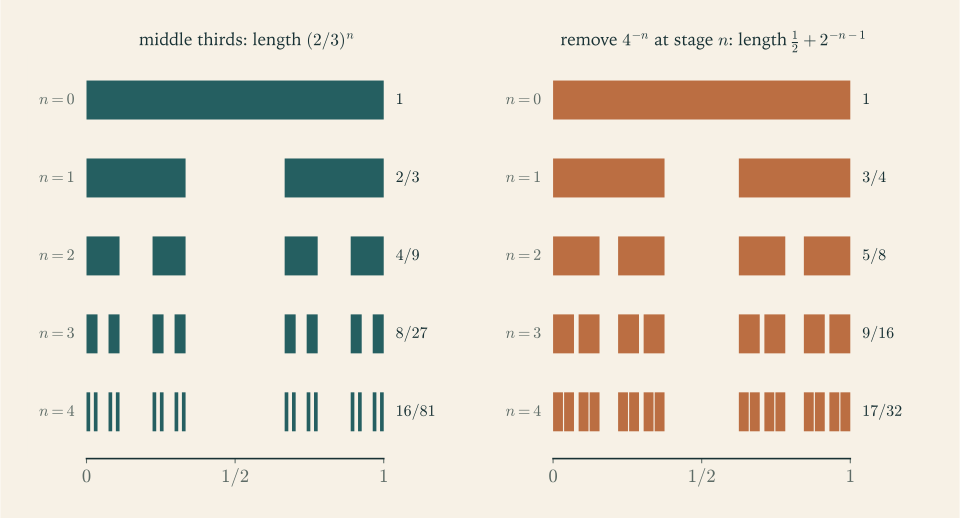
The set \(C\) is not small in the sense of cardinality. A point of \([0,1]\) lies in \(C\) exactly when it has a base-\(3\) expansion using only the digits \(0\) and \(2\) : removing the middle third at stage \(n\) removes the numbers whose \(n\) -th ternary digit is forced to be \(1\) . Replacing each digit \(2\) by \(1\) and reading the result in base \(2\) maps \(C\) onto \([0,1]\) . So \(C\) has as many points as the whole interval, and still it can be covered by intervals of arbitrarily small total length. The left panel of Figure 2.1 shows the first stages.
2.2 The sets that split every set additively
An outer measure is subadditive. On which sets is it additive? Carathéodory’s answer is a definition that looks, at first sight, as if it had been reverse-engineered from the proof it makes possible. It was.
Definition 2.5 (Carathéodory measurability). Let \(\mu^*\) be an outer measure on \(X\) . A set \(E\subseteq X\) is \(\mu^*\) -measurable if
The inequality \(\mu^*(A)\le\mu^*(A\cap E)+\mu^*(A\setminus E)\) holds for all sets by subadditivity, so only the reverse inequality needs checking, and only for test sets \(A\) with \(\mu^*(A)<\infty\) . The definition says that \(E\) is a clean knife: it cuts every set, however wild, into two pieces whose outer measures add up. Demanding this of all test sets, including non-measurable ones, is what gives the criterion its strength. A weaker demand, such as additivity only when \(A\) is the whole space, is not enough: the first outer measure of the next example is one for which every set passes that weaker test, and yet \(\mu^*\) is not additive on the sets so admitted.
Example 2.3: Two outer measures on small sets
First outer measure. On \(X=\{1,2,3\}\) let \(\mu^*(\emptyset)=0\) , \(\mu^*(X)=2\) , and \(\mu^*(E)=1\) for the six other subsets. It is monotone. It is subadditive: a union has value \(2\) only if it is \(X\) , and then either one of the sets is \(X\) itself or at least two of them are nonempty, so the sum of their values is at least \(2\) . Is \(E=\{1\}\) measurable? With the test set \(A=X\) the criterion holds: \(\mu^*(\{1\})+\mu^*(\{2,3\})=1+1=2=\mu^*(X)\) , and in the same way every subset of \(X\) splits the whole space additively. With the test set \(A=\{1,2\}\) the criterion fails:
The same happens for every set other than \(\emptyset\) and \(X\) . The measurable sets are \(\emptyset\) and \(X\) only, and on them \(\mu^*\) is trivially a measure. The displayed line also shows what testing against the whole space alone would have cost: all eight subsets pass that test, and \(\mu^*\) is not additive on them, since the disjoint sets \(\{1\}\) and \(\{2\}\) have values adding to \(2\) while their union has value \(1\) . An outer measure can be so far from additive that the full criterion rejects everything.
Second outer measure. On \(X=\{1,2,3,4\}\) use Proposition 2.3 with the covering family \(\{1,2\}\) , \(\{3\}\) , \(\{4\}\) at costs \(2\) , \(1\) , \(1\) . A set that meets \(\{1,2\}\) must pay \(2\) for it whether it contains one of the points or both, so
For instance \(\mu^*(\{1\})=\mu^*(\{2\})=\mu^*(\{1,2\})=2\) and \(\mu^*(X)=4\) . The set \(\{1\}\) is not measurable, since it splits \(A=\{1,2\}\) into pieces of outer measure \(2+2=4\ne2\) . Checking all \(16\) subsets against all \(16\) test sets shows that exactly \(8\) sets are measurable: the unions of the blocks \(\{1,2\}\) , \(\{3\}\) , \(\{4\}\) . They form a \(\sigma\) -algebra, and on it \(\mu^*\) is additive, \(\mu^*(X)=2+1+1\) . The covering sets could not tell \(1\) from \(2\) , and the criterion faithfully reports that.
Theorem 2.6 (Carathéodory). Let \(\mu^*\) be an outer measure on \(X\) and let \(\mathcal M\) be the family of \(\mu^*\) -measurable sets. Then \(\mathcal M\) is a \(\sigma\) -algebra, and the restriction of \(\mu^*\) to \(\mathcal M\) is a complete measure.
Proof. \(\mathcal M\) is an algebra. The criterion is symmetric in \(E\) and \(E^c\) , and it holds trivially for \(E=X\) . Let \(E,F\in\mathcal M\) and let \(A\) be any test set. Split \(A\) by \(E\) , and then split each piece by \(F\) :
The first three sets on the right have union \(A\cap(E\cup F)\) , so by subadditivity their outer measures sum to at least \(\mu^*(A\cap(E\cup F))\) . The fourth set is \(A\setminus(E\cup F)\) . Hence \(\mu^*(A)\ge\mu^*(A\cap(E\cup F))+\mu^*(A\setminus(E\cup F))\) , and \(E\cup F\in\mathcal M\) .
Additivity inside a test set. If \(E,F\in\mathcal M\) are disjoint, split the test set \(A\cap(E\cup F)\) by \(E\) : its part inside \(E\) is \(A\cap E\) and its part outside is \(A\cap F\) , so \(\mu^*(A\cap(E\cup F))=\mu^*(A\cap E)+\mu^*(A\cap F)\) . By induction the same holds for finitely many pairwise disjoint members of \(\mathcal M\) .
Countable disjoint unions. Let \(E_1,E_2,\dots\in\mathcal M\) be pairwise disjoint, \(S_n=E_1\cup\dots\cup E_n\) , and \(S=\bigcup_kE_k\) . For any test set \(A\) , since \(S_n\in\mathcal M\) and \(A\setminus S\subseteq A\setminus S_n\) ,
Let \(n\to\infty\) and then use countable subadditivity twice:
All three inequalities are therefore equalities. The middle expression shows \(S\in\mathcal M\) . Taking \(A=S\) in the first equality gives \(\mu^*(S)=\sum_k\mu^*(E_k)\) , which is countable additivity.
Arbitrary countable unions. A countable union of members of the algebra \(\mathcal M\) can be rewritten as a disjoint union of members of \(\mathcal M\) by disjointification, so \(\mathcal M\) is a \(\sigma\) -algebra.
Completeness. If \(\mu^*(N)=0\) and \(A\) is any set, then \(\mu^*(A\cap N)+\mu^*(A\setminus N)\le0+\mu^*(A)\) by monotonicity. So every set of outer measure zero is measurable, and a subset of such a set again has outer measure zero.
Read the proof once more for what it does not use. There is no topology, no intervals, no structure on \(X\) at all. The theorem is a statement about any function on the power set that is monotone and countably subadditive. That generality is what lets the same theorem produce, in Section 2.4, a measure from any consistent assignment of mass on an algebra.
2.3 Lebesgue measure
Theorem 2.6 applied to \(\lambda^*\) gives a complete measure on some \(\sigma\) -algebra. The theorem alone does not say the \(\sigma\) -algebra is large; Example 2.3 shows it could be trivial. For \(\lambda^*\) it is not.
Proposition 2.7 (Borel sets are measurable). Every Borel subset of \(\mathbb R\) is \(\lambda^*\) -measurable.
Proof. The measurable sets form a \(\sigma\) -algebra, and the rays \((a,\infty)\) generate \(\mathcal B(\mathbb R)\) by Proposition 1.7, so it suffices to show that each ray \((a,\infty)\) is measurable. Let \(A\) be a test set with \(\lambda^*(A)<\infty\) and let \(\varepsilon>0\) . Choose open intervals \(I_k\) covering \(A\) with \(\sum_k\ell(I_k)\le\lambda^*(A)+\varepsilon\) . Each \(I_k\) is cut by the point \(a\) into two intervals, \(I_k'=I_k\cap(a,\infty)\) and \(I_k''=I_k\cap(-\infty,a]\) , possibly empty, whose lengths add up to \(\ell(I_k)\) . By Theorem 2.4 the outer measure of each piece is its length. The \(I_k'\) cover \(A\cap(a,\infty)\) and the \(I_k''\) cover \(A\setminus(a,\infty)\) , so by subadditivity
Letting \(\varepsilon\to0\) gives the inequality that the criterion requires.
Definition 2.8 (Lebesgue measure). The \(\sigma\) -algebra \(\mathcal L\) of \(\lambda^*\) -measurable subsets of \(\mathbb R\) is the family of Lebesgue measurable sets. Lebesgue measure \(\lambda\) is the restriction of \(\lambda^*\) to \(\mathcal L\) .
So \(\mathcal B(\mathbb R)\subseteq\mathcal L\) , the measure \(\lambda\) is complete, and \(\lambda(I)\) is the length of \(I\) for every interval. It is \(\sigma\) -finite because \(\mathbb R=\bigcup_n[-n,n]\) . On the Borel sets it is the only measure that gives intervals their lengths: the half-open intervals \((a,b]\) together with \(\emptyset\) form a \(\pi\) -system that generates \(\mathcal B(\mathbb R)\) , the sets \((-n,n]\) belong to it, have finite measure, and increase to \(\mathbb R\) , so Theorem 1.17(b) applies. The question that closed Chapter 1 is answered: length exists on the Borel sets, and it is unique.
Proposition 2.9 (translation and dilation). Let \(E\in\mathcal L\) , \(t\in\mathbb R\) , and \(c\ne0\) . Then \(E+t=\{x+t:x\in E\}\) and \(cE=\{cx:x\in E\}\) are Lebesgue measurable, with \(\lambda(E+t)=\lambda(E)\) and \(\lambda(cE)=\lvert c\rvert\lambda(E)\) .
Proof. If open intervals \(I_k\) cover a set \(A\) , then the intervals \(I_k+t\) cover \(A+t\) and have the same lengths, while the intervals \(cI_k\) cover \(cA\) and have lengths \(\lvert c\rvert\ell(I_k)\) . Both correspondences between covers are reversible, so \(\lambda^*(A+t)=\lambda^*(A)\) and \(\lambda^*(cA)=\lvert c\rvert\lambda^*(A)\) for every \(A\subseteq\mathbb R\) . For measurability of \(E+t\) , let \(A\) be a test set. Since \(A\cap(E+t)=((A-t)\cap E)+t\) and \(A\setminus(E+t)=((A-t)\setminus E)+t\) ,
The argument for \(cE\) is the same with \(A-t\) replaced by \(c^{-1}A\) .
How far is a Lebesgue measurable set from an open set, a closed set, or a finite union of intervals? Not far, and the precise statement is one of the most used tools in the subject.
Theorem 2.10 (regularity of Lebesgue measure). For a set \(E\subseteq\mathbb R\) the following are equivalent.
(a) \(E\) is Lebesgue measurable.
(b) For every \(\varepsilon>0\) there is an open set \(U\supseteq E\) with \(\lambda^*(U\setminus E)<\varepsilon\) .
(c) For every \(\varepsilon>0\) there is a closed set \(F\subseteq E\) with \(\lambda^*(E\setminus F)<\varepsilon\) .
Moreover, for \(E\in\mathcal L\) ,
Proof. (a) implies (b). Suppose first \(\lambda(E)<\infty\) . Choose open intervals covering \(E\) with total length less than \(\lambda(E)+\varepsilon\) and let \(U\) be their union. Then \(U\) is open and \(\lambda(U)<\lambda(E)+\varepsilon\) . Since \(E\) is measurable with finite measure, \(\lambda(U\setminus E)=\lambda(U)-\lambda(E)<\varepsilon\) . For general \(E\in\mathcal L\) put \(E_n=E\cap[-n,n]\) , choose open \(U_n\supseteq E_n\) with \(\lambda(U_n\setminus E_n)<\varepsilon2^{-n}\) , and let \(U=\bigcup_nU_n\) . Then \(U\setminus E\subseteq\bigcup_n(U_n\setminus E_n)\) has measure less than \(\varepsilon\) .
(b) implies (a). For each \(n\) choose an open \(U_n\supseteq E\) with \(\lambda^*(U_n\setminus E)<1/n\) and let \(G=\bigcap_nU_n\) . Then \(G\) is a Borel set, and \(G\setminus E\subseteq U_n\setminus E\) for all \(n\) , so \(\lambda^*(G\setminus E)=0\) and \(G\setminus E\) is measurable by completeness. Hence \(E=G\setminus(G\setminus E)\) is measurable.
(a) is equivalent to (c). A set is measurable exactly when its complement is. If \(U\supseteq E^c\) is open, then \(F=U^c\) is a closed subset of \(E\) and \(E\setminus F=E\cap U=U\setminus E^c\) . So (c) for \(E\) is (b) for \(E^c\) .
The two formulas. The first follows from (b) when \(\lambda(E)<\infty\) , and is trivial when \(\lambda(E)=\infty\) . For the second, given \(\varepsilon\) take a closed \(F\subseteq E\) with \(\lambda(E\setminus F)<\varepsilon\) . The sets \(K_n=F\cap[-n,n]\) are closed and bounded, hence compact, and \(K_n\uparrow F\) . By continuity from below \(\lambda(K_n)\uparrow\lambda(F)\ge\lambda(E)-\varepsilon\) , with the obvious reading when \(\lambda(E)=\infty\) .
The proof of the second implication shows more than was asked: every Lebesgue measurable set is a Borel set minus a set of measure zero. So \(\mathcal L\) is exactly the completion of \(\mathcal B(\mathbb R)\) with respect to \(\lambda\) , in the sense of Theorem 1.14.
Corollary 2.11 (approximation by finitely many intervals). If \(E\in\mathcal L\) and \(\lambda(E)<\infty\) , then for every \(\varepsilon>0\) there is a finite union \(J\) of bounded open intervals with \(\lambda(E\triangle J)<\varepsilon\) .
Proof. Choose an open \(U\supseteq E\) with \(\lambda(U\setminus E)<\varepsilon/2\) ; then \(\lambda(U)<\infty\) . An open subset of \(\mathbb R\) is a countable disjoint union of open intervals \(I_1,I_2,\dots\) , and \(\sum_k\lambda(I_k)=\lambda(U)<\infty\) , so each \(I_k\) is bounded and there is an \(N\) with \(\sum_{k>N}\lambda(I_k)<\varepsilon/2\) . Let \(J=I_1\cup\dots\cup I_N\) . Then \(J\setminus E\subseteq U\setminus E\) and \(E\setminus J\subseteq\bigcup_{k>N}I_k\) , so \(\lambda(E\triangle J)<\varepsilon\) .
2.4 Premeasures and the extension theorem
Nothing in the construction of \(\lambda\) was special to length except Theorem 2.4. The general statement starts from mass assigned consistently on an algebra.
Definition 2.12 (premeasure). Let \(\mathcal A_0\) be an algebra on \(X\) . A premeasure on \(\mathcal A_0\) is a function \(\mu_0:\mathcal A_0\to[0,\infty]\) with \(\mu_0(\emptyset)=0\) such that \(\mu_0\bigl(\bigcup_nA_n\bigr)=\sum_n\mu_0(A_n)\) whenever \(A_1,A_2,\dots\in\mathcal A_0\) are pairwise disjoint and their union happens to lie in \(\mathcal A_0\) . It is \(\sigma\) -finite if \(X\) is a countable union of members of \(\mathcal A_0\) of finite premeasure.
A premeasure is finitely additive, hence monotone on \(\mathcal A_0\) . The italicised clause is the whole difficulty: an algebra need not contain countable unions, but when it does, the premeasure must already be countably additive there. The set function of Example 1.4 is finitely additive on an algebra and is not a premeasure.
Theorem 2.13 (Carathéodory extension). Let \(\mu_0\) be a premeasure on an algebra \(\mathcal A_0\) on \(X\) , and let \(\mu^*\) be the outer measure obtained from Proposition 2.3 with \(\mathcal E=\mathcal A_0\) and \(\rho=\mu_0\) .
(a) \(\mu^*(A)=\mu_0(A)\) for every \(A\in\mathcal A_0\) .
(b) Every \(A\in\mathcal A_0\) is \(\mu^*\) -measurable. Consequently the restriction \(\mu\) of \(\mu^*\) to \(\sigma(\mathcal A_0)\) is a measure extending \(\mu_0\) .
(c) If \(\mu_0\) is \(\sigma\) -finite, then \(\mu\) is the only measure on \(\sigma(\mathcal A_0)\) that extends \(\mu_0\) .
Proof. (a) Covering \(A\) by itself shows \(\mu^*(A)\le\mu_0(A)\) . Conversely let \(A\subseteq\bigcup_kA_k\) with \(A_k\in\mathcal A_0\) . The sets \(B_k=A\cap\bigl(A_k\setminus(A_1\cup\dots\cup A_{k-1})\bigr)\) belong to \(\mathcal A_0\) , are pairwise disjoint, and have union \(A\in\mathcal A_0\) . The premeasure property and monotonicity give \(\mu_0(A)=\sum_k\mu_0(B_k)\le\sum_k\mu_0(A_k)\) . Taking the infimum over covers, \(\mu_0(A)\le\mu^*(A)\) .
(b) Let \(E\in\mathcal A_0\) , let \(A\) be a test set with \(\mu^*(A)<\infty\) , and let \(\varepsilon>0\) . Choose \(A_k\in\mathcal A_0\) covering \(A\) with \(\sum_k\mu_0(A_k)\le\mu^*(A)+\varepsilon\) . The sets \(A_k\cap E\) cover \(A\cap E\) and the sets \(A_k\setminus E\) cover \(A\setminus E\) ; all of them are in \(\mathcal A_0\) , and \(\mu_0(A_k)=\mu_0(A_k\cap E)+\mu_0(A_k\setminus E)\) by finite additivity. Hence
So \(E\) is measurable. By Theorem 2.6 the measurable sets form a \(\sigma\) -algebra containing \(\mathcal A_0\) , hence containing \(\sigma(\mathcal A_0)\) , and \(\mu^*\) is a measure there; by (a) it extends \(\mu_0\) .
(c) An algebra is a \(\pi\) -system. By \(\sigma\) -finiteness there are \(X_n\in\mathcal A_0\) of finite premeasure with union \(X\) , and replacing \(X_n\) by \(X_1\cup\dots\cup X_n\) we may take them increasing. Two extensions agree on \(\mathcal A_0\) , so Theorem 1.17(b) shows they agree on \(\sigma(\mathcal A_0)\) .
Lebesgue measure fits this pattern, with \(\mathcal A_0\) the algebra of finite disjoint unions of half-open intervals \((a,b]\) and unbounded intervals \((-\infty,b]\) , \((a,\infty)\) , and \(\mu_0\) the total length. So does a much larger family of measures on the line.
Theorem 2.14 (Lebesgue–Stieltjes measures). Let \(F:\mathbb R\to\mathbb R\) be nondecreasing and right-continuous. There is exactly one measure \(\mu_F\) on \(\mathcal B(\mathbb R)\) such that
Conversely, every measure on \(\mathcal B(\mathbb R)\) that is finite on bounded intervals equals \(\mu_F\) for such an \(F\) , and \(F\) is unique up to an additive constant.
Proof. The premeasure. Let \(\mathcal A_0\) be the algebra of finite disjoint unions of half-open intervals \((a,b]\) , bounded or unbounded, and define \(\mu_0\) on it by adding the increments \(F(b)-F(a)\) of the pieces, with \(F(\pm\infty)\) read as limits. This does not depend on how a set is cut into pieces, because increments of \(F\) telescope, and finite additivity is immediate.
The key step. Suppose a bounded interval \((a,b]\) is a disjoint union of intervals \((a_k,b_k]\) , \(k=1,2,\dots\) ; we show \(F(b)-F(a)=\sum_k(F(b_k)-F(a_k))\) . For each \(n\) the first \(n\) intervals are disjoint subintervals of \((a,b]\) ; arranging them from left to right and using that \(F\) is nondecreasing across the gaps gives \(\sum_{k\le n}(F(b_k)-F(a_k))\le F(b)-F(a)\) , and hence the same for the infinite sum. For the reverse inequality let \(\varepsilon>0\) . By right-continuity choose \(\delta>0\) with \(F(a+\delta)-F(a)<\varepsilon\) and \(\delta_k>0\) with \(F(b_k+\delta_k)-F(b_k)<\varepsilon2^{-k}\) . The open intervals \((a_k,b_k+\delta_k)\) cover the compact interval \([a+\delta,b]\) , so finitely many do. Chain them exactly as in the proof of Theorem 2.4: there are intervals \((\alpha_i,\beta_i)\) , \(i=1,\dots,m\) , among them with \(\alpha_1<a+\delta\) , \(\alpha_{i+1}<\beta_i\) , and \(\beta_m>b\) . Since \(F\) is nondecreasing,
Each term on the right is at most \(F(b_k)-F(a_k)+\varepsilon2^{-k}\) for the corresponding \(k\) . Therefore \(F(b)-F(a)\le2\varepsilon+\sum_k(F(b_k)-F(a_k))\) , and \(\varepsilon\) was arbitrary.
Conclusion. The passage from one bounded interval to a general member of \(\mathcal A_0\) is bookkeeping, which we leave to the reader: a countable disjoint union is intersected with each of the finitely many pieces of the set it fills, and an unbounded piece is exhausted by bounded ones. So \(\mu_0\) is a premeasure, and it is \(\sigma\) -finite because the intervals \((-n,n]\) have finite premeasure. Theorem 2.13 gives existence and uniqueness of \(\mu_F\) on \(\sigma(\mathcal A_0)=\mathcal B(\mathbb R)\) .
For the converse put \(F(x)=\mu((0,x])\) for \(x\ge0\) and \(F(x)=-\mu((x,0])\) for \(x<0\) . It is nondecreasing by monotonicity. It is right-continuous: for \(x\ge0\) the intervals \((0,y]\) decrease to \((0,x]\) as \(y\downarrow x\) , and continuity from above is available because bounded intervals have finite measure; for \(x<0\) the intervals \((y,0]\) increase to \((x,0]\) , and continuity from below applies. The measures \(\mu\) and \(\mu_F\) agree on half-open intervals, hence everywhere.
Taking \(F(x)=x\) gives Lebesgue measure on the Borel sets. A function \(F\) with a jump produces a measure with an atom.
Example 2.4: A Stieltjes measure with an atom
Let
It is nondecreasing and right-continuous, with a jump at \(x=1\) : the left limit is \(F(1^-)=1\) and the value is \(F(1)=2\) . To find the mass of sets that are not half-open intervals, write them as monotone limits of half-open intervals and use continuity of measure. Since \(\{x\}=\bigcap_n(x-\tfrac1n,x]\) ,
Hence \(\mu_F(\{1\})=2-1=1\) , while \(\mu_F(\{\tfrac12\})=0\) because \(F\) is continuous there. In the same way \(\mu_F((a,b))=F(b^-)-F(a)\) and \(\mu_F([a,b])=F(b)-F(a^-)\) . So
The closed interval \([0,1]\) has mass \(2\) and its interior has mass \(1\) ; the difference is the atom at the endpoint \(1\) . For Lebesgue measure the four kinds of interval with the same endpoints all have the same measure, and one gets used to ignoring endpoints. For a general Borel measure on the line that habit is an error. The total mass is \(\mu_F(\mathbb R)=\lim_{x\to\infty}F(x)-\lim_{x\to-\infty}F(x)=2\) .
2.5 A set that cannot be measured
Theorem 2.15 (Vitali). There is a subset of \([0,1)\) that is not Lebesgue measurable.
Proof. Call two points of \([0,1)\) equivalent if their difference is rational. This is an equivalence relation, and it partitions \([0,1)\) into classes, each of which is countable. Using the axiom of choice, let \(V\) be a set containing exactly one point from each class.
For each rational \(q\in[0,1)\) let \(V_q\) be the translate of \(V\) by \(q\) taken modulo one:
The sets \(V_q\) are pairwise disjoint. If a point lies in \(V_q\cap V_{q'}\) , it equals \(v+q\) or \(v+q-1\) for some \(v\in V\) , and also \(v'+q'\) or \(v'+q'-1\) for some \(v'\in V\) . Then \(v-v'\) is rational, so \(v\) and \(v'\) are equivalent, and since \(V\) contains one point per class, \(v=v'\) . It follows that \(q-q'\) is an integer, and as both lie in \([0,1)\) , \(q=q'\) .
The sets \(V_q\) cover \([0,1)\) . Let \(x\in[0,1)\) and let \(v\) be the point of \(V\) equivalent to \(x\) . Then \(x-v\) is a rational number in \((-1,1)\) . Put \(q=x-v\) if this is nonnegative and \(q=x-v+1\) otherwise. In either case \(q\in[0,1)\) is rational and \(x\in V_q\) .
Conclusion. Suppose \(V\) were Lebesgue measurable. Each \(V_q\) is a disjoint union of translates of two measurable pieces of \(V\) , so by Proposition 2.9 it is measurable with \(\lambda(V_q)=\lambda(V\cap[0,1-q))+\lambda(V\cap[1-q,1))=\lambda(V)\) . Countable additivity over the countably many rationals \(q\in[0,1)\) gives
A sum of countably many copies of one number is \(0\) or \(\infty\) , never \(1\) . So \(V\) is not measurable.
The proof used three properties of \(\lambda\) and nothing else: countable additivity, invariance under translation, and \(\lambda([0,1))=1\) . It therefore proves the claim made at the start of Chapter 1: no function defined on all subsets of \(\mathbb R\) has those three properties. The set \(V\) was not constructed but chosen, and the axiom of choice is known to be unavoidable here; one cannot exhibit a non-measurable set by a formula. In practice this means that every set and every function that arises from countable operations on explicit objects is measurable, and that measurability hypotheses, though they must be stated, are rarely the obstacle.
There are thus three families on the line, strictly nested: \(\mathcal B(\mathbb R)\subsetneq\mathcal L\subsetneq\mathcal P(\mathbb R)\) . The second inclusion is strict by Vitali’s theorem. For the first, every subset of the Cantor set is Lebesgue measurable, being a subset of a null set in a complete measure space, and the Cantor set has as many subsets as there are sets of real numbers; but it can be shown that there are only as many Borel sets as real numbers. So most subsets of the Cantor set are Lebesgue measurable and not Borel.
Example 2.5: A nowhere dense set of positive measure
The Cantor set is closed, contains no interval, and has measure zero. The last property is not a consequence of the first two. Start again from \([0,1]\) , and at stage \(n\) remove from the middle of each of the \(2^{n-1}\) remaining closed intervals an open interval of length \(4^{-n}\) . At stage \(1\) this removes an interval of length \(\tfrac14\) and leaves two intervals of length \(\tfrac38\) . The total length removed in all stages is
After stage \(n\) the remaining set \(K_n\) is a union of \(2^n\) closed intervals of total length \(\tfrac12+2^{-n-1}\) , so each has length \((\tfrac12+2^{-n-1})/2^n\) , which is more than the \(4^{-(n+1)}\) to be removed from it next, so the construction can continue. Let \(K=\bigcap_nK_n\) . It is closed, and by continuity from above
It contains no interval, because an interval inside \(K\) would lie inside one of the \(2^n\) pieces of \(K_n\) for every \(n\) , and those have length less than \(2^{-n}\) . So \(K\) is a closed set with empty interior and measure \(\tfrac12\) , and its complement in \([0,1]\) is an open dense set of measure \(\tfrac12\) . The right panel of Figure 2.1 shows its first stages beside those of the Cantor set.
The measure now exists. The next task is to decide which functions can be integrated against it, and the answer will again be a closure condition: a class of functions large enough to contain every limit that analysis produces.
Exercises
-
Show directly from Definition 2.1 that a one-point set has Lebesgue outer measure zero, and that \(\lambda^*([0,1]\setminus\mathbb Q)=1\) , using only subadditivity and Theorem 2.4.
Hint
Cover \(\{x\}\) by the single interval \((x-\varepsilon,x+\varepsilon)\) . For the second claim, \([0,1]\) is the union of \([0,1]\cap\mathbb Q\) , which has outer measure zero by Example 2.1, and \([0,1]\setminus\mathbb Q\) . Subadditivity gives \(1\le0+\lambda^*([0,1]\setminus\mathbb Q)\) , and monotonicity gives the reverse inequality.
-
Let \(A,B\subseteq\mathbb R\) be arbitrary sets with \(\inf\{\lvert a-b\rvert:a\in A,\ b\in B\}>0\) . Prove that \(\lambda^*(A\cup B)=\lambda^*(A)+\lambda^*(B)\) , without assuming that either set is measurable.
Solution
Let \(\delta>0\) be the infimum of the distances. Subadditivity gives \(\lambda^*(A\cup B)\le\lambda^*(A)+\lambda^*(B)\) , so we prove the reverse inequality, assuming \(\lambda^*(A\cup B)<\infty\) .
A refinement step. An open interval \(I\) of length \(\ell\) can be covered by finitely many open intervals, each of length less than \(\delta\) , with total length at most \(\ell+\eta\) , for any \(\eta>0\) : choose \(m\) so large that \((\ell+\eta)/m<\delta\) , cut the closure of \(I\) into \(m\) equal closed pieces, and enlarge each piece to an open interval longer by \(\eta/m\) .
The argument. Let \(\varepsilon>0\) and choose open intervals \(I_k\) covering \(A\cup B\) with \(\sum_k\ell(I_k)\le\lambda^*(A\cup B)+\varepsilon\) . Refine each \(I_k\) as above with \(\eta=\varepsilon2^{-k}\) . The result is a countable cover of \(A\cup B\) by open intervals of length less than \(\delta\) and total length at most \(\lambda^*(A\cup B)+2\varepsilon\) . An interval shorter than \(\delta\) cannot contain a point of \(A\) and a point of \(B\) . So the cover splits into the intervals that meet \(A\) , which cover \(A\) , and the remaining ones, which cover \(B\) . Therefore
\[ \lambda^*(A)+\lambda^*(B)\le\lambda^*(A\cup B)+2\varepsilon , \]and \(\varepsilon\) was arbitrary. Notice that no measurability was used: positive distance is a geometric substitute for the Carathéodory criterion.
-
Let \(E\subseteq\mathbb R\) satisfy \(\lambda^*(E)=0\) . Prove that the set of squares \(\{x^2:x\in E\}\) also has outer measure zero, by treating \(E\cap[-n,n]\) first.
Solution
Fix \(n\) and put \(E_n=E\cap[-n,n]\) , which has outer measure zero by monotonicity. Given \(\varepsilon>0\) choose open intervals \(I_k\) covering \(E_n\) with \(\sum_k\ell(I_k)<\varepsilon\) ; intersecting each with \((-n-1,n+1)\) we may assume \(I_k\subseteq(-n-1,n+1)\) . For \(x,y\) in that range,
\[ \lvert x^2-y^2\rvert=\lvert x+y\rvert\,\lvert x-y\rvert\le2(n+1)\lvert x-y\rvert . \]The image of the interval \(I_k\) under the continuous map \(x\mapsto x^2\) is an interval \(J_k\) , and by the estimate its length is at most \(2(n+1)\ell(I_k)\) . By Theorem 2.4, \(\lambda^*(J_k)\) is that length. The sets \(J_k\) cover \(\{x^2:x\in E_n\}\) , so subadditivity gives
\[ \lambda^*(\{x^2:x\in E_n\})\le\sum_k\lambda^*(J_k)\le2(n+1)\varepsilon . \]Since \(\varepsilon\) is arbitrary, each of these sets has outer measure zero, and \(\{x^2:x\in E\}\) is their countable union. The squaring map is not Lipschitz on the whole line, which is why the set had to be cut into bounded pieces first.
-
On \(X=\{1,2,3,4\}\) let \(\mu^*\) be the outer measure of Proposition 2.3 for the covering sets \(\{1,2\}\) , \(\{2,3\}\) , \(\{3,4\}\) , \(\{4,1\}\) , each at cost \(1\) . Compute \(\mu^*\) on every subset and determine the \(\mu^*\) -measurable sets.
Solution
A single covering set costs \(1\) and two covering sets cost \(2\) ; two of them, for instance \(\{1,2\}\) and \(\{3,4\}\) , cover \(X\) . So \(\mu^*(E)\in\{0,1,2\}\) , and \(\mu^*(E)=1\) exactly when \(E\) is a nonempty subset of one covering set. The covering sets are the four “adjacent” pairs, so:
\[ \mu^*(E)=\begin{cases}0,&E=\emptyset,\\ 1,&E\ \text{a singleton or one of}\ \{1,2\},\{2,3\},\{3,4\},\{4,1\},\\ 2,&E=\{1,3\},\ E=\{2,4\},\ \text{or}\ E\ \text{has at least three points}.\end{cases} \]Now test measurability. A singleton \(\{i\}\) fails with the test set \(A=\{i,j\}\) for an adjacent \(j\) : the pieces have outer measures \(1+1=2\) , but \(\mu^*(A)=1\) . An adjacent pair such as \(E=\{1,2\}\) fails with \(A=\{2,3\}\) : the pieces \(\{2\}\) and \(\{3\}\) give \(1+1=2\ne1\) . The set \(E=\{1,3\}\) fails with \(A=\{1,2\}\) , whose pieces are \(\{1\}\) and \(\{2\}\) . A set is measurable exactly when its complement is, which disposes of the three-point sets and of \(\{2,4\}\) . Hence the only \(\mu^*\) -measurable sets are \(\emptyset\) and \(X\) : of the \(16\) subsets, \(2\) are measurable. The overlapping covering sets leave no nontrivial set that splits every test set additively.
-
Prove that for every \(E\subseteq\mathbb R\) there is a countable intersection of open sets \(G\supseteq E\) with \(\lambda(G)=\lambda^*(E)\) , and that when \(\lambda^*(E)<\infty\) the set \(E\) is measurable if and only if \(\lambda^*(G\setminus E)=0\) .
Hint
If \(\lambda^*(E)=\infty\) take \(G=\mathbb R\) . Otherwise choose open \(U_n\supseteq E\) with \(\lambda(U_n)<\lambda^*(E)+1/n\) , as in the first step of the proof of Theorem 2.10, and let \(G=\bigcap_nU_n\) . If \(E\) is measurable, subtract. If \(\lambda^*(G\setminus E)=0\) , then \(G\setminus E\) is measurable by completeness and \(E=G\setminus(G\setminus E)\) .
-
Show that \(\tfrac14\) belongs to the Cantor set although it is not an endpoint of any interval removed or kept during the construction, by finding its ternary expansion.
Answer
\(\tfrac14=\sum_{k\ge1}2\cdot3^{-2k}\) , since the series sums to \(2\cdot\tfrac19/(1-\tfrac19)=\tfrac14\) . So \(\tfrac14=0.020202\ldots\) in base \(3\) , an expansion using only the digits \(0\) and \(2\) , and \(\tfrac14\in C\) . Endpoints of the construction intervals have expansions that are eventually constant (\(0\) or \(2\) repeated), and this one is not.
-
Modify the Cantor construction so that at stage \(n\) a middle open interval is removed from each remaining interval in proportion \(\theta_n\in(0,1)\) of its length. (a) Show the limiting set has measure \(\prod_{n}(1-\theta_n)\) . (b) Evaluate this for \(\theta_n=(n+1)^{-2}\) and for constant \(\theta_n=\theta\) .
Solution
(a) Let \(K_n\) be the set remaining after stage \(n\) ; it is a finite union of closed intervals. Stage \(n\) removes the proportion \(\theta_n\) of each remaining interval, hence of the total remaining length, so \(\lambda(K_n)=(1-\theta_n)\lambda(K_{n-1})\) and by induction \(\lambda(K_n)=\prod_{j=1}^n(1-\theta_j)\) . The sets \(K_n\) decrease to \(K=\bigcap_nK_n\) and \(\lambda(K_0)=1<\infty\) , so continuity from above gives \(\lambda(K)=\lim_n\prod_{j\le n}(1-\theta_j)\) .
(b) For \(\theta_n=(n+1)^{-2}\) the partial products telescope:
\[ \prod_{k=2}^{N}\Bigl(1-\frac1{k^2}\Bigr)=\prod_{k=2}^N\frac{(k-1)(k+1)}{k\cdot k}=\frac{1}{N}\cdot\frac{N+1}{2}=\frac{N+1}{2N}\longrightarrow\frac12 . \]So this set has measure \(\tfrac12\) . For constant \(\theta\) the product is \((1-\theta)^n\to0\) , however small \(\theta\) is: removing a fixed proportion at every stage always leaves a null set, and positive measure requires the proportions to shrink fast enough that their sum converges.
-
A student claims: “The rationals in \([0,1]\) are dense, so every open set containing them contains \([0,1]\) , and therefore \(\lambda^*(\mathbb Q\cap[0,1])=1\) .” Find the false step, and explain what the argument does prove if only finite covers by intervals are allowed.
Solution
The false step is “every open set containing the rationals of \([0,1]\) contains \([0,1]\) ”. Density of a set \(Q\) means that every nonempty open set meets \(Q\) ; it does not mean that an open set containing \(Q\) must contain every point near \(Q\) . Example 2.1 exhibits an open set \(U\) containing all rationals with \(\lambda^*(U)\le\varepsilon\) , obtained by giving the \(k\) -th rational an interval of length \(\varepsilon2^{-k}\) . The correct value is \(\lambda^*(\mathbb Q\cap[0,1])=0\) .
With finite covers the argument is nearly right. If finitely many open intervals cover \(\mathbb Q\cap[0,1]\) , then the complement of their union in \([0,1]\) is a closed set containing no rational, hence containing no interval, and the complement in \([0,1]\) of a finite union of intervals is a finite union of intervals and points; so it is a finite set. The intervals therefore cover \([0,1]\) up to finitely many points, and their total length is at least \(1\) . The “outer content” defined by finite covers assigns \(\mathbb Q\cap[0,1]\) the value \(1\) , the same as its closure. Countable covers are what allow each rational its own, ever smaller, interval.
-
Let \(F(x)=x+\lfloor x\rfloor\) , where \(\lfloor x\rfloor\) is the greatest integer not exceeding \(x\) . Verify that \(F\) is nondecreasing and right-continuous, and compute \(\mu_F([0,2])\) , \(\mu_F((0,2))\) , \(\mu_F(\{1\})\) , and \(\mu_F(\mathbb Q\cap[0,2])\) .
Solution
Both \(x\) and \(\lfloor x\rfloor\) are nondecreasing, so \(F\) is. The function \(\lfloor x\rfloor\) is constant on each \([n,n+1)\) , hence right-continuous, and \(x\) is continuous; so \(F\) is right-continuous, with a jump of size \(1\) at each integer: \(F(n^-)=2n-1\) and \(F(n)=2n\) .
Using the formulas of Example 2.4:
\[ \mu_F([0,2])=F(2)-F(0^-)=4-(-1)=5,\qquad \mu_F((0,2))=F(2^-)-F(0)=3-0=3,\qquad \mu_F(\{1\})=F(1)-F(1^-)=2-1=1 . \]These agree with the description \(\mu_F=\lambda+\sum_{n\in\mathbb Z}\delta_n\) , which holds because both sides give \((a,b]\) the mass \(b-a\) plus the number of integers in \((a,b]\) : the closed interval has length \(2\) and contains the three integers \(0,1,2\) , and the open interval has length \(2\) and contains only the integer \(1\) . For the last set, \(\lambda(\mathbb Q\cap[0,2])=0\) and the point masses contribute one for each integer in the set, so \(\mu_F(\mathbb Q\cap[0,2])=3\) .
-
Prove that \(E\subseteq\mathbb R\) is Lebesgue measurable if and only if \(E=H\cup N\) , where \(H\) is a countable union of closed sets and \(\lambda^*(N)=0\) .
Hint
Use part (c) of Theorem 2.10 with \(\varepsilon=1/n\) to get closed sets \(F_n\subseteq E\) with \(\lambda^*(E\setminus F_n)<1/n\) ; let \(H=\bigcup_nF_n\) and \(N=E\setminus H\) . The converse is immediate, since closed sets are Borel and sets of outer measure zero are measurable.
-
Let \(D\) be the set of numbers in \([0,1]\) that have a decimal expansion in which the digit \(7\) never appears. Prove that \(D\) is a Borel set with \(\lambda(D)=0\) , and find the smallest \(n\) for which the stage-\(n\) cover has total length below \(\tfrac1{100}\) .
Solution
For a string \(d_1\dots d_n\) of digits none of which is \(7\) , let \(J(d_1\dots d_n)\) be the closed interval of numbers having a decimal expansion that begins \(0.d_1\dots d_n\) ; it has length \(10^{-n}\) . Let \(D_n\) be the union of these \(9^n\) intervals. Then \(D_n\) is closed, \(D_{n+1}\subseteq D_n\) , and \(D=\bigcap_nD_n\) : a point of \(D\) lies in every \(D_n\) by definition. Conversely let \(x\) lie in every \(D_n\) , and for each \(n\) choose an admissible string \(s_n\) of length \(n\) with \(x\in J(s_n)\) . These strings need not extend one another, since a point can lie in two adjacent intervals of the same level, so select by pigeonhole: some digit \(d_1\) is the first digit of \(s_n\) for infinitely many \(n\) ; among those \(n\) , some digit \(d_2\) is the second digit for infinitely many; and so on. For each \(k\) the string \(d_1\dots d_k\) begins some \(s_n\) with \(n\ge k\) , so \(x\in J(s_n)\subseteq J(d_1\dots d_k)\) , an interval of length \(10^{-k}\) whose left endpoint is the number with finite expansion \(0.d_1\dots d_k\) . Hence \(x\) is the sum of the series with digits \(d_1,d_2,\dots\) , an expansion with no digit \(7\) . So \(D\) is a countable intersection of closed sets, hence Borel.
By monotonicity and subadditivity
\[ \lambda(D)\le\lambda(D_n)\le9^n\cdot10^{-n}=\bigl(\tfrac9{10}\bigr)^n\longrightarrow0, \]so \(\lambda(D)=0\) . For the last question, \((9/10)^{43}\approx0.01078\) and \((9/10)^{44}\approx0.00970\) , so the smallest \(n\) with total length below \(\tfrac1{100}\) is \(n=44\) . The set \(D\) is uncountable, like the Cantor set, of which it is a base-\(10\) cousin.
-
Let \(V\) be the set in the proof of Theorem 2.15. Prove that every Lebesgue measurable subset of \(V\) has measure zero, and deduce that \(\lambda^*(V)>0\) .
Hint
Let \(E\subseteq V\) be measurable. Its translates modulo one by the rationals of \([0,1)\) are measurable, pairwise disjoint subsets of \([0,1)\) , each of measure \(\lambda(E)\) , exactly as in the proof of Theorem 2.15. Countably many copies of \(\lambda(E)\) sum to at most \(1\) , which forces \(\lambda(E)=0\) . If \(\lambda^*(V)\) were \(0\) , then \(V\) would be measurable by completeness.
-
Prove that \(\lambda^*\) is continuous from below on arbitrary sets: if \(E_1\subseteq E_2\subseteq\cdots\) are subsets of \(\mathbb R\) , measurable or not, then \(\lambda^*\bigl(\bigcup_nE_n\bigr)=\lim_n\lambda^*(E_n)\) .
Hint
Monotonicity gives one inequality. For the other, assume the limit is finite and use Exercise 2.5 to choose measurable \(G_n\supseteq E_n\) with \(\lambda(G_n)=\lambda^*(E_n)\) . The sets \(H_n=\bigcap_{k\ge n}G_k\) are measurable, increase, and satisfy \(E_n\subseteq H_n\subseteq G_n\) . Apply continuity from below to \(H_n\) .
-
Let \(\mu^*\) be an outer measure on \(X\) and let \(E\) be \(\mu^*\) -measurable. Prove that \(\mu^*(A\cup E)+\mu^*(A\cap E)=\mu^*(A)+\mu^*(E)\) for every set \(A\subseteq X\) , measurable or not.
Solution
Use the Carathéodory criterion for \(E\) twice, with two different test sets. With the test set \(A\cup E\) , whose part inside \(E\) is \(E\) and whose part outside \(E\) is \(A\setminus E\) ,
\[ \mu^*(A\cup E)=\mu^*(E)+\mu^*(A\setminus E). \]With the test set \(A\) ,
\[ \mu^*(A)=\mu^*(A\cap E)+\mu^*(A\setminus E). \]Add \(\mu^*(A\cap E)\) to both sides of the first equation and substitute the second:
\[ \mu^*(A\cup E)+\mu^*(A\cap E)=\mu^*(E)+\mu^*(A\setminus E)+\mu^*(A\cap E)=\mu^*(E)+\mu^*(A). \]No subtraction was performed, so the identity is valid in \([0,\infty]\) even when some of the terms are infinite. This is Proposition 1.9(b) with only one of the two sets required to be measurable.
-
Apply the construction of Theorem 2.13 to the finitely additive set function \(\mu_0\) of Example 1.4 on the algebra of finite or cofinite subsets of \(\mathbb N\) . Compute the resulting outer measure \(\mu^*\) , and identify the step in the proof of Theorem 2.13(a) that fails.
Solution
Every singleton \(\{n\}\) belongs to the algebra and has \(\mu_0(\{n\})=0\) . Any \(E\subseteq\mathbb N\) is covered by the countably many singletons of its points, at total cost \(0\) . Hence \(\mu^*(E)=0\) for every \(E\subseteq\mathbb N\) . In particular \(\mu^*(\mathbb N)=0\) while \(\mu_0(\mathbb N)=1\) : the outer measure does not extend \(\mu_0\) , and conclusion (a) of Theorem 2.13 fails.
The proof of (a) breaks at the line \(\mu_0(A)=\sum_k\mu_0(B_k)\) . There \(A\in\mathcal A_0\) is written as a countable disjoint union of members \(B_k\) of the algebra, and the equality is exactly the premeasure property, countable additivity for unions that lie in the algebra. For \(A=\mathbb N\) and \(B_k=\{k\}\) the equality would read \(1=0\) . Theorem 2.6 still holds, trivially: all sets are measurable and the measure is identically zero. A finitely additive set function that is not a premeasure has no countably additive extension at all, because any extension would itself be countably additive on the algebra.
-
Let \(\mu\) be a measure on \(\mathcal B(\mathbb R)\) that is invariant under translation and satisfies \(\mu((0,1])=1\) . Prove that \(\mu\) is Lebesgue measure on the Borel sets, using Theorem 1.17.
Hint
The \(n\) translates \((\tfrac{j-1}n,\tfrac jn]\) , \(j=1,\dots,n\) , are disjoint with union \((0,1]\) , so each has \(\mu\) -measure \(\tfrac1n\) ; hence \(\mu((0,\tfrac kn])=\tfrac kn\) , and by translation \(\mu((a,b])=b-a\) whenever \(b-a\) is rational. Half-open intervals with rational endpoints form a \(\pi\) -system generating the Borel sets, and \((-n,n]\) increases to \(\mathbb R\) with finite measure.
-
Construct an open dense subset \(U\) of \(\mathbb R\) with \(\lambda(U)<\varepsilon\) , and state what can be said about the interior, the closure, and the measure of its complement.
Answer
Take \(U=\bigcup_kI_k\) with \(I_k\) the open interval of length \(\varepsilon2^{-k-1}\) centred at the \(k\) -th rational; then \(\lambda(U)\le\varepsilon/2\) . The complement is closed, has empty interior because \(U\) is dense, and has infinite measure, since \(\lambda([-n,n]\setminus U)\ge2n-\varepsilon\) .