What is the length of a set of real numbers? For an interval the answer is the difference of its endpoints, and for a finite union of disjoint intervals it is the sum of their lengths. The trouble begins when one asks for a length \(m(E)\) of every subset \(E\) of the line, subject to three requirements that seem beyond dispute: an interval \([a,b]\) has length \(b-a\) ; translating a set does not change its length; and the length of a union of countably many pairwise disjoint sets is the sum of their lengths. No such function exists. Section 2.5 constructs a subset of \([0,1)\) whose countably many disjoint translates, taken modulo one, fill \([0,1)\) exactly, so that its length can be neither zero nor positive.
Something has to give. Weakening the third requirement to finite unions destroys the limit theorems that are the whole reason for wanting a better integral. Strengthening it to uncountable unions is absurd, since an interval is an uncountable disjoint union of points of length zero. The resolution adopted a century ago, and never seriously challenged since, is to keep all three requirements and give up the demand that every set be measured. Length is defined on a family of sets rich enough to contain everything analysis produces and closed under the operations analysis performs.
This chapter answers three questions in the abstract. Which families of sets can serve as the domain of a measure? What follows from countable additivity alone? And when do the values of a measure on a few simple sets determine it everywhere? The construction of length itself is the business of Chapter 2.
1.1 Families closed under countable operations
Definition 1.1 (algebra and sigma-algebra). Let \(X\) be a set. A family \(\mathcal A\) of subsets of \(X\) is an algebra on \(X\) if
It is a \(\sigma\) -algebra if, in addition, \(\bigcup_{n=1}^\infty A_n\in\mathcal A\) whenever \(A_1,A_2,\dots\in\mathcal A\) . A pair \((X,\mathcal A)\) consisting of a set and a \(\sigma\) -algebra on it is a measurable space, and the members of \(\mathcal A\) are its measurable sets.
The smallest \(\sigma\) -algebra on \(X\) is \(\{\emptyset,X\}\) and the largest is the power set \(\mathcal P(X)\) . Between them lie the interesting ones. If \(X\) is uncountable, the family of sets that are countable or have countable complement is a \(\sigma\) -algebra (Exercise 1.5), and it is strictly smaller than the power set.
The definition asks for little, and the rest follows from De Morgan’s laws.
Proposition 1.2 (closure properties). Let \(\mathcal A\) be a \(\sigma\) -algebra on \(X\) and let \(A,B,A_1,A_2,\dots\in\mathcal A\) . Then \(\emptyset\) , \(A\cup B\) , \(A\cap B\) , \(A\setminus B\) , \(A\triangle B\) , and \(\bigcap_{n}A_n\) all belong to \(\mathcal A\) .
Proof. First, \(\emptyset=X^c\in\mathcal A\) . Taking \(A_1=A\) , \(A_2=B\) , and \(A_n=\emptyset\) for \(n\ge 3\) in the countable union shows \(A\cup B\in\mathcal A\) , so a \(\sigma\) -algebra is an algebra. De Morgan’s law gives
and the same computation with two sets gives \(A\cap B\in\mathcal A\) . Finally \(A\setminus B=A\cap B^c\) and \(A\triangle B=(A\setminus B)\cup(B\setminus A)\) .
Two limiting operations on sets are used so often that they have names.
Definition 1.3 (limit superior and inferior of sets). For a sequence of subsets \(A_1,A_2,\dots\) of \(X\) ,
Reading the quantifiers, \(x\in\limsup_n A_n\) exactly when for every \(n\) there is a \(k\ge n\) with \(x\in A_k\) , that is, when \(x\) lies in infinitely many of the sets. And \(x\in\liminf_n A_n\) exactly when \(x\) lies in all but finitely many of them. By Proposition 1.2 both sets are measurable when the \(A_n\) are. Always \(\liminf_n A_n\subseteq\limsup_n A_n\) .
Not every natural family passes the test. The open subsets of \(\mathbb R\) are closed under arbitrary unions but not under complements. The subsets of \(\mathbb N\) that are finite or have finite complement form an algebra, but not a \(\sigma\) -algebra: each singleton \(\{2k\}\) belongs to the family, while their union, the set of even numbers, is neither finite nor cofinite. The difference between an algebra and a \(\sigma\) -algebra is exactly the difference between finitely many steps and a limit, and Example 1.4 shows that it is not a technicality.
Example 1.1: The sigma-algebra generated by two overlapping sets
Let \(X=\{1,2,3,4,5,6\}\) and let \(E_1=\{1,2\}\) and \(E_2=\{2,3\}\) . Which sets must belong to every \(\sigma\) -algebra containing \(E_1\) and \(E_2\) ?
Closure under the set operations forces the four sets
to belong. These four sets are pairwise disjoint and cover \(X\) ; call them the atoms. Every union of atoms must belong as well, and there are \(2^4=16\) such unions, one for each choice of which atoms to include. Conversely the family of all unions of atoms is closed under complements, because the complement of a union of atoms is the union of the remaining atoms, and under unions. It contains \(E_1=\{1\}\cup\{2\}\) and \(E_2=\{2\}\cup\{3\}\) . So the smallest \(\sigma\) -algebra containing \(E_1\) and \(E_2\) consists of exactly \(16\) sets.
Notice what is not in it. The set \(\{4\}\) is not a union of atoms, and neither is \(\{4,5\}\) . The two generating sets never separate the points \(4\) , \(5\) , and \(6\) from one another, and no amount of set algebra can do what the generators do not. A \(\sigma\) -algebra on a finite set is always the family of unions of the blocks of a partition, so it has \(2^k\) members, where \(k\) is the number of blocks.
1.2 Generated sigma-algebras and the Borel sets
On an infinite set there is no hope of listing atoms. The \(\sigma\) -algebra generated by a family is defined from above, as an intersection.
Proposition 1.4 (intersections of sigma-algebras). If \(\{\mathcal A_i\}_{i\in I}\) is any nonempty collection of \(\sigma\) -algebras on \(X\) , then \(\bigcap_{i\in I}\mathcal A_i\) is a \(\sigma\) -algebra on \(X\) .
Proof. The set \(X\) lies in every \(\mathcal A_i\) . If \(A\) lies in every \(\mathcal A_i\) , so does \(A^c\) . If \(A_1,A_2,\dots\) lie in every \(\mathcal A_i\) , so does their union. Each defining condition is inherited because it holds in each \(\mathcal A_i\) separately.
Definition 1.5 (generated sigma-algebra). Let \(\mathcal E\) be a family of subsets of \(X\) . The \(\sigma\) -algebra generated by \(\mathcal E\) , written \(\sigma(\mathcal E)\) , is the intersection of all \(\sigma\) -algebras on \(X\) that contain \(\mathcal E\) .
The collection being intersected is nonempty, since \(\mathcal P(X)\) contains \(\mathcal E\) . So \(\sigma(\mathcal E)\) exists, contains \(\mathcal E\) , and is contained in every \(\sigma\) -algebra that contains \(\mathcal E\) . That last property is the only handle the definition provides, and it leads to the most common proof pattern in the subject. To show that every set in \(\sigma(\mathcal E)\) has some property, let \(\mathcal G\) be the family of all sets having the property, check that \(\mathcal G\) is a \(\sigma\) -algebra, and check that \(\mathcal E\subseteq\mathcal G\) . Then \(\sigma(\mathcal E)\subseteq\mathcal G\) . One never works with a typical member of \(\sigma(\mathcal E)\) , because there is no usable description of one. In particular, if \(\mathcal E\subseteq\sigma(\mathcal F)\) and \(\mathcal F\subseteq\sigma(\mathcal E)\) then \(\sigma(\mathcal E)=\sigma(\mathcal F)\) .
Definition 1.6 (Borel sets). The Borel \(\sigma\) -algebra \(\mathcal B(\mathbb R)\) is the \(\sigma\) -algebra generated by the open subsets of \(\mathbb R\) . Its members are the Borel sets. The same definition applies with \(\mathbb R\) replaced by \(\mathbb R^d\) or by any metric space.
Closed sets are Borel, being complements of open sets. So are countable intersections of open sets and countable unions of closed sets. The rationals are a countable union of singletons, hence Borel, and therefore so are the irrationals. Almost any set one can describe is Borel, and for that reason it is useful to have small generating families.
Proposition 1.7 (generators of the Borel sets). Each of the following families generates \(\mathcal B(\mathbb R)\) : the open intervals \((a,b)\) ; the half-open intervals \((a,b]\) ; the rays \((a,\infty)\) ; the rays \((-\infty,a]\) . In each case the endpoints may be restricted to rational numbers.
Proof. Every open subset \(U\) of \(\mathbb R\) is a countable union of open intervals with rational endpoints: for each \(x\in U\) choose rationals \(p<x<q\) with \((p,q)\subseteq U\) , and note that only countably many intervals \((p,q)\) arise. Hence the open sets lie in the \(\sigma\) -algebra generated by the open intervals with rational endpoints, and since those intervals are open, the two families generate the same \(\sigma\) -algebra, namely \(\mathcal B(\mathbb R)\) .
For the other families it is enough to express the members of each in terms of the next, with rational endpoints throughout. For rationals \(a<b\) ,
and \((-\infty,a+\tfrac1n)=\bigcup_m(a+\tfrac1n-m,a+\tfrac1n)\) is a countable union of open intervals. Reading the chain from left to right, the open intervals lie in the \(\sigma\) -algebra generated by the half-open intervals, which lie in that generated by the rays \((a,\infty)\) , which lie in that generated by the rays \((-\infty,a]\) , which lie in \(\mathcal B(\mathbb R)\) . All four \(\sigma\) -algebras therefore coincide.
1.3 Measures
Definition 1.8 (measure). Let \((X,\mathcal A)\) be a measurable space. A measure on it is a function \(\mu:\mathcal A\to[0,\infty]\) such that \(\mu(\emptyset)=0\) and
The triple \((X,\mathcal A,\mu)\) is a measure space. The measure is finite if \(\mu(X)<\infty\) , and \(\sigma\) -finite if \(X\) is a countable union of measurable sets of finite measure.
The displayed property is countable additivity. Taking \(A_n=\emptyset\) from some index on shows that a measure is also finitely additive. Three examples are worth having at hand before any theory.
Counting measure. On any set \(X\) with \(\mathcal A=\mathcal P(X)\) , let \(\#(A)\) be the number of elements of \(A\) if \(A\) is finite and \(\infty\) otherwise. It is \(\sigma\) -finite exactly when \(X\) is countable.
Point mass. Fix \(x_0\in X\) and let \(\delta_{x_0}(A)=1\) if \(x_0\in A\) and \(0\) otherwise. In a disjoint union at most one set contains \(x_0\) , so both sides of the additivity equation are \(1\) or both are \(0\) .
Weighted sums. Let \(X\) be countable and let \(w:X\to[0,\infty]\) be any function. Put \(\mu_w(A)=\sum_{x\in A}w(x)\) . Countable additivity is the statement that a sum of nonnegative terms indexed by a disjoint union may be computed block by block. That is the rearrangement property of series with nonnegative terms, a result of Real Analysis: such a series has the same sum, finite or infinite, under every reordering and regrouping of its terms. Counting measure is the case of weight \(1\) everywhere, and a point mass is the case of a single nonzero weight.
Lebesgue measure, which assigns to each Borel set its length, is not on this list because proving that it exists takes all of Chapter 2.
Example 1.2: A measure read off from its atoms
Take the \(\sigma\) -algebra \(\mathcal A\) of Example 1.1, with atoms \(\{1\}\) , \(\{2\}\) , \(\{3\}\) , \(\{4,5,6\}\) . A measure on \(\mathcal A\) is determined by its values on the atoms, since every measurable set is a finite disjoint union of atoms. Assign
Then \(\mu(E_1)=\mu(\{1,2\})=2+\tfrac12=\tfrac52\) and \(\mu(E_2)=\mu(\{2,3\})=\tfrac12+3=\tfrac72\) , while \(\mu(E_1\cup E_2)=\mu(\{1,2,3\})=\tfrac{11}2\) . The last number is not \(\mu(E_1)+\mu(E_2)=6\) , because the two sets overlap in \(\{2\}\) , and the overlap has been counted twice: \(\tfrac52+\tfrac72-\tfrac12=\tfrac{11}2\) . The total mass is \(\mu(X)=\tfrac{11}2\) as well, since the atom \(\{4,5,6\}\) carries no mass.
Two things are worth noticing. The value \(\mu(\{4\})\) is not zero; it is undefined, because \(\{4\}\notin\mathcal A\) . And yet \(\{4\}\) is a subset of a set of measure zero, so any reasonable extension would give it measure zero. Section 1.5 makes that extension.
Proposition 1.9 (elementary properties). Let \((X,\mathcal A,\mu)\) be a measure space and let \(A,B,A_1,A_2,\dots\in\mathcal A\) .
(a) If \(A\subseteq B\) then \(\mu(A)\le\mu(B)\) , and if moreover \(\mu(A)<\infty\) then \(\mu(B\setminus A)=\mu(B)-\mu(A)\) .
(b) \(\mu(A\cup B)+\mu(A\cap B)=\mu(A)+\mu(B)\) .
(c) \(\mu\bigl(\bigcup_n A_n\bigr)\le\sum_n\mu(A_n)\) , whether or not the sets are disjoint.
Proof. (a) The sets \(A\) and \(B\setminus A\) are disjoint with union \(B\) , so \(\mu(B)=\mu(A)+\mu(B\setminus A)\ge\mu(A)\) . When \(\mu(A)\) is finite it may be subtracted from both sides.
(b) Write \(A\cup B\) as the disjoint union of \(A\setminus B\) , \(A\cap B\) , and \(B\setminus A\) . Then \(\mu(A\cup B)+\mu(A\cap B)=\mu(A\setminus B)+2\mu(A\cap B)+\mu(B\setminus A)\) , and the right side regroups as \(\mu(A)+\mu(B)\) . No subtraction is performed, so the identity holds even when some terms are infinite.
(c) Make the sets disjoint without changing their union: put \(B_1=A_1\) and \(B_n=A_n\setminus(A_1\cup\dots\cup A_{n-1})\) for \(n\ge2\) . The \(B_n\) are measurable and pairwise disjoint, \(B_n\subseteq A_n\) , and \(\bigcup_n B_n=\bigcup_n A_n\) . Hence \(\mu(\bigcup_n A_n)=\sum_n\mu(B_n)\le\sum_n\mu(A_n)\) by (a).
The device in the proof of (c), replacing a sequence of sets by a disjoint sequence with the same partial unions, is called disjointification. It is the standard way to bring countable additivity to bear on sets that are not given as disjoint.
Common mistake. Writing \(\mu(B\setminus A)=\mu(B)-\mu(A)\) without checking that \(\mu(A)\) is finite. If \(\mu\) is counting measure on \(\mathbb N\) , \(B=\mathbb N\) , and \(A\) is the set of even numbers, the right side is \(\infty-\infty\) , which has no meaning, while the left side is \(\infty\) . Whenever a measure is subtracted, say which quantity is finite and why.
1.4 Continuity along monotone sequences
Countable additivity is a statement about limits, and its most usable form says that a measure is continuous along monotone sequences of sets.
Theorem 1.10 (continuity of measure). Let \((X,\mathcal A,\mu)\) be a measure space and let \(A_1,A_2,\dots\in\mathcal A\) .
(a) If \(A_n\uparrow A\) , then \(\mu(A_n)\uparrow\mu(A)\) .
(b) If \(A_n\downarrow A\) and \(\mu(A_1)<\infty\) , then \(\mu(A_n)\downarrow\mu(A)\) .
Proof. (a) Put \(B_1=A_1\) and \(B_n=A_n\setminus A_{n-1}\) for \(n\ge 2\) . Because the sequence increases, the \(B_n\) are pairwise disjoint, \(A_n=B_1\cup\dots\cup B_n\) , and \(A=\bigcup_n B_n\) . Countable additivity gives
and the sequence \(\mu(A_n)\) is nondecreasing by monotonicity.
(b) The sets \(C_n=A_1\setminus A_n\) increase to \(A_1\setminus A\) . By (a), \(\mu(C_n)\uparrow\mu(A_1\setminus A)\) . Since \(\mu(A_1)<\infty\) , every set in sight has finite measure and Proposition 1.9(a) gives \(\mu(C_n)=\mu(A_1)-\mu(A_n)\) and \(\mu(A_1\setminus A)=\mu(A_1)-\mu(A)\) . Subtracting from \(\mu(A_1)\) turns the increasing convergence into \(\mu(A_n)\downarrow\mu(A)\) .
Part (a) is called continuity from below and part (b) continuity from above. In (b) it is enough that \(\mu(A_m)<\infty\) for some \(m\) , since the sequence may be started there. The left panel of Figure 1.1 shows the rings \(B_n\) of the proof for the intervals \(A_n=[0,1-2^{-n}]\) .
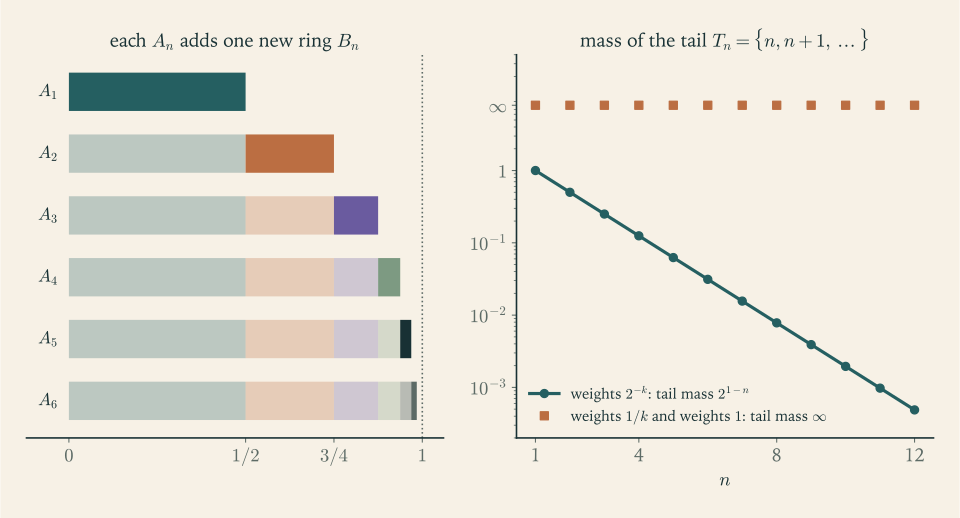
Example 1.3: Tails that carry infinite mass
On \(\mathbb N\) consider the tails \(T_n=\{n,n+1,n+2,\dots\}\) . They decrease, and \(\bigcap_n T_n=\emptyset\) because no natural number exceeds every \(n\) . Compare three measures of the form \(\mu_w\) .
With weights \(w(k)=2^{-k}\) the tail mass is a geometric series, \(\mu_w(T_n)=\sum_{k\ge n}2^{-k}=2^{1-n}\) , which tends to \(0=\mu_w(\emptyset)\) . Here \(\mu_w(T_1)=1\) is finite and Theorem 1.10(b) applies.
With weights \(w(k)=1\) , counting measure, \(\#(T_n)=\infty\) for every \(n\) . The limit of the measures is \(\infty\) and the measure of the limit is \(0\) .
With weights \(w(k)=1/k\) the individual weights tend to zero, and still \(\mu_w(T_n)=\sum_{k\ge n}1/k=\infty\) for every \(n\) , because the harmonic series diverges. Again continuity from above fails.
The second and third cases do not contradict the theorem; they show that the hypothesis \(\mu(A_1)<\infty\) cannot be dropped. In the proof, it is the subtraction \(\mu(A_1)-\mu(A_n)\) that breaks. The same thing happens on the line with the sets \([n,\infty)\) , each of infinite length, whose intersection is empty. The right panel of Figure 1.1 plots the three tail masses.
Continuity from below is not merely a consequence of countable additivity. It is equivalent to it.
Proposition 1.11 (continuity implies countable additivity). Let \(\mathcal A\) be a \(\sigma\) -algebra and let \(\mu:\mathcal A\to[0,\infty]\) satisfy \(\mu(\emptyset)=0\) and \(\mu(A\cup B)=\mu(A)+\mu(B)\) for disjoint \(A,B\in\mathcal A\) . If \(\mu(A_n)\to\mu(A)\) whenever \(A_n\uparrow A\) in \(\mathcal A\) , then \(\mu\) is a measure.
Proof. Let \(E_1,E_2,\dots\in\mathcal A\) be pairwise disjoint and put \(S_n=E_1\cup\dots\cup E_n\) . By finite additivity and induction, \(\mu(S_n)=\sum_{k\le n}\mu(E_k)\) . Since \(S_n\uparrow\bigcup_k E_k\) , the hypothesis gives \(\mu(\bigcup_kE_k)=\lim_n\mu(S_n)=\sum_{k=1}^\infty\mu(E_k)\) .
Example 1.4: Additive for finitely many sets but not for countably many
Let \(\mathcal A_0\) be the algebra of subsets of \(\mathbb N\) that are finite or cofinite, and define \(\mu_0(A)=0\) if \(A\) is finite and \(\mu_0(A)=1\) if \(A\) is cofinite. The definition is unambiguous because no subset of \(\mathbb N\) is both.
Finite additivity. Let \(A,B\in\mathcal A_0\) be disjoint. They cannot both be cofinite, since two cofinite sets share all but finitely many points. If both are finite, so is \(A\cup B\) , and the equation reads \(0=0+0\) . If \(A\) is cofinite and \(B\) finite, then \(A\cup B\) is cofinite and the equation reads \(1=1+0\) .
Failure of countable additivity. The singletons \(\{n\}\) are pairwise disjoint members of \(\mathcal A_0\) whose union \(\mathbb N\) also belongs to \(\mathcal A_0\) , and
Equivalently, the finite sets \(\{1,\dots,n\}\) increase to \(\mathbb N\) while their \(\mu_0\) -values stay at \(0\) : continuity from below fails. The function \(\mu_0\) behaves like a measure in every finite computation and places all of its mass “at infinity”, where no finite set can find it. Countable additivity is precisely the axiom that forbids mass from hiding there.
One consequence of continuity will be used repeatedly in Chapters 3 and 8.
Proposition 1.12 (sets with summable measures). Let \(A_1,A_2,\dots\) be measurable sets with \(\sum_n\mu(A_n)<\infty\) . Then \(\mu(\limsup_n A_n)=0\) : outside a set of measure zero, every point belongs to only finitely many \(A_n\) .
Proof. For each \(n\) , \(\limsup_k A_k\subseteq\bigcup_{k\ge n}A_k\) , so by monotonicity and countable subadditivity
The right side is the tail of a convergent series and tends to \(0\) as \(n\to\infty\) . The left side does not depend on \(n\) , so it is \(0\) .
Probabilists know this statement, together with a converse for independent events, under the name of Borel and Cantelli; the converse and its uses belong to Measure-Theoretic Probability (math.measure-theoretic-probability.borel-cantelli-lemmas).
1.5 Null sets and completion
Definition 1.13 (null sets, almost everywhere, completeness). A null set of a measure space \((X,\mathcal A,\mu)\) is a set \(N\in\mathcal A\) with \(\mu(N)=0\) . A property of points of \(X\) holds almost everywhere, abbreviated a.e., if the set of points where it fails is contained in a null set. The measure space is complete if every subset of a null set belongs to \(\mathcal A\) .
By countable subadditivity a countable union of null sets is null. An uncountable union need not be: once Lebesgue measure is available, each point of \([0,1]\) will be a null set while \([0,1]\) is not. The phrase “almost everywhere” is always relative to a measure, and when more than one measure is in play the measure is named, as in “\(\mu\) -a.e.”.
In Example 1.2 the null set \(\{4,5,6\}\) has non-measurable subsets. This is an inconvenience, not a paradox, and it can always be removed.
Theorem 1.14 (completion). Let \((X,\mathcal A,\mu)\) be a measure space and let \(\mathcal N\) be its family of null sets. Define
Then \(\overline{\mathcal A}\) is a \(\sigma\) -algebra, the formula \(\overline\mu(A\cup F)=\mu(A)\) defines a complete measure on \(\overline{\mathcal A}\) that agrees with \(\mu\) on \(\mathcal A\) , and \(\overline\mu\) is the only measure on \(\overline{\mathcal A}\) that agrees with \(\mu\) on \(\mathcal A\) .
Proof. The family is a \(\sigma\) -algebra. It contains \(X\) . If \(A_n\cup F_n\in\overline{\mathcal A}\) with \(F_n\subseteq N_n\in\mathcal N\) , then \(\bigcup_n(A_n\cup F_n)=\bigl(\bigcup_nA_n\bigr)\cup\bigl(\bigcup_nF_n\bigr)\) and \(\bigcup_nF_n\subseteq\bigcup_nN_n\) , which is null. For complements, let \(F\subseteq N\in\mathcal N\) . A point outside \(A\cup F\) either lies outside \(N\) , and then it is outside \(A\cup N\) , or lies in \(N\) . Hence
where the first set is in \(\mathcal A\) and the second is a subset of \(N\) .
The formula is well defined. Suppose \(A_1\cup F_1=A_2\cup F_2\) with \(F_i\subseteq N_i\in\mathcal N\) . Then \(A_1\subseteq A_2\cup N_2\) , so \(\mu(A_1)\le\mu(A_2)+\mu(N_2)=\mu(A_2)\) , and by symmetry \(\mu(A_2)\le\mu(A_1)\) .
It is a measure. If the sets \(A_n\cup F_n\) are pairwise disjoint then so are the \(A_n\) , and \(\overline\mu\bigl(\bigcup_n(A_n\cup F_n)\bigr)=\mu\bigl(\bigcup_nA_n\bigr)=\sum_n\mu(A_n)=\sum_n\overline\mu(A_n\cup F_n)\) . Taking \(F=\emptyset\) shows \(\overline\mu=\mu\) on \(\mathcal A\) .
It is complete. If \(E\subseteq A\cup F\) and \(\overline\mu(A\cup F)=0\) , where \(F\subseteq N\in\mathcal N\) , then \(\mu(A)=0\) , so \(A\cup N\in\mathcal N\) and \(E=\emptyset\cup E\) with \(E\subseteq A\cup N\) . Thus \(E\in\overline{\mathcal A}\) .
It is unique. If \(\rho\) is a measure on \(\overline{\mathcal A}\) extending \(\mu\) and \(F\subseteq N\in\mathcal N\) , then \(\mu(A)\le\rho(A\cup F)\le\mu(A)+\mu(N)=\mu(A)\) .
The measure space \((X,\overline{\mathcal A},\overline\mu)\) is the completion of \((X,\mathcal A,\mu)\) . In Example 1.2 the completion makes every subset of \(\{4,5,6\}\) measurable with measure zero, and \(\overline{\mathcal A}\) is the whole power set of \(X\) .
1.6 When two measures agree
A measure on \(\mathcal B(\mathbb R)\) should be determined by the masses it gives to intervals. That is true, but not for the reason one might first guess. Agreement on a generating family is not enough.
Example 1.5: Two measures that agree on a generating family
Let \(X=\{1,2,3,4\}\) and \(\mathcal E=\{\{1,2\},\{2,3\}\}\) . The atoms of \(\sigma(\mathcal E)\) are \(\{1\}\) , \(\{2\}\) , \(\{3\}\) , \(\{4\}\) , so \(\sigma(\mathcal E)=\mathcal P(X)\) . Define two measures by their point masses:
Both have total mass \(1\) . On the generators, \(\mu(\{1,2\})=\tfrac12=\nu(\{1,2\})\) and \(\mu(\{2,3\})=\tfrac12=\nu(\{2,3\})\) . Yet \(\mu(\{2\})=\tfrac14\) while \(\nu(\{2\})=0\) . The set where they disagree is \(\{2\}=\{1,2\}\cap\{2,3\}\) , the intersection of the two generators, and that is the clue: \(\mathcal E\) is not closed under intersection. Of the \(16\) subsets of \(X\) , the two measures agree on exactly \(6\) , namely \(\emptyset\) , \(\{1,2\}\) , \(\{2,3\}\) , \(\{1,4\}\) , \(\{3,4\}\) , and \(X\) .
Definition 1.15 (pi-systems and lambda-systems). A family \(\mathcal P\) of subsets of \(X\) is a \(\pi\) -system if \(A\cap B\in\mathcal P\) whenever \(A,B\in\mathcal P\) . A family \(\mathcal D\) of subsets of \(X\) is a \(\lambda\) -system if
The intervals \((a,b]\) , together with the empty set, form a \(\pi\) -system; so do the rays \((-\infty,a]\) . The three conditions defining a \(\lambda\) -system are exactly the operations under which “two finite measures agree on this set” is preserved, as the proof of Theorem 1.17 will show. The letter \(\lambda\) in this name is traditional and has nothing to do with Lebesgue measure.
Theorem 1.16 (Dynkin’s pi–lambda theorem). If \(\mathcal P\) is a \(\pi\) -system, \(\mathcal D\) is a \(\lambda\) -system, and \(\mathcal P\subseteq\mathcal D\) , then \(\sigma(\mathcal P)\subseteq\mathcal D\) .
Proof. An intersection of \(\lambda\) -systems is a \(\lambda\) -system, so there is a smallest \(\lambda\) -system \(\mathcal D_0\) containing \(\mathcal P\) , and \(\mathcal D_0\subseteq\mathcal D\) . We show that \(\mathcal D_0\) is a \(\sigma\) -algebra; then \(\sigma(\mathcal P)\subseteq\mathcal D_0\subseteq\mathcal D\) .
A \(\lambda\) -system closed under finite intersections is a \(\sigma\) -algebra. It contains \(X\) and, taking \(B=X\) in the second condition, complements. It contains \(A\cup B=(A^c\cap B^c)^c\) , hence all finite unions, and a countable union \(\bigcup_nA_n\) is the increasing union of the finite unions \(A_1\cup\dots\cup A_n\) , which the third condition admits.
\(\mathcal D_0\) is closed under finite intersections. For a set \(A\) write \(\mathcal D_A=\{B\in\mathcal D_0: A\cap B\in\mathcal D_0\}\) . If \(A\in\mathcal D_0\) , then \(\mathcal D_A\) is a \(\lambda\) -system: it contains \(X\) because \(A\cap X=A\) ; if \(B\subseteq C\) are in \(\mathcal D_A\) then \(A\cap(C\setminus B)=(A\cap C)\setminus(A\cap B)\) is a difference of nested members of \(\mathcal D_0\) ; and if \(B_n\uparrow B\) with \(B_n\in\mathcal D_A\) then \(A\cap B_n\uparrow A\cap B\) .
First let \(A\in\mathcal P\) . Then \(\mathcal P\subseteq\mathcal D_A\) because \(\mathcal P\) is a \(\pi\) -system. So \(\mathcal D_A\) is a \(\lambda\) -system containing \(\mathcal P\) and contained in \(\mathcal D_0\) , and by minimality \(\mathcal D_A=\mathcal D_0\) . In words: \(A\cap B\in\mathcal D_0\) for every \(A\in\mathcal P\) and every \(B\in\mathcal D_0\) .
Now let \(B\in\mathcal D_0\) . The last sentence says \(\mathcal P\subseteq\mathcal D_B\) . Again \(\mathcal D_B\) is a \(\lambda\) -system containing \(\mathcal P\) , so \(\mathcal D_B=\mathcal D_0\) : for every \(A,B\in\mathcal D_0\) we have \(A\cap B\in\mathcal D_0\) .
Theorem 1.17 (uniqueness of measures). Let \(\mu\) and \(\nu\) be measures on \((X,\mathcal A)\) , where \(\mathcal A=\sigma(\mathcal P)\) for a \(\pi\) -system \(\mathcal P\) , and suppose \(\mu(A)=\nu(A)\) for all \(A\in\mathcal P\) .
(a) If \(\mu(X)=\nu(X)<\infty\) , then \(\mu=\nu\) on \(\mathcal A\) .
(b) If there are sets \(E_n\in\mathcal P\) with \(E_n\uparrow X\) and \(\mu(E_n)<\infty\) for every \(n\) , then \(\mu=\nu\) on \(\mathcal A\) .
Proof. (a) Let \(\mathcal D=\{A\in\mathcal A:\mu(A)=\nu(A)\}\) . It contains \(X\) by hypothesis. If \(A\subseteq B\) are in \(\mathcal D\) , then \(\mu(B\setminus A)=\mu(B)-\mu(A)=\nu(B)-\nu(A)=\nu(B\setminus A)\) , the subtraction being legitimate because the measures are finite. If \(A_n\in\mathcal D\) and \(A_n\uparrow A\) , then \(\mu(A)=\lim\mu(A_n)=\lim\nu(A_n)=\nu(A)\) by continuity from below. So \(\mathcal D\) is a \(\lambda\) -system containing \(\mathcal P\) , and Theorem 1.16 gives \(\mathcal A=\sigma(\mathcal P)\subseteq\mathcal D\) .
(b) Fix \(n\) and define \(\mu_n(A)=\mu(A\cap E_n)\) and \(\nu_n(A)=\nu(A\cap E_n)\) . These are finite measures on \(\mathcal A\) . They agree on \(\mathcal P\) , because \(A\cap E_n\in\mathcal P\) for \(A\in\mathcal P\) , and \(\mu_n(X)=\mu(E_n)=\nu(E_n)=\nu_n(X)\) . By (a), \(\mu(A\cap E_n)=\nu(A\cap E_n)\) for all \(A\in\mathcal A\) . Since \(A\cap E_n\uparrow A\) , continuity from below gives \(\mu(A)=\nu(A)\) .
In Example 1.5 the generators did not form a \(\pi\) -system, and the conclusion failed. Add the intersection \(\{2\}\) to the family and Theorem 1.17(a) applies: two measures of equal total mass that agree on \(\{1,2\}\) , \(\{2,3\}\) , and \(\{2\}\) agree on all of \(\mathcal P(X)\) . The finiteness condition in (b) cannot be dropped either. Counting measure on \(\mathbb Q\) and twice counting measure both give every nonempty open interval of rationals the value \(\infty\) , and these intervals form a \(\pi\) -system generating all subsets of \(\mathbb Q\) ; yet the two measures differ on every singleton.
The chapter leaves one question open, and it is the important one. Everything so far concerns measures that are assumed to exist. Weighted sums over countable sets are easy to write down, but they cannot produce length, since every point of the line must have length zero. How does one build a measure on the Borel sets of \(\mathbb R\) that gives each interval its length?
Exercises
-
List every \(\sigma\) -algebra on the set \(X=\{1,2,3\}\) , state how many there are, and explain why each one is the family of unions of blocks of a partition of \(X\) .
Answer
There are five: \(\{\emptyset,X\}\) ; \(\{\emptyset,\{1\},\{2,3\},X\}\) ; \(\{\emptyset,\{2\},\{1,3\},X\}\) ; \(\{\emptyset,\{3\},\{1,2\},X\}\) ; and \(\mathcal P(X)\) with \(8\) members. They correspond to the five partitions of a three-point set. In a finite \(\sigma\) -algebra the atom of a point \(x\) is the intersection of all members containing \(x\) ; the atoms partition \(X\) , and every member is the union of the atoms of its points.
-
Let \(\mathcal A\) be a \(\sigma\) -algebra on \(X\) . (a) For \(Y\subseteq X\) , prove that \(\{A\cap Y:A\in\mathcal A\}\) is a \(\sigma\) -algebra on \(Y\) . (b) For a map \(f:Z\to X\) , prove that \(\{f^{-1}(A):A\in\mathcal A\}\) is a \(\sigma\) -algebra on \(Z\) .
Solution
(a) Write \(\mathcal A_Y=\{A\cap Y:A\in\mathcal A\}\) . It contains \(Y=X\cap Y\) . The complement of \(A\cap Y\) inside \(Y\) is \(Y\setminus(A\cap Y)=A^c\cap Y\) , which is in \(\mathcal A_Y\) because \(A^c\in\mathcal A\) . For a sequence, \(\bigcup_n(A_n\cap Y)=\bigl(\bigcup_nA_n\bigr)\cap Y\) and \(\bigcup_nA_n\in\mathcal A\) . So all three defining conditions hold on the set \(Y\) .
(b) Write \(\mathcal A_f=\{f^{-1}(A):A\in\mathcal A\}\) . Preimages commute with every set operation: \(f^{-1}(X)=Z\) , \(f^{-1}(A^c)=Z\setminus f^{-1}(A)\) , and \(f^{-1}\bigl(\bigcup_nA_n\bigr)=\bigcup_nf^{-1}(A_n)\) . Each identity is checked by chasing a point: for instance \(z\in f^{-1}(A^c)\) means \(f(z)\notin A\) , which means \(z\notin f^{-1}(A)\) . Hence \(Z\in\mathcal A_f\) , complements of members are members, and countable unions of members are members. Part (a) is the special case in which \(f\) is the inclusion map of \(Y\) into \(X\) .
-
On \(X=\{1,2,3,4,5\}\) find the atoms of the \(\sigma\) -algebra generated by \(\{1,2,3\}\) and \(\{3,4\}\) , and count its members without listing them.
Answer
The atoms are \(\{1,2\}\) , \(\{3\}\) , \(\{4\}\) , \(\{5\}\) : the points \(1\) and \(2\) are never separated, \(\{3\}\) is the intersection of the generators, \(\{4\}=\{3,4\}\setminus\{1,2,3\}\) , and \(\{5\}\) is the complement of their union. With four atoms the \(\sigma\) -algebra has \(2^4=16\) members.
-
Prove that an infinite \(\sigma\) -algebra is uncountable, by first showing that it contains an infinite sequence of pairwise disjoint nonempty sets.
Hint
Let \(\mathcal A\) be an infinite \(\sigma\) -algebra and pick \(A\in\mathcal A\) other than \(\emptyset\) and \(X\) . A member \(B\) is determined by the pair \((B\cap A,\ B\cap A^c)\) , so one of the two trace \(\sigma\) -algebras of Exercise 1.2(a), on \(A\) or on \(A^c\) , is infinite. Keep the other piece as \(E_1\) and repeat inside the infinite one. This produces pairwise disjoint nonempty sets \(E_1,E_2,\dots\) in \(\mathcal A\) . The unions \(\bigcup_{n\in S}E_n\) for \(S\subseteq\mathbb N\) are distinct members of \(\mathcal A\) , and there are uncountably many subsets \(S\) .
-
Let \(X\) be uncountable and let \(\mathcal C\) be the family of subsets that are countable or have countable complement. Prove that \(\mathcal C\) is a \(\sigma\) -algebra and that \(\mu(A)=0\) for countable \(A\) , \(\mu(A)=1\) for co-countable \(A\) , defines a measure on \(\mathcal C\) .
Solution
\(\mathcal C\) is a \(\sigma\) -algebra. The complement of \(X\) is empty, hence countable, so \(X\in\mathcal C\) . The definition is symmetric in \(A\) and \(A^c\) , so \(\mathcal C\) is closed under complements. Let \(A_1,A_2,\dots\in\mathcal C\) . If every \(A_n\) is countable, the union is a countable union of countable sets and is countable. Otherwise some \(A_m\) has countable complement, and \(\bigl(\bigcup_nA_n\bigr)^c\subseteq A_m^c\) is countable. Either way the union is in \(\mathcal C\) .
\(\mu\) is well defined. No set is both countable and co-countable, for then \(X=A\cup A^c\) would be countable.
\(\mu\) is countably additive. Let \(A_1,A_2,\dots\in\mathcal C\) be pairwise disjoint. If all are countable, so is the union, and both sides of the additivity equation are \(0\) . Suppose \(A_m\) is co-countable. Every other \(A_n\) is disjoint from \(A_m\) , so \(A_n\subseteq A_m^c\) is countable. Thus exactly one set in the sequence is co-countable, the union is co-countable, and the equation reads \(1=1+0+0+\cdots\) . Finally \(\mu(\emptyset)=0\) because the empty set is countable.
-
Prove that the closed intervals \([a,b]\) with rational endpoints generate \(\mathcal B(\mathbb R)\) , and deduce that every countable subset of \(\mathbb R\) is a Borel set.
Hint
By Proposition 1.7 it is enough to build each open interval with rational endpoints from closed ones: \((a,b)=\bigcup_n[a+\tfrac1n,b-\tfrac1n]\) . Conversely each closed interval is a closed set, hence Borel. A singleton \(\{x\}\) is the intersection of the intervals \([p,q]\) with rational \(p\le x\le q\) , and a countable set is a countable union of singletons.
-
For the intervals \(A_n=[0,1+(-1)^n/n]\) in \(\mathbb R\) , compute \(\liminf_nA_n\) and \(\limsup_nA_n\) , and say for which points \(x\) the sequence \(\mathbf 1_{A_n}(x)\) fails to converge.
Answer
\(\liminf_nA_n=[0,1)\) and \(\limsup_nA_n=[0,1]\) . A point \(x<1\) lies in \(A_n\) for all large \(n\) ; a point \(x>1\) lies in only finitely many; the point \(x=1\) lies in \(A_n\) for every even \(n\) and no odd \(n\) . The indicators fail to converge only at \(x=1\) , where they alternate between \(0\) and \(1\) .
-
Let \(A_1,A_2,\dots\) be measurable sets in a measure space. (a) Prove \(\mu(\liminf_nA_n)\le\liminf_n\mu(A_n)\) . (b) Prove \(\limsup_n\mu(A_n)\le\mu(\limsup_nA_n)\) when \(\mu(\bigcup_nA_n)<\infty\) . (c) Show by example that (b) can fail without the finiteness assumption.
Solution
(a) Put \(B_n=\bigcap_{k\ge n}A_k\) . Then \(B_n\uparrow\liminf_nA_n\) by Definition 1.3. For every \(k\ge n\) we have \(B_n\subseteq A_k\) , so \(\mu(B_n)\le\mu(A_k)\) , and therefore \(\mu(B_n)\le\inf_{k\ge n}\mu(A_k)\) . Continuity from below gives
\[ \mu\bigl(\liminf_nA_n\bigr)=\lim_n\mu(B_n)\le\lim_n\inf_{k\ge n}\mu(A_k)=\liminf_n\mu(A_n). \](b) Put \(C_n=\bigcup_{k\ge n}A_k\) . Then \(C_n\downarrow\limsup_nA_n\) and \(\mu(C_1)<\infty\) by hypothesis, so continuity from above applies. Since \(A_k\subseteq C_n\) for \(k\ge n\) , \(\mu(C_n)\ge\sup_{k\ge n}\mu(A_k)\) , and
\[ \mu\bigl(\limsup_nA_n\bigr)=\lim_n\mu(C_n)\ge\lim_n\sup_{k\ge n}\mu(A_k)=\limsup_n\mu(A_n). \](c) On \(\mathbb N\) with counting measure let \(A_n=\{n\}\) . Each point lies in exactly one \(A_n\) , so \(\limsup_nA_n=\emptyset\) has measure \(0\) , while \(\mu(A_n)=1\) for every \(n\) . Here \(\bigcup_nA_n=\mathbb N\) has infinite measure, and the inequality in (b) would read \(1\le 0\) .
-
Prove that \(\mu(A\cup B\cup C)=\mu(A)+\mu(B)+\mu(C)-\mu(A\cap B)-\mu(A\cap C)-\mu(B\cap C)+\mu(A\cap B\cap C)\) for sets of finite measure, and use it to count the integers from \(1\) to \(60\) divisible by at least one of \(2\) , \(3\) , \(5\) .
Solution
Apply Proposition 1.9(b) to the two sets \(A\cup B\) and \(C\) . All measures are finite, so terms may be moved across the equation:
\[ \mu(A\cup B\cup C)=\mu(A\cup B)+\mu(C)-\mu\bigl((A\cup B)\cap C\bigr). \]Now \((A\cup B)\cap C=(A\cap C)\cup(B\cap C)\) , and the intersection of these two sets is \(A\cap B\cap C\) . Two more applications of Proposition 1.9(b) give \(\mu(A\cup B)=\mu(A)+\mu(B)-\mu(A\cap B)\) and \(\mu\bigl((A\cap C)\cup(B\cap C)\bigr)=\mu(A\cap C)+\mu(B\cap C)-\mu(A\cap B\cap C)\) . Substituting both yields the stated formula.
For the count, use counting measure on \(\{1,\dots,60\}\) with \(A\) , \(B\) , \(C\) the multiples of \(2\) , \(3\) , \(5\) . The intersections are the multiples of \(6\) , \(10\) , \(15\) , and \(30\) . Hence the number of integers divisible by at least one of the three is \(30+20+12-10-6-4+2=44\) .
-
A student argues: “The intervals \((0,1/n)\) decrease to the empty set, so \(\mu((0,1/n))\to 0\) for every measure \(\mu\) on the Borel sets of \((0,1)\) .” Exhibit a measure for which the conclusion is false and identify the hypothesis that was not checked.
Solution
Let \(\mu(A)\) be the number of integers \(k\ge 2\) with \(1/k\in A\) , for Borel sets \(A\subseteq(0,1)\) . This is the weighted-sum measure carried by the countable set \(\{1/2,1/3,1/4,\dots\}\) , so it is countably additive. The interval \((0,1/n)\) contains \(1/k\) for every \(k>n\) , so \(\mu((0,1/n))=\infty\) for every \(n\) , although the intervals decrease to the empty set, which has measure \(0\) .
The student applied continuity from above, Theorem 1.10(b), without checking that some set in the sequence has finite measure. For Lebesgue measure the check succeeds, since the first interval has length \(1\) ; for this \(\mu\) every interval in the sequence has infinite measure and the theorem says nothing. The decreasing half of continuity of measure is the half with a hypothesis.
-
Let \(\mu\) be a finitely additive function with values in \([0,\infty)\) on a \(\sigma\) -algebra \(\mathcal A\) , with \(\mu(\emptyset)=0\) . Prove that \(\mu\) is countably additive if and only if \(\mu(A_n)\to 0\) whenever \(A_n\downarrow\emptyset\) in \(\mathcal A\) .
Solution
Suppose \(\mu\) is countably additive. Then it is a finite measure, and if \(A_n\downarrow\emptyset\) , continuity from above (Theorem 1.10(b), applicable since \(\mu(A_1)<\infty\) ) gives \(\mu(A_n)\to\mu(\emptyset)=0\) .
Conversely, suppose \(\mu(A_n)\to0\) whenever \(A_n\downarrow\emptyset\) . Let \(E_1,E_2,\dots\in\mathcal A\) be pairwise disjoint with union \(E\) , and put \(R_n=E\setminus(E_1\cup\dots\cup E_n)\) . The sets \(R_n\) are in \(\mathcal A\) , they decrease, and their intersection is empty because every point of \(E\) lies in some \(E_k\) . Finite additivity applied to the disjoint sets \(E_1,\dots,E_n,R_n\) gives
\[ \mu(E)=\sum_{k=1}^n\mu(E_k)+\mu(R_n). \]All terms are finite. Letting \(n\to\infty\) and using \(\mu(R_n)\to0\) gives \(\mu(E)=\sum_{k=1}^\infty\mu(E_k)\) . Finiteness was used twice: to make the forward direction available, and implicitly to keep the remainder \(\mu(R_n)\) a real number that can tend to zero.
-
On \(\mathbb N\) let \(\mu\) be the measure with weights \(w(k)=1/(k(k+1))\) . Compute \(\mu(\mathbb N)\) , the tail masses \(\mu(\{n,n+1,\dots\})\) , and the mass of the set of even numbers in closed form.
Solution
Since \(w(k)=\frac1k-\frac1{k+1}\) , the tail sums telescope:
\[ \mu(\{n,n+1,\dots\})=\sum_{k\ge n}\Bigl(\frac1k-\frac1{k+1}\Bigr)=\lim_{N\to\infty}\Bigl(\frac1n-\frac1{N+1}\Bigr)=\frac1n . \]In particular \(\mu(\mathbb N)=1\) , the case \(n=1\) . The tails decrease to the empty set and their masses \(1/n\) tend to \(0\) , as continuity from above requires for a finite measure.
For the even numbers,
\[ \mu(\{2,4,6,\dots\})=\sum_{j\ge1}\frac1{2j(2j+1)}=\sum_{j\ge1}\Bigl(\frac1{2j}-\frac1{2j+1}\Bigr)=\frac12-\frac13+\frac14-\frac15+\cdots . \]The alternating harmonic series \(1-\frac12+\frac13-\frac14+\cdots\) equals \(\ln 2\) , so the series above equals \(1-\ln 2\approx 0.3069\) . The odd numbers therefore have mass \(\ln 2\approx 0.6931\) , more than half, because the weight \(w(1)=\tfrac12\) alone is half the total.
-
Let \(X=\{1,2,3\}\) , \(\mathcal A=\{\emptyset,\{1\},\{2,3\},X\}\) , and let \(\mu\) be the measure with \(\mu(\{1\})=1\) and \(\mu(\{2,3\})=0\) . Describe the completion \((\overline{\mathcal A},\overline\mu)\) explicitly.
Answer
The only null sets are \(\emptyset\) and \(\{2,3\}\) , so the sets added are \(A\cup F\) with \(F\subseteq\{2,3\}\) . Every subset of \(X\) arises: \(\overline{\mathcal A}=\mathcal P(X)\) , and \(\overline\mu(E)=1\) if \(1\in E\) and \(0\) otherwise. The completion is the point mass \(\delta_1\) on the power set.
-
Let \(\mu\) be \(\sigma\) -finite. Prove that \(X\) is a countable union of pairwise disjoint sets of finite measure, and that any family of pairwise disjoint measurable sets of positive measure is countable.
Hint
For the first claim disjointify a sequence of finite-measure sets covering \(X\) , as in the proof of Proposition 1.9(c). For the second, let \(X=\bigcup_nX_n\) with \(\mu(X_n)<\infty\) and let \(\mathcal F\) be the family. For fixed \(n\) and \(m\) , at most \(m\,\mu(X_n)\) members \(E\) of \(\mathcal F\) can satisfy \(\mu(E\cap X_n)>1/m\) , by finite additivity. Every member of \(\mathcal F\) satisfies this for some pair \((n,m)\) , by continuity from below.
-
On \(X=\{1,2,3,4\}\) let \(\mathcal D\) be the family of subsets with an even number of elements. (a) Verify that \(\mathcal D\) is a \(\lambda\) -system but neither a \(\pi\) -system nor a \(\sigma\) -algebra. (b) Prove that two finite measures on \(\mathcal P(X)\) that agree on \(\mathcal D\) are nevertheless equal, and explain why this does not contradict Example 1.5.
Solution
(a) The whole set has \(4\) elements, so \(X\in\mathcal D\) . If \(A\subseteq B\) both have an even number of elements, then \(B\setminus A\) has \(\lvert B\rvert-\lvert A\rvert\) elements, an even number. An increasing sequence of subsets of a finite set is eventually constant, so its union is one of its terms and lies in \(\mathcal D\) . Hence \(\mathcal D\) is a \(\lambda\) -system. It is not a \(\pi\) -system, because \(\{1,2\}\cap\{2,3\}=\{2\}\) has one element, and so it is not a \(\sigma\) -algebra either.
(b) Let \(\mu\) and \(\nu\) be finite measures on \(\mathcal P(X)\) agreeing on \(\mathcal D\) , and let \(d_i=\mu(\{i\})-\nu(\{i\})\) . Agreement on the two-point sets says \(d_i+d_j=0\) for all \(i\ne j\) . Then
\[ 2d_1=(d_1+d_2)+(d_1+d_3)-(d_2+d_3)=0, \]and by symmetry every \(d_i\) vanishes: \(d_1=d_2=d_3=d_4=0\) . So the point masses agree and \(\mu=\nu\) .
There is no contradiction with Example 1.5. Theorem 1.17 says that agreement on a generating \(\pi\) -system is sufficient for equality; it does not say that agreement on a family that is not a \(\pi\) -system must fail to force equality. The family in Example 1.5 contains only two of the six two-point sets, too few equations to pin down four point masses, whereas \(\mathcal D\) contains all six.
-
Prove that a finite measure \(\mu\) on \(\mathcal B(\mathbb R)\) is determined by the function \(F(x)=\mu((-\infty,x])\) , and explain which \(\pi\) -system and which part of Theorem 1.17 you used.
Hint
The rays \((-\infty,x]\) form a \(\pi\) -system, since the intersection of two rays is the shorter one, and they generate \(\mathcal B(\mathbb R)\) by Proposition 1.7. If two finite measures have the same \(F\) , they agree on the rays, and their total masses agree because \(F(n)\to\mu(\mathbb R)\) by continuity from below. Now apply Theorem 1.17(a).
-
Show that every measure on \((\mathbb N,\mathcal P(\mathbb N))\) has the form \(\mu_w\) for a unique weight function \(w:\mathbb N\to[0,\infty]\) , and point out the step of your proof that fails for the finitely additive set function \(\mu_0\) of Example 1.4.
Answer
Put \(w(k)=\mu(\{k\})\) . Any \(A\subseteq\mathbb N\) is the countable disjoint union of its singletons, so countable additivity gives \(\mu(A)=\sum_{k\in A}w(k)\) ; uniqueness holds because \(w(k)\) must be \(\mu(\{k\})\) . For \(\mu_0\) the step “\(\mu(A)\) is the sum over the singletons of \(A\) ” is exactly the countable additivity that \(\mu_0\) lacks: all its singleton weights are \(0\) and yet \(\mu_0(\mathbb N)=1\) .
-
Let \(A_1,A_2,\dots\) be measurable with \(\mu(A_n)\le 2^{-n}\) . (a) Show that almost every point lies in only finitely many \(A_n\) . (b) Give sets \(A_n\subseteq\mathbb N\) with \(\#(A_n)=1\) for all \(n\) and \(\limsup_nA_n=\mathbb N\) , so that the conclusion of Proposition 1.12 can fail when the sum of the measures diverges.
Hint
(a) The measures are summable, so Proposition 1.12 applies directly. (b) List the natural numbers so that each one recurs infinitely often, for example \(1;\ 1,2;\ 1,2,3;\ 1,2,3,4;\dots\) , and let \(A_n\) be the singleton of the \(n\) -th entry of the list.