In 1807 Joseph Fourier submitted a memoir on the conduction of heat in which he asserted that an arbitrary initial temperature on a rod, even one with jumps, could be written as an infinite sum of sines, and that the heat equation could then be solved one sine at a time. The referees, Lagrange among them, did not believe it. A sum of smooth, odd, periodic functions representing a function that is none of those things seemed absurd. Fourier was right, in a sense that took the rest of the century to make precise, and the attempt to make it precise created a good part of modern analysis.
The idea begins from the standing wave of Example 6.3 and the decaying mode of Example 1.1. Both are products of a function of \(x\) and a function of \(t\) . This chapter finds all such product solutions for the model equations on an interval, shows that the admissible spatial shapes form an orthogonal family, proves in what senses a general function is the sum of its components along that family, and then solves initial-boundary value problems for the heat, wave, and Laplace equations by superposition.
7.1 Product solutions and an eigenvalue problem
Consider the heat equation \(u_t=ku_{xx}\) on \(0<x<L\) with both ends held at zero. Look for a solution of the form \(u(x,t)=X(x)T(t)\) that is not identically zero. Substituting and dividing by \(kXT\) ,
The left side depends only on \(t\) and the right side only on \(x\) , so both equal a constant, which we call \(-\lambda\) . The time factor satisfies \(T'=-k\lambda T\) , so \(T=e^{-k\lambda t}\) . The space factor must satisfy
with \(X\) not identically zero. This is an eigenvalue problem: the differential operator \(-d^2/dx^2\) with the boundary conditions plays the part of a matrix, \(\lambda\) of an eigenvalue, and \(X\) of an eigenvector.
Lemma 7.1 (Dirichlet eigenvalues of an interval). The eigenvalue problem above has nonzero solutions exactly for
and for each \(\lambda_n\) the solutions are the multiples of \(X_n\) .
Proof. Let \(X\) be a real nonzero solution for some real \(\lambda\) . Multiply the equation by \(X\) and integrate by parts, using the boundary conditions: \(\lambda\int_0^LX^2dx=-\int_0^LX''X\,dx=\int_0^L(X')^2dx\) . The right side is positive, because \(X'=0\) would make \(X\) constant and hence zero. So \(\lambda>0\) . Write \(\lambda=\mu^2\) with \(\mu>0\) . The general solution of \(X''+\mu^2X=0\) is \(A\cos\mu x+B\sin\mu x\) ; the condition \(X(0)=0\) gives \(A=0\) , and then \(X(L)=0\) requires \(\sin\mu L=0\) , that is, \(\mu=n\pi/L\) . A complex eigenvalue is excluded by the same computation applied to \(X\) and its complex conjugate.
So the product solutions are \(e^{-k\lambda_nt}\sin(n\pi x/L)\) , and since the equation and the boundary conditions are linear and homogeneous, any finite sum \(\sum b_ne^{-k\lambda_nt}\sin(n\pi x/L)\) is again a solution with zero boundary values. At \(t=0\) it equals \(\sum b_n\sin(n\pi x/L)\) . Fourier’s programme is to allow infinite sums and to choose the coefficients so that this equals the given initial temperature \(g\) .
Other boundary conditions lead to other families by the same computation:
| Conditions at the two ends | Eigenvalues | Eigenfunctions |
|---|---|---|
| \(X(0)=0\) , \(X(L)=0\) | \((n\pi/L)^2\) , \(n\ge1\) | \(\sin(n\pi x/L)\) |
| \(X'(0)=0\) , \(X'(L)=0\) | \((n\pi/L)^2\) , \(n\ge0\) | \(\cos(n\pi x/L)\) |
| \(X(0)=0\) , \(X'(L)=0\) | \(\bigl((n-\tfrac12)\pi/L\bigr)^2\) , \(n\ge1\) | \(\sin\bigl((n-\tfrac12)\pi x/L\bigr)\) |
| periodic with period \(2L\) | \((n\pi/L)^2\) , \(n\ge0\) | \(\cos(n\pi x/L)\) and \(\sin(n\pi x/L)\) |
In the second row \(\lambda=0\) is an eigenvalue, with the constant eigenfunction: an insulated rod has a steady state that is not zero.
7.2 Orthogonality and the coefficients
Lemma 7.2 (orthogonality). For positive integers \(m,n\) ,
Proof. The second integral follows from \(\sin^2\theta=\tfrac12(1-\cos2\theta)\) . For the first, a computation that works for every family in the table: since \(-X_m''=\lambda_mX_m\) and \(-X_n''=\lambda_nX_n\) ,
the bracket vanishing by the boundary conditions. As \(\lambda_m\ne\lambda_n\) , the integral is zero.
The proof is the one-dimensional case of Green’s second identity, and it is the same argument that shows eigenvectors of a symmetric matrix for different eigenvalues to be orthogonal: the operator \(-d^2/dx^2\) with these boundary conditions is symmetric with respect to the inner product \(\int_0^Lfg\,dx\) .
Orthogonality identifies the coefficients. If \(g=\sum b_n\sin(n\pi x/L)\) and the series may be integrated term by term, multiplying by \(\sin(m\pi x/L)\) and integrating leaves only the term \(n=m\) .
Definition 7.3 (Fourier sine series). For a function \(g\) on \((0,L)\) with \(\int_0^Lg^2dx\) finite, the Fourier sine coefficients and partial sums are
The series \(\sum_{n\ge1}b_n\sin(n\pi x/L)\) is the Fourier sine series of \(g\) .
Whether the series converges, and to what, is a separate question. One fact needs no convergence theory at all.
Theorem 7.4 (best approximation and Bessel’s inequality). Let \(g\) be square-integrable on \((0,L)\) with sine coefficients \(b_n\) . For every \(N\) and all real \(c_1,\dots,c_N\) ,
Consequently the partial sum \(S_Ng\) is the best approximation to \(g\) in mean square among all combinations of the first \(N\) sines, and \(\dfrac L2\displaystyle\sum_{n=1}^{\infty}b_n^2\le\int_0^Lg^2\,dx\) .
Proof. Expand the square. By Lemma 7.2 the square of the sum integrates to \(\tfrac L2\sum c_n^2\) , and the cross term is \(-2\sum c_n\int_0^Lg\sin(n\pi x/L)\,dx=-L\sum c_nb_n\) . So the left side equals \(\int g^2-L\sum c_nb_n+\tfrac L2\sum c_n^2\) , and completing the square in each \(c_n\) gives the identity. The right side is smallest when \(c_n=b_n\) . Since the left side is nonnegative, taking \(c_n=b_n\) gives \(\tfrac L2\sum_{n\le N}b_n^2\le\int g^2\) for every \(N\) .
Bessel’s inequality implies \(b_n\to0\) . The same statements hold, with the same proof, for each orthogonal family in the table and for the full trigonometric system on an interval of length \(2\pi\) , which we use next.
7.3 Three kinds of convergence
The sine series of \(g\) on \((0,L)\) is, after the change of scale \(x\mapsto\pi x/L\) , the full Fourier series of the odd \(2\pi\) -periodic extension of \(g\) . So it suffices to study a \(2\pi\) -periodic function \(f\) with coefficients and partial sums
We call \(f\) piecewise continuous if on each period it is continuous except at finitely many points, where it has finite one-sided limits \(f(x^+)\) and \(f(x^-)\) , and piecewise continuously differentiable, written piecewise \(C^1\) , if in addition \(f'\) exists and is continuous except at finitely many points per period, where it has finite one-sided limits. A piecewise \(C^1\) function has one-sided derivatives at every point, computed from the one-sided limits of \(f\) .
Inserting the definitions of the coefficients into the partial sum and using \(\cos nx\cos ny+\sin nx\sin ny=\cos n(x-y)\) ,
The closed form of the Dirichlet kernel \(D_N\) comes from multiplying the sum by \(\sin(y/2)\) and using \(2\cos ny\,\sin\tfrac y2=\sin(n+\tfrac12)y-\sin(n-\tfrac12)y\) , which telescopes. The kernel is even and \(\tfrac{1}{2\pi}\int_{-\pi}^{\pi}D_N\,dy=1\) . Unlike the Poisson kernel and the heat kernel it is not positive; it oscillates, and its convergence properties are correspondingly delicate.
Lemma 7.5 (Riemann–Lebesgue). If \(F\) is bounded and piecewise continuous on \([-\pi,\pi]\) , then \(\displaystyle\int_{-\pi}^{\pi}F(y)\sin\bigl((N+\tfrac12)y\bigr)\,dy\to0\) as \(N\to\infty\) .
Proof. Write \(\sin(N+\tfrac12)y=\sin Ny\cos\tfrac y2+\cos Ny\sin\tfrac y2\) . The integral is then \(\pi\) times the sum of the \(N\) -th sine coefficient of \(F(y)\cos\tfrac y2\) and the \(N\) -th cosine coefficient of \(F(y)\sin\tfrac y2\) . Both functions are square-integrable, so by Bessel’s inequality their coefficients tend to zero.
Theorem 7.6 (pointwise convergence). Let \(f\) be \(2\pi\) -periodic and piecewise continuous, and let \(x\) be a point at which \(f\) has finite one-sided derivatives. Then
In particular \(S_Nf(x)\to f(x)\) at every point where \(f\) is differentiable.
Proof. Since \(D_N\) is even with \(\tfrac{1}{2\pi}\int_0^{\pi}D_N\,dy=\tfrac12\) ,
In the first integral put \(F(y)=\dfrac{f(x+y)-f(x^+)}{\sin(y/2)}\) for \(0<y\le\pi\) and \(F(y)=0\) for \(-\pi\le y\le0\) . Away from \(y=0\) this is piecewise continuous. Near \(y=0\) it is bounded, because \(\dfrac{f(x+y)-f(x^+)}{y}\) tends to the right-hand derivative and \(\dfrac{y}{\sin(y/2)}\) tends to \(2\) . So Lemma 7.5 applies and the first integral, which is \(\tfrac{1}{2\pi}\int F(y)\sin(N+\tfrac12)y\,dy\) , tends to zero. The second is treated in the same way.
At a jump the series converges to the midpoint of the jump, whatever value \(f\) itself is given there. This already answers Fourier’s critics: the sum of the series is a perfectly good function, but it need not equal the function one started from at every point.
Theorem 7.7 (uniform convergence). Let \(f\) be \(2\pi\) -periodic, continuous, and piecewise \(C^1\) . Then \(\sum(\lvert a_n\rvert+\lvert b_n\rvert)\) converges, and \(S_Nf\to f\) uniformly. In terms of sine series: if \(g\) is continuous and piecewise \(C^1\) on \([0,L]\) with \(g(0)=g(L)=0\) , then \(\sum\lvert b_n\rvert\) converges and \(S_Ng\to g\) uniformly on \([0,L]\) .
Proof. Integrate by parts on each interval where \(f\) is \(C^1\) ; because \(f\) is continuous and periodic the boundary terms cancel, and the coefficients of \(f'\) are \(a_n(f')=nb_n\) and \(b_n(f')=-na_n\) . Bessel’s inequality for the piecewise continuous function \(f'\) gives \(\sum n^2(a_n^2+b_n^2)\le\tfrac1\pi\int_{-\pi}^{\pi}(f')^2dy\) . By the Cauchy–Schwarz inequality,
Each term of the series is bounded by \(\lvert a_n\rvert+\lvert b_n\rvert\)
, so by the Weierstrass test the series converges uniformly, and its sum is a continuous function (math.real-analysis.uniform-limit-continuity). By Theorem 7.6 the sum equals \(f(x)\)
at every \(x\)
. For the sine series apply this to the odd periodic extension of \(g\)
, which is continuous because \(g\)
vanishes at both ends.
Theorem 7.8 (mean-square convergence and Parseval’s identity). For every square-integrable \(g\) on \((0,L)\) ,
Proof. If \(g\) is continuous and piecewise \(C^1\) with \(g(0)=g(L)=0\) , then \(S_Ng\to g\) uniformly by Theorem 7.7, hence in mean square. For a general \(g\) and any \(\varepsilon>0\) choose such a function \(\tilde g\) with \(\int_0^L(g-\tilde g)^2dx<\varepsilon^2\) . For piecewise continuous \(g\) this can be done by hand, replacing \(g\) near its jumps and near the endpoints by steep linear ramps and then by a piecewise linear interpolant; for a general square-integrable function it is the density of continuous functions in \(L^2\) , a result of Measure Theory. By the best approximation property, \(S_Ng\) is at least as close to \(g\) in mean square as \(S_N\tilde g\) is, and by the triangle inequality for the mean-square norm
and the last term tends to zero. Parseval’s identity follows by letting \(N\to\infty\) in the identity of Theorem 7.4 with \(c_n=b_n\) .
Parseval’s identity is Pythagoras’ theorem in infinitely many dimensions: the squared length of \(g\) is the sum of the squared lengths of its components. It says the sines are a complete orthogonal system: no nonzero square-integrable function is orthogonal to all of them.
Corollary 7.9 (sharp Poincaré inequality on an interval). If \(g\) is continuous and piecewise \(C^1\) on \([0,L]\) with \(g(0)=g(L)=0\) , then
with equality exactly when \(g\) is a multiple of \(\sin(\pi x/L)\) .
Proof. Integrating by parts, the cosine coefficients of \(g'\) are \(\tfrac2L\int_0^Lg'\cos\tfrac{n\pi x}{L}\,dx=\tfrac{n\pi}{L}b_n\) . Bessel’s inequality for the cosine family gives \(\tfrac L2\sum(\tfrac{n\pi}{L})^2b_n^2\le\int_0^L(g')^2dx\) . Since \((\tfrac{n\pi}{L})^2\ge(\tfrac{\pi}{L})^2\) for \(n\ge1\) , with equality only for \(n=1\) , Parseval’s identity gives \(\int_0^Lg^2dx=\tfrac L2\sum b_n^2\le\tfrac{L^2}{\pi^2}\cdot\tfrac L2\sum(\tfrac{n\pi}{L})^2b_n^2\) , and the two inequalities combine. Equality forces \(b_n=0\) for \(n\ge2\) .
The constant \(L^2/\pi^2\) is the reciprocal of the smallest eigenvalue. It replaces the cruder constant \(L^2/2\) found in Theorem 5.7.
Example 7.1: The sine series of a parabola
Let \(g(x)=x(1-x)\) on \((0,1)\) . Integrating by parts twice,
that is, \(b_n=\dfrac{8}{n^3\pi^3}\) for odd \(n\) and \(b_n=0\) for even \(n\) . The even coefficients vanish because \(g\) is symmetric about the midpoint and the even sines are antisymmetric about it. Since \(g\) is \(C^1\) and vanishes at both ends, Theorem 7.7 applies and the series converges uniformly. It does so quickly: at \(x=\tfrac12\) , where \(g=0.25\) , the partial sums are \(S_1=0.2580\) , \(S_3=0.2485\) , and \(S_5=0.2505\) . The coefficients decay like \(n^{-3}\) , and the bound \(\max\lvert g-S_N\rvert\le\sum_{n>N}\lvert b_n\rvert\) makes the error after \(N\) terms of the order \(N^{-2}\) .
Example 7.2: Gibbs’ overshoot at a jump
Let \(f(x)=1\) for \(0<x<\pi\) and \(f(x)=-1\) for \(-\pi<x<0\) , extended periodically: a square wave with jumps of size \(2\) . It is odd, so \(a_n=0\) , and \(b_n=\tfrac2\pi\int_0^\pi\sin nx\,dx=\tfrac{2}{n\pi}(1-(-1)^n)\) . Keeping the first \(m\) nonzero terms,
By Theorem 7.6 the series converges to \(1\) at each point of \((0,\pi)\) and to \(0\) , the midpoint of the jump, at \(x=0\) . The convergence cannot be uniform, since a uniform limit of continuous functions would be continuous. What actually happens near the jump is more specific. The first maximum of \(S\) to the right of the origin is at \(x=\pi/(2m)\) (Exercise 13), and its height is \(1.1823\) for \(m=5\) , \(1.1798\) for \(m=10\) , and \(1.1790\) for \(m=50\) . It does not tend to \(1\) . It tends to
an overshoot of \(0.0895\) times the size of the jump. Adding terms makes the overshooting spike narrower and moves it toward the jump, but does not make it lower.
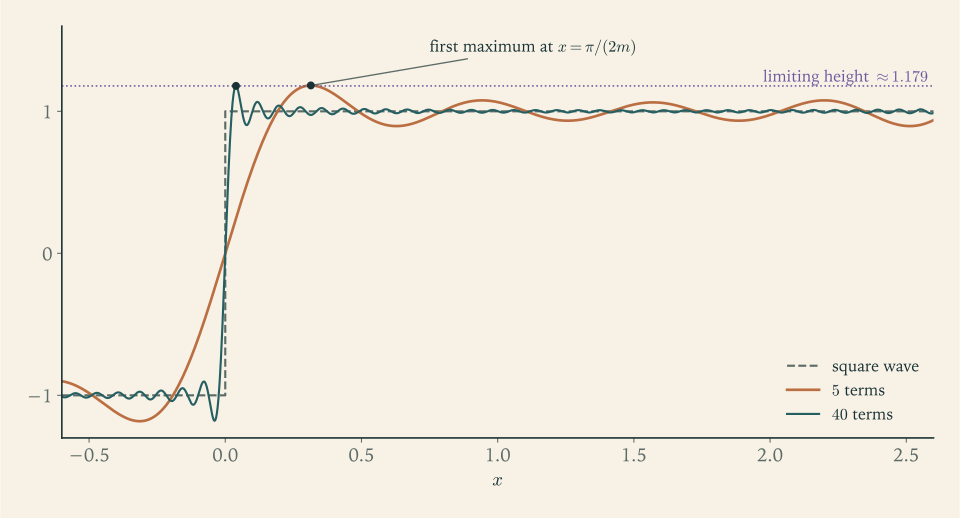
Figure 7.1 separates two notions that are easy to confuse. Pointwise convergence holds at every point: pick any \(x>0\) and the spike eventually passes to its left. Uniform convergence fails: for every \(m\) there is some point where the error is about \(0.18\) . Mean-square convergence holds, because the spike, although tall, becomes thin.
7.4 The heat equation on a rod
Theorem 7.10 (series solution of the heat equation). Let \(g\) be square-integrable on \((0,L)\) with sine coefficients \(b_n\) , and let \(\lambda_n=(n\pi/L)^2\) . The function
is infinitely differentiable for \(t>0\) , satisfies \(u_t=ku_{xx}\) and \(u(0,t)=u(L,t)=0\) there, and \(\int_0^L(u(x,t)-g(x))^2dx\to0\) as \(t\to0\) . If \(g\) is continuous and piecewise \(C^1\) with \(g(0)=g(L)=0\) , then \(u\) is continuous on \([0,L]\times[0,\infty)\) with \(u(x,0)=g(x)\) , and it is the only solution of the initial-boundary value problem with these properties.
Proof. By Bessel’s inequality the \(b_n\) are bounded, say by \(M\) . For \(t\ge t_0>0\) the \(n\) -th term, differentiated \(i\) times in \(t\) and \(j\) times in \(x\) , is bounded by \(M\,k^i\lambda_n^{\,i}(n\pi/L)^{j}e^{-k\lambda_nt_0}\) , and the sum over \(n\) of these bounds converges because the exponential beats every power of \(n\) . So the series and all its termwise derivatives converge uniformly on \([0,L]\times[t_0,\infty)\) , and by the theorem on termwise differentiation of uniformly convergent series \(u\) is infinitely differentiable for \(t>0\) with derivatives computed term by term. Each term satisfies the equation and the boundary conditions, hence so does \(u\) .
By Parseval’s identity applied to \(u(\cdot,t)-g\) , whose sine coefficients are \(b_n(e^{-k\lambda_nt}-1)\) ,
Given \(\varepsilon>0\) choose \(N\) with \(\tfrac L2\sum_{n>N}b_n^2<\varepsilon\) ; the remaining finite sum tends to zero as \(t\to0\) .
Under the stronger hypothesis \(\sum\lvert b_n\rvert\) converges by Theorem 7.7, so the series converges uniformly on \([0,L]\times[0,\infty)\) , \(u\) is continuous there, and \(u(x,0)=\sum b_n\sin(n\pi x/L)=g(x)\) . Uniqueness is Theorem 5.5.
The theorem displays the smoothing of Chapter 5 in a new form. The \(n\) -th mode decays at the rate \(k\lambda_n\) , proportional to \(n^2\) , so high modes disappear almost at once and the solution soon looks like its first term. In particular, by Parseval, \(\int_0^Lu^2dx=\tfrac L2\sum b_n^2e^{-2k\lambda_nt}\le e^{-2k\pi^2t/L^2}\int_0^Lg^2dx\) : the energy of Theorem 5.7 decays at the rate \(2k\pi^2/L^2\) , and this rate is attained by the first mode.
Example 7.3: The parabola cools
With \(k=1\) and \(L=1\) let the initial temperature be \(g(x)=x(1-x)\) , as in Example 5.3. By Example 7.1 and Theorem 7.10,
At \(x=\tfrac12\) and \(t=0.1\) the first term is \(\tfrac{8}{\pi^3}e^{-0.1\pi^2}\approx0.09616\) and the second, with \(n=3\) , is about \(-1.3\times10^{-6}\) . So \(u(\tfrac12,0.1)\approx0.0962\) , the value quoted in Example 5.3, and it lies between the bounds \(0.0932\) and \(0.1186\) found there by the maximum principle. After a tenth of a time unit the solution is the first mode to five decimal places: the profile has become a sine arch, whatever it was at the start.
7.5 Strings, plates, and the limits of the method
The vibrating string. For \(u_{tt}=c^2u_{xx}\) on \((0,L)\) with fixed ends the same separation gives the spatial problem of Lemma 7.1 and the time equation \(T''=-c^2\lambda_nT\) . The product solutions are the normal modes \(\cos(n\pi ct/L)\sin(n\pi x/L)\) and \(\sin(n\pi ct/L)\sin(n\pi x/L)\) , standing waves with frequencies \(nc/(2L)\) , all integer multiples of the lowest one. The solution with initial displacement \(g\) and initial velocity \(h\) is
where \(A_n\) are the sine coefficients of \(g\) and \(\tfrac{n\pi c}{L}B_n\) those of \(h\) . Here the time factors do not decay, so the series for \(u\) converges no better than the series for the data, and termwise differentiation is not automatically justified. This is the absence of smoothing again.
Example 7.4: A plucked string, two ways
A string on \([0,1]\) with \(c=1\) is pulled up to height \(1\) at its midpoint and released: \(g(x)=2x\) for \(x\le\tfrac12\) , \(g(x)=2(1-x)\) for \(x\ge\tfrac12\) , and \(h=0\) . Splitting the integral at the midpoint,
so \(A_1\approx0.8106\) , \(A_3\approx-0.0901\) , \(A_5\approx0.0324\) , and the even coefficients vanish. The coefficients decay like \(n^{-2}\) , more slowly than for the parabola, because \(g\) has a corner. The solution is \(u=\sum A_n\cos(n\pi t)\sin(n\pi x)\) .
Chapter 6 gives a second expression: \(u=\tfrac12[\tilde g(x+t)+\tilde g(x-t)]\) with \(\tilde g\) the odd extension of \(g\) of period \(2\) . At \(x=0.25\) , \(t=0.4\) this is \(\tfrac12[\tilde g(0.65)+\tilde g(-0.15)]=\tfrac12[0.7-0.3]=0.2\) , and summing the series numerically gives \(0.2000\) . The two formulas describe the same function, as the identity \(\cos(n\pi t)\sin(n\pi x)=\tfrac12[\sin n\pi(x+t)+\sin n\pi(x-t)]\) shows term by term: each normal mode is a pair of travelling waves. The series tells you which frequencies are present and how strong each is. The travelling-wave form tells you where the corners are.
The Laplace equation in a rectangle. For \(\Delta u=0\) in \(0<x<a\) , \(0<y<b\) with \(u=0\) on three sides and \(u(x,b)=g(x)\) , separating \(u=X(x)Y(y)\) gives the same \(X_n\) and \(Y''=\lambda_nY\) with \(Y(0)=0\) , so \(Y_n=\sinh(n\pi y/a)\) and
with \(b_n\) the sine coefficients of \(g\) on \((0,a)\) . For \(y<b\) the ratio of hyperbolic sines decays like \(e^{-n\pi(b-y)/a}\) , so, as for the heat equation, the series may be differentiated term by term inside the rectangle.
Example 7.5: The centre of a square plate
Let the unit square have its top side at temperature \(1\) and the other three at \(0\) . The sine coefficients of the constant \(1\) on \((0,1)\) are \(4/(n\pi)\) for odd \(n\) , so
At the centre, \(\sinh(n\pi/2)/\sinh(n\pi)=1/(2\cosh(n\pi/2))\) , and the first three terms are \(0.25372\) , \(-0.00381\) , and \(0.00010\) , with sum \(0.2500\) . The terms alternate in sign and decrease in size, so the neglected remainder is smaller than the next term, about \(3\times10^{-6}\) . There is a reason for the round number. Rotating the square by quarter turns gives four solutions, one for each heated side, all with the same value at the centre. Their sum is harmonic in the square and has boundary value \(1\) on each of the four open sides. If that sum is the constant \(1\) , the common centre value is exactly \(\tfrac14\) . Theorem 3.7 does not deliver this by itself, because it needs continuity on the closed square and each of the four solutions is discontinuous at two corners. What is needed is the extension of the uniqueness theorem to bounded harmonic functions whose boundary values are continuous except at finitely many points; it is true, and it is not proved in this book. So the symmetry argument explains the value with the help of a quoted result, and the series confirms it independently. The boundary data here are discontinuous at two corners, and the series converges there only in the sense of Theorem 7.6; inside the square it is a genuine harmonic function.
Common mistake. Differentiating a Fourier series term by term without checking the hypotheses. The sine series of the constant \(1\) on \((0,\pi)\) is \(\tfrac4\pi\sum_{n\ \mathrm{odd}}\tfrac1n\sin nx\) , and it converges to \(1\) at every interior point. Its termwise derivative is \(\tfrac4\pi\sum_{n\ \mathrm{odd}}\cos nx\) , whose terms do not tend to zero at any point of \((0,\pi)\) other than \(x=\pi/2\) , so it diverges at every point of \((0,\pi)\) except \(\pi/2\) , where every term happens to vanish. Yet the derivative of \(1\) is \(0\) everywhere. The odd periodic extension of the constant has jumps, and the series knows it. Termwise differentiation is safe when the differentiated series converges uniformly, as it does for \(t>0\) in Theorem 7.10. For a continuous, piecewise \(C^1\) periodic function the differentiated series is the Fourier series of the derivative, by the computation in the proof of Theorem 7.7, and it converges at least in mean square. A related slip is choosing the wrong family: sines for an insulated end, or a cosine series without its constant term. The boundary conditions, not the data, decide the family.
Separation of variables depends on geometry. It needs a region that is a product of intervals in some coordinate system and boundary conditions on coordinate lines. On a general region \(\Omega\)
the Laplacian with Dirichlet conditions still has a complete orthogonal family of eigenfunctions, by the spectral theorem for compact self-adjoint operators on a Hilbert space (math.functional-analysis.compact-self-adjoint-spectral-theorem), but they are not explicit. To get there one must first make sense of \(-\Delta\)
as an operator on a space of functions that need not be twice differentiable. The plucked string has already forced the issue: its solution has corners, and is not a classical solution of the wave equation at all. In what sense does it solve it?
Exercises
-
Solve the eigenvalue problem \(-X''=\lambda X\) on \((0,L)\) with \(X'(0)=X'(L)=0\) . Show that \(\lambda=0\) is an eigenvalue, that there are no negative eigenvalues, and that the eigenfunctions for different eigenvalues are orthogonal.
Answer
Multiplying by \(X\) and integrating by parts with the Neumann conditions gives \(\lambda\int_0^LX^2dx=\int_0^L(X')^2dx\ge0\) , so \(\lambda\ge0\) . For \(\lambda=0\) , \(X''=0\) and the conditions force \(X\) constant: an eigenfunction. For \(\lambda=\mu^2>0\) , \(X=A\cos\mu x+B\sin\mu x\) with \(X'(0)=0\) giving \(B=0\) and \(X'(L)=0\) giving \(\sin\mu L=0\) . So \(\lambda_n=(n\pi/L)^2\) , \(X_n=\cos(n\pi x/L)\) , \(n\ge0\) . Orthogonality follows from the bracket \([X_mX_n'-X_m'X_n]_0^L\) , which vanishes because both derivatives do.
-
Solve the eigenvalue problem \(-X''=\lambda X\) on \((0,L)\) with \(X(0)=0\) and \(X'(L)=0\) , and prove the orthogonality of the eigenfunctions by the method of Lemma 7.2 without evaluating any trigonometric integral.
Answer
\(\lambda>0\) as before, \(X=B\sin\mu x\) , and \(X'(L)=0\) requires \(\cos\mu L=0\) : \(\lambda_n=\bigl((n-\tfrac12)\pi/L\bigr)^2\) , \(X_n=\sin\bigl((n-\tfrac12)\pi x/L\bigr)\) , \(n\ge1\) . For orthogonality, \((\lambda_m-\lambda_n)\int_0^LX_mX_n\,dx=[X_mX_n'-X_m'X_n]_0^L\) ; at \(x=0\) both \(X_m\) and \(X_n\) vanish, and at \(x=L\) both derivatives vanish.
-
Find the sine series of \(g=1\) on \((0,\pi)\) . Evaluate it at \(x=\pi/2\) to obtain the sum of \(1-\tfrac13+\tfrac15-\dots\) , and apply Parseval’s identity to obtain the sum of \(1+\tfrac19+\tfrac1{25}+\dots\) .
Solution
The coefficients are \(b_n=\tfrac2\pi\int_0^\pi\sin nx\,dx=\tfrac{2}{n\pi}\bigl(1-\cos n\pi\bigr)\) , which is \(\tfrac{4}{n\pi}\) for odd \(n\) and \(0\) for even \(n\) :
\[ 1\sim\frac4\pi\Bigl(\sin x+\frac{\sin3x}{3}+\frac{\sin5x}{5}+\dots\Bigr)\qquad(0<x<\pi). \]The odd periodic extension of the constant is piecewise \(C^1\) and differentiable at \(x=\pi/2\) , so by Theorem 7.6 the series converges there to \(1\) . Since \(\sin(n\pi/2)\) is \(1,-1,1,\dots\) for \(n=1,3,5,\dots\) ,
\[ 1=\frac4\pi\Bigl(1-\frac13+\frac15-\dots\Bigr),\qquad\text{so}\qquad 1-\frac13+\frac15-\dots=\frac\pi4 . \]Parseval’s identity with \(L=\pi\) reads \(\int_0^\pi1\,dx=\tfrac\pi2\sum b_n^2\) , that is, \(\pi=\tfrac\pi2\cdot\tfrac{16}{\pi^2}\sum_{n\ \mathrm{odd}}n^{-2}\) , hence
\[ 1+\frac19+\frac1{25}+\dots=\frac{\pi^2}{8}\approx1.2337 . \]The first identity needed pointwise convergence at one point; the second needed only mean-square convergence, which Theorem 7.8 gives for every square-integrable function.
-
Find the sine series of \(g(x)=x\) on \((0,\pi)\) , say what it converges to at \(x=\pi\) and why, and use Parseval’s identity to show that \(\sum_{n\ge1}n^{-2}=\pi^2/6\) .
Answer
\(b_n=\tfrac2\pi\int_0^\pi x\sin nx\,dx=\dfrac{2(-1)^{n+1}}{n}\) . At \(x=\pi\) every term vanishes and the series sums to \(0\) , the midpoint of the jump of the odd periodic extension from \(\pi\) to \(-\pi\) . Parseval: \(\int_0^\pi x^2dx=\tfrac{\pi^3}{3}=\tfrac\pi2\sum\tfrac{4}{n^2}\) , so \(\sum n^{-2}=\pi^2/6\) .
-
Solve \(u_t=u_{xx}\) on \((0,\pi)\) with zero boundary values and \(u(x,0)=\sin^3x\) , by first writing \(\sin^3x\) as a combination of sines.
Answer
\(\sin^3x=\tfrac34\sin x-\tfrac14\sin3x\) , so \(u(x,t)=\tfrac34e^{-t}\sin x-\tfrac14e^{-9t}\sin3x\) .
-
A rod on \((0,\pi)\) with \(k=1\) has insulated ends and initial temperature \(g(x)=x\) . Find the cosine series of \(g\) , write the solution, and find its limit as \(t\to\infty\) . Explain the limit by conservation of heat.
Answer
\(a_0=\tfrac2\pi\int_0^\pi x\,dx=\pi\) and, for \(n\ge1\) , \(a_n=\tfrac2\pi\int_0^\pi x\cos nx\,dx=\tfrac{2}{\pi n^2}\bigl((-1)^n-1\bigr)\) , so \(x\sim\tfrac\pi2-\tfrac4\pi\sum_{n\ \mathrm{odd}}\tfrac{\cos nx}{n^2}\) and \(u(x,t)=\tfrac\pi2-\tfrac4\pi\sum_{n\ \mathrm{odd}}\tfrac{1}{n^2}e^{-n^2t}\cos nx\) . As \(t\to\infty\) , \(u\to\tfrac\pi2\) , the mean of the initial temperature: no heat leaves an insulated rod, so the final uniform temperature must carry the same total heat.
-
Solve \(u_t=u_{xx}\) on \((0,1)\) with \(u(0,t)=0\) , \(u(1,t)=1\) , and \(u(x,0)=0\) by subtracting the steady state, and find the time after which the temperature at the midpoint is within \(0.01\) of its limiting value, using the first term of the series.
Solution
The steady state with the given boundary values is the linear function \(\ell(x)=x\) . Put \(w=u-x\) . Then \(w_t=w_{xx}\) , \(w(0,t)=w(1,t)=0\) , and \(w(x,0)=-x\) . The sine coefficients of \(-x\) on \((0,1)\) are
\[ b_n=-2\int_0^1x\sin(n\pi x)\,dx=\frac{2(-1)^n}{n\pi}, \]so by Theorem 7.10
\[ u(x,t)=x+\sum_{n=1}^{\infty}\frac{2(-1)^n}{n\pi}\,e^{-n^2\pi^2t}\sin(n\pi x). \]The initial condition holds in the mean-square sense, and at each interior point by Theorem 7.6; the data are incompatible at the corner \((1,0)\) , where the boundary value \(1\) meets the initial value \(0\) .
At the midpoint the limit is \(\tfrac12\) . The term \(n=1\) is \(-\tfrac2\pi e^{-\pi^2t}\) , the term \(n=2\) vanishes because \(\sin\pi=0\) , and the term \(n=3\) carries \(e^{-9\pi^2t}\) , which is negligible by comparison. So \(\lvert u(\tfrac12,t)-\tfrac12\rvert\approx\tfrac2\pi e^{-\pi^2t}\) , and this is below \(0.01\) when \(e^{-\pi^2t}<0.005\pi\) , that is, when
\[ t>\frac{\log\bigl(200/\pi\bigr)}{\pi^2}\approx0.421 . \]In units where the rod has length \(L\) and diffusivity \(k\) this is \(0.421\,L^2/k\) , the scaling of Exercise 1.13.
-
Let \(g\in C^2[0,L]\) with \(g(0)=g(L)=0\) . Prove by two integrations by parts that \(\lvert b_n\rvert\le\dfrac{2L^2\max\lvert g''\rvert}{n^2\pi^2}\) , and explain what further condition on \(g\) would give a bound of order \(n^{-3}\) .
Hint
\(b_n=\tfrac2L\int_0^Lg\sin\tfrac{n\pi x}{L}dx\) . One integration by parts gives \(\tfrac{2}{n\pi}\int_0^Lg'\cos\tfrac{n\pi x}{L}dx\) , the boundary term vanishing because \(g(0)=g(L)=0\) ; a second gives \(-\tfrac{2L}{n^2\pi^2}\int_0^Lg''\sin\tfrac{n\pi x}{L}dx\) , the boundary term vanishing because the sine does. Bound the integral by \(L\max\lvert g''\rvert\) . The further condition is \(g\in C^3[0,L]\) , with nothing required of \(g''\) at the ends: a third integration by parts gives \(\int_0^Lg''\sin\tfrac{n\pi x}{L}dx=\tfrac{L}{n\pi}\bigl(g''(0)-(-1)^ng''(L)\bigr)+\tfrac{L}{n\pi}\int_0^Lg'''\cos\tfrac{n\pi x}{L}dx\) , and both pieces are of order \(1/n\) , so \(b_n\) is of order \(n^{-3}\) . Example 7.1, with \(g''=-2\) , shows the boundary terms at work. If in addition \(g''(0)=g''(L)=0\) and \(g\in C^4\) , the order improves to \(n^{-4}\) .
-
For a string on \((0,L)\) with fixed ends, initial displacement \(g\) with sine coefficients \(A_n\) , and zero initial velocity, show term by term that the series solution equals \(\tfrac12[\tilde g(x+ct)+\tilde g(x-ct)]\) , where \(\tilde g\) is the odd \(2L\) -periodic extension of \(g\) , assuming \(g\) satisfies the hypotheses of Theorem 7.7.
Solution
By the product-to-sum formula,
\[ \cos\frac{n\pi ct}{L}\,\sin\frac{n\pi x}{L}=\frac12\left[\sin\frac{n\pi(x+ct)}{L}+\sin\frac{n\pi(x-ct)}{L}\right]. \]Multiplying by \(A_n\) and summing, the series solution is \(\tfrac12[G(x+ct)+G(x-ct)]\) , where \(G(s)=\sum A_n\sin(n\pi s/L)\) for all real \(s\) . Splitting the sum in two is legitimate because, under the hypotheses of Theorem 7.7, \(\sum\lvert A_n\rvert\) converges, so each of the two series converges absolutely and uniformly.
It remains to identify \(G\) . On \([0,L]\) , \(G=g\) by Theorem 7.7. Each term \(\sin(n\pi s/L)\) is odd and \(2L\) -periodic in \(s\) , hence so is \(G\) . An odd \(2L\) -periodic function is determined by its values on \([0,L]\) , so \(G=\tilde g\) . Therefore the series equals \(\tfrac12[\tilde g(x+ct)+\tilde g(x-ct)]\) , which is the formula of Section 6.5. The two methods give the same function; one organizes it by frequency and the other by position.
-
The Laplace equation in the unit disc has the product solutions \(r^n\cos n\theta\) and \(r^n\sin n\theta\) of Exercise 3.2. Use them to solve the Dirichlet problem with boundary values \(g(\theta)=\sin^3\theta\) , and find the maximum of the solution on the circle of radius \(\tfrac12\) .
Answer
\(\sin^3\theta=\tfrac34\sin\theta-\tfrac14\sin3\theta\) , so \(u=\tfrac34r\sin\theta-\tfrac14r^3\sin3\theta\) . On \(r=\tfrac12\) this is \(\tfrac38\sin\theta-\tfrac1{32}\sin3\theta=\tfrac{9}{32}s+\tfrac18s^3\) with \(s=\sin\theta\) , increasing in \(s\) ; the maximum, at \(\theta=\pi/2\) , is \(\tfrac{13}{32}\approx0.406\) .
-
Solve \(-\Delta u=1\) in the unit square with \(u=0\) on the boundary by expanding in the products \(\sin(m\pi x)\sin(n\pi y)\) , and sum enough terms to confirm the value \(u(\tfrac12,\tfrac12)\approx0.0737\) quoted in Example 3.4.
Solution
The products \(\sin(m\pi x)\sin(n\pi y)\) vanish on the boundary of the square and satisfy \(-\Delta\bigl(\sin m\pi x\sin n\pi y\bigr)=\pi^2(m^2+n^2)\sin m\pi x\sin n\pi y\) . Expand the source: by Exercise 7.3 rescaled to \((0,1)\) , \(1=\sum_{m\ \mathrm{odd}}\tfrac{4}{m\pi}\sin m\pi x\) , and multiplying two such expansions,
\[ 1=\sum_{m,n\ \mathrm{odd}}\frac{16}{mn\pi^2}\,\sin m\pi x\,\sin n\pi y . \]Seek \(u=\sum c_{mn}\sin m\pi x\sin n\pi y\) ; matching coefficients in \(-\Delta u=1\) gives \(c_{mn}=\dfrac{16}{\pi^4mn(m^2+n^2)}\) for odd \(m,n\) and zero otherwise:
\[ u(x,y)=\sum_{m,n\ \mathrm{odd}}\frac{16}{\pi^4\,mn\,(m^2+n^2)}\,\sin m\pi x\,\sin n\pi y . \]The coefficients are summable, since \(\sum(mn(m^2+n^2))^{-1}\le\sum(2m^2n^2)^{-1}\) , so the series converges uniformly.
At the centre \(\sin(m\pi/2)\sin(n\pi/2)=\pm1\) with sign \((-1)^{(m-1)/2+(n-1)/2}\) . The leading terms are: \((1,1)\) gives \(\tfrac{16}{2\pi^4}=0.08213\) ; \((1,3)\) and \((3,1)\) together give \(-0.01095\) ; \((3,3)\) gives \(0.00101\) ; \((1,5)\) and \((5,1)\) give \(0.00253\) ; \((3,5)\) and \((5,3)\) give \(-0.00064\) . The running total is \(0.0741\) , and summing all terms with \(m,n\le199\) gives \(0.07367\) . So \(u(\tfrac12,\tfrac12)\approx0.0737\) , between the barrier bounds \(0.0625\) and \(0.125\) of Example 3.4.
-
A student solves the insulated rod of Exercise 6 by expanding \(g(x)=x\) in a sine series and writing \(u=\sum b_ne^{-n^2t}\sin nx\) . Show that this function satisfies the heat equation for \(t>0\) , identify the boundary conditions it satisfies, compare its limit as \(t\to\infty\) with the correct one, and state the rule that was broken.
Solution
Each term \(b_ne^{-n^2t}\sin nx\) satisfies the heat equation, and for \(t>0\) the series may be differentiated term by term as in Theorem 7.10, so the student’s function does satisfy \(u_t=u_{xx}\) for \(t>0\) , and it takes the initial values \(x\) in mean square.
But every term vanishes at \(x=0\) and \(x=\pi\) . So the function satisfies \(u(0,t)=u(\pi,t)=0\) : it is the solution for a rod whose ends are held at temperature zero, not for an insulated rod. Its \(x\) -derivative at the ends, \(\sum nb_ne^{-n^2t}\cos nx\) evaluated at \(0\) and \(\pi\) , is not zero; for large \(t\) it is dominated by the first term \(b_1e^{-t}=2e^{-t}\) at \(x=0\) .
The limits differ accordingly. The student’s function tends to \(0\) as \(t\to\infty\) : all the heat leaks out through the cold ends. The correct solution, from Exercise 7.6, tends to the mean \(\pi/2\) , because an insulated rod loses nothing.
The rule broken: the family of eigenfunctions is dictated by the boundary conditions, not by the data. Any square-integrable function on \((0,\pi)\) has both a sine series and a cosine series, and each solves a different physical problem. Insulated ends require \(X'(0)=X'(\pi)=0\) , hence cosines, including the constant mode.
-
For the partial sum \(S\) of Example 7.2 show that \(S'(x)=\dfrac{2\sin(2mx)}{\pi\sin x}\) , deduce that the first positive critical point is \(x=\pi/(2m)\) , and show that \(S(\pi/(2m))\to\tfrac2\pi\int_0^\pi\tfrac{\sin s}{s}\,ds\) as \(m\to\infty\) by recognizing a Riemann sum.
Solution
Differentiating term by term, \(S'(x)=\tfrac4\pi\sum_{j=1}^m\cos\bigl((2j-1)x\bigr)\) . Multiply by \(\sin x\) and use \(2\cos\bigl((2j-1)x\bigr)\sin x=\sin(2jx)-\sin\bigl((2j-2)x\bigr)\) ; the sum telescopes to \(\sin(2mx)\) , so
\[ S'(x)=\frac{2\sin(2mx)}{\pi\sin x}. \]For \(0<x<\pi\) the denominator is positive, and the numerator first vanishes at \(2mx=\pi\) . Since \(S'>0\) on \((0,\pi/(2m))\) and \(S'<0\) just beyond, \(x=\pi/(2m)\) is the first maximum.
There, with \(s_j=(2j-1)\pi/(2m)\) ,
\[ S\Bigl(\frac{\pi}{2m}\Bigr)=\frac4\pi\sum_{j=1}^m\frac{\sin s_j}{2j-1}=\frac2\pi\sum_{j=1}^m\frac{\sin s_j}{s_j}\cdot\frac{\pi}{m}. \]The points \(s_j\) are the midpoints of the \(m\) equal subintervals of \([0,\pi]\) , each of length \(\pi/m\) . So the sum is the midpoint Riemann sum of the continuous function \(\sin s/s\) on \([0,\pi]\) , and it converges to \(\int_0^\pi\tfrac{\sin s}{s}ds\approx1.8519\) . Hence \(S(\pi/(2m))\to\tfrac2\pi\cdot1.8519\approx1.1790\) , an overshoot of \(0.179\) above the value \(1\) , which is \(0.0895\) of the jump \(2\) .
-
Use Corollary 7.9 in the proof of Theorem 5.7 to show that \(E(t)\le E(0)e^{-2k\pi^2t/L^2}\) for solutions with zero boundary values, and exhibit a solution for which equality holds for all \(t\) .
Solution
In the proof of Theorem 5.7, \(E'(t)=-k\int_0^Lu_x^2dx\) . For each \(t>0\) the function \(w=u(\cdot,t)\) is \(C^1\) on \([0,L]\) and vanishes at both ends, so Corollary 7.9 gives \(\int_0^Lu_x^2dx\ge\tfrac{\pi^2}{L^2}\int_0^Lu^2dx=\tfrac{2\pi^2}{L^2}E(t)\) . Hence
\[ E'(t)\le-\frac{2k\pi^2}{L^2}\,E(t),\qquad\text{so}\qquad\frac{d}{dt}\Bigl(e^{2k\pi^2t/L^2}E(t)\Bigr)\le0 , \]and \(E(t)\le E(0)e^{-2k\pi^2t/L^2}\) . For \(u=e^{-k\pi^2t/L^2}\sin(\pi x/L)\) we have \(E(t)=\tfrac L4e^{-2k\pi^2t/L^2}=E(0)e^{-2k\pi^2t/L^2}\) exactly, by Exercise 5.12. So the exponent cannot be improved, and equality occurs precisely for the first eigenfunction, the case of equality in the corollary. The decay rate of the heat equation on an interval is twice \(k\) times the smallest Dirichlet eigenvalue.
-
For \(g(x)=x(\pi-x)\) on \((0,\pi)\) the sine coefficients are \(8/(\pi n^3)\) for odd \(n\) and zero for even \(n\) . Use the bound \(\max\lvert g-S_N\rvert\le\sum_{n>N}\lvert b_n\rvert\) and a comparison with an integral to find an \(N\) that guarantees a maximum error below \(0.01\) .
Answer
For odd \(n\) , \(n^{-3}\le\tfrac12\int_{n-2}^{n}s^{-3}ds\) , so for odd \(N\) the tail is \(\sum_{n>N,\ n\ \mathrm{odd}}\tfrac{8}{\pi n^3}\le\tfrac8\pi\cdot\tfrac12\int_N^\infty s^{-3}ds=\tfrac{2}{\pi N^2}\) . This is below \(0.01\) when \(N^2>63.7\) , so \(N=9\) suffices: five nonzero terms.
-
The sine coefficients of a jump function, of a function with a corner, and of the parabola in Examples 7.2, 7.4, and 7.1 decay like \(n^{-1}\) , \(n^{-2}\) , and \(n^{-3}\) . Explain the pattern by integration by parts, and predict the decay rate for \(g(x)=x^2(1-x)^2\) on \((0,1)\) .
Hint
Each integration by parts gains a factor \(1/n\) and produces boundary terms involving the jumps of the function or of one of its derivatives, taken for the odd periodic extension. A jump in the function itself leaves a term of order \(n^{-1}\) ; a continuous function whose derivative jumps leaves \(n^{-2}\) ; a \(C^1\) function whose second derivative jumps leaves \(n^{-3}\) . For \(g=x^2(1-x)^2\) the function and its first derivative vanish at both ends, but \(g''(0)=g''(1)=2\) , and the odd extension of an even-order derivative changes sign across the endpoint; so the second derivative of the extension jumps and the rate is \(n^{-3}\) , for odd \(n\) .
-
Heat conduction in a thin ring of circumference \(2\pi\) is governed by \(u_t=ku_{\theta\theta}\) with \(u\) periodic in \(\theta\) . Write the series solution for square-integrable initial data, show that it converges uniformly as \(t\to\infty\) to the mean of the initial data, and give the rate.
Answer
\(u(\theta,t)=\tfrac{a_0}{2}+\sum_{n\ge1}e^{-kn^2t}(a_n\cos n\theta+b_n\sin n\theta)\) . For \(t\ge t_0>0\) , \(\lvert u-\tfrac{a_0}{2}\rvert\le\sum_{n\ge1}(\lvert a_n\rvert+\lvert b_n\rvert)e^{-kn^2t}\le Ce^{-kt}\) , since the coefficients are bounded and \(\sum e^{-k(n^2-1)t_0}\) converges. The limit \(\tfrac{a_0}{2}=\tfrac{1}{2\pi}\int g\,d\theta\) is the mean, and the rate is \(e^{-kt}\) , set by the first nonconstant mode.