The two lists of rationals in Example 1.3 close in on \(\sqrt2\) . The numbers \(1/n\) shrink towards \(0\) . The decimal truncations \(3,\ 3.1,\ 3.14,\ 3.141,\dots\) home in on something. Each of these sentences uses a verb of motion to describe a list of fixed numbers, and none of them says how close, or by when. The definition of a limit replaces the motion by a guarantee: name any tolerance, and from some point on every term meets it.
That definition answers one question and raises another. To check it you must already know the limit. But the decimal truncations above are given with no candidate limit attached, and a recursively defined sequence usually arrives the same way. Can one decide that a sequence converges by looking only at its terms? In \(\mathbb R\) the answer is yes, and the answer turns out to be the completeness axiom wearing different clothes.
2.1 The definition and how to use it
A sequence of real numbers is a function from \(\mathbb N\) to \(\mathbb R\) ; we write its value at \(n\) as \(x_n\) and the whole sequence as \((x_n)\) .
Definition 2.1 (convergence). A sequence \((x_n)\) converges to the real number \(L\) if for every \(\varepsilon>0\) there is an \(N\in\mathbb N\) such that
We then write \(x_n\to L\) or \(\lim_{n\to\infty}x_n=L\) and call \(L\) the limit. A sequence that converges to no real number diverges.
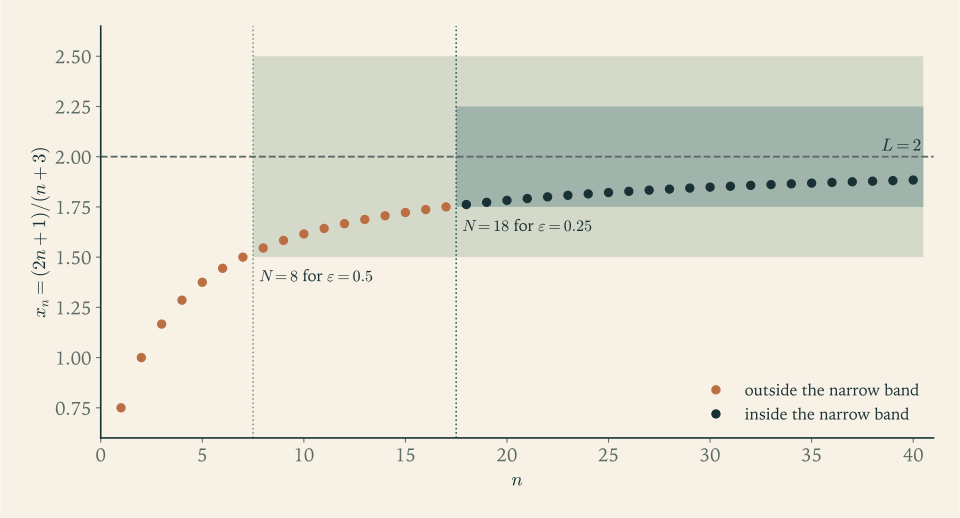
Read the definition as a challenge and a response. A sceptic names a tolerance \(\varepsilon\) . You must answer with an index \(N\) , which is allowed to depend on \(\varepsilon\) , after which every term lies in the band from \(L-\varepsilon\) to \(L+\varepsilon\) . A smaller \(\varepsilon\) will usually need a larger \(N\) ; what matters is that some \(N\) exists for each \(\varepsilon\) . Only finitely many terms, those with \(n<N\) , can lie outside the band, and what they do is irrelevant.
Example 2.1: An explicit index for a given tolerance
Let \(x_n=(2n+1)/(n+3)\) . We claim \(x_n\to 2\) .
Scratch work. Compute the distance to the proposed limit:
This is less than \(\varepsilon\) exactly when \(n+3>5/\varepsilon\) .
Proof. Let \(\varepsilon>0\) . By the Archimedean property choose \(N\in\mathbb N\) with \(N>5/\varepsilon\) . If \(n\ge N\) , then \(n+3>5/\varepsilon\) , so \(\lvert x_n-2\rvert=5/(n+3)<\varepsilon\) .
For the tolerance \(\varepsilon=0.01\) the exact condition is \(n+3>500\) , so the smallest index that works is \(N=498\) : indeed \(\lvert x_{498}-2\rvert=5/501\approx 0.00998\) , while \(\lvert x_{497}-2\rvert=5/500=0.01\) is not less than \(0.01\) . The proof did not need the smallest \(N\) ; any \(N\) beyond \(5/\varepsilon\) is acceptable, and choosing a generous one is often what keeps a proof short.
Theorem 2.2 (uniqueness of the limit). A sequence converges to at most one number.
Proof. Suppose \(x_n\to L\) and \(x_n\to L'\) with \(L\ne L'\) . Put \(\varepsilon=\lvert L-L'\rvert/2>0\) . There are \(N_1\) and \(N_2\) with \(\lvert x_n-L\rvert<\varepsilon\) for \(n\ge N_1\) and \(\lvert x_n-L'\rvert<\varepsilon\) for \(n\ge N_2\) . For an \(n\) larger than both,
which is absurd.
To prove divergence one needs the negation of Definition 2.1, and it pays to write it out once. The statement “\((x_n)\) does not converge to \(L\) ” reads: there is an \(\varepsilon_0>0\) such that for every \(N\) there is some \(n\ge N\) with \(\lvert x_n-L\rvert\ge\varepsilon_0\) . One bad tolerance suffices, but it must defeat every \(N\) .
Example 2.2: A bounded sequence with no limit
Let \(x_n=(-1)^n\) . We show that no real number \(L\) is its limit, using \(\varepsilon_0=1\) . Fix \(L\) and any \(N\) . The terms \(x_{2N}=1\) and \(x_{2N+1}=-1\) both have index at least \(N\) , and
So at least one of the two distances is at least \(1\) . Hence for every \(N\) there is an \(n\ge N\) with \(\lvert x_n-L\rvert\ge 1\) , and \((x_n)\) does not converge to \(L\) . Numerically: whatever \(L\) is, the larger of \(\lvert 1-L\rvert\) and \(\lvert -1-L\rvert\) equals \(1+\lvert L\rvert\ge 1\) .
Common mistake. Reading “converges to \(L\) ” as “the terms get closer and closer to \(L\) ”. The terms of \((1/n)\) get steadily closer to \(-1\) as well, since the distance \(1+1/n\) decreases at every step; yet \(1/n\) does not converge to \(-1\) , because the distance never drops below \(1\) . Conversely the terms of a convergent sequence need not approach the limit steadily: \(x_n=(1+(-1)^n)/n\) converges to \(0\) while alternately landing on \(0\) and jumping away. Convergence is not about monotone approach. It is about eventually staying inside every band.
2.2 Limits and algebra
Proposition 2.3 (convergent sequences are bounded). If \((x_n)\) converges, there is a number \(M\) with \(\lvert x_n\rvert\le M\) for all \(n\) .
Proof. Let \(x_n\to L\) and apply the definition with \(\varepsilon=1\) : there is \(N\) with \(\lvert x_n\rvert\le\lvert L\rvert+\lvert x_n-L\rvert<\lvert L\rvert+1\) for \(n\ge N\) . The finitely many earlier terms have a largest absolute value. Take \(M\) to be the larger of that value and \(\lvert L\rvert+1\) .
The converse fails, as Example 2.2 shows. Boundedness is necessary for convergence and far from sufficient; Section 2.4 says exactly how much it buys.
Theorem 2.4 (limit laws). Suppose \(x_n\to x\) and \(y_n\to y\) , and let \(c\in\mathbb R\) . Then (a) \(x_n+y_n\to x+y\) and \(cx_n\to cx\) ; (b) \(x_ny_n\to xy\) ; (c) if \(y\ne 0\) and \(y_n\ne 0\) for all \(n\) , then \(x_n/y_n\to x/y\) .
Proof. (a) Let \(\varepsilon>0\) . Choose \(N_1\) with \(\lvert x_n-x\rvert<\varepsilon/2\) for \(n\ge N_1\) and \(N_2\) with \(\lvert y_n-y\rvert<\varepsilon/2\) for \(n\ge N_2\) . For \(n\ge\max\{N_1,N_2\}\) the triangle inequality gives \(\lvert(x_n+y_n)-(x+y)\rvert<\varepsilon\) . For the multiple, if \(c=0\) there is nothing to prove; otherwise choose \(N\) with \(\lvert x_n-x\rvert<\varepsilon/\lvert c\rvert\) for \(n\ge N\) .
(b) By Proposition 2.3 there is \(M>0\) with \(\lvert x_n\rvert\le M\) for all \(n\) . Insert the intermediate term \(x_ny\) :
Given \(\varepsilon>0\) , choose \(N\) so that for \(n\ge N\) both \(\lvert y_n-y\rvert<\varepsilon/(2M)\) and \(\lvert x_n-x\rvert<\varepsilon/(2\lvert y\rvert+2)\) . Then the right side is less than \(\varepsilon/2+\varepsilon/2\) .
(c) By (b) it is enough to show \(1/y_n\to 1/y\) . Since \(\lvert y\rvert/2>0\) , there is \(N_1\) with \(\lvert y_n-y\rvert<\lvert y\rvert/2\) for \(n\ge N_1\) , and then \(\lvert y_n\rvert\ge\lvert y\rvert-\lvert y_n-y\rvert>\lvert y\rvert/2\) by Proposition 1.4. For such \(n\) ,
Given \(\varepsilon>0\) choose \(N\ge N_1\) with \(\lvert y_n-y\rvert<\varepsilon\lvert y\rvert^2/2\) for \(n\ge N\) .
The proof of (c) contains a move worth isolating: before dividing by \(y_n\) we used convergence once, with the fixed tolerance \(\lvert y\rvert/2\) , to keep \(y_n\) away from \(0\) . Using the definition with a specific convenient \(\varepsilon\) to gain control, and then again with the given \(\varepsilon\) , is a standard two-stage argument.
Theorem 2.5 (order and squeeze). (a) If \(x_n\to x\) , \(y_n\to y\) , and \(x_n\le y_n\) for all \(n\) , then \(x\le y\) . (b) If \(x_n\le w_n\le y_n\) for all \(n\) and both \(x_n\to L\) and \(y_n\to L\) , then \(w_n\to L\) .
Proof. (a) Suppose \(x>y\) and put \(\varepsilon=(x-y)/2\) . For all large \(n\) we have \(x_n>x-\varepsilon\) and \(y_n<y+\varepsilon\) . But \(x-\varepsilon=y+\varepsilon\) , so \(x_n>y_n\) for such \(n\) , a contradiction.
(b) Let \(\varepsilon>0\) and choose \(N\) so that for \(n\ge N\) both \(x_n>L-\varepsilon\) and \(y_n<L+\varepsilon\) . Then \(L-\varepsilon<x_n\le w_n\le y_n<L+\varepsilon\) .
Two cautions. In (a) the hypotheses need only hold from some index on, since finitely many terms never affect a limit. And strict inequalities are not preserved: \(1/n>0\) for every \(n\) , yet the limit is \(0\) , not a positive number. Part (b) proves convergence of \((w_n)\) ; it does not assume it.
Lemma 2.6 (Bernoulli’s inequality). If \(h\ge-1\) and \(n\in\mathbb N\) , then \((1+h)^n\ge 1+nh\) .
Proof. By induction on \(n\) . For \(n=1\) the two sides are equal. If \((1+h)^n\ge 1+nh\) , multiply by \(1+h\ge 0\) to get \((1+h)^{n+1}\ge(1+nh)(1+h)=1+(n+1)h+nh^2\ge 1+(n+1)h\) .
Proposition 2.7 (two basic limits). (a) \(1/n\to 0\) . (b) If \(\lvert r\rvert<1\) , then \(r^n\to 0\) .
Proof. (a) is the Archimedean property: given \(\varepsilon>0\) choose \(N\) with \(1/N<\varepsilon\) ; then \(0<1/n\le 1/N<\varepsilon\) for \(n\ge N\) . (b) If \(r=0\) this is trivial. Otherwise \(1/\lvert r\rvert>1\) , so \(1/\lvert r\rvert=1+h\) with \(h>0\) , and by Lemma 2.6
The right side tends to \(0\) by (a) and Theorem 2.4, so \(r^n\to 0\) by the squeeze theorem applied to \(-\lvert r^n\rvert\le r^n\le\lvert r^n\rvert\) .
Example 2.3: A limit that the limit laws cannot reach directly
Let \(x_n=\sqrt{n^2+n}-n\) . Both \(\sqrt{n^2+n}\) and \(n\) are unbounded, so Theorem 2.4 says nothing about their difference. Multiply and divide by the conjugate:
Since \(\sqrt{n^2+n}>n\) , the denominator exceeds \(2n\) , so \(0<x_n<1/2\) . We claim \(x_n\to 1/2\) and estimate the gap:
So \(0<1/2-x_n<1/(8n)\) , and \(x_n\to 1/2\) by the squeeze theorem. The estimate also delivers indices: for \(\varepsilon=0.001\) any \(N\ge 125\) works, because then \(1/(8n)\le 0.001\) . As a check, \(x_{100}=\sqrt{10100}-100\approx 0.498756\) , at distance about \(0.001244\) from \(1/2\) , just inside the bound \(1/800=0.00125\) .
The moral is that an indeterminate form is a request to rewrite. The limit laws apply only after the expression has been rearranged into pieces that converge separately.
2.3 Monotone sequences
Definition 2.8 (monotone sequence). A sequence \((x_n)\) is increasing if \(x_n\le x_{n+1}\) for all \(n\) , decreasing if \(x_n\ge x_{n+1}\) for all \(n\) , and monotone if it is one or the other.
Theorem 2.9 (monotone convergence). A monotone sequence converges if and only if it is bounded. An increasing sequence that is bounded above converges to the supremum of its set of terms; a decreasing sequence that is bounded below converges to the infimum.
Proof. A convergent sequence is bounded by Proposition 2.3. Conversely, let \((x_n)\) be increasing and bounded above, and let \(s=\sup\{x_n:n\in\mathbb N\}\) , which exists by completeness. Let \(\varepsilon>0\) . By Lemma 1.6 there is an index \(N\) with \(x_N>s-\varepsilon\) . For \(n\ge N\) , monotonicity gives \(x_n\ge x_N\) , and \(s\) is an upper bound, so
Hence \(\lvert x_n-s\rvert<\varepsilon\) for \(n\ge N\) . The decreasing case follows by applying this to \((-x_n)\) .
This is the first theorem that produces a limit without being told what it is. Completeness supplies the candidate, exactly as it supplied \(\sqrt2\) in Theorem 1.11. Over \(\mathbb Q\) the theorem is false: the increasing rationals \(1,\,4/3,\,7/5,\,24/17,\dots\) of Example 1.3 are bounded above and have no rational limit.
Example 2.4: The Babylonian square root
Define \(x_1=2\) and \(x_{n+1}=\tfrac12\bigl(x_n+2/x_n\bigr)\) . The first terms are \(2\) , \(3/2\) , \(17/12\) , \(577/408\) . All terms are positive, by induction. Two identities control the sequence:
The first shows \(x_n^2\ge 2\) for every \(n\ge 2\) , and \(x_1^2=4\ge 2\) as well. The second then shows \(x_n-x_{n+1}\ge 0\) . So the sequence is decreasing and bounded below by \(0\) , and by Theorem 2.9 it converges to some \(L\) . Since \(x_n^2\ge 2\) and \(x_n>0\) we have \(x_n\ge 1\) , so \(L\ge 1\) by Theorem 2.5, and in particular \(L\ne 0\) .
Only now may we take limits in the recursion. The sequence \((x_{n+1})\) has the same limit \(L\) , and Theorem 2.4 gives \(L=\tfrac12(L+2/L)\) , that is, \(L^2=2\) . So \(L=\sqrt2\) .
The convergence is fast. A similar computation gives \(x_{n+1}-\sqrt2=(x_n-\sqrt2)^2/(2x_n)\) , so each error is roughly the square of the previous one: \(x_3=17/12\approx 1.416667\) is off by about \(2.5\times 10^{-3}\) , and \(x_4=577/408\approx 1.4142157\) is off by about \(2.1\times 10^{-6}\) .
Common mistake. Solving for the limit before proving there is one. Take \(x_1=1\) and \(x_{n+1}=2x_n+1\) . “Let \(L=\lim x_n\) ; then \(L=2L+1\) , so \(L=-1\) .” But the sequence is \(1,3,7,15,\dots\) , which is unbounded and has no limit. The algebra is correct and the conclusion is false, because the first sentence assumed what had to be proved. Passing to the limit in a recursion finds the only possible value of the limit. Existence is a separate step, and for recursive sequences it usually comes from Theorem 2.9 or from the Cauchy criterion below.
2.4 Subsequences and the Bolzano–Weierstrass theorem
Definition 2.10 (subsequence). Let \((x_n)\) be a sequence and let \(n_1<n_2<n_3<\cdots\) be a strictly increasing sequence of natural numbers. Then \((x_{n_k})\) , indexed by \(k\) , is a subsequence of \((x_n)\) . A number that is the limit of some subsequence is a subsequential limit of \((x_n)\) .
A subsequence selects infinitely many terms and keeps them in their original order. Note that \(n_k\ge k\) for every \(k\) , by induction.
Proposition 2.11 (subsequences inherit limits). If \(x_n\to L\) , then every subsequence of \((x_n)\) converges to \(L\) .
Proof. Given \(\varepsilon>0\) choose \(N\) with \(\lvert x_n-L\rvert<\varepsilon\) for \(n\ge N\) . If \(k\ge N\) then \(n_k\ge k\ge N\) , so \(\lvert x_{n_k}-L\rvert<\varepsilon\) .
The contrapositive is the most convenient divergence test there is: a sequence with two subsequences converging to different limits diverges.
Bounded sequences need not converge, but they cannot avoid having convergent subsequences. The proof rests on a combinatorial fact with no hypotheses at all.
Lemma 2.12 (monotone subsequence). Every sequence of real numbers has a monotone subsequence.
Proof. Call an index \(m\) a peak of \((x_n)\) if \(x_m>x_n\) for every \(n>m\) . If there are infinitely many peaks \(m_1<m_2<\cdots\) , then \(x_{m_1}>x_{m_2}>\cdots\) , since each is a peak and the next index is later; this is a decreasing subsequence. If there are only finitely many peaks, choose \(n_1\) larger than all of them. Since \(n_1\) is not a peak, there is \(n_2>n_1\) with \(x_{n_2}\ge x_{n_1}\) . Since \(n_2\) is not a peak, there is \(n_3>n_2\) with \(x_{n_3}\ge x_{n_2}\) . Continuing, we obtain an increasing subsequence.
Theorem 2.13 (Bolzano–Weierstrass). Every bounded sequence of real numbers has a convergent subsequence.
Proof. By Lemma 2.12 the sequence has a monotone subsequence. That subsequence is bounded because the whole sequence is, so it converges by Theorem 2.9.
Example 2.5: Two subsequential limits
Let \(x_n=(-1)^n(1+1/n)\) . The terms are \(-2\) , \(3/2\) , \(-4/3\) , \(5/4\) , \(-6/5,\dots\) , and \(\lvert x_n\rvert\le 2\) . The even-indexed subsequence \(x_{2k}=1+1/(2k)\) converges to \(1\) and the odd-indexed subsequence \(x_{2k-1}=-(1+1/(2k-1))\) converges to \(-1\) , by Proposition 2.7 and Theorem 2.4. Since \(1\ne-1\) , the sequence diverges.
There are no other subsequential limits. Any subsequence contains infinitely many even-indexed terms or infinitely many odd-indexed terms. If it converges, a further subsequence consisting of terms of one parity has the same limit by Proposition 2.11, and that limit is \(1\) or \(-1\) .
Boundedness cannot be dropped from Theorem 2.13: every subsequence of \(x_n=n\) is unbounded, hence divergent by Proposition 2.3.
2.5 Cauchy sequences
We return to the question from the chapter opening: how can one recognise convergence without knowing the limit? The idea, due to Cauchy, is that terms which are all close to a common limit must be close to each other.
Definition 2.14 (Cauchy sequence). A sequence \((x_n)\) is a Cauchy sequence if for every \(\varepsilon>0\) there is an \(N\in\mathbb N\) such that
The definition mentions no limit. It compares every pair of terms beyond \(N\) , not just neighbours.
Lemma 2.15 (three facts about Cauchy sequences). (a) Every convergent sequence is Cauchy. (b) Every Cauchy sequence is bounded. (c) A Cauchy sequence that has a convergent subsequence converges, to the limit of that subsequence.
Proof. (a) Let \(x_n\to L\) and \(\varepsilon>0\) . Choose \(N\) with \(\lvert x_n-L\rvert<\varepsilon/2\) for \(n\ge N\) . For \(m,n\ge N\) , \(\lvert x_n-x_m\rvert\le\lvert x_n-L\rvert+\lvert L-x_m\rvert<\varepsilon\) .
(b) Take \(\varepsilon=1\) in the definition: there is \(N\) with \(\lvert x_n-x_N\rvert<1\) for \(n\ge N\) , so \(\lvert x_n\rvert<\lvert x_N\rvert+1\) for those \(n\) . The terms before \(x_N\) are finite in number. So the sequence is bounded.
(c) Let \((x_n)\) be Cauchy with \(x_{n_k}\to x\) , and let \(\varepsilon>0\) . Choose \(N\) with \(\lvert x_n-x_m\rvert<\varepsilon/2\) for \(m,n\ge N\) . Choose \(k\) so large that \(n_k\ge N\) and \(\lvert x_{n_k}-x\rvert<\varepsilon/2\) . Then for every \(n\ge N\) ,
Theorem 2.16 (Cauchy criterion). A sequence of real numbers converges if and only if it is a Cauchy sequence.
Proof. Convergent sequences are Cauchy by Lemma 2.15(a). Conversely, a Cauchy sequence is bounded by (b), so it has a convergent subsequence by the Bolzano–Weierstrass theorem, and therefore it converges by (c).
Trace the dependence backwards: the Cauchy criterion rests on Bolzano–Weierstrass, which rests on monotone convergence, which rests on the completeness axiom. The chain can be closed. In an ordered field with the Archimedean property, each of the following implies the others: the supremum property of Definition 1.7; the monotone convergence theorem; the nested interval theorem; the Bolzano–Weierstrass theorem; the Cauchy criterion. Exercise 16 proves one of the return implications. This is why “\(\mathbb R\) is complete” is often taken to mean that every Cauchy sequence converges, and that is the form in which completeness will be carried to metric spaces in Chapter 4. Over \(\mathbb Q\) the criterion fails: the rationals \(1,\,4/3,\,7/5,\dots\) of Example 1.3 form a Cauchy sequence, since they converge in \(\mathbb R\) , but they have no limit in \(\mathbb Q\) .
Example 2.6: Neighbouring terms close, sequence not Cauchy
Let \(x_n=\sqrt n\) . Consecutive terms get close:
for instance \(\sqrt{101}-\sqrt{100}\approx 0.0499\) . Yet the sequence is unbounded, so by Lemma 2.15(b) it is not Cauchy. One can see the failure directly with \(\varepsilon_0=1\) : for every \(N\) , the indices \(n=N\) and \(m=4N\) are both at least \(N\) , and \(x_{4N}-x_N=2\sqrt N-\sqrt N=\sqrt N\ge 1\) .
Common mistake. Checking the Cauchy condition only for consecutive terms. The condition \(\lvert x_{n+1}-x_n\rvert\to 0\) is necessary for convergence and not sufficient, as \(\sqrt n\) shows; the partial sums \(1+1/2+\cdots+1/n\) are a second example (Exercise 13). Small steps can still add up to a long walk. The Cauchy condition controls all pairs \(m,n\ge N\) simultaneously. When you do have control of consecutive differences, you need it to be summable, as in the next proposition.
Proposition 2.17 (contractive sequences). Suppose there is a constant \(c\) with \(0<c<1\) such that \(\lvert x_{n+2}-x_{n+1}\rvert\le c\,\lvert x_{n+1}-x_n\rvert\) for all \(n\) . Then \((x_n)\) converges, and its limit \(L\) satisfies
Proof. Put \(d=\lvert x_2-x_1\rvert\) . By induction, \(\lvert x_{j+1}-x_j\rvert\le c^{\,j-1}d\) . For \(m>n\) , the triangle inequality and the identity \((1-c)(1+c+\cdots+c^{k-1})=1-c^k\) give
Since \(c^{\,n-1}\to 0\) by Proposition 2.7, for each \(\varepsilon>0\) there is \(N\) with \(d\,c^{\,N-1}/(1-c)<\varepsilon\) , and then \(\lvert x_m-x_n\rvert<\varepsilon\) for \(m>n\ge N\) . So \((x_n)\) is Cauchy and converges to some \(L\) . Fix \(n\) and let \(m\to\infty\) in the displayed inequality: \(\lvert x_m-x_n\rvert\to\lvert L-x_n\rvert\) (Exercise 3), and Theorem 2.5 preserves the weak inequality.
Example 2.7: A sequence that converges without being monotone
Let \(x_1=1\) and \(x_{n+1}=1/(2+x_n)\) . The terms are \(1\) , \(1/3\) , \(3/7\) , \(7/17\) , \(17/41,\dots\) , approximately \(1\) , \(0.3333\) , \(0.4286\) , \(0.4118\) , \(0.4146\) . They jump alternately down and up, so Theorem 2.9 does not apply. All terms are positive, and
The sequence is contractive with \(c=1/4\) , so it converges to some \(L\ge 0\) . Now the recursion may be used: \(L=1/(2+L)\) , so \(L^2+2L-1=0\) , and the nonnegative root is \(L=\sqrt2-1\approx 0.414214\) .
Proposition 2.17 also says how good each term is. With \(\lvert x_2-x_1\rvert=2/3\) the bound is \(\lvert x_n-L\rvert\le\tfrac89\,(1/4)^{n-1}\) . For \(n=5\) it gives about \(0.00347\) , and the actual error is \(\lvert 17/41-L\rvert\approx 0.00042\) . The bound is not sharp, but it was obtained without knowing \(L\) .
2.6 Limit superior and limit inferior
A bounded divergent sequence still has a largest and a smallest subsequential limit. They can be defined without mentioning subsequences, and they measure how far the sequence is from converging.
Definition 2.18 (limit superior and inferior). Let \((x_n)\) be a bounded sequence. For each \(n\) put
The limit superior and limit inferior of \((x_n)\) are
The limits exist. The tail \(\{x_k:k\ge n+1\}\) is a subset of \(\{x_k:k\ge n\}\) , so \(u_{n+1}\le u_n\) and \(\ell_{n+1}\ge\ell_n\) by Proposition 1.15(a) and its mirror image for infima. Both sequences are bounded because \((x_n)\) is, and Theorem 2.9 applies.
Theorem 2.19 (properties of the limit superior and inferior). Let \((x_n)\) be a bounded sequence with \(U=\limsup x_n\) and \(\Lambda=\liminf x_n\) . (a) \(\Lambda\le U\) . (b) Some subsequence of \((x_n)\) converges to \(U\) , some subsequence converges to \(\Lambda\) , and every subsequential limit \(t\) of \((x_n)\) satisfies \(\Lambda\le t\le U\) . (c) \((x_n)\) converges if and only if \(\Lambda=U\) , and then \(\lim x_n=U\) .
Proof. (a) Since \(\ell_n\le x_n\le u_n\) for every \(n\) , Theorem 2.5(a) gives \(\Lambda\le U\) .
(b) We build indices \(n_1<n_2<\cdots\) with \(\lvert x_{n_k}-U\rvert<1/k\) . Suppose \(n_{k-1}\) has been chosen (for \(k=1\) there is no constraint). Because \((u_m)\) decreases to \(U\) , there is an \(m>n_{k-1}\) with \(U\le u_m<U+1/k\) . By Lemma 1.6 applied to the tail \(\{x_j:j\ge m\}\) , there is an index \(n_k\ge m\) with \(x_{n_k}>u_m-1/k\ge U-1/k\) . Also \(x_{n_k}\le u_m<U+1/k\) . So \(\lvert x_{n_k}-U\rvert<1/k\) , and \(x_{n_k}\to U\) by Proposition 2.7 and the squeeze theorem. The construction for \(\Lambda\) is the mirror image. Finally, if \(x_{n_k}\to t\) , then \(\ell_{n_k}\le x_{n_k}\le u_{n_k}\) , and the subsequences \((\ell_{n_k})\) and \((u_{n_k})\) converge to \(\Lambda\) and \(U\) by Proposition 2.11, so \(\Lambda\le t\le U\) by Theorem 2.5(a).
(c) If \(x_n\to x\) , every subsequence converges to \(x\) , so by (b) both \(U\) and \(\Lambda\) equal \(x\) . If \(\Lambda=U\) , then \(\ell_n\le x_n\le u_n\) and the squeeze theorem give \(x_n\to U\) .
For the sequence of Example 2.5 the tail suprema are \(u_n=1+1/n\) when \(n\) is even and \(u_n=1+1/(n+1)\) when \(n\) is odd, so \(\limsup x_n=1\) ; similarly \(\liminf x_n=-1\) . The gap \(U-\Lambda=2\) is the size of the oscillation that survives in every tail.
One more piece of vocabulary. We write \(x_n\to+\infty\) if for every real \(M\) there is an \(N\) with \(x_n>M\) for all \(n\ge N\) , and \(x_n\to-\infty\) analogously. Such a sequence diverges; the notation records the manner of divergence and does not make \(\infty\) a number. For a sequence not bounded above we set \(\limsup x_n=+\infty\) , and for one not bounded below \(\liminf x_n=-\infty\) .
With limits of sequences in hand, the next chapter adds infinitely many numbers. A series is nothing more than the sequence of its partial sums, so every theorem here has an echo there, and the Cauchy criterion in particular becomes the main working tool.
Exercises
-
Using only Definition 2.1, prove that \((3n-1)/(n+2)\to 3\) , and find the smallest \(N\) that works for \(\varepsilon=0.01\) .
Solution
Scratch work. For \(x_n=(3n-1)/(n+2)\) ,
\[ \lvert x_n-3\rvert=\left\lvert\frac{3n-1-3(n+2)}{n+2}\right\rvert=\frac{7}{n+2}. \]Proof. Let \(\varepsilon>0\) . By the Archimedean property choose \(N\in\mathbb N\) with \(N>7/\varepsilon\) . For \(n\ge N\) we have \(n+2>7/\varepsilon\) , hence \(\lvert x_n-3\rvert=7/(n+2)<\varepsilon\) . So \(x_n\to 3\) .
The smallest index for \(\varepsilon=0.01\) . The inequality \(7/(n+2)<0.01\) is equivalent to \(n+2>700\) , that is \(n>698\) . Because \(7/(n+2)\) decreases as \(n\) grows, every \(n\ge 699\) works and \(n=698\) does not: \(\lvert x_{698}-3\rvert=7/700=0.01\) exactly, which is not less than \(0.01\) , while \(\lvert x_{699}-3\rvert=7/701\approx 0.009986\) . The smallest \(N\) is \(N=699\) .
-
Write out, with all quantifiers, the statement “the sequence \((x_n)\) diverges” (it must mention every candidate limit \(L\) ). Use it to prove that \(x_n=n\) diverges without quoting Proposition 2.3.
Answer
“For every real \(L\) there is an \(\varepsilon_0>0\) such that for every \(N\in\mathbb N\) there is an \(n\ge N\) with \(\lvert x_n-L\rvert\ge\varepsilon_0\) .” For \(x_n=n\) : given \(L\) , take \(\varepsilon_0=1\) . Given \(N\) , choose by the Archimedean property an \(n\ge N\) with \(n>\lvert L\rvert+1\) . Then \(\lvert n-L\rvert\ge n-\lvert L\rvert>1\) .
-
Prove that \(x_n\to x\) implies \(\lvert x_n\rvert\to\lvert x\rvert\) . Show by example that the converse is false in general, and prove that it is true when \(x=0\) .
Solution
The implication. Let \(x_n\to x\) and \(\varepsilon>0\) . Choose \(N\) with \(\lvert x_n-x\rvert<\varepsilon\) for \(n\ge N\) . By the second inequality of Proposition 1.4,
\[ \bigl\lvert\,\lvert x_n\rvert-\lvert x\rvert\,\bigr\rvert\le\lvert x_n-x\rvert<\varepsilon\qquad\text{for }n\ge N . \]Hence \(\lvert x_n\rvert\to\lvert x\rvert\) .
The converse fails. For \(x_n=(-1)^n\) we have \(\lvert x_n\rvert=1\) for all \(n\) , so \(\lvert x_n\rvert\to 1\) , but \((x_n)\) diverges by Example 2.2. Absolute values forget the sign, and the sign can oscillate.
The converse holds when \(x=0\) . Suppose \(\lvert x_n\rvert\to 0\) . The quantity that the definition of \(x_n\to 0\) asks us to make small is \(\lvert x_n-0\rvert=\lvert x_n\rvert\) , and the quantity that \(\lvert x_n\rvert\to 0\) makes small is \(\bigl\lvert\lvert x_n\rvert-0\bigr\rvert=\lvert x_n\rvert\) . They are the same number, so the two statements are literally the same statement.
-
Prove that if \(x_n\to 0\) and \((y_n)\) is bounded, then \(x_ny_n\to 0\) , and explain why Theorem 2.4(b) cannot be quoted for this. Deduce that \(\sin(n)/n\to 0\) .
Hint
Let \(\lvert y_n\rvert\le M\) with \(M>0\) . Then \(\lvert x_ny_n\rvert\le M\lvert x_n\rvert\) ; given \(\varepsilon\) , choose \(N\) with \(\lvert x_n\rvert<\varepsilon/M\) . Theorem 2.4(b) needs both sequences to converge, and \((y_n)\) is only assumed bounded. For the last part take \(x_n=1/n\) and \(y_n=\sin n\) , which is bounded by \(1\) ; whether \(\sin n\) converges is irrelevant.
-
Find each limit and justify it with the theorems of Section 2.2: (a) \((4n^2-n)/(2n^2+3)\) ; (b) \(\sqrt{n+1}-\sqrt n\) ; (c) \((2^n+3^n)^{1/n}\) , for which you may use that \(c^{1/n}\to 1\) for \(c>0\) .
Answer
(a) \(2\) : divide numerator and denominator by \(n^2\) to get \((4-1/n)/(2+3/n^2)\) and apply Theorem 2.4. (b) \(0\) : the expression equals \(1/(\sqrt{n+1}+\sqrt n)\) , which lies between \(0\) and \(1/\sqrt n\) , and \(1/\sqrt n<\varepsilon\) once \(n>1/\varepsilon^2\) ; squeeze. (c) \(3\) : since \(3^n\le 2^n+3^n\le 2\cdot 3^n\) , we get \(3\le(2^n+3^n)^{1/n}\le 3\cdot 2^{1/n}\) , and \(2^{1/n}\to 1\) ; squeeze.
-
Prove that \(n^{1/n}\to 1\) by writing \(n^{1/n}=1+h_n\) with \(h_n\ge 0\) and using the binomial inequality \((1+h)^n\ge\tfrac12n(n-1)h^2\) for \(h\ge 0\) and \(n\ge 2\) . Deduce that \(c^{1/n}\to 1\) for every \(c>0\) .
Solution
For \(n\ge 1\) we have \(n^{1/n}\ge 1\) , since a positive number less than \(1\) has \(n\) th power less than \(1\) . So \(h_n=n^{1/n}-1\ge 0\) .
For \(h\ge 0\) and \(n\ge 2\) the binomial theorem expresses \((1+h)^n\) as a sum of nonnegative terms, one of which is \(\binom n2h^2=\tfrac12n(n-1)h^2\) . Hence \((1+h)^n\ge\tfrac12n(n-1)h^2\) . Apply this with \(h=h_n\) :
\[ n=(1+h_n)^n\ge\tfrac12n(n-1)h_n^2,\qquad\text{so}\qquad 0\le h_n\le\sqrt{\frac{2}{n-1}}\quad(n\ge 2). \]Given \(\varepsilon>0\) , the bound \(\sqrt{2/(n-1)}\) is less than \(\varepsilon\) as soon as \(n>1+2/\varepsilon^2\) . So \(h_n\to 0\) by the squeeze theorem, and \(n^{1/n}=1+h_n\to 1\) .
Now let \(c>0\) . If \(c\ge 1\) , then for every \(n\ge c\) we have \(1\le c^{1/n}\le n^{1/n}\) , and the squeeze theorem gives \(c^{1/n}\to 1\) . If \(0<c<1\) , then \(1/c>1\) and \(c^{1/n}=1/(1/c)^{1/n}\to 1/1=1\) by the quotient law.
-
Let \(x_1=1\) and \(x_{n+1}=\sqrt{2+x_n}\) . Prove that the sequence is increasing and bounded above by \(2\) , and find its limit, taking care to justify the passage to the limit in the recursion.
Solution
Bounded. We show \(0<x_n\le 2\) by induction. \(x_1=1\) . If \(0<x_n\le 2\) then \(2<2+x_n\le 4\) , so \(x_{n+1}=\sqrt{2+x_n}\) satisfies \(0<x_{n+1}\le 2\) , because the square root is increasing on positive numbers (Exercise 1.2).
Increasing. Compare squares:
\[ x_{n+1}^2-x_n^2=2+x_n-x_n^2=(2-x_n)(1+x_n)\ge 0, \]since \(0<x_n\le 2\) . As both terms are positive, \(x_{n+1}\ge x_n\) .
Convergence. By the monotone convergence theorem \(x_n\to L\) for some \(L\) , and \(1\le L\le 2\) by Theorem 2.5.
The limit. To avoid assuming anything about limits of square roots, square the recursion: \(x_{n+1}^2=2+x_n\) . The left side converges to \(L^2\) by the product law, because \((x_{n+1})\) also converges to \(L\) ; the right side converges to \(2+L\) . By uniqueness of limits \(L^2=2+L\) , so \((L-2)(L+1)=0\) . Since \(L\ge 1\) , we conclude \(L=2\) .
Numerically \(x_2=\sqrt3\approx 1.7321\) , \(x_3\approx 1.9319\) , \(x_4\approx 1.9829\) , \(x_5\approx 1.9957\) .
-
Show that \(a_n=(1+1/n)^n\) is increasing and that \(a_n<3\) for all \(n\) , so that the sequence converges. (Expand by the binomial theorem and compare the terms of \(a_n\) and \(a_{n+1}\) one by one.)
Hint
By the binomial theorem
\[ a_n=\sum_{k=0}^{n}\frac{1}{k!}\Bigl(1-\frac1n\Bigr)\Bigl(1-\frac2n\Bigr)\cdots\Bigl(1-\frac{k-1}{n}\Bigr). \]Each factor \(1-j/n\) increases when \(n\) is replaced by \(n+1\) , and \(a_{n+1}\) has one more positive term; so \(a_n<a_{n+1}\) . Each product is at most \(1\) , so \(a_n\le\sum_{k=0}^n1/k!\) ; bound this using \(k!\ge 2^{k-1}\) and the finite geometric sum.
-
A student is given \(x_1=1\) , \(x_{n+1}=3x_n-1\) and writes: “Let \(L\) be the limit. Then \(L=3L-1\) , so the sequence converges to \(1/2\) .” Compute the first five terms, say what is wrong with the argument, and say what the computation \(L=3L-1\) does establish.
Answer
The terms are \(1,2,5,14,41\) . Since \(x_{n+1}-x_n=2x_n-1\ge 1\) whenever \(x_n\ge 1\) , the sequence increases by at least \(1\) per step and is unbounded, hence divergent. The argument assumed that a limit exists. What \(L=3L-1\) establishes is conditional: if a sequence satisfying the recursion converges, its limit is \(1/2\) . That happens only for the constant sequence started at \(x_1=1/2\) .
-
For each \(n\) let \(r_n\in\{0,1,2\}\) be the remainder of \(n\) on division by \(3\) , and let \(x_n=r_n+1/n\) . Find all subsequential limits of \((x_n)\) , and find \(\limsup x_n\) and \(\liminf x_n\) .
Answer
Along \(n=3k\) , \(x_n=1/(3k)\to 0\) ; along \(n=3k+1\) , \(x_n\to 1\) ; along \(n=3k+2\) , \(x_n\to 2\) . A convergent subsequence contains infinitely many indices from one of the three classes, so its limit is \(0\) , \(1\) , or \(2\) . Hence the subsequential limits are exactly \(0,1,2\) , with \(\limsup x_n=2\) and \(\liminf x_n=0\) .
-
Prove that \(x_n\to L\) if and only if every subsequence of \((x_n)\) has a further subsequence that converges to \(L\) .
Solution
If \(x_n\to L\) . By Proposition 2.11 every subsequence converges to \(L\) . A sequence is a subsequence of itself, so each subsequence has a further subsequence, namely itself, converging to \(L\) .
Conversely, we prove the contrapositive. Suppose \((x_n)\) does not converge to \(L\) . By the negation of Definition 2.1 there is \(\varepsilon_0>0\) such that for every \(N\) some \(n\ge N\) has \(\lvert x_n-L\rvert\ge\varepsilon_0\) . Use this repeatedly: choose \(n_1\) with \(\lvert x_{n_1}-L\rvert\ge\varepsilon_0\) ; then, applying the statement with \(N=n_1+1\) , choose \(n_2>n_1\) with \(\lvert x_{n_2}-L\rvert\ge\varepsilon_0\) ; and so on. This produces a subsequence \((x_{n_k})\) all of whose terms are at distance at least \(\varepsilon_0\) from \(L\) . Every further subsequence of it has the same property, so none of them converges to \(L\) : the tolerance \(\varepsilon_0\) is never met. Thus there is a subsequence with no further subsequence converging to \(L\) , which is the negation of the condition.
-
Prove directly from Definition 2.14, without mentioning any limit, that \(x_n=(n+1)/n\) is a Cauchy sequence.
Hint
\(\lvert x_n-x_m\rvert=\lvert 1/n-1/m\rvert\) . For \(m,n\ge N\) both \(1/n\) and \(1/m\) lie in the interval \((0,1/N]\) , so their distance is less than \(1/N\) . Given \(\varepsilon\) , choose \(N\ge 1/\varepsilon\) .
-
Let \(s_n=1+1/2+\cdots+1/n\) . Show that \(s_{2n}-s_n\ge 1/2\) for every \(n\) , and conclude that \((s_n)\) is not Cauchy although \(s_{n+1}-s_n\to 0\) .
Solution
For every \(n\) ,
\[ s_{2n}-s_n=\frac{1}{n+1}+\frac{1}{n+2}+\cdots+\frac{1}{2n}. \]There are \(n\) terms and each is at least the last one, \(1/(2n)\) . Hence \(s_{2n}-s_n\ge n\cdot\frac{1}{2n}=\frac12\) .
Now suppose \((s_n)\) were Cauchy and apply Definition 2.14 with \(\varepsilon=1/2\) : there would be \(N\) with \(\lvert s_m-s_n\rvert<1/2\) for all \(m,n\ge N\) . But \(n=N\) and \(m=2N\) are both at least \(N\) and \(s_{2N}-s_N\ge 1/2\) . So \((s_n)\) is not Cauchy, and by the Cauchy criterion it diverges; being increasing, it is unbounded.
Meanwhile \(s_{n+1}-s_n=1/(n+1)\to 0\) . Consecutive differences that tend to zero do not make a sequence Cauchy. For instance \(s_{20}-s_{10}\approx 0.6688\) , comfortably above \(1/2\) , although the individual steps between them are all at most \(1/11\) .
-
Let \(x_1=1\) and \(x_{n+1}=1+1/x_n\) . Show that \(3/2\le x_n\le 2\) for \(n\ge 2\) , that the sequence is contractive with constant \(4/9\) from the second term on, and that its limit is \((1+\sqrt5)/2\) .
Solution
The terms are \(x_1=1\) , \(x_2=2\) , \(x_3=3/2\) , \(x_4=5/3\) , \(x_5=8/5\) .
Bounds. \(x_2=2\) lies in \([3/2,2]\) . If \(3/2\le x_n\le 2\) , then \(1/2\le 1/x_n\le 2/3\) , so \(3/2\le x_{n+1}\le 5/3\le 2\) . By induction \(3/2\le x_n\le 2\) for all \(n\ge 2\) .
Contraction. For \(n\ge 2\) ,
\[ \lvert x_{n+2}-x_{n+1}\rvert=\left\lvert\frac{1}{x_{n+1}}-\frac{1}{x_n}\right\rvert=\frac{\lvert x_{n+1}-x_n\rvert}{x_{n+1}x_n}\le\frac49\,\lvert x_{n+1}-x_n\rvert, \]because \(x_nx_{n+1}\ge(3/2)^2=9/4\) .
Convergence and limit. Proposition 2.17 applies to the sequence \(x_2,x_3,x_4,\dots\) with \(c=4/9\) , so it converges; a sequence and the same sequence with its first term removed have the same limit. Call the limit \(L\) ; then \(3/2\le L\le 2\) by Theorem 2.5. Letting \(n\to\infty\) in \(x_{n+1}=1+1/x_n\) , with the quotient law justified because \(L\ne 0\) , gives \(L=1+1/L\) , that is \(L^2-L-1=0\) . The roots are \((1\pm\sqrt5)/2\) , and only \(L=(1+\sqrt5)/2\approx 1.618034\) lies in \([3/2,2]\) .
The terms are ratios of consecutive Fibonacci numbers; \(x_{10}=89/55\approx 1.618182\) .
-
Give a proof of the Bolzano–Weierstrass theorem by bisection: enclose the sequence in \([a,b]\) , repeatedly halve, always keeping a half that contains infinitely many terms, and use the nested interval theorem to produce the limit of a subsequence.
Hint
Let \(I_1=[a,b]\) contain every term. If \(I_k\) contains \(x_n\) for infinitely many \(n\) , at least one of its two closed halves does too; call it \(I_{k+1}\) . The lengths are \((b-a)/2^{k-1}\) , with infimum \(0\) , so the nested interval theorem gives a single common point \(x\) . Choose indices \(n_1<n_2<\cdots\) with \(x_{n_k}\in I_k\) , which is possible because each \(I_k\) contains infinitely many terms. Then \(\lvert x_{n_k}-x\rvert\le(b-a)/2^{k-1}\) .
-
Assume only the Archimedean property and the statement “every Cauchy sequence of real numbers converges”. Prove from these that every increasing sequence that is bounded above converges.
Solution
Let \((x_n)\) be increasing with \(x_n\le B\) for all \(n\) . We show that \((x_n)\) is Cauchy; the assumed statement then gives convergence.
Suppose it is not Cauchy. Then there is \(\varepsilon_0>0\) such that for every \(N\) there are indices \(m>n\ge N\) with \(\lvert x_m-x_n\rvert\ge\varepsilon_0\) ; since the sequence is increasing, this says \(x_m-x_n\ge\varepsilon_0\) .
Apply this with \(N=1\) to get \(n_1<m_1\) with \(x_{m_1}\ge x_{n_1}+\varepsilon_0\ge x_1+\varepsilon_0\) . Apply it with \(N=m_1\) to get \(m_1\le n_2<m_2\) with \(x_{m_2}\ge x_{n_2}+\varepsilon_0\ge x_{m_1}+\varepsilon_0\ge x_1+2\varepsilon_0\) , where \(x_{n_2}\ge x_{m_1}\) by monotonicity. Continuing, for every \(k\) we find an index \(m_k\) with
\[ x_{m_k}\ge x_1+k\varepsilon_0 . \]By the Archimedean property there is \(k\) with \(k>(B-x_1)/\varepsilon_0\) , and for that \(k\) we get \(x_{m_k}>B\) , contradicting the bound. Hence \((x_n)\) is Cauchy and therefore converges.
The Archimedean property was used exactly once, to turn “infinitely many jumps of size \(\varepsilon_0\) ” into “arbitrarily large”.
-
Let \(x_n=(-1)^n(2+3/n)\) . Compute \(u_n=\sup\{x_k:k\ge n\}\) and \(\ell_n=\inf\{x_k:k\ge n\}\) for each \(n\) , and hence find \(\limsup x_n\) and \(\liminf x_n\) .
Answer
For even \(n\) , \(x_n=2+3/n\) , decreasing towards \(2\) ; for odd \(n\) , \(x_n=-(2+3/n)\) , increasing towards \(-2\) . Hence \(u_n=2+3/n\) for even \(n\) and \(u_n=2+3/(n+1)\) for odd \(n\) ; \(\ell_n=-(2+3/n)\) for odd \(n\) and \(\ell_n=-(2+3/(n+1))\) for even \(n\) . So \(\limsup x_n=2\) and \(\liminf x_n=-2\) .
-
For bounded sequences \((x_n)\) and \((y_n)\) prove that \(\limsup(x_n+y_n)\le\limsup x_n+\limsup y_n\) , and give an example in which the inequality is strict.
Solution
Write \(u_n=\sup\{x_k:k\ge n\}\) , \(v_n=\sup\{y_k:k\ge n\}\) , and \(w_n=\sup\{x_k+y_k:k\ge n\}\) . For every \(k\ge n\) we have \(x_k\le u_n\) and \(y_k\le v_n\) , so \(x_k+y_k\le u_n+v_n\) . Thus \(u_n+v_n\) is an upper bound of the set \(\{x_k+y_k:k\ge n\}\) , and therefore \(w_n\le u_n+v_n\) for every \(n\) .
The three sequences \((w_n)\) , \((u_n)\) , \((v_n)\) converge, to \(\limsup(x_n+y_n)\) , \(\limsup x_n\) , and \(\limsup y_n\) respectively. By the sum law and the order theorem (Theorems 2.4 and 2.5),
\[ \limsup_{n\to\infty}(x_n+y_n)=\lim w_n\le\lim(u_n+v_n)=\limsup_{n\to\infty}x_n+\limsup_{n\to\infty}y_n . \]For strict inequality take \(x_n=(-1)^n\) and \(y_n=(-1)^{n+1}\) . Then \(x_n+y_n=0\) for all \(n\) , so the left side is \(0\) , while each limit superior on the right is \(1\) and the right side is \(2\) . The two sequences are large at different indices, which is the sequential version of Example 1.5.
-
Let \(S\) be a nonempty set of real numbers that is bounded above, and let \(s=\sup S\) . Prove that there is a sequence of elements of \(S\) converging to \(s\) , and that if \(s\notin S\) the sequence can be chosen strictly increasing.
Solution
Existence. For each \(n\in\mathbb N\) , Lemma 1.6 with \(\varepsilon=1/n\) gives an element \(x_n\in S\) with \(s-1/n<x_n\) ; also \(x_n\le s\) because \(s\) is an upper bound. Since \(s-1/n\to s\) , the squeeze theorem gives \(x_n\to s\) .
Strictly increasing when \(s\notin S\) . Now every element of \(S\) is strictly less than \(s\) . Choose any \(x_1\in S\) . Suppose \(x_n\in S\) has been chosen; then \(x_n<s\) , so
\[ \varepsilon_n=\min\{1/(n+1),\ s-x_n\} \]is positive. By Lemma 1.6 there is \(x_{n+1}\in S\) with \(x_{n+1}>s-\varepsilon_n\) . Then \(x_{n+1}>s-(s-x_n)=x_n\) , so the sequence is strictly increasing, and \(s-1/(n+1)<x_{n+1}<s\) , so it converges to \(s\) by the squeeze theorem.
If \(s\in S\) and \(s\) is isolated from the rest of \(S\) , as for \(S=\{0,1\}\) , no strictly increasing sequence in \(S\) converges to \(s\) ; that is why the hypothesis \(s\notin S\) is needed for the second claim.
-
Find the flaw: “If \(\lvert x_{n+1}-x_n\rvert<1/n\) for all \(n\) , the differences tend to \(0\) , so the sequence is Cauchy.” Then prove that the stronger hypothesis \(\lvert x_{n+1}-x_n\rvert\le 2^{-n}\) does imply that \((x_n)\) is Cauchy.
Hint
The flaw is the step from “consecutive differences tend to \(0\) ” to “Cauchy”; the partial sums \(s_n\) of Exercise 13 satisfy \(\lvert s_{n+1}-s_n\rvert=1/(n+1)<1/n\) and are not Cauchy. Under the stronger hypothesis, for \(m>n\) estimate \(\lvert x_m-x_n\rvert\le\sum_{j=n}^{m-1}2^{-j}<2^{-n+1}\) , as in the proof of Proposition 2.17.
-
Let \(x_n\to L\) and let \(a_n=(x_1+\cdots+x_n)/n\) be the sequence of averages. Prove that \(a_n\to L\) , and show that the averages of the divergent sequence \(x_n=(-1)^n\) converge.
Hint
Replace \(x_n\) by \(x_n-L\) to reduce to \(L=0\) . Given \(\varepsilon>0\) choose \(N\) with \(\lvert x_n\rvert<\varepsilon/2\) for \(n>N\) . For \(n>N\) split the average: \(\lvert a_n\rvert\le(\lvert x_1\rvert+\cdots+\lvert x_N\rvert)/n+\varepsilon/2\) . The first term has a fixed numerator, so it is below \(\varepsilon/2\) for large \(n\) . For \(x_n=(-1)^n\) the averages are \(-1/n\) for odd \(n\) and \(0\) for even \(n\) .