Reread three proofs from Chapter 2: that a limit is unique, that a convergent sequence is Cauchy, and that a Cauchy sequence with a convergent subsequence converges. None of them adds two terms of the sequence, multiplies them, or compares them in size. Each uses only the distance \(\lvert x-y\rvert\) and three of its properties: it is positive unless \(x=y\) , it is symmetric, and it obeys the triangle inequality. Those proofs are therefore valid wherever a distance with these properties exists, for points of the plane and for functions as much as for numbers.
The Bolzano–Weierstrass theorem is different. Its proof used the order of \(\mathbb R\) , and its statement singles out bounded sequences. In the plane there is no order, and in spaces of functions bounded sequences can fail to have convergent subsequences. So two questions organise this chapter. What is the right general setting for limits? And what property of a set like \([0,1]\) , which \((0,1)\) and \([0,\infty)\) lack, guarantees that sequences in it have convergent subsequences? The answers are metric spaces and compactness, and the next four chapters are written in their language.
4.1 Distance
Definition 4.1 (metric space). A metric on a set \(X\) is a function \(d:X\times X\to\mathbb R\) such that for all \(x,y,z\in X\) : (M1) \(d(x,y)\ge 0\) , and \(d(x,y)=0\) if and only if \(x=y\) ; (M2) \(d(x,y)=d(y,x)\) ; (M3) \(d(x,z)\le d(x,y)+d(y,z)\) . A metric space \((X,d)\) is a set together with a metric on it.
The real line with \(d(x,y)=\lvert x-y\rvert\) is a metric space by Proposition 1.4. Any subset \(Y\) of a metric space is itself a metric space with the same distance function; it is called a subspace. Thus \(\mathbb Q\) , \((0,1)\) , and \([0,\infty)\) are metric spaces in their own right. On any set at all, the discrete metric sets \(d(x,y)=1\) when \(x\ne y\) and \(d(x,x)=0\) ; (M3) holds because the right side is at least \(1\) unless \(x=y=z\) . It is a useful test case precisely because it has nothing to do with geometry.
On \(\mathbb R^n\) three metrics are in common use. For \(x=(x_1,\dots,x_n)\) and \(y=(y_1,\dots,y_n)\) put
The second is the Euclidean distance. That \(d_1\) and \(d_\infty\) satisfy the triangle inequality follows coordinate by coordinate from the triangle inequality in \(\mathbb R\) . For \(d_2\) it needs an inequality.
Lemma 4.2 (Cauchy–Schwarz inequality). For real numbers \(a_1,\dots,a_n\) and \(b_1,\dots,b_n\) ,
Proof. Write \(A=\sum a_i^2\) , \(B=\sum b_i^2\) , \(C=\sum a_ib_i\) . If \(B=0\) every \(b_i\) is \(0\) and both sides vanish. Otherwise, for every real \(t\) ,
Choose \(t=C/B\) to get \(0\le A-C^2/B\) , that is, \(C^2\le AB\) .
Proposition 4.3 (three metrics on Euclidean space). Each of \(d_1\) , \(d_2\) , \(d_\infty\) is a metric on \(\mathbb R^n\) , and for all \(x,y\in\mathbb R^n\) ,
Proof. (M1) and (M2) are clear in all three cases. For the Euclidean triangle inequality put \(a_i=x_i-y_i\) and \(b_i=y_i-z_i\) . By Lemma 4.2,
and taking square roots gives \(d_2(x,z)\le d_2(x,y)+d_2(y,z)\) . For the chain, write \(c_i=\lvert x_i-y_i\rvert\) . Then \(\max c_i^2\le\sum c_i^2\) gives the first inequality; \(\sum c_i^2\le(\sum c_i)^2\) , true because the cross terms are nonnegative, gives the second; and \(\sum c_i\le n\max c_i\) gives the third.
The most important examples for later chapters are spaces whose points are functions.
Proposition 4.4 (the supremum metric). Let \(S\) be a nonempty set and let \(B(S)\) be the set of all bounded functions \(f:S\to\mathbb R\) . Then
is a metric on \(B(S)\) .
Proof. The supremum exists because \(f-g\) is bounded. (M1): the supremum of nonnegative numbers is nonnegative, and it is \(0\) only if \(\lvert f(x)-g(x)\rvert=0\) for every \(x\) , that is, \(f=g\) . (M2) is clear. (M3): for every \(x\in S\) ,
So the right side is an upper bound for the set of values \(\lvert f(x)-h(x)\rvert\) , and hence at least their supremum.
In this space a “point” is an entire function, and two functions are close when their graphs are uniformly close: \(d_\infty(f,g)<\varepsilon\) says that the graph of \(g\) lies in a band of half-width \(\varepsilon\) around the graph of \(f\) . Chapter 8 is the study of convergence in this metric.
Example 4.1: One pair of points, three distances; one pair of functions, one distance
Take \(p=(1,2)\) and \(q=(4,6)\) in \(\mathbb R^2\) . The coordinate differences are \(3\) and \(4\) , so
The chain of Proposition 4.3 reads \(4\le 5\le 7\le 2\cdot 4\) . The three metrics disagree about how far apart \(p\) and \(q\) are, but never by more than a factor of \(n=2\) .
For functions, let \(f(x)=x\) and \(g(x)=x^2\) on \(S=[0,1]\) . Then \(\lvert f(x)-g(x)\rvert=x-x^2=\tfrac14-(x-\tfrac12)^2\) , which is largest at \(x=\tfrac12\) . So \(d_\infty(f,g)=\tfrac14\) : the two graphs are never more than \(\tfrac14\) apart, and they are exactly that far apart at one point.
4.2 Convergence and completeness
Definition 4.5 (convergent and Cauchy sequences, completeness). Let \((X,d)\) be a metric space. A sequence \((x_n)\) in \(X\) converges to \(x\in X\) if the real sequence \(d(x_n,x)\) converges to \(0\) : for every \(\varepsilon>0\) there is \(N\) with \(d(x_n,x)<\varepsilon\) for all \(n\ge N\) . The sequence is Cauchy if for every \(\varepsilon>0\) there is \(N\) with \(d(x_n,x_m)<\varepsilon\) for all \(m,n\ge N\) . The space \((X,d)\) is complete if every Cauchy sequence in \(X\) converges to a point of \(X\) .
Proposition 4.6 (what carries over unchanged). In any metric space: (a) a sequence has at most one limit; (b) every convergent sequence is Cauchy; (c) a Cauchy sequence with a convergent subsequence converges to the limit of that subsequence; (d) every subsequence of a convergent sequence converges to the same limit.
Proof. (a) If \(x_n\to x\) and \(x_n\to x'\) , then \(0\le d(x,x')\le d(x,x_n)+d(x_n,x')\) for every \(n\) , and the right side tends to \(0\) . So \(d(x,x')=0\) and \(x=x'\) by (M1). Parts (b), (c), (d) are proved by copying the proofs of Lemma 2.15(a), Lemma 2.15(c), and Proposition 2.11 with \(d(\cdot,\cdot)\) written in place of \(\lvert\cdot-\cdot\rvert\) ; each used only the triangle inequality.
What does not carry over is the Cauchy criterion. Theorem 2.16 says that \(\mathbb R\) is complete. The subspace \(\mathbb Q\) is not complete, as we saw in Chapter 2. Nor is the subspace \((0,1)\) : the sequence \(1/(n+1)\) is Cauchy in it and has no limit in it, because the only possible limit, \(0\) , is not a point of the space. Completeness is a property of the space, not of the formula for the distance. At the other extreme, a set with the discrete metric is complete for a trivial reason: a Cauchy sequence, taking \(\varepsilon=1\) , must be constant from some index on.
Proposition 4.7 (coordinatewise convergence). Let \(p_k=(p_{k,1},\dots,p_{k,n})\) be a sequence in \(\mathbb R^n\) and \(p=(p_1,\dots,p_n)\) . With any of the metrics \(d_1,d_2,d_\infty\) : \(p_k\to p\) if and only if \(p_{k,i}\to p_i\) in \(\mathbb R\) for each \(i\) ; and \((p_k)\) is Cauchy if and only if each coordinate sequence is Cauchy. Consequently \(\mathbb R^n\) is complete.
Proof. For each \(i\) we have \(\lvert p_{k,i}-p_i\rvert\le d_\infty(p_k,p)\le d_2(p_k,p)\le d_1(p_k,p)=\sum_i\lvert p_{k,i}-p_i\rvert\) . If \(p_k\to p\) in one of the three metrics, the left side tends to \(0\) . If every coordinate converges, the right side tends to \(0\) by the limit laws, and so do all three distances. The same inequalities applied to \(p_k\) and \(p_m\) give the statement about Cauchy sequences. Finally, if \((p_k)\) is Cauchy, each coordinate sequence is Cauchy in \(\mathbb R\) , hence convergent by Theorem 2.16, and the limits assemble into a limit of \((p_k)\) .
A subset \(A\) of a metric space is bounded if it is contained in some ball, that is, if there are a point \(x_0\) and a number \(R\) with \(d(x_0,a)<R\) for every \(a\in A\) .
Theorem 4.8 (Bolzano–Weierstrass in Euclidean space). Every bounded sequence in \(\mathbb R^n\) has a convergent subsequence.
Proof. Let \((p_k)\) be bounded. Each coordinate sequence is then a bounded sequence of real numbers. By Theorem 2.13 there is a subsequence of \((p_k)\) whose first coordinates converge. Its second coordinates are still bounded, so a further subsequence has convergent second coordinates, and its first coordinates still converge by Proposition 2.11. After \(n\) such extractions we have a subsequence all of whose coordinate sequences converge, and Proposition 4.7 finishes the proof.
The proof took a subsequence of a subsequence \(n\) times. With infinitely many coordinates this cannot be done so simply, and Example 4.5 below shows that the theorem itself fails in spaces of functions.
4.3 Open sets
Definition 4.9 (open ball, open set). In a metric space \((X,d)\) the open ball with centre \(x\) and radius \(r>0\) is \(B(x,r)=\{y\in X:d(x,y)<r\}\) . A set \(U\subseteq X\) is open if for every \(x\in U\) there is an \(r>0\) with \(B(x,r)\subseteq U\) . The interior of a set \(A\) is the set of points \(x\) for which some ball \(B(x,r)\) lies in \(A\) .
In \(\mathbb R\) the ball \(B(x,r)\) is the interval \((x-r,x+r)\) . An open set is one that contains, along with each of its points, all sufficiently near points: no point of it is on its edge.
Proposition 4.10 (properties of open sets). In a metric space \((X,d)\) : (a) every open ball is open; (b) \(\emptyset\) and \(X\) are open; (c) the union of any collection of open sets is open; (d) the intersection of finitely many open sets is open.
Proof. (a) Let \(y\in B(x,r)\) and put \(\rho=r-d(x,y)>0\) . If \(z\in B(y,\rho)\) , then \(d(x,z)\le d(x,y)+d(y,z)<d(x,y)+\rho=r\) . So \(B(y,\rho)\subseteq B(x,r)\) . (b) The condition is vacuous for \(\emptyset\) , and every ball lies in \(X\) . (c) A point of the union lies in one of the sets, and a ball about it inside that set lies inside the union. (d) Let \(x\in U_1\cap\dots\cap U_m\) with \(B(x,r_i)\subseteq U_i\) . With \(r=\min\{r_1,\dots,r_m\}>0\) we get \(B(x,r)\subseteq U_i\) for every \(i\) .
Part (d) fails for infinitely many sets, and the proof shows where: an infinite set of positive radii can have infimum \(0\) . In \(\mathbb R\) the open intervals \((-1/n,1/n)\) have intersection \(\{0\}\) , which is not open.
Openness is relative to the ambient space. In the metric space \(X=[0,\infty)\) the ball \(B(0,1)\) is \(\{y\ge 0:\lvert y\rvert<1\}=[0,1)\) , so \([0,1)\) is an open subset of \([0,\infty)\) , although it is not an open subset of \(\mathbb R\) . When the ambient space is not mentioned in what follows, it is \(\mathbb R\) or \(\mathbb R^n\) with the usual metric.
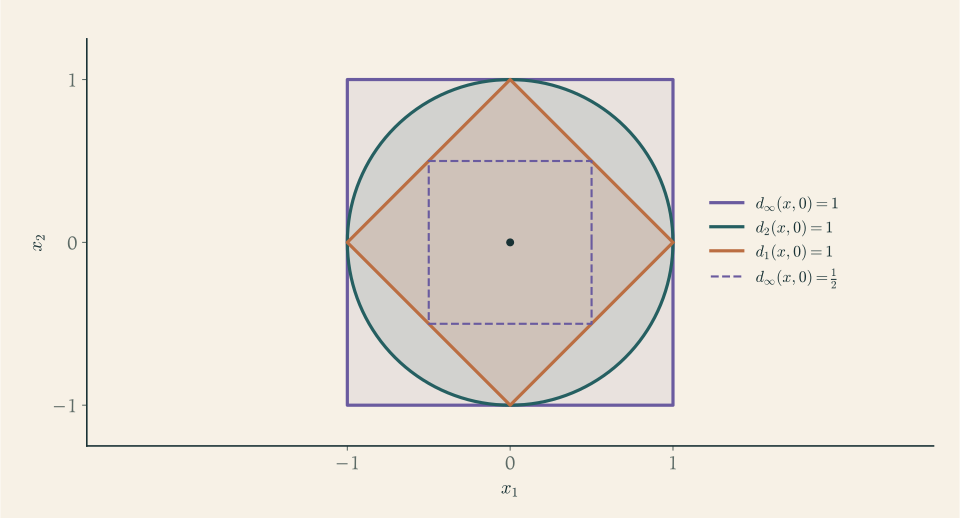
Proposition 4.3 implies that the three metrics on \(\mathbb R^n\) have the same open sets. Writing \(B_1,B_2,B_\infty\) for the balls of the three metrics, the chain of inequalities gives
so a set that contains a ball of one kind about each of its points contains a ball of each other kind as well. This is the content of Figure 4.1.
4.4 Closed sets and limit points
Definition 4.11 (closed set, limit point, closure). A set \(F\subseteq X\) is closed if its complement \(X\setminus F\) is open. A point \(x\in X\) is a limit point of a set \(A\subseteq X\) if every ball \(B(x,r)\) contains a point of \(A\) other than \(x\) . A point of \(A\) that is not a limit point of \(A\) is an isolated point of \(A\) . The closure \(\overline A\) is the union of \(A\) and the set of its limit points.
A limit point of \(A\) need not belong to \(A\) : \(0\) is a limit point of \(\{1/n:n\in\mathbb N\}\) . The definition of “closed” by complements is convenient for proofs about covers; the following theorem gives the form used in proofs about sequences.
Theorem 4.12 (three descriptions of closed sets). For a subset \(F\) of a metric space \(X\) the following are equivalent: (a) \(F\) is closed; (b) whenever \((x_n)\) is a sequence of points of \(F\) that converges to a point \(x\in X\) , the limit \(x\) belongs to \(F\) ; (c) \(F\) contains all of its limit points.
Proof. (a) implies (b). Let \(x_n\in F\) and \(x_n\to x\) , and suppose \(x\notin F\) . The complement of \(F\) is open, so \(B(x,r)\subseteq X\setminus F\) for some \(r>0\) . But \(d(x_n,x)<r\) for large \(n\) , so \(x_n\in B(x,r)\) , contradicting \(x_n\in F\) .
(b) implies (c). Let \(x\) be a limit point of \(F\) . For each \(n\) choose \(x_n\in F\cap B(x,1/n)\) . Then \(d(x_n,x)<1/n\to 0\) , so \(x_n\to x\) , and \(x\in F\) by (b).
(c) implies (a). Let \(x\in X\setminus F\) . By (c), \(x\) is not a limit point of \(F\) , so some ball \(B(x,r)\) contains no point of \(F\) other than possibly \(x\) itself; and \(x\notin F\) . Hence \(B(x,r)\subseteq X\setminus F\) . So the complement of \(F\) is open.
Taking complements in Proposition 4.10 and using De Morgan’s laws: \(\emptyset\) and \(X\) are closed, the intersection of any collection of closed sets is closed, and the union of finitely many closed sets is closed. An infinite union of closed sets need not be closed: the union of the sets \([1/n,1]\) is \((0,1]\) .
Example 4.2: Classifying subsets of the line
For each set we ask whether it is open, closed, both, or neither, as a subset of \(\mathbb R\) .
The interval \((0,1]\) is neither. It is not open because no ball about \(1\) lies inside it. It is not closed because \(1/n\in(0,1]\) and \(1/n\to 0\notin(0,1]\) .
The set \(A=\{1/n:n\in\mathbb N\}\) is neither. It contains no interval, so it is not open, and its limit point \(0\) is missing. Adding it gives \(A\cup\{0\}\) , which is closed: a convergent sequence in it either takes some value infinitely often, and then converges to that value, or involves \(1/n\) for arbitrarily large \(n\) , and then has the subsequential limit \(0\) .
The set \(\mathbb Z\) is closed and not open. It has no limit points at all: the ball of radius \(\tfrac12\) about a real number \(x\) contains at most one integer, and if that integer is some \(k\ne x\) , the smaller ball of radius \(\lvert x-k\rvert\) contains no integer other than possibly \(x\) itself. So \(\mathbb Z\) contains all of its limit points, vacuously.
The set \(\mathbb Q\) is neither. Every interval contains irrationals, so no ball lies in \(\mathbb Q\) ; every real number is a limit of rationals, so the closure of \(\mathbb Q\) is \(\mathbb R\) .
The sets \(\emptyset\) and \(\mathbb R\) are both open and closed, and in \(\mathbb R\) they are the only such sets, a fact equivalent to the Intermediate Value Theorem of Chapter 5.
Common mistake. Arguing “this set is not open, so it is closed”. Open and closed are not opposites. Most sets are neither, a few are both, and to prove a set closed you must show something positive: that its complement is open, or that it contains the limits of its convergent sequences.
Example 4.3: The Cantor set
Start with \(C_0=[0,1]\) . Remove the open middle third to get \(C_1=[0,\tfrac13]\cup[\tfrac23,1]\) . Remove the open middle third of each remaining interval to get \(C_2\) , a union of four intervals of length \(\tfrac19\) , and continue. Formally,
so that \(C_n\) is a union of \(2^n\) disjoint closed intervals of length \(3^{-n}\) . The Cantor set is \(C=\bigcap_{n}C_n\) .
It is closed, as an intersection of closed sets.
It is small. At stage \(n\) we remove \(2^{n-1}\) intervals of length \(3^{-n}\) , so the total length removed is
the full length of \([0,1]\) . Accordingly \(C\) contains no interval of positive length: such an interval would have to fit inside a single interval of \(C_n\) , of length \(3^{-n}\) , for every \(n\) . So \(C\) has empty interior.
It is not just endpoints. The endpoints of the removed intervals, such as \(\tfrac13\) and \(\tfrac29\) , clearly survive. So does \(\tfrac14\) , which is not an endpoint. From the recursion, if \(x\in C_n\) then \(x/3\in C_{n+1}\) and \(\tfrac23+x/3\in C_{n+1}\) . Now \(\tfrac14=\tfrac13\cdot\tfrac34\) and \(\tfrac34=\tfrac23+\tfrac13\cdot\tfrac14\) . Both \(\tfrac14\) and \(\tfrac34\) lie in \(C_0\) , and if both lie in \(C_n\) then both lie in \(C_{n+1}\) . By induction \(\tfrac14\in C_n\) for every \(n\) , so \(\tfrac14\in C\) . In base three, \(\tfrac14=0.020202\ldots\) , and in general \(C\) consists of the numbers in \([0,1]\) that have a ternary expansion using only the digits \(0\) and \(2\) , of which there are uncountably many. (These two general statements are standard; we do not prove them, and nothing later depends on them.)
So \(C\) is a closed set with no interior and of total length zero which nevertheless has far more points than the endpoints one sees. It is the standard test for conjectures about closed sets, and it returns in Chapter 7.
4.5 Compactness
Definition 4.13 (open cover, compact set). Let \(K\) be a subset of a metric space \(X\) . An open cover of \(K\) is a collection of open subsets of \(X\) whose union contains \(K\) . The set \(K\) is compact if every open cover of \(K\) has a finite subcover: finitely many sets of the collection whose union still contains \(K\) .
The definition says “every”, and to show that a set is not compact one exhibits a single cover with no finite subcover. Finite sets are compact: choose one set of the cover for each point. The definition earns its keep on infinite sets.
Example 4.4: The same cover with and without the endpoints
For \(n\in\mathbb N\) let \(W_n=(1/(n+2),\,1/n)\) . Consecutive intervals overlap, since \(1/(n+2)<1/(n+1)<1/n\) , and their union is \((0,1)\) .
The open interval. The family \(\{W_n\}\) is an open cover of \((0,1)\) with no finite subcover. A finite subfamily has a largest index \(N\) , and then the point \(1/(N+3)\) of \((0,1)\) lies in none of its members, each of which is contained in \((1/(N+2),1)\) . So \((0,1)\) is not compact.
The closed interval. To cover \([0,1]\) the family must be enlarged by open sets containing \(0\) and \(1\) ; take \(U=(-0.05,\,0.05)\) and \(V=(0.9,\,1.1)\) . Now a finite subcover exists. The set \(U\) takes care of every point below \(0.05\) , so only the points of \([0.05,1]\) remain, and the single set \(U\) has absorbed all but finitely many of the \(W_n\) . Explicitly, \(W_1,\dots,W_{19}\) have union \((1/21,\,1)\) , which contains \([0.05,1)\) , and \(V\) contains \(1\) . So
is a subcover with \(21\) members. None of them can be dropped: \(U\) and \(V\) are the only members containing \(0\) and \(1\) , and the point \(1/(n+1)\) lies in \(W_n\) and in no other \(W_m\) , while for \(n\le 19\) it is at least \(0.05\) and at most \(0.5\) and so is in neither \(U\) nor \(V\) .
The example shows the mechanism behind the theorems that follow. An open set around the troublesome point \(0\) must swallow a whole neighbourhood of it, and that leaves only finitely much to do.
Theorem 4.14 (compact sets are closed and bounded). A compact subset \(K\) of a metric space \(X\) is closed in \(X\) and bounded.
Proof. Bounded. Fix \(x_0\in X\) . The balls \(B(x_0,n)\) , \(n\in\mathbb N\) , are open and their union is \(X\) . Finitely many cover \(K\) , and since the balls are nested, the largest of those contains \(K\) .
Closed. We may assume \(K\ne\emptyset\) . Let \(x\in X\setminus K\) . For each \(y\in K\) put \(r_y=d(x,y)/2>0\) . The balls \(B(y,r_y)\) , \(y\in K\) , form an open cover of \(K\) ; let \(B(y_1,r_{y_1}),\dots,B(y_m,r_{y_m})\) be a finite subcover and put \(r=\min\{r_{y_1},\dots,r_{y_m}\}>0\) . If some \(z\) were in both \(B(x,r)\) and \(B(y_i,r_{y_i})\) , then \(d(x,y_i)\le d(x,z)+d(z,y_i)<r+r_{y_i}\le 2r_{y_i}=d(x,y_i)\) , which is absurd. So \(B(x,r)\) meets none of the balls of the subcover and hence does not meet \(K\) . Thus \(X\setminus K\) is open.
Proposition 4.15 (closed subsets of compact sets). If \(K\) is compact and \(F\subseteq K\) is closed in \(X\) , then \(F\) is compact.
Proof. Given an open cover of \(F\) , add to it the open set \(X\setminus F\) . The enlarged collection covers \(K\) , so finitely many of its members cover \(K\) . Discard \(X\setminus F\) if it is among them; the rest still cover \(F\) .
In \(\mathbb R^n\) the converse of Theorem 4.14 holds. This is the theorem that makes compactness usable in practice.
Theorem 4.16 (Heine–Borel). A subset of \(\mathbb R^n\) is compact if and only if it is closed and bounded.
Proof. One direction is Theorem 4.14. For the other, we first show that a closed box \(Q=[a_1,b_1]\times\dots\times[a_n,b_n]\) is compact. Let \(D\) be the Euclidean distance between opposite corners of \(Q\) ; any two points of \(Q\) are at distance at most \(D\) .
Suppose some open cover \(\mathcal U\) of \(Q\) has no finite subcover. Bisecting every side cuts \(Q\) into \(2^n\) closed boxes. If each of them were covered by finitely many members of \(\mathcal U\) , so would \(Q\) be; so at least one, call it \(Q_1\) , is not. Bisect \(Q_1\) in the same way and choose \(Q_2\) , and so on. We obtain boxes \(Q\supseteq Q_1\supseteq Q_2\supseteq\cdots\) , none of which is covered by finitely many members of \(\mathcal U\) , and any two points of \(Q_k\) are at distance at most \(D/2^k\) .
In each coordinate the sides of the boxes are nested closed bounded intervals, so by Theorem 1.13 there is a point \(x\) belonging to every \(Q_k\) . Since \(\mathcal U\) covers \(Q\) , some \(U\in\mathcal U\) contains \(x\) , and since \(U\) is open, \(B(x,r)\subseteq U\) for some \(r>0\) . Choose \(k\) with \(D/2^k<r\) . Every point of \(Q_k\) is within \(D/2^k\) of \(x\) , so \(Q_k\subseteq B(x,r)\subseteq U\) . Then \(Q_k\) is covered by a single member of \(\mathcal U\) , contradicting its choice. Hence \(Q\) is compact.
Finally, a closed and bounded set \(K\subseteq\mathbb R^n\) lies in some closed box, and a closed subset of a compact set is compact by Proposition 4.15.
For subsets of the line the theorem says: the compact sets are exactly the closed bounded ones, such as \([a,b]\) , finite unions of closed bounded intervals, the set \(\{0\}\cup\{1/n\}\) , and the Cantor set.
4.6 Compactness through sequences
The Bolzano–Weierstrass theorem and the Heine–Borel theorem look like different kinds of statement. In a metric space they are the same.
Theorem 4.17 (sequential characterisation of compactness). For a subset \(K\) of a metric space \(X\) the following are equivalent: (a) \(K\) is compact; (b) every sequence in \(K\) has a subsequence that converges to a point of \(K\) .
A set with property (b) is called sequentially compact. The proof that (b) implies (a) uses two lemmas, each of interest in itself.
Lemma 4.18 (Lebesgue number). Let \(K\) be sequentially compact and let \(\mathcal U\) be an open cover of \(K\) . Then there is a \(\delta>0\) such that for every \(x\in K\) the ball \(B(x,\delta)\) is contained in a single member of \(\mathcal U\) .
Proof. Suppose no such \(\delta\) exists. Then for each \(n\) there is \(x_n\in K\) such that \(B(x_n,1/n)\) lies in no member of \(\mathcal U\) . By hypothesis a subsequence \(x_{n_k}\) converges to some \(x\in K\) . Choose \(U\in\mathcal U\) with \(x\in U\) and \(r>0\) with \(B(x,r)\subseteq U\) . For large \(k\) both \(d(x_{n_k},x)<r/2\) and \(1/n_k<r/2\) , and then every \(z\in B(x_{n_k},1/n_k)\) satisfies \(d(z,x)<r/2+r/2\) . So \(B(x_{n_k},1/n_k)\subseteq B(x,r)\subseteq U\) , contradicting the choice of \(x_{n_k}\) .
Lemma 4.19 (finitely many small balls suffice). Let \(K\) be sequentially compact and \(\delta>0\) . Then there are finitely many points \(x_1,\dots,x_m\in K\) with \(K\subseteq B(x_1,\delta)\cup\dots\cup B(x_m,\delta)\) .
Proof. Suppose not. Choose \(x_1\in K\) . Since \(B(x_1,\delta)\) does not cover \(K\) , choose \(x_2\in K\) outside it. Since the first two balls do not cover \(K\) , choose \(x_3\in K\) outside both, and so on. This produces a sequence in \(K\) with \(d(x_i,x_j)\ge\delta\) whenever \(i\ne j\) . No subsequence of it is Cauchy, so none converges, contradicting sequential compactness.
Proof. Of Theorem 4.17. (a) implies (b). Let \(K\) be compact and let \((x_n)\) be a sequence in \(K\) . Suppose no subsequence converges to a point of \(K\) . Then every \(y\in K\) has a ball \(B(y,r_y)\) that contains \(x_n\) for only finitely many indices \(n\) ; otherwise we could choose indices \(n_1<n_2<\cdots\) with \(d(x_{n_k},y)<1/k\) and obtain a subsequence converging to \(y\) . These balls cover \(K\) , so finitely many of them cover \(K\) . Each of the finitely many contains \(x_n\) for only finitely many \(n\) , yet together they contain \(x_n\) for every \(n\in\mathbb N\) . That is impossible.
(b) implies (a). Let \(\mathcal U\) be an open cover of \(K\) . Take \(\delta\) from Lemma 4.18 and then points \(x_1,\dots,x_m\) from Lemma 4.19. Each ball \(B(x_i,\delta)\) lies in some \(U_i\in\mathcal U\) , and the balls cover \(K\) . So \(U_1,\dots,U_m\) is a finite subcover.
Combining Theorems 4.16 and 4.17: a subset of \(\mathbb R^n\) is closed and bounded exactly when every sequence in it has a subsequence converging to a point of it. For proofs, the sequential form is usually the handier one; the open-cover form is better at producing a single finite number that works everywhere, as in the proof of Theorem 4.14, where the smallest of finitely many radii did the work. Chapter 5 uses each where it is strongest.
Theorem 4.20 (nested compact sets). If \(K_1\supseteq K_2\supseteq K_3\supseteq\cdots\) are nonempty compact subsets of a metric space, then \(\bigcap_nK_n\) is not empty.
Proof. Choose \(x_n\in K_n\) . The sequence lies in \(K_1\) , so a subsequence \(x_{n_k}\) converges to some \(x\in K_1\) . Fix \(m\) . For \(k\ge m\) we have \(n_k\ge m\) and so \(x_{n_k}\in K_{n_k}\subseteq K_m\) . The set \(K_m\) is closed by Theorem 4.14, so \(x\in K_m\) by Theorem 4.12. Since \(m\) was arbitrary, \(x\) lies in every \(K_m\) .
This generalises the nested interval theorem from intervals on the line to compact sets anywhere.
Example 4.5: Closed and bounded is not enough outside Euclidean space
An infinite discrete space. Let \(X\) be an infinite set with the discrete metric. The whole space is closed in itself, and bounded, since it is contained in a ball of radius \(2\) . It is not compact: the balls \(B(x,\tfrac12)=\{x\}\) form an open cover, and no finite number of one-point sets covers an infinite set.
A ball of bounded sequences. Let \(X=B(\mathbb N)\) be the space of bounded real sequences with the supremum metric, and let \(K\) be the closed unit ball, the set of sequences \(f\) with \(\sup_j\lvert f(j)\rvert\le 1\) . It is closed and bounded. For each \(k\) let \(e_k\in K\) be the sequence that is \(1\) in position \(k\) and \(0\) elsewhere. If \(j\ne k\) , then \(\lvert e_j(i)-e_k(i)\rvert\) equals \(1\) at \(i=j\) and at \(i=k\) and equals \(0\) elsewhere, so \(d_\infty(e_j,e_k)=1\) . No subsequence of \((e_k)\) is Cauchy. By Theorem 4.17, \(K\) is not compact.
The rationals. In the metric space \(\mathbb Q\) the set \(\{q\in\mathbb Q:0\le q\le 2\}\) is closed and bounded. The rational sequence \(1,\,4/3,\,7/5,\dots\) of Example 1.3 lies in it and has no subsequence converging to a point of \(\mathbb Q\) .
Common mistake. Using “closed and bounded” as the definition of compact. It is a theorem about \(\mathbb R^n\)
, not a definition, and it is false in general metric spaces, as the three cases of Example 4.5 show. Before invoking Heine–Borel, name the ambient space. In an infinite-dimensional space of functions, compactness requires more than boundedness; describing what more is a central topic of Functional Analysis, where complete normed spaces are studied under the name of Banach spaces (math.functional-analysis.banach-space).
The chapter has assembled the vocabulary: metric, open, closed, complete, compact. So far the only maps between metric spaces we have considered are sequences. Chapter 5 turns to continuous functions and shows what compactness is for: on a compact set a continuous function is bounded, attains its bounds, and is continuous in a stronger, uniform sense.
Exercises
-
Compute \(d_1\) , \(d_2\) , and \(d_\infty\) between \((2,-1,3)\) and \((0,3,-1)\) in \(\mathbb R^3\) , and check the chain of inequalities of Proposition 4.3 for these numbers.
Answer
The coordinate differences are \(2,-4,4\) . So \(d_1=2+4+4=10\) , \(d_2=\sqrt{4+16+16}=6\) , \(d_\infty=4\) , and the chain reads \(4\le 6\le 10\le 3\cdot 4=12\) .
-
Decide which of the following are metrics on \(\mathbb R\) , proving your answers: (a) \((x-y)^2\) ; (b) \(\lvert x^2-y^2\rvert\) ; (c) \(\sqrt{\lvert x-y\rvert}\) ; (d) \(\lvert x-y\rvert/(1+\lvert x-y\rvert)\) .
Solution
(a) Not a metric. The triangle inequality fails: with \(x=0\) , \(y=1\) , \(z=2\) we get \(d(x,z)=4\) but \(d(x,y)+d(y,z)=1+1=2\) .
(b) Not a metric. (M1) fails: \(d(1,-1)=\lvert 1-1\rvert=0\) although \(1\ne-1\) .
(c) A metric. (M1) and (M2) are clear. For (M3) we use two facts about square roots of nonnegative numbers: the square root is increasing, and \(\sqrt{a+b}\le\sqrt a+\sqrt b\) , which follows by squaring, since \(a+b\le a+b+2\sqrt{ab}\) . Hence
\[ \sqrt{\lvert x-z\rvert}\le\sqrt{\lvert x-y\rvert+\lvert y-z\rvert}\le\sqrt{\lvert x-y\rvert}+\sqrt{\lvert y-z\rvert}. \](d) A metric. Let \(\varphi(t)=t/(1+t)=1-1/(1+t)\) for \(t\ge 0\) . Then \(\varphi(t)=0\) only for \(t=0\) , which gives (M1); (M2) is clear. The function \(\varphi\) is increasing, and for \(a,b\ge 0\)
\[ \varphi(a+b)=\frac{a}{1+a+b}+\frac{b}{1+a+b}\le\frac{a}{1+a}+\frac{b}{1+b}=\varphi(a)+\varphi(b). \]Therefore \(\varphi(\lvert x-z\rvert)\le\varphi(\lvert x-y\rvert+\lvert y-z\rvert)\le\varphi(\lvert x-y\rvert)+\varphi(\lvert y-z\rvert)\) , which is (M3).
The pattern in (c) and (d) is general: if \(\varphi\) is increasing, vanishes only at \(0\) , and satisfies \(\varphi(a+b)\le\varphi(a)+\varphi(b)\) , then \(\varphi\circ d\) is a metric whenever \(d\) is. The squaring function in (a) fails the last condition.
-
Let \(X\) be a set with the discrete metric. Describe the open balls, the open sets, the convergent sequences, the Cauchy sequences, and the compact subsets of \(X\) , with proofs.
Solution
Balls. If \(r\le 1\) , then \(d(x,y)<r\) forces \(d(x,y)=0\) , so \(B(x,r)=\{x\}\) . If \(r>1\) , every \(y\) satisfies \(d(x,y)\le 1<r\) , so \(B(x,r)=X\) .
Open sets. Every subset \(U\) is open, because for \(x\in U\) the ball \(B(x,1)=\{x\}\) lies in \(U\) . Consequently every subset is also closed.
Convergent sequences. If \(x_n\to x\) , apply the definition with \(\varepsilon=1\) : for \(n\ge N\) , \(d(x_n,x)<1\) , so \(x_n=x\) . Conversely an eventually constant sequence converges. So the convergent sequences are exactly the eventually constant ones.
Cauchy sequences. The same argument with \(\varepsilon=1\) shows that a Cauchy sequence satisfies \(x_n=x_m\) for all \(m,n\ge N\) , so it is eventually constant and therefore convergent. The space is complete.
Compact subsets. A finite set is compact in any metric space. If \(A\) is infinite, the one-point sets \(\{a\}=B(a,1)\) , \(a\in A\) , form an open cover of \(A\) , and finitely many of them cover only finitely many points. So the compact subsets are exactly the finite ones. In particular an infinite discrete space is closed and bounded in itself but not compact.
-
Prove that in any metric space \(\lvert d(x,z)-d(y,z)\rvert\le d(x,y)\) , and deduce that if \(x_n\to x\) then \(d(x_n,z)\to d(x,z)\) for every point \(z\) .
Hint
From (M3), \(d(x,z)\le d(x,y)+d(y,z)\) , so \(d(x,z)-d(y,z)\le d(x,y)\) . Exchange \(x\) and \(y\) and use (M2). For the deduction apply the inequality with \(x_n\) in place of \(y\) .
-
In \(B([0,1])\) with the supremum metric, compute the distance between \(f(x)=x^2\) and \(g(x)=x^3\) . Then compute, for each \(n\) , the distance in \(B([0,1))\) between \(h_n(x)=x^n\) and the zero function, and say whether \(h_n\) converges to the zero function in that space.
Answer
\(x^2-x^3\ge 0\) on \([0,1]\) , with derivative \(2x-3x^2\) vanishing at \(x=2/3\) , where the value is \(4/9-8/27=4/27\) ; the endpoint values are \(0\) . So \(d_\infty(f,g)=4/27\approx 0.148\) . For each \(n\) , \(\sup_{0\le x<1}x^n=1\) , since \(x^n<1\) and \(x^n\to 1\) as \(x\to 1\) ; so \(d_\infty(h_n,0)=1\) for every \(n\) and \(h_n\) does not converge to the zero function in \(B([0,1))\) , although \(h_n(x)\to 0\) for each fixed \(x\) .
-
For each subset of \(\mathbb R\) find the interior, the set of limit points, and the closure, and say whether the set is open, closed, both, or neither: (a) \([0,1)\cup\{2\}\) ; (b) \(\{(-1)^n+1/n:n\in\mathbb N\}\) ; (c) \(\mathbb Q\cap(0,1)\) ; (d) \(\bigcap_{n}(-1/n,\,1+1/n)\) .
Answer
(a) Interior \((0,1)\) ; limit points \([0,1]\) ; closure \([0,1]\cup\{2\}\) ; neither. (b) Interior empty; limit points \(\{-1,1\}\) ; closure is the set together with \(-1\) and \(1\) ; neither. (c) Interior empty; limit points \([0,1]\) ; closure \([0,1]\) ; neither. (d) The intersection is \([0,1]\) : interior \((0,1)\) ; limit points and closure \([0,1]\) ; closed, not open.
-
Let \(A\) be a subset of a metric space. Prove that the closure \(\overline A\) is closed, and that it is the smallest closed set containing \(A\) : if \(F\) is closed and \(A\subseteq F\) , then \(\overline A\subseteq F\) .
Solution
The closure is closed. By Theorem 4.12 it suffices to show that \(\overline A\) contains each of its limit points. Let \(x\) be a limit point of \(\overline A\) and let \(r>0\) . The ball \(B(x,r)\) contains a point \(y\in\overline A\) with \(y\ne x\) . If \(y\in A\) , then \(B(x,r)\) contains a point of \(A\) other than \(x\) . If \(y\notin A\) , then \(y\) is a limit point of \(A\) . Put \(\rho=\min\{r-d(x,y),\,d(x,y)\}>0\) . The ball \(B(y,\rho)\) contains a point \(a\in A\) . Then \(d(x,a)\le d(x,y)+d(y,a)<d(x,y)+\rho\le r\) , so \(a\in B(x,r)\) ; and \(a\ne x\) , because \(d(y,a)<\rho\le d(x,y)\) . In either case \(B(x,r)\) contains a point of \(A\) other than \(x\) . As \(r\) was arbitrary, \(x\) is a limit point of \(A\) , so \(x\in\overline A\) .
It is the smallest. Let \(F\) be closed with \(A\subseteq F\) . If \(x\) is a limit point of \(A\) , every ball about \(x\) contains a point of \(A\) other than \(x\) , and that point is in \(F\) ; so \(x\) is a limit point of \(F\) , and \(x\in F\) because \(F\) is closed. Hence \(F\) contains \(A\) and all limit points of \(A\) , that is, \(\overline A\subseteq F\) .
It follows that \(A\) is closed if and only if \(A=\overline A\) .
-
Prove that the following are equivalent for a point \(x\) and a nonempty set \(A\) in a metric space: \(x\in\overline A\) ; some sequence in \(A\) converges to \(x\) ; \(\inf\{d(x,a):a\in A\}=0\) .
Hint
If \(x\in\overline A\) , either \(x\in A\) (use the constant sequence) or \(x\) is a limit point (choose \(a_n\in A\cap B(x,1/n)\) ). If \(a_n\to x\) with \(a_n\in A\) , then \(d(x,a_n)\to 0\) , so the infimum is \(0\) . If the infimum is \(0\) and \(x\notin A\) , every ball about \(x\) contains a point of \(A\) , necessarily different from \(x\) .
-
In \(\mathbb R^2\) with the Euclidean metric, prove from the definitions that the open unit disc \(\{p:d_2(p,0)<1\}\) is open and that the hyperbola \(\{(x,y):xy=1\}\) is closed. Is the hyperbola compact?
Solution
The disc is open. Let \(p\) satisfy \(d_2(p,0)<1\) and put \(r=1-d_2(p,0)>0\) . If \(q\in B(p,r)\) , then \(d_2(q,0)\le d_2(q,p)+d_2(p,0)<r+d_2(p,0)=1\) . So \(B(p,r)\) lies in the disc.
The hyperbola is closed. Let \(H=\{(x,y):xy=1\}\) , and let \((x_k,y_k)\in H\) converge to \((x,y)\in\mathbb R^2\) . By Proposition 4.7, \(x_k\to x\) and \(y_k\to y\) in \(\mathbb R\) . By the product law, \(x_ky_k\to xy\) . But \(x_ky_k=1\) for every \(k\) , so \(xy=1\) and \((x,y)\in H\) . By Theorem 4.12, \(H\) is closed.
It is not compact. The points \((k,1/k)\) , \(k\in\mathbb N\) , lie on \(H\) and have distance at least \(k\) from the origin, so \(H\) is not bounded. By Theorem 4.14 (or Heine–Borel) it is not compact. Concretely, the sequence \((k,1/k)\) has no convergent subsequence, since its first coordinates are unbounded along every subsequence.
-
A student writes: “Every point of \(A=\{1/n:n\in\mathbb N\}\) is isolated, so \(A\) has no limit points, so \(A\) contains all its limit points and is closed.” Find the error and state what the first observation does prove.
Answer
“Isolated” means that a point of \(A\) is not a limit point of \(A\) . So the first observation proves only that no limit point of \(A\) lies in \(A\) . It says nothing about points outside \(A\) , and \(0\notin A\) is a limit point of \(A\) . Hence \(A\) does not contain all its limit points and is not closed.
-
For each set, exhibit an open cover that has no finite subcover, and prove that it has none: (a) \([1,\infty)\) ; (b) \(\{1/n:n\in\mathbb N\}\) ; (c) \(\mathbb Q\cap[0,2]\) , regarded as a subset of \(\mathbb R\) .
Solution
(a) Let \(U_n=(0,n)\) for \(n\in\mathbb N\) . Every \(x\ge 1\) lies in \(U_n\) once \(n>x\) , by the Archimedean property, so the \(U_n\) cover \([1,\infty)\) . The sets are nested, so the union of finitely many of them is the largest, some \(U_N=(0,N)\) , which does not contain the point \(N\in[1,\infty)\) .
(b) The gap between \(1/n\) and its nearest neighbour \(1/(n+1)\) is \(1/(n(n+1))\) . Let \(\delta_n=1/(2n(n+1))\) and \(U_n=(1/n-\delta_n,\ 1/n+\delta_n)\) . Then \(U_n\) contains \(1/n\) and no other point of the set, since every other point is at distance at least \(1/(n(n+1))>\delta_n\) from \(1/n\) . The \(U_n\) cover the set, and each point lies in exactly one of them, so a subfamily that omits \(U_n\) fails to cover \(1/n\) . No finite subfamily covers the infinite set.
(c) Let \(U_n=\{x\in\mathbb R:\lvert x-\sqrt2\rvert>1/n\}\) , a union of two open rays. Since \(\sqrt2\) is irrational, every rational \(q\) has \(\lvert q-\sqrt2\rvert>0\) and so lies in some \(U_n\) : the \(U_n\) cover \(\mathbb Q\cap[0,2]\) . They are nested, so finitely many of them have union \(U_N\) for some \(N\) . By density of the rationals there is a rational \(q\) with \(\sqrt2<q<\min\{\sqrt2+1/N,\,2\}\) . Then \(q\in\mathbb Q\cap[0,2]\) and \(q\notin U_N\) .
In each case the cover exploits a specific defect: unboundedness in (a), a missing limit point \(0\) in (b), a missing limit point \(\sqrt2\) in (c).
-
Prove directly from Definition 4.13, without the Heine–Borel theorem, that \(K=\{0\}\cup\{1/n:n\in\mathbb N\}\) is compact.
Solution
Let \(\mathcal U\) be an open cover of \(K\) . Some member \(U_0\in\mathcal U\) contains \(0\) . Since \(U_0\) is open there is \(r>0\) with \((-r,r)\subseteq U_0\) . By the Archimedean property choose \(N\) with \(1/N<r\) . Then \(1/n\in(-r,r)\subseteq U_0\) for every \(n\ge N\) .
The points of \(K\) not yet accounted for are among \(1,\tfrac12,\dots,\tfrac1{N-1}\) , finitely many. For each \(n<N\) choose a member \(U_n\in\mathcal U\) containing \(1/n\) . Then \(U_0,U_1,\dots,U_{N-1}\) is a finite subfamily of \(\mathcal U\) whose union contains \(K\) .
This is the mechanism of Example 4.4 in its simplest form. The single open set around the limit point \(0\) contains all but finitely many points of \(K\) . Remove \(0\) from \(K\) and the argument has nowhere to start, which is Exercise 11(b).
-
Prove that the union of two compact sets is compact and that the intersection of any collection of compact sets is compact. Give an example of a countable union of compact sets that is not compact.
Hint
For the union, take finite subcovers for each set and combine them. For the intersection, note that it is a closed set (compact sets are closed, and intersections of closed sets are closed) contained in any one of the compact sets, and use Proposition 4.15. For the example, \(\bigcup_n[-n,n]=\mathbb R\) , or \(\bigcup_n[1/n,1]=(0,1]\) .
-
Prove that a compact metric space is complete. Is every complete metric space compact?
Solution
Let \(X\) be a compact metric space and let \((x_n)\) be a Cauchy sequence in \(X\) . By Theorem 4.17, applied to \(K=X\) , some subsequence of \((x_n)\) converges to a point \(x\in X\) . By Proposition 4.6(c), a Cauchy sequence with a convergent subsequence converges to the limit of that subsequence. So \(x_n\to x\) . Every Cauchy sequence in \(X\) converges in \(X\) ; that is, \(X\) is complete.
The converse is false. The real line is complete by Theorem 2.16, but it is not compact: it is not bounded, or directly, the open cover by the intervals \((-n,n)\) has no finite subcover.
So compactness is strictly stronger than completeness. The missing ingredient is the total boundedness of Exercise 19: a complete space in which, for every \(\delta\) , finitely many balls of radius \(\delta\) cover everything is compact.
-
Let \(K\) and \(F\) be disjoint nonempty subsets of a metric space, with \(K\) compact and \(F\) closed. Prove that \(\inf\{d(x,y):x\in K,\ y\in F\}>0\) . Show by an example in \(\mathbb R^2\) that the conclusion can fail if \(K\) is only assumed closed.
Solution
The proof. Let \(\delta=\inf\{d(x,y):x\in K,\ y\in F\}\) , which exists because the set is nonempty and bounded below by \(0\) . Suppose \(\delta=0\) . Then for each \(n\) there are \(x_n\in K\) and \(y_n\in F\) with \(d(x_n,y_n)<1/n\) . Since \(K\) is compact, Theorem 4.17 gives a subsequence \(x_{n_k}\to x\) with \(x\in K\) . Then
\[ d(y_{n_k},x)\le d(y_{n_k},x_{n_k})+d(x_{n_k},x)<\frac1{n_k}+d(x_{n_k},x)\to 0, \]so \(y_{n_k}\to x\) as well. Since \(F\) is closed, \(x\in F\) by Theorem 4.12. Thus \(x\in K\cap F\) , contradicting disjointness. Hence \(\delta>0\) .
The example. In \(\mathbb R^2\) let \(K=\{(x,0):x\in\mathbb R\}\) be the horizontal axis and \(F=\{(x,1/x):x>0\}\) a branch of a hyperbola. Both are closed (for \(F\) , argue as in Exercise 9, noting that a limit of points with \(xy=1\) and \(x>0\) has \(xy=1\) and \(x\ge 0\) , hence \(x>0\) ). They are disjoint because \(1/x\ne 0\) . But the points \((x,0)\in K\) and \((x,1/x)\in F\) are at distance \(1/x\) , which is \(0.001\) for \(x=1000\) and tends to \(0\) . So the infimum is \(0\) . Neither set is compact; the points that would realise distance \(0\) have escaped to infinity.
-
Prove that \([a,b]\) is compact by a supremum argument: given an open cover, let \(S\) be the set of \(x\in[a,b]\) such that \([a,x]\) is covered by finitely many members, and show that \(\sup S\) belongs to \(S\) and equals \(b\) .
Hint
\(a\in S\) , so \(S\) is nonempty and bounded above by \(b\) ; let \(s=\sup S\) . Some member \(U\) of the cover contains \(s\) , and \((s-r,s+r)\subseteq U\) for some \(r>0\) . Pick \(x\in S\) with \(x>s-r\) ; a finite cover of \([a,x]\) together with \(U\) covers \([a,t]\) for every \(t\in[x,s+r)\cap[a,b]\) . Deduce that \(s\in S\) , and that \(s<b\) would contradict \(s\) being an upper bound.
-
Decide which of the numbers \(\tfrac13\) , \(\tfrac12\) , and \(\tfrac7{10}\) belong to the Cantor set, with proof. For \(\tfrac7{10}\) , find a finite set of points containing it that is carried into itself by the two maps \(x\mapsto x/3\) and \(x\mapsto\tfrac23+x/3\) in the sense used for \(\tfrac14\) in Example 4.3.
Solution
Recall from Example 4.3 that if \(x\in C_n\) then \(x/3\in C_{n+1}\) and \(\tfrac23+x/3\in C_{n+1}\) .
\(\tfrac13\) belongs to \(C\) . First, \(1\in C_n\) for every \(n\) : \(1\in C_0\) , and if \(1\in C_n\) then \(1=\tfrac23+\tfrac13\cdot 1\in C_{n+1}\) . Then \(\tfrac13=\tfrac13\cdot 1\in C_{n+1}\) for every \(n\) , and \(\tfrac13\in C_0\) . So \(\tfrac13\in C\) .
\(\tfrac12\) does not. The first stage removes the open interval \((\tfrac13,\tfrac23)\) , which contains \(\tfrac12\) . So \(\tfrac12\notin C_1\) and hence \(\tfrac12\notin C\) .
\(\tfrac7{10}\) belongs to \(C\) . Consider the set \(P=\{\tfrac1{10},\tfrac3{10},\tfrac7{10},\tfrac9{10}\}\) . Each of its points is the image of another under one of the two maps:
\[ \tfrac1{10}=\tfrac13\cdot\tfrac3{10},\qquad\tfrac3{10}=\tfrac13\cdot\tfrac9{10},\qquad\tfrac7{10}=\tfrac23+\tfrac13\cdot\tfrac1{10},\qquad\tfrac9{10}=\tfrac23+\tfrac13\cdot\tfrac7{10}. \]All four points lie in \(C_0=[0,1]\) . If all four lie in \(C_n\) , the displayed identities show that all four lie in \(C_{n+1}\) . By induction \(P\subseteq C_n\) for every \(n\) , so \(P\subseteq C\) , and in particular \(\tfrac7{10}\in C\) .
In base three, \(\tfrac7{10}=0.20022002\ldots\) , with only the digits \(0\) and \(2\) , as the description of \(C\) by ternary expansions predicts. None of the four points of \(P\) is an endpoint of a removed interval, since endpoints have denominators that are powers of \(3\) .
-
Let \((x_n)\) be a bounded sequence of real numbers and let \(E\) be the set of its subsequential limits. Prove that \(E\) is a nonempty compact set. (Its largest and smallest elements are then the limit superior and inferior.)
Solution
Let \(\lvert x_n\rvert\le M\) for all \(n\) .
Nonempty. By the Bolzano–Weierstrass theorem some subsequence converges, so \(E\ne\emptyset\) .
Bounded. If \(x_{n_k}\to t\) , then \(-M\le x_{n_k}\le M\) for all \(k\) gives \(-M\le t\le M\) by Theorem 2.5. So \(E\subseteq[-M,M]\) .
Closed. Let \(t_j\in E\) with \(t_j\to t\) ; we show \(t\in E\) by building a subsequence of \((x_n)\) converging to \(t\) . Suppose indices \(n_1<\dots<n_{k-1}\) have been chosen. Choose \(j\) with \(\lvert t_j-t\rvert<1/(2k)\) . Since \(t_j\) is the limit of a subsequence of \((x_n)\) , infinitely many indices \(n\) satisfy \(\lvert x_n-t_j\rvert<1/(2k)\) ; choose one with \(n>n_{k-1}\) and call it \(n_k\) . Then
\[ \lvert x_{n_k}-t\rvert\le\lvert x_{n_k}-t_j\rvert+\lvert t_j-t\rvert<\frac1k . \]So \(x_{n_k}\to t\) and \(t\in E\) . By Theorem 4.12, \(E\) is closed.
A closed bounded subset of \(\mathbb R\) is compact by the Heine–Borel theorem. Being compact and nonempty, \(E\) contains its supremum and infimum; by Theorem 2.19(b) these are \(\limsup x_n\) and \(\liminf x_n\) .
-
A metric space is totally bounded if for every \(\delta>0\) it is a union of finitely many balls of radius \(\delta\) . Prove that a metric space is compact if and only if it is complete and totally bounded.
Hint
If \(X\) is compact, it is complete by Exercise 14 and totally bounded by Lemma 4.19 with \(K=X\) . Conversely, let \(X\) be complete and totally bounded and let \((x_n)\) be a sequence. Some ball of radius \(1\) contains \(x_n\) for infinitely many \(n\) ; among those indices, some ball of radius \(\tfrac12\) contains infinitely many; and so on with radii \(1/k\) . Choose \(n_1<n_2<\cdots\) with \(x_{n_k}\) taken from the \(k\) th stage. The subsequence is Cauchy, hence convergent, and Theorem 4.17 applies.
-
In the metric space \(\mathbb Q\) let \(K=\{q\in\mathbb Q:0\le q\le 2\}\) . Explain why \(K\) is closed and bounded in \(\mathbb Q\) , and exhibit an open cover of \(K\) by open subsets of \(\mathbb Q\) with no finite subcover.
Answer
\(K\) is bounded, being inside the ball of radius \(3\) about \(0\) . It is closed in \(\mathbb Q\) because a sequence in \(K\) that converges to a rational number has its limit in \([0,2]\) , hence in \(K\) . For the cover take \(V_n=\{q\in\mathbb Q:\lvert q-\sqrt2\rvert>1/n\}\) ; these are open subsets of \(\mathbb Q\) that cover \(K\) , and as in Exercise 11(c) no finite number of them does.
-
Prove that a sequence in \(\mathbb R^n\) converges for one of the metrics \(d_1,d_2,d_\infty\) if and only if it converges for the others, and that the discrete metric on \(\mathbb R\) does not have the same convergent sequences as the usual metric.
Hint
Use \(d_\infty\le d_2\le d_1\le n\,d_\infty\) : if one of the three distances \(d(p_k,p)\) tends to \(0\) , the chain squeezes the others to \(0\) . For the discrete metric, \(1/n\to 0\) in the usual metric, but in the discrete metric a convergent sequence is eventually constant (Exercise 3).