Two drivers take the same mountain road. One brakes hard into every bend; the other holds a steady pace. Their trips are different functions of time, and yet the road is one road, with one length and one sequence of bends. Which of the quantities we can compute from a trip belong to the driver, and which belong to the road?
This chapter answers that question, and in doing so assembles the geometric language the rest of the book speaks. Vectors measure length, angle, area, and direction. Lines and planes are the flat objects against which curved ones are compared. A curve is a vector-valued function of one variable, and its derivative is a velocity. Speed and acceleration depend on the driver. Arc length and curvature do not, and proving that they do not is the first real theorem of the course.
1.1 Length, angle, and projection
For vectors \(\mathbf a,\mathbf b\in\mathbb R^n\) the dot product is \(\mathbf a\cdot\mathbf b=a_1b_1+\dots+a_nb_n\) and the length of \(\mathbf a\) is \(\lVert\mathbf a\rVert=\sqrt{\mathbf a\cdot\mathbf a}\) . The one inequality about these that we use constantly is the Cauchy–Schwarz inequality from linear algebra: for all \(\mathbf a,\mathbf b\in\mathbb R^n\) ,
with equality exactly when one vector is a scalar multiple of the other; the proof is given in Linear Algebra. It guarantees that the quotient \(\mathbf a\cdot\mathbf b/(\lVert\mathbf a\rVert\lVert\mathbf b\rVert)\) lies in \([-1,1]\) for nonzero vectors, so there is a unique angle \(\theta\in[0,\pi]\) with
Two vectors are orthogonal when \(\mathbf a\cdot\mathbf b=0\) . The dot product is positive when the vectors make an acute angle and negative when the angle is obtuse; this sign is how a formula knows whether a force helps or hinders a motion, or whether a flow crosses a surface outward or inward.
The dot product also splits one vector along another. If \(\mathbf b\ne\mathbf 0\) , the projection of \(\mathbf a\) onto \(\mathbf b\) is
the unique multiple of \(\mathbf b\) for which the remainder \(\mathbf a-\operatorname{proj}_{\mathbf b}\mathbf a\) is orthogonal to \(\mathbf b\) . Its signed length, \(\mathbf a\cdot\mathbf b/\lVert\mathbf b\rVert\) , is the component of \(\mathbf a\) in the direction of \(\mathbf b\) . Almost every “how much of this is along that” question in the book is a component.
1.2 The cross product, lines, and planes
In \(\mathbb R^3\) two vectors determine a third, in a way that has no counterpart in the plane.
Definition 1.1 (cross product). For \(\mathbf a=(a_1,a_2,a_3)\) and \(\mathbf b=(b_1,b_2,b_3)\) in \(\mathbb R^3\) ,
Proposition 1.2 (geometry of the cross product). For \(\mathbf a,\mathbf b\in\mathbb R^3\) : (a) \(\mathbf a\times\mathbf b\) is orthogonal to both \(\mathbf a\) and \(\mathbf b\) ; (b) \(\lVert\mathbf a\times\mathbf b\rVert=\lVert\mathbf a\rVert\,\lVert\mathbf b\rVert\sin\theta\) , the area of the parallelogram spanned by \(\mathbf a\) and \(\mathbf b\) , where \(\theta\) is the angle between them; (c) \(\mathbf b\times\mathbf a=-\mathbf a\times\mathbf b\) , and \(\mathbf a\times\mathbf b=\mathbf 0\) exactly when \(\mathbf a\) and \(\mathbf b\) are parallel.
Proof. For (a), expand \(\mathbf a\cdot(\mathbf a\times\mathbf b)=a_1(a_2b_3-a_3b_2)+a_2(a_3b_1-a_1b_3)+a_3(a_1b_2-a_2b_1)\) ; the six terms cancel in pairs. The same happens for \(\mathbf b\) . For (b), a direct expansion, which is Exercise 4, gives the identity \(\lVert\mathbf a\times\mathbf b\rVert^{2}=\lVert\mathbf a\rVert^{2}\lVert\mathbf b\rVert^{2}-(\mathbf a\cdot\mathbf b)^{2}\) . Substituting \(\mathbf a\cdot\mathbf b=\lVert\mathbf a\rVert\lVert\mathbf b\rVert\cos\theta\) turns the right side into \(\lVert\mathbf a\rVert^{2}\lVert\mathbf b\rVert^{2}\sin^{2}\theta\) , and \(\sin\theta\ge 0\) on \([0,\pi]\) . A parallelogram with sides \(\lVert\mathbf a\rVert\) and \(\lVert\mathbf b\rVert\) meeting at angle \(\theta\) has height \(\lVert\mathbf b\rVert\sin\theta\) over the base \(\lVert\mathbf a\rVert\) , which is the area claim. For (c), swapping \(\mathbf a\) and \(\mathbf b\) in Definition 1.1 changes the sign of each entry, and by (b) the product vanishes exactly when a vector is zero or \(\sin\theta=0\) .
Parts (a) and (b) fix the line along which \(\mathbf a\times\mathbf b\) points and its length, leaving two candidates. The definition picks the one given by the right-hand rule: \(\mathbf i\times\mathbf j=\mathbf k\) . Part (c) is the price. The cross product is not commutative, and every later statement about orientation, from the sign of a flux to the direction of a boundary curve, descends from this sign.
A line through the point \(\mathbf p\) with direction \(\mathbf d\ne\mathbf 0\) is the set of points \(\mathbf p+t\mathbf d\) , \(t\in\mathbb R\) . A plane through \(\mathbf p\) with normal vector \(\mathbf n\ne\mathbf 0\) is the set of points \(\mathbf x\) with
that is, the points whose displacement from \(\mathbf p\) has no component along \(\mathbf n\) . Writing \(\mathbf n=(a,b,c)\) gives the familiar equation \(ax+by+cz=d\) with \(d=\mathbf n\cdot\mathbf p\) , and conversely the coefficients of any such equation are the entries of a normal vector. The distance from a point \(\mathbf q\) to the plane is the absolute value of the component of \(\mathbf q-\mathbf p\) along \(\mathbf n\) :
Example 1.1: A plane through three points
Find the plane through \(A=(1,0,2)\) , \(B=(3,1,1)\) , and \(C=(0,2,4)\) , the area of the triangle \(ABC\) , and the distance from \(Q=(2,3,5)\) to the plane.
Two directions lying in the plane are \(\overrightarrow{AB}=(2,1,-1)\) and \(\overrightarrow{AC}=(-1,2,2)\) . A normal vector must be orthogonal to both, and Proposition 1.2(a) hands us one:
The plane is \(4(x-1)-3(y-0)+5(z-2)=0\) , that is, \(4x-3y+5z=14\) . As a check, \(B\) gives \(12-3+5=14\) and \(C\) gives \(0-6+20=14\) .
The triangle is half of the parallelogram spanned by the two edge vectors, so by Proposition 1.2(b) its area is \(\tfrac12\lVert\mathbf n\rVert=\tfrac12\sqrt{16+9+25}\) , which is \(\tfrac12\sqrt{50}=\tfrac52\sqrt2\) .
For the distance, \(\mathbf n\cdot(Q-A)=4\cdot 1-3\cdot 3+5\cdot 3=10\) , so
One cross product produced the equation of the plane and the area of the triangle at once; that economy is why the cross product is the standard tool for normals.
1.3 Curves, velocity, and speed
Definition 1.3 (vector-valued function and its derivative). A vector-valued function on an interval \(I\) is a map \(\mathbf r:I\to\mathbb R^n\) , \(\mathbf r(t)=(x_1(t),\dots,x_n(t))\) . It is differentiable at \(t\) if the limit
exists. The limit of a vector-valued expression is taken in each coordinate, so \(\mathbf r'(t)=(x_1'(t),\dots,x_n'(t))\) , and \(\mathbf r\) is differentiable exactly when every coordinate function is.
The image of \(\mathbf r\) is a curve and \(\mathbf r\) is a parametrization of it. The distinction matters. The road is the curve; a trip along it is a parametrization. When \(t\) is time, \(\mathbf r'(t)\) is the velocity, the number \(\lVert\mathbf r'(t)\rVert\) is the speed, and \(\mathbf r''(t)\) is the acceleration. The difference quotient in Definition 1.3 is a displacement divided by an elapsed time, a chord of the curve rescaled, and as \(h\to 0\) the chords turn into the tangent direction. So when \(\mathbf r'(t_0)\ne\mathbf 0\) the tangent line at \(\mathbf r(t_0)\) is the line \(\mathbf r(t_0)+s\,\mathbf r'(t_0)\) .
Because differentiation is coordinatewise, the familiar rules survive, including product rules for each kind of product.
Proposition 1.4 (product rules). Let \(\mathbf r,\mathbf q:I\to\mathbb R^n\) and \(f:I\to\mathbb R\) be differentiable. Then \((f\mathbf r)'=f'\mathbf r+f\mathbf r'\) and \((\mathbf r\cdot\mathbf q)'=\mathbf r'\cdot\mathbf q+\mathbf r\cdot\mathbf q'\) . If \(n=3\) , also \((\mathbf r\times\mathbf q)'=\mathbf r'\times\mathbf q+\mathbf r\times\mathbf q'\) , with the order of the factors kept.
Proof. Each coordinate of \(f\mathbf r\) is a product \(fx_i\) of real functions; the dot product is a sum of products \(x_iy_i\) ; each coordinate of the cross product is a difference of two such products. Apply the single-variable product rule to every product and collect terms.
Corollary 1.5 (constant length forces orthogonality). If \(\mathbf r\) is differentiable and \(\lVert\mathbf r(t)\rVert\) is constant on \(I\) , then \(\mathbf r(t)\cdot\mathbf r'(t)=0\) for every \(t\in I\) .
Proof. The function \(\mathbf r\cdot\mathbf r=\lVert\mathbf r\rVert^{2}\) is constant, so its derivative vanishes. By Proposition 1.4 that derivative is \(\mathbf r'\cdot\mathbf r+\mathbf r\cdot\mathbf r'=2\,\mathbf r\cdot\mathbf r'\) .
The corollary says that a point moving on a sphere centred at the origin always moves perpendicular to its position vector. We shall apply it less to positions than to unit vectors, whose derivatives are therefore always orthogonal to them.
Definition 1.6 (regular parametrization, unit tangent). A parametrization \(\mathbf r\) is regular if it is of class \(C^1\) and \(\mathbf r'(t)\ne\mathbf 0\) for every \(t\) . For a regular parametrization the unit tangent vector is
Example 1.2: Velocity and speed on the twisted cubic
Let \(\mathbf r(t)=(t,t^{2},t^{3})\) . Then \(\mathbf r'(t)=(1,2t,3t^{2})\) and \(\mathbf r''(t)=(0,2,6t)\) . At \(t=1\) the particle is at \((1,1,1)\) with velocity \((1,2,3)\) and speed \(\sqrt{14}\) . The tangent line there is \((1,1,1)+s(1,2,3)\) .
Is the particle speeding up at that moment? Speed is \(v(t)=\sqrt{\mathbf r'\cdot\mathbf r'}\) , so by the chain rule and Proposition 1.4,
The speed is increasing, because the acceleration has a positive component along the velocity.
How good is the tangent line as a stand-in for the curve? At \(s=0.1\) the line is at \((1.1,1.2,1.3)\) , while the curve at \(t=1.1\) is at \((1.1,\,1.21,\,1.331)\) . The discrepancy is \((0,0.01,0.031)\) : an error of a few hundredths after a step of one tenth. Errors that shrink faster than the step are the signature of a derivative, and the same pattern defines differentiability for functions of several variables in the next two chapters.
Common mistake. Confusing speed with the rate of change of distance from the origin. For \(\mathbf r(t)=(\cos t,\sin t)\) the distance \(\lVert\mathbf r(t)\rVert\) is constantly \(1\) , so its derivative is \(0\) , yet the point moves with speed \(\lVert\mathbf r'(t)\rVert=1\) . Speed is the norm of the derivative, not the derivative of the norm. Differentiate the coordinates first, then take the length.
1.4 Arc length
Chop the parameter interval \([a,b]\) into short pieces. Over a piece of duration \(\Delta t\) the point moves approximately \(\mathbf r'(t)\,\Delta t\) , a distance of about \(\lVert\mathbf r'(t)\rVert\,\Delta t\) . Adding the pieces and passing to the limit gives an integral.
Definition 1.7 (arc length). The arc length of a \(C^1\) parametrization \(\mathbf r:[a,b]\to\mathbb R^n\) is
For a \(C^1\) parametrization this integral is also the limit of the lengths of inscribed polygons as their vertices become dense on the curve; that statement justifies the name, and its proof is a real-analysis argument that we do not reproduce. What we do prove is that the integral depends on the road and not on the trip.
Theorem 1.8 (arc length is independent of the parametrization). Let \(\mathbf r:[a,b]\to\mathbb R^n\) be \(C^1\) and let \(\varphi:[c,d]\to[a,b]\) be a \(C^1\) bijection whose derivative does not change sign. Then the reparametrized curve \(\tilde{\mathbf r}(u)=\mathbf r(\varphi(u))\) has the same arc length as \(\mathbf r\) .
Proof. By the chain rule in each coordinate, \(\tilde{\mathbf r}'(u)=\mathbf r'(\varphi(u))\,\varphi'(u)\) , so \(\lVert\tilde{\mathbf r}'(u)\rVert=\lVert\mathbf r'(\varphi(u))\rVert\,\lvert\varphi'(u)\rvert\) . Suppose first that \(\varphi'\ge 0\) . Then \(\varphi(c)=a\) , \(\varphi(d)=b\) , and the substitution \(t=\varphi(u)\) gives
If instead \(\varphi'\le 0\) , then \(\varphi(c)=b\) , \(\varphi(d)=a\) , and \(\lvert\varphi'\rvert=-\varphi'\) ; the substitution produces \(-\int_b^a\lVert\mathbf r'(t)\rVert\,dt\) , which is the same number.
The hypothesis that \(\varphi\) is a bijection is what “the same road, driven once” means. A parametrization that backs up and covers a stretch twice has a larger arc-length integral, as it should: the integral measures distance travelled.
Example 1.3: The length of a curve with a cusp
Let \(\mathbf r(t)=(t^{2},t^{3})\) for \(0\le t\le 1\) , an arc of the curve \(y^{2}=x^{3}\) from \((0,0)\) to \((1,1)\) . Here \(\mathbf r'(t)=(2t,3t^{2})\) and
The substitution \(w=4+9t^{2}\) , \(dw=18t\,dt\) , gives
The straight segment between the endpoints has length \(\sqrt2\approx1.414\) , and the curve is slightly longer, as any curve joining two points must be. Notice that \(\mathbf r'(0)=\mathbf 0\) : this parametrization is not regular at the cusp. The length integral does not mind, since Definition 1.7 asks only for a \(C^1\) parametrization, but the unit tangent of Definition 1.6 does not exist at \(t=0\) .
Arc length also supplies a canonical parametrization. For a regular \(\mathbf r\) on \([a,b]\) define the arc-length function
By the Fundamental Theorem of Calculus (math.calculus.fundamental-theorem-bridge), \(s'(t)=\lVert\mathbf r'(t)\rVert\)
, which is positive because the parametrization is regular. So \(s\)
is strictly increasing and has a differentiable inverse \(t(s)\)
, and the curve can be reparametrized by \(s\)
itself. In that parametrization the speed is \(\lVert\mathbf r'(t)\rVert\,dt/ds=1\)
: one unit of parameter is one unit of road. Derivatives with respect to \(s\)
are therefore statements about the road alone.
Example 1.4: A helix measured along itself
Let \(\mathbf r(t)=(3\cos t,3\sin t,4t)\) , a helix on the cylinder of radius \(3\) that climbs \(8\pi\) per turn. Then \(\mathbf r'(t)=(-3\sin t,3\cos t,4)\) and \(\lVert\mathbf r'(t)\rVert=\sqrt{9+16}=5\) . The speed is constant, so one full turn, \(0\le t\le 2\pi\) , has length \(10\pi\) , noticeably more than the circumference \(6\pi\) of the cylinder.
The arc-length function is \(s=5t\) , so \(t=s/5\) and the arc-length parametrization is
One checks that \(\lVert\mathbf T\rVert^{2}=\tfrac9{25}+\tfrac{16}{25}=1\) . Differentiating once more,
The unit tangent turns at the constant rate \(\tfrac3{25}\) radians per unit length. That number is the curvature of the helix, \(\kappa=\frac{3}{25}\) , defined next. A circle of radius \(3\) would have curvature \(\tfrac13\) ; stretching the circle into a helix makes it bend less.
1.5 Curvature
A straight road has a constant unit tangent. A bend is a place where the unit tangent turns, and a sharp bend is one where it turns a lot over a short distance.
Definition 1.9 (curvature). For a regular \(C^2\) parametrization \(\mathbf r\) , the curvature is the rate at which the unit tangent turns per unit of arc length:
The second expression follows from the first by the chain rule, \(\mathbf T'(t)=(d\mathbf T/ds)\,(ds/dt)\) with \(ds/dt=\lVert\mathbf r'(t)\rVert\) . The definition is stated in terms of arc length precisely so that the answer cannot depend on the driver. For computation, however, one rarely wants to find \(\mathbf T\) and differentiate a quotient. In space there is a formula that needs only two derivatives of \(\mathbf r\) .
Theorem 1.10 (curvature formula). For a regular \(C^2\) parametrization \(\mathbf r:I\to\mathbb R^3\) ,
Proof. Write \(v=\lVert\mathbf r'\rVert\) for the speed, so that \(\mathbf r'=v\mathbf T\) . Differentiating with Proposition 1.4 gives \(\mathbf r''=v'\mathbf T+v\mathbf T'\) . Therefore
because a vector crossed with itself is zero. Since \(\lVert\mathbf T\rVert=1\) is constant, Corollary 1.5 gives \(\mathbf T\cdot\mathbf T'=0\) : the two vectors are orthogonal, the angle between them has sine \(1\) , and Proposition 1.2(b) yields \(\lVert\mathbf T\times\mathbf T'\rVert=\lVert\mathbf T\rVert\lVert\mathbf T'\rVert=\lVert\mathbf T'\rVert\) . Hence \(\lVert\mathbf r'\times\mathbf r''\rVert=v^{2}\lVert\mathbf T'\rVert=v^{3}\kappa\) by Definition 1.9, and dividing by \(v^{3}\) finishes the proof.
A plane curve \((x(t),y(t))\) can be regarded as the space curve \((x(t),y(t),0)\) . Its cross product has only a third entry, and the theorem becomes
For a circle of radius \(R\) the formula gives \(\kappa=1/R\) at every point. That suggests a way to read curvature off a picture: at each point of a curve with \(\kappa\ne 0\) there is a circle, the osculating circle, that passes through the point with the same tangent and the same curvature. Its radius is \(1/\kappa\) , and its centre lies at that distance from the point in the direction in which \(\mathbf T\) is turning.
Example 1.5: Where an ellipse bends most
Let \(\mathbf r(t)=(2\cos t,\sin t)\) , the ellipse \(x^{2}/4+y^{2}=1\) . Then \(x'=-2\sin t\) , \(y'=\cos t\) , \(x''=-2\cos t\) , \(y''=-\sin t\) , so
The numerator is constant, so curvature is largest where the speed \(\sqrt{4\sin^{2}t+\cos^{2}t}\) is smallest. At the end of the long axis, \(\kappa(0)=2\) , and the osculating circle has radius \(\tfrac12\) and centre \((\tfrac32,0)\) . At the end of the short axis, \(\kappa(\pi/2)=\tfrac14\) , and the osculating circle has radius \(4\) and centre \((0,-3)\) , well outside the ellipse.
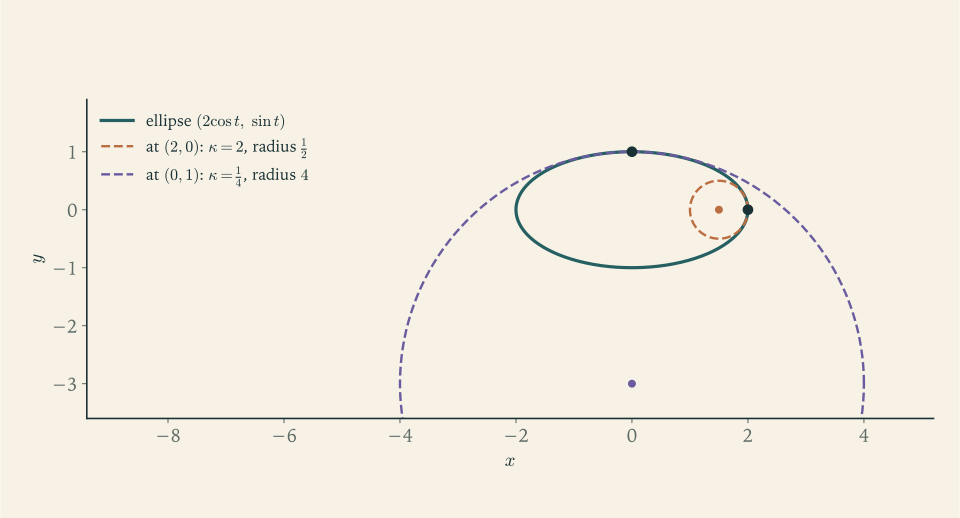
Figure 1.1 shows why curvature and not the second derivative of a coordinate is the right measure of bending. Near \((0,1)\) the large circle and the ellipse are almost indistinguishable over a wide arc; near \((2,0)\) the small circle hugs the ellipse only briefly. The ratio of the two curvatures, \(2\) to \(\tfrac14\) , is the factor of eight in the caption.
Curvature also organizes acceleration. Where \(\kappa\ne 0\) , the principal unit normal is \(\mathbf N=\mathbf T'/\lVert\mathbf T'\rVert\) , a unit vector orthogonal to \(\mathbf T\) that points toward the centre of the osculating circle.
Proposition 1.11 (tangential and normal acceleration). For a regular \(C^2\) parametrization with speed \(v\) and curvature \(\kappa\ne 0\) ,
Proof. In the proof of Theorem 1.10 we found \(\mathbf r''=v'\mathbf T+v\mathbf T'\) . By Definition 1.9, \(\lVert\mathbf T'\rVert=\kappa v\) , so \(\mathbf T'=\kappa v\,\mathbf N\) , and substituting gives the formula.
The proposition separates the driver from the road once more. The tangential component \(a_T=v'\) is the rate of change of speed, which the driver controls with the pedals. The normal component \(a_N=\kappa v^{2}\) is forced by the bend: it depends on the road through \(\kappa\) and on the driver only through the speed, and it grows with the square of that speed. Doubling your speed through a bend quadruples the sideways force your tyres must supply.
Example 1.6: Braking and turning on a parabola
A car follows \(\mathbf r(t)=(t,t^{2})\) . At \(t=1\) the velocity is \((1,2)\) , the speed is \(v=\sqrt5\) , and the acceleration is \(\mathbf r''=(0,2)\) . The tangential component is the component of acceleration along the velocity,
For the normal component we need the curvature of the road at \((1,1)\) : with \(x'=1\) , \(y'=2\) , \(x''=0\) , \(y''=2\) the plane formula gives \(\kappa=2/5^{3/2}\) , so
The two components are orthogonal, so their squares should add up to the squared length of the acceleration: \(\frac{16}{5}+\frac45=4\) , and indeed \(\lVert(0,2)\rVert^{2}=4\) . The driver is speeding up at \(4/\sqrt5\) units per second per second, and the road demands a sideways acceleration of \(2/\sqrt5\) at this speed. A second driver passing the same point at twice the speed would need a sideways acceleration four times as large, whatever the pedals were doing.
Common mistake. Blaming the curve for a defect of the parametrization, or the reverse. The parametrization \((t^{3},t^{6})\) of the parabola \(y=x^{2}\) has zero velocity at \(t=0\) , yet the parabola has a perfectly good tangent at the origin, as the regular parametrization \((t,t^{2})\) shows. The curve \(y^{2}=x^{3}\) of Example 1.3 is different: it has a genuine cusp at the origin, and no regular parametrization passes through that point. A zero of \(\mathbf r'\) tells you to look more closely; it does not by itself tell you what you will find.
1.6 What belongs to the road
We can now answer the opening question. Velocity, speed, acceleration, and the tangential component \(a_T\) belong to the trip: change the schedule and they change. The curve itself, its tangent line at a regular point, its arc length between two points, its curvature, and its osculating circles belong to the road: Theorem 1.8 and the arc-length definition of \(\kappa\) make them independent of the parametrization. The normal component \(a_N=\kappa v^{2}\) is a product of one quantity of each kind.
The same sorting of quantities into those that depend on a description and those that do not will recur throughout the book. A double integral does not depend on the order of integration or on the coordinates used to compute it; a work integral along a path depends on the direction of travel but not on the speed; a flux through a surface depends on which side is called positive but not on how the surface is parametrized. In every case the invariance is a theorem proved by a change of variables, just as it was here.
Curves return in two roles. In the next chapter a curve is a probe: to learn how a function of several variables changes at a point, we watch its values along curves through that point. In Chapter 8 a curve is a path along which a force does work. The vectors of Sections 1.1 and 1.2 are needed sooner still, because the derivative of a function of several variables turns out to be a vector, and the plane that best fits a surface is described by its normal.
Exercises
-
State the definitions of velocity, speed, and the unit tangent vector for a parametrization \(\mathbf r\) , say which are vectors and which are numbers, and explain why the unit tangent is defined only where \(\mathbf r'(t)\ne\mathbf 0\) .
-
For \(\mathbf a=(1,2,2)\) and \(\mathbf b=(2,-1,2)\) compute \(\mathbf a\cdot\mathbf b\) , the cosine of the angle between them, \(\mathbf a\times\mathbf b\) , the area of the parallelogram they span, and the projection of \(\mathbf b\) onto \(\mathbf a\) .
Answer
\(\mathbf a\cdot\mathbf b=2-2+4=4\) . Both vectors have length \(3\) , so \(\cos\theta=\tfrac49\) . \(\mathbf a\times\mathbf b=(6,2,-5)\) , and the area of the parallelogram is \(\lVert\mathbf a\times\mathbf b\rVert=\sqrt{65}\) . The projection of \(\mathbf b\) onto \(\mathbf a\) is \(\tfrac49(1,2,2)\) .
-
The planes \(x+y+z=3\) and \(x-y+2z=2\) meet in a line. Find a direction vector for the line, one point on it, and the angle between the two planes, defined as the angle between their normals.
Solution
The line lies in both planes, so its direction is orthogonal to both normals \(\mathbf n_1=(1,1,1)\) and \(\mathbf n_2=(1,-1,2)\) . The cross product is such a vector:
\[ \mathbf n_1\times\mathbf n_2=\bigl(1\cdot 2-1\cdot(-1),\ 1\cdot 1-1\cdot 2,\ 1\cdot(-1)-1\cdot 1\bigr)=(3,-1,-2). \]So a direction vector is \((3,-1,-2)\) . For a point, set \(z=0\) and solve \(x+y=3\) , \(x-y=2\) : adding gives \(x=\tfrac52\) , then \(y=\tfrac12\) . The point \((\tfrac52,\tfrac12,0)\) lies on the line, and the line is \((\tfrac52,\tfrac12,0)+t(3,-1,-2)\) . As a check, moving along the direction changes \(x+y+z\) by \(3-1-2=0\) and \(x-y+2z\) by \(3+1-4=0\) , so every point of the line stays in both planes.
The angle \(\theta\) between the planes satisfies
\[ \cos\theta=\frac{\mathbf n_1\cdot\mathbf n_2}{\lVert\mathbf n_1\rVert\,\lVert\mathbf n_2\rVert}=\frac{1-1+2}{\sqrt3\,\sqrt6}=\frac{2}{3\sqrt2}=\frac{\sqrt2}{3}, \]so \(\theta\approx 61.9^\circ\) .
-
Prove the identity \(\lVert\mathbf a\times\mathbf b\rVert^{2}=\lVert\mathbf a\rVert^{2}\lVert\mathbf b\rVert^{2}-(\mathbf a\cdot\mathbf b)^{2}\) for \(\mathbf a,\mathbf b\in\mathbb R^3\) by expanding both sides, and explain how it implies the Cauchy–Schwarz inequality in \(\mathbb R^3\) .
Solution
Write \(\mathbf a=(a_1,a_2,a_3)\) and \(\mathbf b=(b_1,b_2,b_3)\) . The left side is
\[ (a_2b_3-a_3b_2)^2+(a_3b_1-a_1b_3)^2+(a_1b_2-a_2b_1)^2 . \]Expanding the three squares gives the six “square” terms \(a_i^2b_j^2\) with \(i\ne j\) , and the three cross terms \(-2a_2a_3b_2b_3-2a_1a_3b_1b_3-2a_1a_2b_1b_2\) .
The right side is \((a_1^2+a_2^2+a_3^2)(b_1^2+b_2^2+b_3^2)-(a_1b_1+a_2b_2+a_3b_3)^2\) . The first product contains all nine terms \(a_i^2b_j^2\) . The square of the dot product contains the three terms \(a_i^2b_i^2\) and the cross terms \(2a_1a_2b_1b_2+2a_1a_3b_1b_3+2a_2a_3b_2b_3\) . Subtracting removes the three terms with \(i\) equal to \(j\) and leaves exactly the six square terms and three negative cross terms found on the left. The two sides agree.
Since the left side is a sum of squares it is nonnegative, so \((\mathbf a\cdot\mathbf b)^2\le\lVert\mathbf a\rVert^2\lVert\mathbf b\rVert^2\) . Taking square roots gives \(\lvert\mathbf a\cdot\mathbf b\rvert\le\lVert\mathbf a\rVert\lVert\mathbf b\rVert\) , which is the Cauchy–Schwarz inequality in \(\mathbb R^3\) . Equality holds exactly when \(\mathbf a\times\mathbf b=\mathbf 0\) , that is, when the vectors are parallel.
-
For \(\mathbf r(t)=(e^{t}\cos t,e^{t}\sin t,e^{t})\) find the velocity and speed, the tangent line at \(t=0\) , and the arc length from \(t=0\) to \(t=T\) .
Answer
\(\mathbf r'(t)=e^{t}(\cos t-\sin t,\ \sin t+\cos t,\ 1)\) and \(\lVert\mathbf r'(t)\rVert=\sqrt3\,e^{t}\) , because \((\cos t-\sin t)^2+(\sin t+\cos t)^2+1=3\) . The tangent line at \(t=0\) is \((1,0,1)+s(1,1,1)\) . The arc length from \(0\) to \(T\) is \(\sqrt3\,(e^{T}-1)\) .
-
Prove that a particle moving with constant speed has acceleration orthogonal to its velocity at every instant, and give an example in which the acceleration is nevertheless never zero.
Solution
Let \(\mathbf v=\mathbf r'\) be the velocity. Constant speed means that \(\lVert\mathbf v(t)\rVert\) is constant. Corollary 1.5, applied to the vector-valued function \(\mathbf v\) in place of \(\mathbf r\) , says that a differentiable vector function of constant length is orthogonal to its derivative. The derivative of \(\mathbf v\) is the acceleration \(\mathbf r''\) , so \(\mathbf v\cdot\mathbf r''=0\) at every instant. Spelled out: \(\mathbf v\cdot\mathbf v\) is constant, and its derivative is \(2\mathbf v\cdot\mathbf v'\) by the product rule of Proposition 1.4.
For an example, take uniform circular motion \(\mathbf r(t)=(\cos t,\sin t)\) . The velocity \((-\sin t,\cos t)\) has constant length \(1\) , and the acceleration \((-\cos t,-\sin t)\) also has length \(1\) , so it is never zero. Their dot product is \(\sin t\cos t-\cos t\sin t=0\) . Constant speed rules out acceleration along the path; it does not rule out acceleration across it. In the language of Proposition 1.11, \(a_T=0\) while \(a_N=\kappa v^{2}=1\) .
-
Find the arc length of \(\mathbf r(t)=\bigl(t,\tfrac{2\sqrt2}{3}t^{3/2},\tfrac12t^{2}\bigr)\) for \(0\le t\le 2\) by first simplifying the speed to a polynomial in \(t\) .
Solution
Differentiate each coordinate: \(\mathbf r'(t)=\bigl(1,\ \sqrt2\,t^{1/2},\ t\bigr)\) , since the derivative of \(\tfrac{2\sqrt2}{3}t^{3/2}\) is \(\sqrt2\,t^{1/2}\) . Then
\[ \lVert\mathbf r'(t)\rVert^{2}=1+2t+t^{2}=(1+t)^2 , \]and because \(1+t\) is positive on the interval, the speed is \(1+t\) . The arc length is
\[ L=\int_0^2(1+t)\,dt=\Bigl[t+\tfrac12t^{2}\Bigr]_0^2=2+2=4 . \]The length is \(4\) . The curve was built so that the expression under the square root is a perfect square; for most curves the arc-length integral has no elementary antiderivative and must be evaluated numerically.
-
Reparametrize the curve of Exercise 5 by arc length measured from \(t=0\) , and verify directly that the new parametrization has unit speed.
Hint
From Exercise 5, \(s(t)=\sqrt3\,(e^{t}-1)\) . Solve for \(t\) to get \(t=\ln(1+s/\sqrt3)\) , and note that then \(e^{t}=1+s/\sqrt3\) . Substitute into \(\mathbf r\) . To verify unit speed without expanding, use \(d\mathbf r/ds=\mathbf r'(t)\,dt/ds\) and \(dt/ds=1/(\sqrt3\,e^{t})\) .
-
A student writes: “The parametrization \(\mathbf r(t)=(t^{3},t^{6})\) has \(\mathbf r'(0)=\mathbf 0\) , so the parabola \(y=x^{2}\) has no tangent line at the origin.” Identify the error, and explain how the situation differs for the curve \(\mathbf r(t)=(t^{2},t^{3})\) .
Solution
The error is to treat a property of one parametrization as a property of the curve. The image of \(\mathbf r(t)=(t^{3},t^{6})\) is the parabola \(y=x^{2}\) , because the second coordinate is the square of the first and the first takes every real value. That parabola is also the image of the regular parametrization \((t,t^{2})\) , whose velocity at the origin is \((1,0)\) . So the parabola has the tangent line \(y=0\) there. The parametrization \((t^{3},t^{6})\) merely passes through the origin with zero velocity, like a car that stops for an instant on a straight road. Definition 1.6 fails for that trip; nothing is wrong with the road.
For \((t^{2},t^{3})\) the situation is different. The image is the curve \(y^{2}=x^{3}\) , on which \(x\ge 0\) and \(\lvert y\rvert=x^{3/2}\) . Let \(\mathbf r(t)=(x(t),y(t))\) be any differentiable parametrization of part of this curve that passes through the origin at a parameter value \(t_0\) in the interior of its interval. Since \(x(t)\ge 0=x(t_0)\) for every \(t\) , the function \(x\) has a minimum at \(t_0\) , and therefore \(x'(t_0)=0\) . For \(t\ne t_0\) ,
\[ \frac{\lvert y(t)-y(t_0)\rvert}{\lvert t-t_0\rvert}=\frac{x(t)^{3/2}}{\lvert t-t_0\rvert}=x(t)^{1/2}\cdot\frac{x(t)-x(t_0)}{\lvert t-t_0\rvert}. \]As \(t\to t_0\) the first factor tends to \(0\) because \(x\) is continuous, and the second tends to \(\lvert x'(t_0)\rvert=0\) . So \(y'(t_0)=0\) as well, and \(\mathbf r'(t_0)=\mathbf 0\) . Every differentiable parametrization that passes through the cusp has zero velocity there, so none is regular. Here the vanishing velocity reflects the geometry of the curve and not a choice of schedule. A parametrization can start at the cusp with nonzero velocity, as \((t,t^{3/2})\) for \(t\ge 0\) does; what is impossible is to pass through it.
-
Compute the curvature of the circle \(\mathbf r(t)=(R\cos t,R\sin t)\) directly from Definition 1.9, without using Theorem 1.10, and interpret the answer for very large \(R\) .
Answer
\(\mathbf r'(t)=(-R\sin t,R\cos t)\) has length \(R\) , so \(\mathbf T(t)=(-\sin t,\cos t)\) and \(\mathbf T'(t)=(-\cos t,-\sin t)\) , of length \(1\) . Definition 1.9 gives \(\kappa=1/R\) . As \(R\) grows the curvature tends to \(0\) : a very large circle is locally almost a straight line.
-
Show that the graph \(y=f(x)\) of a \(C^2\) function has curvature \(\kappa=\lvert f''(x)\rvert/\bigl(1+f'(x)^{2}\bigr)^{3/2}\) , and find the point of the curve \(y=\ln x\) at which the curvature is largest.
Solution
Parametrize the graph by \(\mathbf r(x)=(x,f(x))\) . In the notation of the plane curvature formula the first coordinate has derivatives \(1\) and \(0\) and the second has derivatives \(f'\) and \(f''\) , so the numerator is \(\lvert 1\cdot f''-f'\cdot 0\rvert=\lvert f''\rvert\) and the denominator is \((1+f'^{2})^{3/2}\) . This proves the formula.
For \(f(x)=\ln x\) on \(x>0\) we have \(f'=1/x\) and \(f''=-1/x^{2}\) , so
\[ \kappa(x)=\frac{1/x^{2}}{(1+1/x^{2})^{3/2}}=\frac{x}{(x^{2}+1)^{3/2}} . \]Differentiate: \(\kappa'(x)=\bigl((x^{2}+1)-3x^{2}\bigr)/(x^{2}+1)^{5/2}=(1-2x^{2})/(x^{2}+1)^{5/2}\) . The derivative is positive for \(x<1/\sqrt2\) and negative afterwards, so the curvature is largest at \(x=1/\sqrt2\) . The point is \((1/\sqrt2,-\tfrac12\ln 2)\) and the maximal curvature is
\[ \kappa\bigl(1/\sqrt2\bigr)=\frac{1/\sqrt2}{(3/2)^{3/2}}=\frac{2\sqrt3}{9}\approx 0.385 . \]Both as \(x\to 0\) and as \(x\to\infty\) the curvature tends to \(0\) : the graph is nearly a vertical line near the axis and nearly a horizontal line far out.
-
Compute the curvature of the twisted cubic \(\mathbf r(t)=(t,t^{2},t^{3})\) at \(t=0\) and at \(t=1\) using Theorem 1.10, and say at which of the two points the curve bends more sharply.
Hint
Compute \(\mathbf r'\times\mathbf r''=(1,2t,3t^{2})\times(0,2,6t)=(6t^{2},-6t,2)\) . At \(t=0\) the cross product is \((0,0,2)\) and the speed is \(1\) , so \(\kappa(0)=2\) . At \(t=1\) you should get \(\kappa(1)=\sqrt{76}/14^{3/2}\approx 0.166\) . The curve bends far more sharply at the origin.
-
For \(\mathbf r(t)=(\cos t+t\sin t,\ \sin t-t\cos t)\) with \(t>0\) , find the speed, the tangential and normal components of acceleration, and the curvature.
Solution
Differentiate: \(x'=-\sin t+\sin t+t\cos t=t\cos t\) and \(y'=\cos t-\cos t+t\sin t=t\sin t\) . So \(\mathbf r'(t)=t(\cos t,\sin t)\) and, since \(t\) is positive, the speed is \(v=t\) . The unit tangent is \(\mathbf T=(\cos t,\sin t)\) .
The acceleration is \(\mathbf r''(t)=(\cos t-t\sin t,\ \sin t+t\cos t)\) . Its tangential component is the rate of change of speed, \(a_T=1\) ; as a check, \(\mathbf r''\cdot\mathbf T=\cos^{2}t+\sin^{2}t=1\) . The squared length of the acceleration is \((\cos t-t\sin t)^2+(\sin t+t\cos t)^2=1+t^{2}\) , and since the tangential and normal components are orthogonal, \(a_N^{2}=1+t^{2}-1=t^{2}\) , so \(a_N=t\) .
By Proposition 1.11, \(a_N=\kappa v^{2}\) , which gives \(\kappa=t/t^{2}\) , that is, \(\kappa=1/t\) . This curve is the path traced by the end of a taut string unwinding from the unit circle; its osculating circle at parameter \(t\) has radius \(t\) , the length of string unwound so far.
-
The curve of intersection of the cylinder \(x^{2}+y^{2}=4\) and the surface \(z=xy\) is given by two equations. Find a parametrization of it and a tangent vector at the point \((\sqrt2,\sqrt2,2)\) .
Hint
Parametrize the cylinder first: \(x=2\cos t\) , \(y=2\sin t\) . The surface then forces \(z=xy=4\cos t\sin t=2\sin 2t\) . The given point corresponds to \(t=\pi/4\) . Differentiating, the tangent vector there is \((-\sqrt2,\sqrt2,0)\) : at that instant the curve is moving horizontally, at a highest point.
-
Let \(\mathbf r\) be a regular \(C^2\) parametrization of a space curve whose curvature is zero at every point. Prove that the curve is contained in a straight line.
Solution
Zero curvature means, by Definition 1.9, that \(\lVert\mathbf T'(t)\rVert=\kappa(t)\lVert\mathbf r'(t)\rVert=0\) for every \(t\) , so \(\mathbf T'(t)=\mathbf 0\) on the whole interval. Each coordinate of \(\mathbf T\) is then a real function with zero derivative on an interval, hence constant. So \(\mathbf T(t)=\mathbf T_0\) for a fixed unit vector \(\mathbf T_0\) .
Write \(v(t)=\lVert\mathbf r'(t)\rVert\) for the speed. Then \(\mathbf r'(t)=v(t)\mathbf T_0\) . Fix a parameter value \(a\) and integrate each coordinate from \(a\) to \(t\) :
\[ \mathbf r(t)=\mathbf r(a)+\Bigl(\int_a^t v(\tau)\,d\tau\Bigr)\mathbf T_0=\mathbf r(a)+s(t)\,\mathbf T_0 , \]where \(s(t)\) is the arc-length function. Every point of the curve therefore has the form \(\mathbf r(a)\) plus a multiple of \(\mathbf T_0\) , so the curve lies in the line through \(\mathbf r(a)\) with direction \(\mathbf T_0\) . The hypothesis that the parametrization is regular was used to make \(\mathbf T\) defined everywhere; without it a path could stop, turn a corner, and continue along a second line with \(\kappa=0\) wherever \(\kappa\) is defined.
-
A student computes \(\int_0^{4\pi}\lVert\mathbf r'(t)\rVert\,dt=4\pi\) for \(\mathbf r(t)=(\cos t,\sin t)\) and concludes that the unit circle has circumference \(4\pi\) . Which hypothesis of Theorem 1.8 has been overlooked, and what does the integral actually measure?
Solution
Theorem 1.8 compares two parametrizations related by a bijection \(\varphi\) between parameter intervals, so that each point of the road is visited once by each trip. The map \(t\mapsto(\cos t,\sin t)\) on \([0,4\pi]\) is not a bijection onto the circle: every point is visited twice, once for \(t\) and once for \(t+2\pi\) . The standard parametrization on \([0,2\pi]\) cannot be obtained from it by a bijective change of parameter, so the theorem does not say that the two integrals agree, and they do not.
The integral \(\int_0^{4\pi}\lVert\mathbf r'(t)\rVert\,dt=4\pi\) is correct as a computation. It measures the distance travelled by a point that goes around the circle twice. The length of the circle as a set is the arc length of a parametrization that traces it once, which is \(2\pi\) . In general the arc-length integral equals the length of the image only when the parametrization does not retrace any part of it.
-
For the ellipse \(\mathbf r(t)=(2\cos t,\sin t)\) , use single-variable calculus to find the values of \(t\) at which the speed is largest and smallest, and compare them with the points of smallest and largest curvature found in Example 1.5.
Hint
The squared speed is \(4\sin^{2}t+\cos^{2}t=1+3\sin^{2}t\) . Maximize and minimize this function of one variable on \([0,2\pi]\) . You should find the largest speed, \(2\) , at \(t=\pi/2\) and \(3\pi/2\) , and the smallest, \(1\) , at \(t=0\) and \(\pi\) . In Example 1.5 the curvature is \(2\) divided by the cube of the speed, so the parametrization moves fastest exactly where the ellipse bends least.
-
A particle has acceleration \(\mathbf r''(t)=(0,0,-10)\) , initial velocity \((3,4,5)\) , and initial position \(\mathbf 0\) . Find \(\mathbf r(t)\) , the time at which it returns to the plane \(z=0\) , its position and speed at that time, and an integral for the distance travelled.
Answer
\(\mathbf r'(t)=(3,4,5-10t)\) and \(\mathbf r(t)=(3t,4t,5t-5t^{2})\) . The particle returns to \(z=0\) at \(t=1\) , at the point \((3,4,0)\) , with velocity \((3,4,-5)\) and speed \(\sqrt{50}=5\sqrt2\) , the same as its initial speed. The distance travelled is \(\int_0^1\sqrt{25+(5-10t)^2}\,dt\) .
-
Find the distance from the point \(Q=(1,2,3)\) to the line through \(P=(0,1,1)\) with direction \(\mathbf d=(1,1,0)\) in two ways: by projecting \(\overrightarrow{PQ}\) onto \(\mathbf d\) , and from the area of the parallelogram spanned by \(\overrightarrow{PQ}\) and \(\mathbf d\) .
Answer
\(\overrightarrow{PQ}=(1,1,2)\) . Its projection onto \(\mathbf d\) is \((1,1,0)\) , leaving the orthogonal remainder \((0,0,2)\) of length \(2\) . Alternatively \(\overrightarrow{PQ}\times\mathbf d=(-2,2,0)\) has length \(2\sqrt2\) , and dividing the area by the base \(\lVert\mathbf d\rVert=\sqrt2\) gives the height \(2\) . The distance is \(2\) .