A force acts at every point of a region, with a strength and direction that vary from place to place, and a particle is moved through the region along a prescribed path. How much work does the force do? If the force were constant and the path straight, the answer would be the dot product of force and displacement. For a varying force and a curved path we cut the path into short nearly straight pieces, add the dot products, and pass to the limit, and the result is an integral along the curve.
Having defined it, we meet an unexpected question. Move the particle between the same two points along a different path: is the work the same? For some fields it always is, and for others it is not, and the distinction turns out to be one of the organizing ideas of the subject. The second half of the chapter asks the analogous question one dimension up. A fluid flows through space; how much of it crosses a given surface per unit time? That is an integral over a surface, and to define it we must first say what the area of a curved surface is.
8.1 Fields, and integrals with respect to arc length
Definition 8.1 (vector field). A vector field on a set \(U\subseteq\mathbb R^n\) is a map \(\mathbf F:U\to\mathbb R^n\) that assigns a vector to each point. In the plane we write \(\mathbf F=(P,Q)\) and in space \(\mathbf F=(P,Q,R)\) , where the components are real-valued functions on \(U\) . The field is continuous, or of class \(C^1\) , when its components are.
The gradient of a function is a vector field. So is the velocity of a fluid at each point, the gravitational force on a unit mass, or the electric field around a charge. By contrast, a real-valued function such as temperature or density is called a scalar field.
The simplest integral along a curve involves a scalar field. A wire lies along a curve \(C\) and has density \(\delta\) , in mass per unit length, varying along it. A short piece of wire of length \(\Delta s\) has mass about \(\delta\,\Delta s\) , and by Section 1.4 a short piece of the curve traced over a parameter interval \(\Delta t\) has length about \(\lVert\mathbf r'(t)\rVert\,\Delta t\) .
Definition 8.2 (integral with respect to arc length). Let \(C\) be a curve with \(C^1\) parametrization \(\mathbf r:[a,b]\to\mathbb R^n\) that traces it once, and let \(f\) be continuous on \(C\) . The integral of \(f\) along \(C\) with respect to arc length is
With \(f=1\) this is the arc length of Definition 1.7. The argument of Theorem 1.8 applies word for word with the extra factor \(f(\mathbf r(t))\) carried along, so the value does not depend on which parametrization is used, nor on the direction in which the curve is traced. A curve made of finitely many \(C^1\) pieces joined end to end is piecewise \(C^1\) , and its integral is the sum over the pieces.
Example 8.1: The mass and balance point of a wire
A wire is bent into the upper half of the circle of radius \(2\) centred at the origin, and its density at \((x,y)\) is \(\delta=y\) . Parametrize by \(\mathbf r(t)=(2\cos t,2\sin t)\) , \(0\le t\le\pi\) , so that \(\lVert\mathbf r'(t)\rVert=2\) . Then
The mass is \(8\) . By symmetry the centre of mass lies on the \(y\) -axis, and its height is the density-weighted average of \(y\) :
A uniform half-circle of radius \(2\) would balance at height \(4/\pi\approx 1.27\) ; this wire is heavier near the top, and its balance point is higher.
8.2 The work done by a field
Now let \(\mathbf F\) be a force field and let a particle move along \(C\) . Over a short piece of the path the displacement is approximately \(\mathbf r'(t)\,\Delta t\) , and the work done is approximately \(\mathbf F(\mathbf r(t))\cdot\mathbf r'(t)\,\Delta t\) .
Definition 8.3 (line integral of a vector field). Let \(\mathbf F\) be a continuous vector field on a set containing the curve \(C\) , and let \(\mathbf r:[a,b]\to\mathbb R^n\) be a piecewise \(C^1\) parametrization of \(C\) . The line integral of \(\mathbf F\) along \(C\) is
For \(\mathbf F=(P,Q,R)\) it is also written \(\int_CP\,dx+Q\,dy+R\,dz\) . When \(\mathbf F\) is a force it is the work done by the force; when \(C\) is a closed curve it is called the circulation of \(\mathbf F\) around \(C\) and written \(\oint_C\mathbf F\cdot d\mathbf r\) .
Where the parametrization is regular, \(\mathbf r'(t)=\lVert\mathbf r'(t)\rVert\,\mathbf T\) , so the definition can be rewritten as \(\int_C(\mathbf F\cdot\mathbf T)\,ds\) : the line integral is the arc-length integral of the tangential component of the field. A force perpendicular to the path does no work. A force along the direction of motion does positive work, and a force against it does negative work. That last remark shows that this integral, unlike the integral of Definition 8.2, must be sensitive to direction.
Proposition 8.4 (dependence on the parametrization). Let \(\mathbf r:[a,b]\to\mathbb R^n\) be piecewise \(C^1\) and let \(\varphi:[c,d]\to[a,b]\) be a \(C^1\) bijection. If \(\varphi\) is increasing, the reparametrization \(\tilde{\mathbf r}=\mathbf r\circ\varphi\) gives the same value of \(\int\mathbf F\cdot d\mathbf r\) as \(\mathbf r\) . If \(\varphi\) is decreasing, so that \(\tilde{\mathbf r}\) traces the curve in the opposite direction, the value changes sign.
Proof. By the chain rule \(\tilde{\mathbf r}'(u)=\mathbf r'(\varphi(u))\,\varphi'(u)\) , so
by the substitution \(t=\varphi(u)\) . If \(\varphi\) is increasing the limits are \(a\) and \(b\) . If \(\varphi\) is decreasing they are \(b\) and \(a\) , and exchanging them changes the sign. In contrast with Theorem 1.8 the factor \(\varphi'\) enters without an absolute value, which is where the sign comes from.
So a line integral of a vector field belongs to an oriented curve: a curve together with a direction of travel. Writing \(-C\) for \(C\) traced backwards, \(\int_{-C}\mathbf F\cdot d\mathbf r=-\int_C\mathbf F\cdot d\mathbf r\) .
Example 8.2: Three paths, three answers
Let \(\mathbf F(x,y)=(y^{2},x)\) , and move from \((0,0)\) to \((1,1)\) in three ways.
Along the straight line \(\mathbf r(t)=(t,t)\) , \(0\le t\le 1\) : \(\mathbf F=(t^{2},t)\) and \(\mathbf r'=(1,1)\) , so the work is \(\int_0^1(t^{2}+t)\,dt=\tfrac13+\tfrac12\) , that is, \(\tfrac56\) .
Along the parabola \(\mathbf r(t)=(t,t^{2})\) : \(\mathbf F=(t^{4},t)\) and \(\mathbf r'=(1,2t)\) , so the work is \(\int_0^1(t^{4}+2t^{2})\,dt=\tfrac15+\tfrac23\) , that is, \(\tfrac{13}{15}\) .
Along the two legs, first from \((0,0)\) to \((1,0)\) and then up to \((1,1)\) : on the first leg \(y=0\) , so \(\mathbf F=(0,x)\) is perpendicular to the motion and does no work; on the second leg \(x=1\) and \(\mathbf F\cdot\mathbf r'=1\) , contributing \(1\) . Along this route the work is \(1\) .
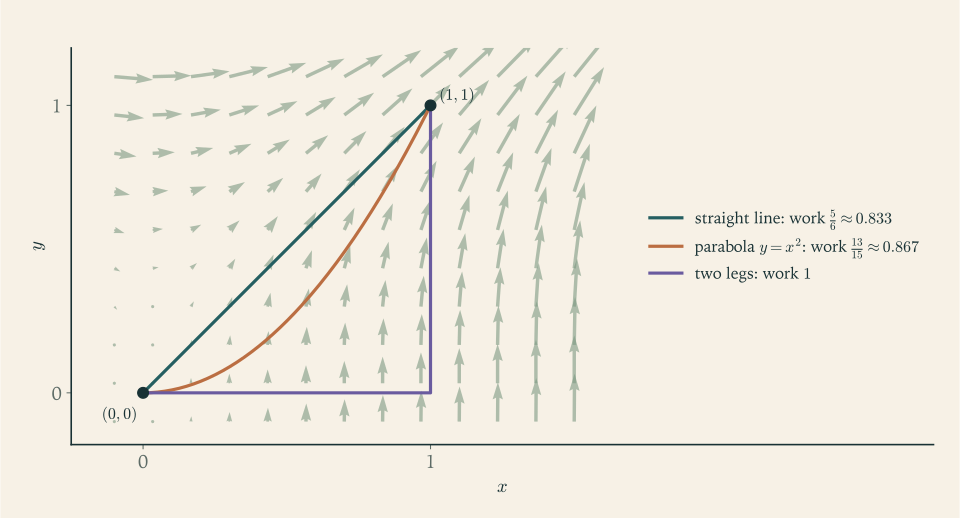
Figure 8.1 makes the differences plausible. The vertical component of the field, \(x\) , is largest along the right edge of the square, exactly where the third route climbs, so that route collects the most work. The field of this example is path-dependent: the work is a property of the route and not just of its endpoints.
8.3 Conservative fields and potentials
For gradient fields the situation is entirely different.
Theorem 8.5 (fundamental theorem for line integrals). Let \(f\) be a \(C^1\) function on an open set \(U\) , and let \(C\) be a piecewise \(C^1\) curve in \(U\) from \(A\) to \(B\) . Then
Proof. Let \(\mathbf r:[a,b]\to U\) parametrize a \(C^1\) piece of \(C\) . By the chain rule along a curve, Theorem 2.10, \(\nabla f(\mathbf r(t))\cdot\mathbf r'(t)=\dfrac{d}{dt}f(\mathbf r(t))\) . So the line integral over that piece is \(\int_a^b\frac{d}{dt}f(\mathbf r(t))\,dt=f(\mathbf r(b))-f(\mathbf r(a))\) by the Fundamental Theorem of Calculus. Adding over the pieces, the values at the intermediate junctions cancel in pairs, leaving \(f(B)-f(A)\) .
Definition 8.6 (conservative field, potential). A continuous vector field \(\mathbf F\) on an open set \(U\) is conservative if \(\mathbf F=\nabla f\) for some \(C^1\) function \(f\) on \(U\) , called a potential of \(\mathbf F\) . The line integrals of \(\mathbf F\) are path-independent in \(U\) if \(\int_C\mathbf F\cdot d\mathbf r\) has the same value for any two piecewise \(C^1\) curves in \(U\) with the same initial point and the same final point.
Theorem 8.5 says that a conservative field is path-independent. The converse is also true, and with it we get a complete description. Call an open set \(U\) connected if any two of its points can be joined by a piecewise \(C^1\) curve lying in \(U\) .
Theorem 8.7 (characterizations of conservative fields). For a continuous vector field \(\mathbf F\) on a connected open set \(U\) , the following are equivalent: (a) \(\mathbf F\) is conservative; (b) the line integrals of \(\mathbf F\) are path-independent in \(U\) ; (c) \(\oint_C\mathbf F\cdot d\mathbf r=0\) for every closed piecewise \(C^1\) curve \(C\) in \(U\) .
Proof. (a) implies (b) by Theorem 8.5.
(b) and (c) are equivalent. If \(C_1\) and \(C_2\) run from \(A\) to \(B\) , then \(C_1\) followed by \(-C_2\) is a closed curve, and its integral is \(\int_{C_1}-\int_{C_2}\) ; conversely any closed curve can be split at two of its points into two curves with common endpoints, one traversed backwards. So all closed-curve integrals vanish exactly when integrals over curves with common endpoints agree.
(b) implies (a). Fix a point \(A\in U\) and define \(f(\mathbf x)=\int_{C_{\mathbf x}}\mathbf F\cdot d\mathbf r\) , where \(C_{\mathbf x}\) is any curve in \(U\) from \(A\) to \(\mathbf x\) ; one exists because \(U\) is connected, and by (b) the value does not depend on the choice. To find \(\partial f/\partial x_i\) at \(\mathbf x\) , take \(h\) so small that the segment from \(\mathbf x\) to \(\mathbf x+h\mathbf e_i\) lies in \(U\) , and reach \(\mathbf x+h\mathbf e_i\) by going first to \(\mathbf x\) and then along that segment, parametrized by \(\mathbf x+t\mathbf e_i\) for \(t\) between \(0\) and \(h\) . Then
since the velocity along the segment is \(\mathbf e_i\) . Dividing by \(h\) and letting \(h\to 0\) , the right side tends to \(F_i(\mathbf x)\) because \(F_i\) is continuous. So \(\partial f/\partial x_i=F_i\) for each \(i\) . These partial derivatives are continuous, hence \(f\) is \(C^1\) and \(\nabla f=\mathbf F\) .
The theorem characterizes conservative fields but offers no practical test, since nobody can check all closed curves. Derivatives provide a test that is at least necessary.
Proposition 8.8 (a necessary condition). If a \(C^1\) field \(\mathbf F=(P,Q)\) in the plane is conservative, then \(P_y=Q_x\) . If a \(C^1\) field \(\mathbf F=(P,Q,R)\) in space is conservative, then \(P_y=Q_x\) , \(P_z=R_x\) , and \(Q_z=R_y\) .
Proof. If \(\mathbf F=\nabla f\) with \(\mathbf F\) of class \(C^1\) , then \(f\) is \(C^2\) , and each condition is an equality of mixed partial derivatives of \(f\) , for instance \(P_y=f_{xy}=f_{yx}=Q_x\) , which holds by Theorem 4.1.
For the field of Example 8.2, \(P_y=2y\) and \(Q_x=1\) differ, which confirms that it is not conservative.
Example 8.3: Finding and using a potential
Let \(\mathbf F=(2xy+z^{2},\ x^{2},\ 2xz)\) . The conditions of Proposition 8.8 hold: \(P_y=2x=Q_x\) , \(P_z=2z=R_x\) , \(Q_z=0=R_y\) . To find a potential, integrate one component at a time. From \(f_x=2xy+z^{2}\) we get \(f=x^{2}y+xz^{2}+g(y,z)\) for some function \(g\) . Then \(f_y=x^{2}+g_y\) must equal \(x^{2}\) , so \(g\) depends on \(z\) only; and \(f_z=2xz+g'(z)\) must equal \(2xz\) , so \(g\) is constant. Thus
is a potential, as one verifies by differentiating. The work done by \(\mathbf F\) along any curve from \((1,0,1)\) to \((2,1,3)\) is \(f(2,1,3)-f(1,0,1)=(4+18)-(0+1)\) , that is, \(22-1=21\) . No parametrization was needed, and none could have changed the answer.
The necessary condition of Proposition 8.8 is so easy to check that one would like it to be sufficient. It is not.
Example 8.4: A field that passes the derivative test and is not conservative
On the plane with the origin removed let
A direct computation gives \(P_y=\dfrac{y^{2}-x^{2}}{(x^{2}+y^{2})^{2}}=Q_x\) , so the condition of Proposition 8.8 holds everywhere on the domain. Now integrate around the unit circle \(\mathbf r(t)=(\cos t,\sin t)\) , \(0\le t\le 2\pi\) . There \(\mathbf F=(-\sin t,\cos t)\) and \(\mathbf r'=(-\sin t,\cos t)\) , so \(\mathbf F\cdot\mathbf r'=1\) and the circulation is \(2\pi\) . A nonzero integral around a closed curve: by Theorem 8.7 the field is not conservative on its domain.
What has gone wrong is geometric. On the half-plane \(x>0\) the field is the gradient of the polar angle \(\theta=\arctan(y/x)\) , by the formulas of Example 3.4. The angle is a perfectly good potential on any region where it can be defined continuously, but it cannot be defined continuously on a region that encircles the origin: going once around increases it by \(2\pi\) , which is exactly the circulation found. The obstruction is the hole in the domain. Chapter 9 shows that on a domain without holes the condition \(P_y=Q_x\) does suffice.
8.4 Parametrized surfaces and their area
A curve is described by one parameter. A surface needs two.
Definition 8.9 (parametrized surface). A parametrized surface is a \(C^1\) map \(\mathbf r:D\to\mathbb R^3\) , \(\mathbf r(u,v)=(x(u,v),y(u,v),z(u,v))\) , defined on a region \(D\) of the plane. The vectors \(\mathbf r_u\) and \(\mathbf r_v\) of partial derivatives are tangent to the surface, and the parametrization is regular at a point where
At such a point \(\mathbf r_u\times\mathbf r_v\) is a normal vector to the surface.
Holding \(v\) fixed and varying \(u\) traces a curve on the surface with velocity \(\mathbf r_u\) ; holding \(u\) fixed gives a curve with velocity \(\mathbf r_v\) . Regularity says that these two velocities are not parallel, so that they span a tangent plane. Two families of surfaces cover most needs. A graph \(z=g(x,y)\) is parametrized by \(\mathbf r(x,y)=(x,y,g(x,y))\) , for which
always regular, with normal pointing upward. The sphere of radius \(R\) is parametrized by the spherical angles, \(\mathbf r(\phi,\theta)=R(\sin\phi\cos\theta,\sin\phi\sin\theta,\cos\phi)\) , and a computation with the columns found in Section 7.6 gives \(\mathbf r_\phi\times\mathbf r_\theta=R\sin\phi\;\mathbf r(\phi,\theta)\) : the normal is radial, pointing outward, of length \(R^{2}\sin\phi\) .
For area, reason as in Section 7.3. The map \(\mathbf r\) carries a small rectangle with sides \(\Delta u\) , \(\Delta v\) to a small piece of surface that is nearly the parallelogram spanned by \(\mathbf r_u\Delta u\) and \(\mathbf r_v\Delta v\) , whose area is \(\lVert\mathbf r_u\times\mathbf r_v\rVert\,\Delta u\,\Delta v\) by Proposition 1.2(b).
Definition 8.10 (surface area, integral over a surface). Let \(S\) be parametrized by \(\mathbf r:D\to\mathbb R^3\) , one-to-one on the interior of \(D\) . The area of \(S\) and the integral of a continuous function \(f\) over \(S\) are
The length \(\lVert\mathbf r_u\times\mathbf r_v\rVert\) plays for surfaces the role that the speed plays for curves and the Jacobian determinant plays for plane regions. A definition phrased through a parametrization must not depend on which one is chosen, and that needs proof.
Proposition 8.11 (independence of the parametrization). Let \(\mathbf r:D\to\mathbb R^3\) parametrize \(S\) , and let \((u,v)=G(s,t)\) be a \(C^1\) map from a region \(\tilde D\) onto \(D\) satisfying the hypotheses of Theorem 7.2. Then the parametrization \(\tilde{\mathbf r}=\mathbf r\circ G\) satisfies
and it assigns to \(S\) the same area and the same integrals \(\iint_Sf\,dS\) .
Proof. By the chain rule, \(\tilde{\mathbf r}_s=\mathbf r_uu_s+\mathbf r_vv_s\) and \(\tilde{\mathbf r}_t=\mathbf r_uu_t+\mathbf r_vv_t\) . Expand the cross product using its linearity in each factor, \(\mathbf r_u\times\mathbf r_u=\mathbf 0=\mathbf r_v\times\mathbf r_v\) , and \(\mathbf r_v\times\mathbf r_u=-\mathbf r_u\times\mathbf r_v\) :
The scalar factor is the Jacobian determinant. Taking lengths, \(\lVert\tilde{\mathbf r}_s\times\tilde{\mathbf r}_t\rVert=\bigl\lvert\tfrac{\partial(u,v)}{\partial(s,t)}\bigr\rvert\,\lVert\mathbf r_u\times\mathbf r_v\rVert\) , and Theorem 7.2 converts the integral over \(\tilde D\) of \(f(\tilde{\mathbf r})\lVert\tilde{\mathbf r}_s\times\tilde{\mathbf r}_t\rVert\) into the integral over \(D\) of \(f(\mathbf r)\lVert\mathbf r_u\times\mathbf r_v\rVert\) .
Example 8.5: The area of a paraboloid bowl
Find the area of the part of the paraboloid \(z=x^{2}+y^{2}\) below the plane \(z=2\) . As a graph over the disc \(x^{2}+y^{2}\le 2\) the normal vector is \((-2x,\,-2y,\,1)\) , of length \(\sqrt{1+4x^{2}+4y^{2}}\) . Evaluating the area integral in polar coordinates with the substitution \(w=1+4r^{2}\) ,
The disc beneath the bowl has area \(2\pi\approx 6.28\) ; the bowl, being tilted everywhere except at its lowest point, has more than twice as much. The factor \(\sqrt{1+g_x^{2}+g_y^{2}}\) is the amount by which a tilted patch of surface exceeds its shadow.
For the sphere of radius \(R\) the same definition gives \(\int_0^{2\pi}\int_0^{\pi}R^{2}\sin\phi\,d\phi\,d\theta=4\pi R^{2}\) , the familiar area.
8.5 Flux through an oriented surface
Let \(\mathbf F\) be the velocity field of a fluid, and let \(S\) be a surface that the fluid can pass through, like a net. Across a small flat patch of area \(\Delta S\) with unit normal \(\mathbf n\) , the volume of fluid crossing per unit time in the direction of \(\mathbf n\) is \((\mathbf F\cdot\mathbf n)\,\Delta S\) : only the component of the velocity perpendicular to the patch carries fluid across it. To add this up over a surface we must first agree which way is “across”.
An orientation of a surface is a continuous choice of unit normal vector \(\mathbf n\) at each of its points; a surface with an orientation is an oriented surface. At each regular point there are two unit normals, \(\pm\mathbf n\) , and an orientation picks one of them consistently. A graph can be oriented upward or downward. A closed surface, one that bounds a solid, can be oriented outward or inward, and unless otherwise stated closed surfaces are oriented outward. Not every surface can be oriented at all; the one-sided Möbius band is the standard example, and such surfaces are excluded from what follows.
Definition 8.12 (flux). Let \(S\) be an oriented surface with unit normal \(\mathbf n\) and let \(\mathbf F\) be a continuous vector field on \(S\) . The flux of \(\mathbf F\) through \(S\) is \(\iint_S\mathbf F\cdot\mathbf n\,dS\) . If \(\mathbf r:D\to\mathbb R^3\) is a regular parametrization whose normal \(\mathbf r_u\times\mathbf r_v\) points in the direction of \(\mathbf n\) , then
and if \(\mathbf r_u\times\mathbf r_v\) points opposite to \(\mathbf n\) the right side acquires a minus sign.
The formula follows from Definition 8.10: the unit normal is \(\mathbf n=(\mathbf r_u\times\mathbf r_v)/\lVert\mathbf r_u\times\mathbf r_v\rVert\) and \(dS=\lVert\mathbf r_u\times\mathbf r_v\rVert\,du\,dv\) , so the lengths cancel and \(\mathbf n\,dS=(\mathbf r_u\times\mathbf r_v)\,du\,dv\) . By Proposition 8.11 a reparametrization multiplies \(\mathbf r_u\times\mathbf r_v\) by its Jacobian determinant, so the flux is unchanged when that determinant is positive and changes sign when it is negative. Flux is to oriented surfaces what work is to oriented curves.
Example 8.6: Flux through a bowl and through a sphere
Let \(\mathbf F=(x,y,z)\) , and let \(S\) be the bowl of Example 8.5 oriented upward. With the graph parametrization, \(\mathbf r_x\times\mathbf r_y=(-2x,-2y,1)\) points upward, as required. On the surface \(z=x^{2}+y^{2}\) , so
and the flux is \(\displaystyle-\int_0^{2\pi}\!\!\int_0^{\sqrt2}r^{2}\cdot r\,dr\,d\theta=-2\pi\cdot\frac{4}{4}\) , which is \(-2\pi\) . The sign is informative. The field points directly away from the origin, and at each point of the bowl that direction has a component down through the surface, toward the outside of the bowl. With the downward orientation the flux would be \(2\pi\) .
For the sphere of radius \(R\) oriented outward the unit normal is \(\mathbf n=\mathbf r/R\) , so \(\mathbf F\cdot\mathbf n=\lVert\mathbf r\rVert^{2}/R=R\) at every point, and the flux is \(R\) times the area: \(R\cdot 4\pi R^{2}\) , that is, \(4\pi R^{3}\) . When the normal component of the field is constant on the surface, flux needs no integration.
Common mistake. Multiplying by the length of the normal twice, or not at all. In the parametrized formula the vector \(\mathbf r_u\times\mathbf r_v\) already contains the area factor; writing \(\iint\mathbf F\cdot(\mathbf r_u\times\mathbf r_v)\,\lVert\mathbf r_u\times\mathbf r_v\rVert\,du\,dv\) counts it twice, and writing \(\iint\mathbf F\cdot\mathbf n\,du\,dv\) with a unit normal omits it. A second common error is to assume that the normal produced by a parametrization is the one the problem wants. For the bowl, \((-2x,-2y,1)\) points up and into the bowl; a problem about the outward flux from the solid inside the bowl needs its negative. Test the normal at one convenient point before integrating.
8.6 Circulation and flux in the plane
The two kinds of integral of a vector field, work along a curve and flux across a surface, both have meaning for a plane field and a plane curve, and seeing them side by side clarifies each. Let \(C\) be a curve in the plane traced by \(\mathbf r(t)=(x(t),y(t))\) , with unit tangent \(\mathbf T\) . Rotating \(\mathbf T\) clockwise by a right angle gives a unit normal \(\mathbf n\) pointing to the right of the direction of travel; for a closed curve traced counterclockwise this is the outward normal. Since \(\mathbf T\,ds=(dx,dy)\) , we have \(\mathbf n\,ds=(dy,-dx)\) , and for \(\mathbf F=(P,Q)\)
The first is the work or circulation; the second is the flux of \(\mathbf F\) across \(C\) , the rate at which a plane flow with velocity \(\mathbf F\) crosses the curve from left to right.
Example 8.7: A rotation field and a radial field
Take the unit circle traced counterclockwise, \(x=\cos t\) , \(y=\sin t\) , so \(dx=-\sin t\,dt\) and \(dy=\cos t\,dt\) .
For the rotation field \(\mathbf F=(-y,x)\) : \(P\,dx+Q\,dy=(\sin^{2}t+\cos^{2}t)\,dt\) and \(P\,dy-Q\,dx=(-\sin t\cos t+\cos t\sin t)\,dt\) . So this field has circulation \(2\pi\) and flux \(0\) around the circle.
For the radial field \(\mathbf F=(x,y)\) : \(P\,dx+Q\,dy=(-\cos t\sin t+\sin t\cos t)\,dt\) and \(P\,dy-Q\,dx=(\cos^{2}t+\sin^{2}t)\,dt\) . So this field has circulation \(0\) and flux \(2\pi\) .
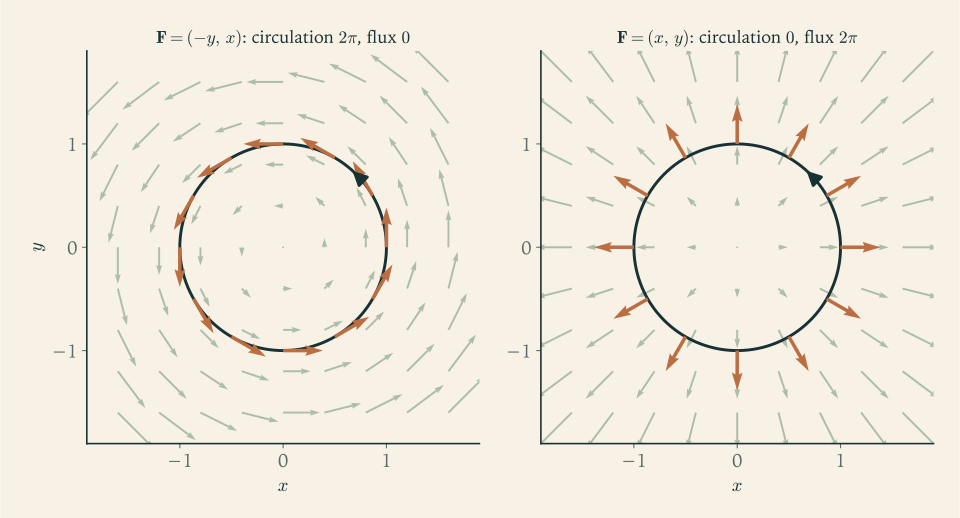
In Figure 8.2 the rotation field is everywhere tangent to the circle: it pushes a particle around and carries nothing across. The radial field is everywhere perpendicular to the circle: it does no work on a particle constrained to the circle and carries fluid straight out. A general field does some of each, and the two integrals separate the two effects.
Both numbers in the example equal twice the area of the disc. That is not a coincidence. For the rotation field the quantity \(Q_x-P_y\) equals \(2\) at every point, and for the radial field the quantity \(P_x+Q_y\) equals \(2\) at every point; in each case the integral around the boundary equals the integral of that quantity over the disc. The next chapter proves that this always happens, in the plane and in space, and the resulting theorems convert each of the integrals of this chapter into an integral over a region of one dimension more.
Exercises
-
Write down the definitions of \(\int_Cf\,ds\) , \(\int_C\mathbf F\cdot d\mathbf r\) , and the flux \(\iint_S\mathbf F\cdot\mathbf n\,dS\) in terms of parametrizations, and say for each whether reversing the orientation of the curve or surface changes its value.
-
Evaluate \(\int_C(x+y)\,ds\) where \(C\) is the line segment from \((0,0)\) to \((3,4)\) .
Answer
With \(\mathbf r(t)=(3t,4t)\) , \(0\le t\le 1\) , the speed is \(5\) and \(x+y=7t\) , so \(\int_C(x+y)\,ds=\int_0^135t\,dt=\tfrac{35}{2}\) .
-
Compute the circulation of \(\mathbf F=(x-y,\ x+y)\) around the circle of radius \(2\) centred at the origin, traced counterclockwise.
Answer
With \(\mathbf r(t)=(2\cos t,2\sin t)\) , \(\mathbf F\cdot\mathbf r'=(2\cos t-2\sin t)(-2\sin t)+(2\cos t+2\sin t)(2\cos t)=4\) , so the circulation is \(8\pi\) .
-
Compute the work done by \(\mathbf F=(yz,xz,xy)\) along the twisted cubic \(\mathbf r(t)=(t,t^{2},t^{3})\) , \(0\le t\le 1\) , directly from Definition 8.3, and again by finding a potential.
Solution
Directly: on the curve \(x=t\) , \(y=t^{2}\) , \(z=t^{3}\) , so \(\mathbf F=(yz,xz,xy)=(t^{5},t^{4},t^{3})\) , and \(\mathbf r'(t)=(1,2t,3t^{2})\) . The integrand is
\[ \mathbf F(\mathbf r(t))\cdot\mathbf r'(t)=t^{5}+2t^{5}+3t^{5}, \]that is, \(6t^{5}\) , and \(\int_0^16t^{5}\,dt=1\) .
With a potential: the components \(yz\) , \(xz\) , \(xy\) are the three partial derivatives of \(f(x,y,z)=xyz\) , so \(\mathbf F=\nabla f\) on all of space. By Theorem 8.5 the work is \(f(\mathbf r(1))-f(\mathbf r(0))=f(1,1,1)-f(0,0,0)=1-0\) . Either way the work is \(1\) .
The second method shows more: the work is \(1\) along every curve from the origin to \((1,1,1)\) , not just along the twisted cubic. The first method, applied to the composite \(f(\mathbf r(t))=t\cdot t^{2}\cdot t^{3}=t^{6}\) , is simply the statement that the integral of the derivative \(6t^{5}\) is the change in \(t^{6}\) .
-
Show that \(\mathbf F=(2x\cos y,\ -x^{2}\sin y+3y^{2})\) satisfies the condition of Proposition 8.8, find a potential, and evaluate \(\int_C\mathbf F\cdot d\mathbf r\) for a curve from \((1,0)\) to \((2,\pi)\) .
Solution
Here \(P=2x\cos y\) and \(Q=-x^{2}\sin y+3y^{2}\) , so \(P_y=-2x\sin y\) and \(Q_x=-2x\sin y\) . They agree, so the necessary condition holds. That alone does not prove the field conservative; exhibiting a potential does.
Integrate \(P\) with respect to \(x\) : \(f=x^{2}\cos y+g(y)\) . Then \(f_y=-x^{2}\sin y+g'(y)\) must equal \(Q\) , so \(g'(y)=3y^{2}\) and \(g=y^{3}\) up to a constant. Thus
\[ f(x,y)=x^{2}\cos y+y^{3} \]is a potential on the whole plane, and the field is conservative. By Theorem 8.5, for any curve from \((1,0)\) to \((2,\pi)\) ,
\[ \int_C\mathbf F\cdot d\mathbf r=f(2,\pi)-f(1,0)=(-4+\pi^{3})-(1+0)=\pi^{3}-5\approx 26.006 . \]The value does not depend on the curve chosen, so the exercise did not need to specify one.
-
For \(\mathbf F=(xy,x)\) , compute the circulation counterclockwise around the boundary of the unit square \([0,1]\times[0,1]\) by integrating along its four sides, and conclude that the field is not conservative.
Solution
Trace the boundary counterclockwise, starting at the origin. On the bottom side, \(\mathbf r=(t,0)\) , the field is \((0,t)\) and the velocity is \((1,0)\) : the integrand is \(0\) . On the right side, \(\mathbf r=(1,t)\) , the field is \((t,1)\) and the velocity is \((0,1)\) : the integrand is \(1\) , contributing \(1\) . On the top side, traced from right to left, \(\mathbf r=(1-t,1)\) , the field is \((1-t,1-t)\) and the velocity is \((-1,0)\) : the integrand is \(-(1-t)\) , contributing \(-\tfrac12\) . On the left side, \(\mathbf r=(0,1-t)\) , the field is \((0,0)\) : the contribution is \(0\) .
The circulation is \(0+1-\tfrac12+0=\tfrac12\) . It is not zero, so by Theorem 8.7 the field is not conservative. This agrees with the derivative test: \(P_y=x\) and \(Q_x=1\) are different functions. The value \(\tfrac12\) is also the integral of \(Q_x-P_y=1-x\) over the square, an agreement that Chapter 9 explains.
-
Prove from the definitions that reversing the direction in which a curve is traced changes the sign of \(\int_C\mathbf F\cdot d\mathbf r\) but leaves \(\int_Cf\,ds\) unchanged.
Solution
Let \(\mathbf r:[a,b]\to\mathbb R^n\) parametrize \(C\) and let \(\tilde{\mathbf r}(u)=\mathbf r(a+b-u)\) for \(a\le u\le b\) , which traces the same curve backwards. By the chain rule \(\tilde{\mathbf r}'(u)=-\mathbf r'(a+b-u)\) .
For the vector field, substitute \(t=a+b-u\) , \(dt=-du\) :
\[ \int_a^b\mathbf F(\tilde{\mathbf r}(u))\cdot\tilde{\mathbf r}'(u)\,du=-\int_a^b\mathbf F(\mathbf r(a+b-u))\cdot\mathbf r'(a+b-u)\,du=-\int_a^b\mathbf F(\mathbf r(t))\cdot\mathbf r'(t)\,dt . \]The substitution reverses the limits, which contributes one minus sign, and \(dt=-du\) contributes another; these cancel, leaving the minus sign from the velocity. So the line integral changes sign.
For the scalar integral the velocity enters only through its length, and \(\lVert\tilde{\mathbf r}'(u)\rVert=\lVert\mathbf r'(a+b-u)\rVert\) . The same substitution now gives \(\int_a^bf(\tilde{\mathbf r}(u))\lVert\tilde{\mathbf r}'(u)\rVert\,du=\int_a^bf(\mathbf r(t))\lVert\mathbf r'(t)\rVert\,dt\) , with the two sign changes from the limits and from \(dt=-du\) cancelling and nothing left over. Mass does not care which way one walks along the wire; work does.
-
Let \(\mathbf F\) be a continuous field and \(C\) a closed regular curve along which \(\mathbf F\cdot\mathbf T>0\) at every point. Prove that \(\mathbf F\) is not conservative on any open set containing \(C\) , and apply this to \(\mathbf F=(-y,x)\) .
Solution
Suppose, for contradiction, that \(\mathbf F=\nabla f\) on an open set \(U\) containing \(C\) . The curve \(C\) is closed, so its initial and final points coincide, and Theorem 8.5 gives \(\oint_C\mathbf F\cdot d\mathbf r=f(A)-f(A)=0\) .
On the other hand, for a regular parametrization the line integral equals \(\int_C(\mathbf F\cdot\mathbf T)\,ds=\int_a^b(\mathbf F\cdot\mathbf T)\,\lVert\mathbf r'(t)\rVert\,dt\) . The integrand is a continuous function that is positive at every point of \([a,b]\) , since \(\mathbf F\cdot\mathbf T>0\) and the speed is positive. The integral of a positive continuous function over an interval of positive length is positive. So \(\oint_C\mathbf F\cdot d\mathbf r>0\) , a contradiction. Hence \(\mathbf F\) is not conservative on any such \(U\) .
For \(\mathbf F=(-y,x)\) take \(C\) to be the unit circle, with \(\mathbf T=(-\sin t,\cos t)\) at the point \((\cos t,\sin t)\) . There \(\mathbf F=(-\sin t,\cos t)\) and \(\mathbf F\cdot\mathbf T=1>0\) . So the rotation field is not conservative on any open set containing the unit circle. Physically, a field that pushes a particle forward all the way around a loop would deliver energy on every lap.
-
A student argues: “The field \(\mathbf F=\bigl(-y/(x^{2}+y^{2}),\ x/(x^{2}+y^{2})\bigr)\) satisfies \(P_y=Q_x\) , so it is conservative, so its integral around the unit circle is \(0\) .” Identify the false step, state what the condition \(P_y=Q_x\) does and does not establish, and give the correct value of the integral.
Solution
The false step is “so it is conservative”. Proposition 8.8 says that a conservative \(C^1\) field satisfies \(P_y=Q_x\) ; it is a necessary condition, and the student has used its converse, which the proposition does not assert.
What the condition does establish is local: on any region without holes, such as a disc not containing the origin or the half-plane \(x>0\) , the field has a potential, here the polar angle. What it does not establish is the existence of a single potential on the whole domain. The domain of this field is the plane with the origin removed, and a closed curve that encircles the missing point cannot be handled by any locally defined angle.
The correct value is found by direct computation, as in Example 8.4: on the unit circle \(\mathbf F\cdot\mathbf r'=\sin^{2}t+\cos^{2}t=1\) , so the integral is \(2\pi\) . Since this is not zero, Theorem 8.7 shows the field is not conservative on its domain, which settles the matter independently of any derivative test.
-
Find the area of the triangle cut from the plane \(2x+2y+z=4\) by the first octant in two ways: from the cross product of two edge vectors as in Chapter 1, and from the surface area formula for a graph.
Solution
The plane meets the axes at \(A=(2,0,0)\) , \(B=(0,2,0)\) , and \(C=(0,0,4)\) . Two edge vectors are \(\overrightarrow{AB}=(-2,2,0)\) and \(\overrightarrow{AC}=(-2,0,4)\) , with cross product
\[ \overrightarrow{AB}\times\overrightarrow{AC}=(2\cdot 4-0\cdot 0,\ 0\cdot(-2)-(-2)\cdot 4,\ (-2)\cdot 0-2\cdot(-2))=(8,8,4). \]So the cross product is \((8,8,4)\) , of length \(\sqrt{144}=12\) , and the triangle has area half of that.
As a graph, \(z=g(x,y)=4-2x-2y\) over the triangle \(T\) in the \(xy\) -plane with vertices \((0,0)\) , \((2,0)\) , \((0,2)\) , of area \(2\) . The area factor is \(\sqrt{1+g_x^{2}+g_y^{2}}=\sqrt{1+4+4}=3\) , a constant, so the surface area is \(3\cdot 2\) .
The area is \(6\) by both methods. The second shows that a plane region is larger than its shadow by a constant factor, the reciprocal of the cosine of the angle between the plane and the horizontal; here the unit normal \((2,2,1)/3\) has vertical component \(\tfrac13\) .
-
Find the area of the part of the sphere \(x^{2}+y^{2}+z^{2}=4\) that lies above the plane \(z=1\) .
Hint
Use the spherical parametrization with \(R=2\) , for which \(\lVert\mathbf r_\phi\times\mathbf r_\theta\rVert=4\sin\phi\) . The plane \(z=1\) is \(2\cos\phi=1\) , so \(\phi\) runs from \(0\) to \(\pi/3\) . You should get \(4\pi\) . More generally a cap of height \(h\) on a sphere of radius \(R\) has area \(2\pi Rh\) .
-
Evaluate \(\iint_Sz\,dS\) over the upper half of the unit sphere, and use it to find the height of the centroid of that hemispherical shell.
Hint
On the unit sphere \(z=\cos\phi\) and \(dS=\sin\phi\,d\phi\,d\theta\) , with \(0\le\phi\le\pi/2\) . The integral is \(2\pi\int_0^{\pi/2}\cos\phi\sin\phi\,d\phi=\pi\) . Divide by the area \(2\pi\) of the hemisphere: the centroid is at height \(\tfrac12\) .
-
Find the flux of \(\mathbf F=(0,0,z)\) upward through the upper half of the sphere of radius \(R\) centred at the origin.
Solution
Parametrize the hemisphere by \(\mathbf r(\phi,\theta)=R(\sin\phi\cos\theta,\sin\phi\sin\theta,\cos\phi)\) with \(0\le\phi\le\pi/2\) , \(0\le\theta\le 2\pi\) . From Section 8.4, \(\mathbf r_\phi\times\mathbf r_\theta=R\sin\phi\,\mathbf r\) , which points radially outward and therefore upward on the upper hemisphere, the required orientation. Its third component is \(R\sin\phi\cdot R\cos\phi\) .
On the surface \(\mathbf F=(0,0,z)=(0,0,R\cos\phi)\) , so
\[ \mathbf F\cdot(\mathbf r_\phi\times\mathbf r_\theta)=R\cos\phi\cdot R^{2}\sin\phi\cos\phi=R^{3}\cos^{2}\phi\sin\phi . \]The flux is
\[ \int_0^{2\pi}\!\!\int_0^{\pi/2}R^{3}\cos^{2}\phi\sin\phi\,d\phi\,d\theta=2\pi R^{3}\Bigl[-\tfrac13\cos^{3}\phi\Bigr]_0^{\pi/2}=\frac{2\pi R^{3}}{3}. \]As a check, project onto the disc \(x^{2}+y^{2}\le R^{2}\) . The graph \(z=\sqrt{R^{2}-x^{2}-y^{2}}\) is not differentiable on the rim of the disc, so it is not a parametrization in the sense of Definition 8.9 and the graph formula cannot simply be quoted. Instead, observe that the third component of \(\mathbf r_\phi\times\mathbf r_\theta\) , namely \(R^{2}\sin\phi\cos\phi\) , is exactly the Jacobian determinant of the map \((\phi,\theta)\mapsto(x,y)=(R\sin\phi\cos\theta,\ R\sin\phi\sin\theta)\) . That map is \(C^1\) , carries the rectangle \(0\le\phi\le\pi/2\) , \(0\le\theta\le 2\pi\) onto the disc, and is one-to-one with nonzero Jacobian on the interior of the rectangle, so Theorem 7.2 applies and converts the flux integral \(\iint z\,R^{2}\sin\phi\cos\phi\,d\phi\,d\theta\) into \(\iint z\,dA\) over the disc. That is the volume of the half-ball, \(\tfrac23\pi R^{3}\) . The two computations agree.
-
Find the flux of \(\mathbf F=(x,y,0)\) outward through the curved side of the cylinder \(x^{2}+y^{2}=4\) , \(0\le z\le 3\) , by identifying the normal component of the field.
Answer
On the cylinder the outward unit normal is \((x,y,0)/2\) , so \(\mathbf F\cdot\mathbf n=(x^{2}+y^{2})/2=2\) , a constant. The flux is \(2\) times the lateral area \(2\pi\cdot 2\cdot 3\) , that is, \(24\pi\) .
-
Find the flux of the constant field \(\mathbf F=(1,2,3)\) through the triangle of Exercise 10, oriented upward.
Answer
With the graph parametrization the upward normal vector is \((2,2,1)\) , and \(\mathbf F\cdot(2,2,1)=9\) , a constant. The flux is \(9\) times the area \(2\) of the shadow triangle: \(18\) .
-
Compute the flux of \(\mathbf F=(x,2y)\) outward across the unit circle using the formula \(\int_CP\,dy-Q\,dx\) .
Answer
With \(x=\cos t\) , \(y=\sin t\) : \(P\,dy-Q\,dx=(\cos^{2}t+2\sin^{2}t)\,dt\) , and the flux is \(\pi+2\pi=3\pi\) .
-
For the field \(\mathbf F=(x,y)\) , decide from the direction of the field relative to the path, without integrating, whether the work is positive, negative, or zero along (a) the segment from \((1,0)\) to \((2,0)\) ; (b) the quarter circle from \((1,0)\) to \((0,1)\) ; (c) the segment from \((2,2)\) to \((1,1)\) . Then verify each answer with a potential.
Hint
The field points radially outward. In (a) the motion is radially outward, with the field: positive. In (b) the motion is along a circle centred at the origin, perpendicular to the field: zero. In (c) the motion is toward the origin, against the field: negative. A potential is \(f=\tfrac12(x^{2}+y^{2})\) , and the three values are \(\tfrac32\) , \(0\) , and \(-3\) .
-
The torus obtained by revolving a circle of radius \(b\) about an axis at distance \(a>b\) from its centre is parametrized by \(\mathbf r(u,v)=\bigl((a+b\cos v)\cos u,\ (a+b\cos v)\sin u,\ b\sin v\bigr)\) for \(0\le u,v\le 2\pi\) . Compute \(\lVert\mathbf r_u\times\mathbf r_v\rVert\) and the area of the torus.
Solution
Differentiate: with \(w=a+b\cos v\) for brevity,
\[ \mathbf r_u=(-w\sin u,\ w\cos u,\ 0),\qquad\mathbf r_v=(-b\sin v\cos u,\ -b\sin v\sin u,\ b\cos v). \]The cross product has components \(w\cos u\cdot b\cos v\) , then \(w\sin u\cdot b\cos v\) , then \(wb\sin v\sin^{2}u+wb\sin v\cos^{2}u=wb\sin v\) . So
\[ \mathbf r_u\times\mathbf r_v=bw\,(\cos u\cos v,\ \sin u\cos v,\ \sin v), \]and the vector in brackets has length \(\sqrt{\cos^{2}v+\sin^{2}v}=1\) . Since \(a>b\) , \(w>0\) and \(\lVert\mathbf r_u\times\mathbf r_v\rVert=bw=b(a+b\cos v)\) . The parametrization is regular everywhere.
The area is
\[ \int_0^{2\pi}\!\!\int_0^{2\pi}b(a+b\cos v)\,du\,dv=2\pi b\Bigl[av+b\sin v\Bigr]_0^{2\pi}=4\pi^{2}ab . \]The answer is the product of the circumference \(2\pi b\) of the revolving circle and the distance \(2\pi a\) travelled by its centre. The term \(b\cos v\) integrates to zero: the outer half of the torus has more area than a cylinder of the same length would, and the inner half has less by the same amount.
-
For the ellipse \(\mathbf r(t)=(2\cos t,\sin t)\) of Example 1.5, evaluate \(\int_C\kappa\,ds\) , the integral of the curvature with respect to arc length around the whole ellipse, and interpret the answer.
Solution
From Example 1.5 the speed is \(v(t)=\sqrt{4\sin^{2}t+\cos^{2}t}\) and the curvature is \(\kappa(t)=2/v(t)^{3}\) . By Definition 8.2,
\[ \int_C\kappa\,ds=\int_0^{2\pi}\kappa(t)\,v(t)\,dt=\int_0^{2\pi}\frac{2}{4\sin^{2}t+\cos^{2}t}\,dt . \]The integrand has period \(\pi\) and is symmetric about \(t=\pi/2\) , so the integral is four times the integral over \([0,\pi/2]\) . There, divide numerator and denominator by \(\cos^{2}t\) and substitute \(w=\tan t\) , \(dw=dt/\cos^{2}t\) :
\[ \int_0^{\pi/2}\frac{2}{4\sin^{2}t+\cos^{2}t}\,dt=\int_0^{\infty}\frac{2}{4w^{2}+1}\,dw=\bigl[\arctan(2w)\bigr]_0^{\infty}=\frac\pi2 . \]So \(\int_C\kappa\,ds=4\cdot\tfrac\pi2\) , which is \(2\pi\) .
The interpretation comes from Definition 1.9: curvature is the rate at which the unit tangent turns per unit of arc length. Integrating a rate of turning over the whole curve gives the total angle through which the tangent turns, and going once around an oval the tangent makes exactly one full revolution, \(2\pi\) radians. The answer does not depend on the semi-axes: every convex closed curve has total curvature \(2\pi\) , sharp bends being compensated by flat stretches.