The integral \(\int_{-\infty}^{\infty}e^{-x^{2}}\,dx\) is the most important integral in probability, and it cannot be found by antidifferentiation: \(e^{-x^{2}}\) has no elementary antiderivative. The standard way to evaluate it is to square it, which turns it into a double integral of \(e^{-(x^{2}+y^{2})}\) over the plane, and then to notice that this integrand depends only on the distance from the origin. In coordinates built around that distance the double integral becomes easy, and the answer, \(\sqrt\pi\) , falls out.
The step from \(x\) and \(y\) to distance and angle is a change of variables in a double integral. This chapter establishes the rule for such changes. Its content is that a change of variables distorts area, by a factor that varies from point to point and equals the absolute value of the determinant of the derivative matrix. That one sentence explains the factor \(r\) in polar coordinates, the factor \(\rho^{2}\sin\phi\) in spherical coordinates, and every other substitution a problem may call for.
7.1 Substitution, reconsidered
The one-variable substitution rule says that for a \(C^1\) function \(\varphi\) ,
The factor \(\varphi'(u)\) has a geometric meaning. The map \(\varphi\) carries a short interval of length \(\Delta u\) to an interval of length about \(\lvert\varphi'(u)\rvert\,\Delta u\) : the derivative is the local stretching factor for length. If \(\varphi\) is decreasing, the limits \(\varphi(a)\) and \(\varphi(b)\) appear in the wrong order, and putting them right introduces a minus sign that turns \(\varphi'\) into \(\lvert\varphi'\rvert\) . So for a one-to-one \(\varphi\) from an interval \(J\) onto an interval \(I\) , the rule can be stated without reference to orientation:
This is the form that generalizes. In two variables we need to know what a map does to small areas.
7.2 What a linear map does to area
Start with the simplest maps. A linear map \(T(u,v)=(au+bv,\ cu+dv)\)
, with matrix \(A=\begin{pmatrix}a&b\\ c&d\end{pmatrix}\)
, sends the unit square to the parallelogram spanned by the columns \((a,c)\)
and \((b,d)\)
. Regarding these as vectors in space with third coordinate zero, their cross product is \((0,0,ad-bc)\)
, so by Proposition 1.2(b) the parallelogram has area \(\lvert ad-bc\rvert=\lvert\det A\rvert\)
. Every other square is sent to a translate of a scaled copy of the same parallelogram, and any reasonable region can be approximated by small squares. Hence a linear map multiplies all areas by the constant factor \(\lvert\det A\rvert\)
; in three dimensions it multiplies volumes by \(\lvert\det A\rvert\)
. This is the geometric meaning of the determinant established in linear algebra (math.linear-algebra.determinant-as-volume-scale). The sign of the determinant records whether the map preserves or reverses orientation; for area only the absolute value matters.
Example 7.1: Integrating over a parallelogram
Let \(D\) be the parallelogram with vertices \((0,0)\) , \((2,1)\) , \((3,4)\) , and \((1,3)\) , and evaluate \(\iint_D(x+y)\,dA\) . In rectangular coordinates \(D\) would have to be cut into three pieces. But \(D\) is the image of the unit square \(S=[0,1]\times[0,1]\) under the linear map
which sends \((1,0)\) to \((2,1)\) and \((0,1)\) to \((1,3)\) . Its area factor is \(\det\begin{pmatrix}2&1\\ 1&3\end{pmatrix}=5\) , so a small rectangle of area \(du\,dv\) in the square corresponds to a small parallelogram of area \(5\,du\,dv\) in \(D\) . The integrand becomes \(x+y=3u+4v\) . Therefore
which is \(\tfrac{35}{2}\) . As a check on the factor, the same formula with integrand \(1\) gives the area of \(D\) as \(5\) , in agreement with the cross product of its edge vectors.
7.3 The change of variables formula
A differentiable map is not linear, but near each point it is nearly so. Let \(T(u,v)=(x(u,v),y(u,v))\) be a \(C^1\) map. By Definition 3.1, near a point \((u_0,v_0)\) ,
with an error small compared with the size of the displacement. So \(T\) carries a small rectangle with sides \(\Delta u\) and \(\Delta v\) at \((u_0,v_0)\) to a slightly curved quadrilateral that is very nearly the parallelogram into which the linear map \(DT(u_0,v_0)\) carries the rectangle. By Section 7.2 that parallelogram has area \(\lvert\det DT(u_0,v_0)\rvert\,\Delta u\,\Delta v\) .
Definition 7.1 (Jacobian determinant). The Jacobian determinant of a \(C^1\) map \(T(u,v)=(x,y)\) is
and similarly for maps of three variables, with a \(3\times 3\) determinant.
Now cut a region \(S\) of the \(uv\) -plane into small rectangles \(S_{ij}\) . Their images \(T(S_{ij})\) cut \(D=T(S)\) into small curved pieces of area approximately \(\lvert\det DT\rvert\,\Delta u_i\,\Delta v_j\) . A Riemann-type sum for \(\iint_Df\,dA\) over these pieces is
which is a Riemann sum for the function \((f\circ T)\,\lvert\det DT\rvert\) over \(S\) . This is the idea behind the following theorem.
Theorem 7.2 (change of variables for double integrals). Let \(S\) be a closed bounded region of the \(uv\) -plane whose boundary has zero area, and let \(T\) be a \(C^1\) map from an open set containing \(S\) into the \(xy\) -plane. Suppose that \(T\) is one-to-one on the interior of \(S\) and that \(\det DT\ne 0\) at every interior point of \(S\) . Let \(D=T(S)\) . Then for every continuous function \(f\) on \(D\) ,
The analogous statement holds for triple integrals, with the \(3\times 3\) Jacobian determinant.
The argument sketched above is not a proof, because it does not control the accumulated error from replacing each curved piece by a parallelogram, nor the pieces that straddle the boundary. A complete proof bounds those errors using the uniform continuity of \(DT\) and is carried out in advanced analysis; we use the theorem and do not reproduce its proof. What we can and shall do is confirm the formula independently in the cases that matter most.
Three features of the statement deserve attention. The absolute value appears because areas are positive. The hypotheses are imposed only on the interior of \(S\) : the map may fail to be one-to-one, and its Jacobian may vanish, on the boundary, which has zero area and so contributes nothing to either integral. And the theorem has three jobs to be done in every application: transform the integrand, transform the region, and insert the Jacobian factor.
7.4 Polar coordinates
The polar coordinate map \(T(r,\theta)=(r\cos\theta,r\sin\theta)\) was differentiated in Example 3.4, where we found \(\det DT=r\) . So for a region described in polar coordinates,
Take \(S=[0,R]\times[0,2\pi]\) , whose image is the disc of radius \(R\) . On the interior of \(S\) , where \(0<r<R\) and \(0<\theta<2\pi\) , the map is one-to-one and \(r\ne 0\) . It fails to be one-to-one only on the edges \(r=0\) , which collapses to the origin, and \(\theta=0\) and \(\theta=2\pi\) , which are sent to the same radius. Theorem 7.2 was phrased to tolerate exactly this.
For polar coordinates the area factor can be checked exactly, with no approximation. The image of the rectangle \(r_1\le r\le r_2\) , \(\theta_1\le\theta\le\theta_2\) is a piece of a ring. A full disc of radius \(r\) has area \(\pi r^{2}\) , so a sector of angle \(\Delta\theta\) has area \(\tfrac12r^{2}\Delta\theta\) , and the piece of ring has area
where \(\bar r\) is the middle radius. The area of the polar cell is exactly its \(r\theta\) -area times the value of \(r\) at its centre. Cells far from the origin are larger than cells near it, in proportion to \(r\) , and the Jacobian is the bookkeeping for that.
Example 7.2: The Gaussian integral
Let \(D_R\) be the disc of radius \(R\) about the origin. In polar coordinates \(x^{2}+y^{2}=r^{2}\) , so
The factor \(r\) supplied by the Jacobian is precisely what makes \(e^{-r^{2}}\) integrable in elementary terms.
Now let \(I_R=\int_{-R}^{R}e^{-x^{2}}\,dx\) . By Fubini’s theorem on the square \(Q_R=[-R,R]\times[-R,R]\) , and because the integrand is a product,
The square contains the disc \(D_R\) and is contained in the disc \(D_{\sqrt2R}\) , and the integrand is positive, so
For \(R=2\) the three numbers are \(3.0841\) , \(3.1123\) , and \(3.1405\) to four decimal places, already bracketing \(\pi\) . As \(R\to\infty\) both bounds tend to \(\pi\) , so \(I_R^{2}\to\pi\) and
A one-dimensional integral with no elementary antiderivative has been evaluated by passing through two dimensions, where a better coordinate system exists.
Example 7.3: A disc that is not centred at the origin
Evaluate \(\iint_D\sqrt{x^{2}+y^{2}}\,dA\) where \(D\) is the disc \(x^{2}+y^{2}\le 2x\) , that is, \((x-1)^{2}+y^{2}\le 1\) . The integrand is \(r\) , which suggests polar coordinates even though the disc is not centred at the origin. The boundary circle \(x^{2}+y^{2}=2x\) becomes \(r^{2}=2r\cos\theta\) , that is, \(r=2\cos\theta\) . The disc lies in the half-plane \(x\ge 0\) , so \(\theta\) runs from \(-\pi/2\) to \(\pi/2\) , and along the ray at angle \(\theta\) the radius runs from \(0\) to \(2\cos\theta\) . Hence
which is \(\tfrac{32}{9}\) ; the integral of \(\cos^{3}\theta=(1-\sin^{2}\theta)\cos\theta\) over the interval is \(\tfrac43\) . Here the region in the \(r\theta\) -plane is not a rectangle but a region of the type of Definition 6.3, with the inner limit depending on \(\theta\) . Changing variables and choosing an order of integration are separate steps, and both are read off a sketch.
7.5 Coordinates fitted to the region
Polar coordinates are one choice among many. When the boundary of a region consists of level curves of two functions, those two functions make natural coordinates, and in them the region is a rectangle. The Jacobian is then most easily found backwards.
Proposition 7.3 (Jacobian of the inverse map). Let \(T\) be a \(C^1\) map with \(\det DT\ne 0\) that has a \(C^1\) inverse on the regions concerned. Then
where the right side is evaluated at the corresponding point.
Proof. By Theorem 3.5 the derivative matrix of the inverse map is the inverse matrix, \(D(T^{-1})=(DT)^{-1}\) , and the determinant of an inverse matrix is the reciprocal of the determinant.
Unlike the false reciprocal rule for individual partial derivatives exposed in Chapter 3, this reciprocal rule for Jacobian determinants is correct, because it is a statement about the whole matrix.
Example 7.4: A region bounded by hyperbolas and lines
Let \(D\) be the region in the first quadrant bounded by the hyperbolas \(xy=1\) and \(xy=4\) and the lines \(y=x\) and \(y=4x\) . Find its area and \(\iint_Dxy\,dA\) .
Put \(u=xy\) and \(v=y/x\) . Then \(D\) is described by \(1\le u\le 4\) and \(1\le v\le 4\) : a square \(S\) in the \(uv\) -plane. On the first quadrant the map \((x,y)\mapsto(u,v)\) is one-to-one, with inverse \(x=\sqrt{u/v}\) , \(y=\sqrt{uv}\) . Its Jacobian determinant is
By Proposition 7.3 the factor required by Theorem 7.2 is the reciprocal, \(\dfrac{\partial(x,y)}{\partial(u,v)}=\frac{1}{2v}\) , which is positive on \(S\) . Therefore
We never needed the formulas for \(x\) and \(y\) in terms of \(u\) and \(v\) to compute the Jacobian, only to know that the inverse exists.
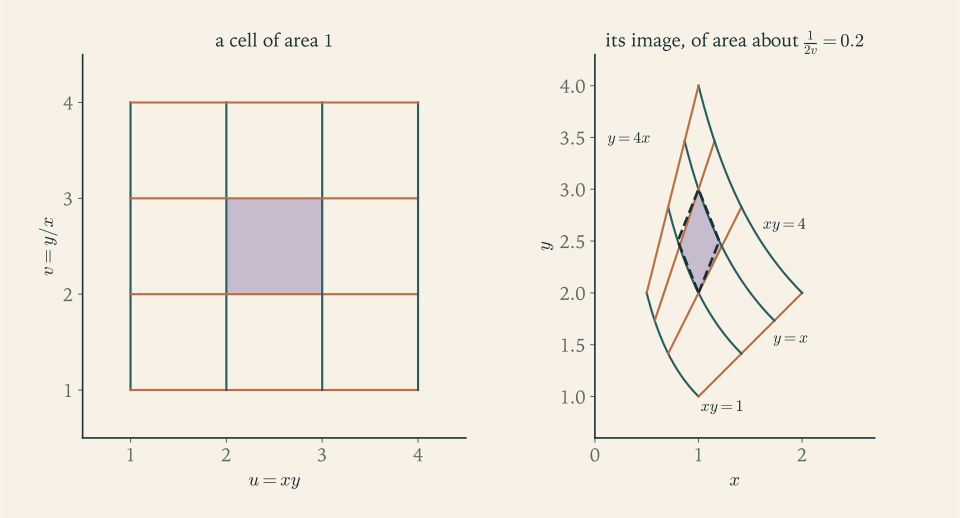
Figure 7.1 shows the grid lines \(u=1,2,3,4\) and \(v=1,2,3,4\) and their images, which are hyperbolas and rays. The shaded cell \(2\le u\le 3\) , \(2\le v\le 3\) has area \(1\) . Its image is the small curved quadrilateral on the right, and the dashed outline is the parallelogram obtained by applying the derivative matrix at the centre of the cell. The two nearly coincide. The parallelogram has area \(1/(2v)=0.2\) at \(v=2.5\) ; the exact area of the image cell is \(\int_2^3\int_2^3\frac{1}{2v}\,du\,dv=\tfrac12\ln\tfrac32\approx 0.203\) . Notice also that the cells in the upper part of the image, where \(v\) is large, are smaller than those in the lower part: the factor \(1/(2v)\) decreases with \(v\) .
7.6 Cylindrical and spherical coordinates
In space two coordinate systems dominate. Cylindrical coordinates \((r,\theta,z)\) use polar coordinates in the \(xy\) -plane and keep \(z\) :
The derivative matrix has the polar matrix in its upper left corner and a \(1\) in the lower right, so its determinant is again \(r\) , and \(dV=r\,dz\,dr\,d\theta\) . These coordinates suit solids with an axis of symmetry.
Spherical coordinates \((\rho,\phi,\theta)\) describe a point by its distance \(\rho\ge 0\) from the origin, the angle \(\phi\in[0,\pi]\) that its position vector makes with the positive \(z\) -axis, and the polar angle \(\theta\) of its projection onto the \(xy\) -plane:
The three columns of the derivative matrix are the partial derivatives of the position with respect to \(\rho\) , \(\phi\) , and \(\theta\) :
A direct check shows that these three vectors are mutually orthogonal and have lengths \(1\) , \(\rho\) , and \(\rho\sin\phi\) . The box they span is rectangular, so its volume, which is the absolute value of the determinant, is the product of the three lengths:
The three lengths have a direct meaning. Changing \(\rho\) moves the point radially at unit rate; changing \(\phi\) moves it along a meridian circle of radius \(\rho\) ; changing \(\theta\) moves it along a circle of latitude, whose radius is \(\rho\sin\phi\) . Since \(0\le\phi\le\pi\) , the factor \(\sin\phi\) is nonnegative and no absolute value sign is needed.
Example 7.5: A ball and an ice-cream cone
The ball of radius \(R\) is \(0\le\rho\le R\) , \(0\le\phi\le\pi\) , \(0\le\theta\le 2\pi\) , a box in spherical coordinates, and the integrand \(\rho^{2}\sin\phi\) is a product. So
Now let \(E\) be the solid inside the sphere \(\rho=2\) and above the cone \(z=\sqrt{x^{2}+y^{2}}\) . On the cone, \(\rho\cos\phi=\rho\sin\phi\) , so \(\phi=\pi/4\) , and the solid is \(0\le\rho\le 2\) , \(0\le\phi\le\pi/4\) , \(0\le\theta\le 2\pi\) . Its volume is
That is about \(15\) percent of the volume \(\tfrac{32}{3}\pi\approx 33.5\) of the whole ball. In rectangular coordinates the same solid would require an integral with square roots in four of its six limits.
Example 7.6: Mass and centre of mass of a paraboloid bowl
Let \(E\) be the solid \(x^{2}+y^{2}\le z\le 2\) , the region inside the paraboloid \(z=x^{2}+y^{2}\) and below the plane \(z=2\) , with density equal to the height, \(\delta(x,y,z)=z\) . The solid has the \(z\) -axis as an axis of symmetry, so use cylindrical coordinates. The paraboloid is \(z=r^{2}\) ; it meets the plane where \(r=\sqrt2\) . So \(E\) is \(0\le\theta\le 2\pi\) , \(0\le r\le\sqrt2\) , \(r^{2}\le z\le 2\) , and the mass is
which is \(\tfrac{8\pi}{3}\) . As a check, integrate in the other order: for fixed \(z\) between \(0\) and \(2\) the cross-section is the disc \(r\le\sqrt z\) , of area \(\pi z\) , so \(M=\int_0^2z\cdot\pi z\,dz=\tfrac{8\pi}{3}\) again. The same slicing gives the volume of the solid as \(\int_0^2\pi z\,dz\) , which is \(2\pi\) , and the moment \(\iiint_Ez\cdot z\,dV=\int_0^2\pi z^{3}\,dz=4\pi\) . The centre of mass lies on the axis, at height \(\bar z=\tfrac32\) , three quarters of the way up, because both the volume and the density are concentrated near the top.
7.7 What the hypotheses prevent
Example 7.7: A map that folds
Let \(T(u,v)=(u^{2},v)\) on \(S=[-1,1]\times[0,1]\) . The image is the unit square \(D=[0,1]\times[0,1]\) , of area \(1\) . The Jacobian determinant is \(2u\) . Applying the formula of Theorem 7.2 to \(f=1\) gives \(\iint_S\lvert 2u\rvert\,du\,dv\) , with the value \(2\) : twice the true area. The map is not one-to-one on the interior of \(S\) , since \(T(-u,v)=T(u,v)\) ; it folds the rectangle along the line \(u=0\) and covers the square twice, and the formula faithfully counts both layers. If, in addition, the absolute value is forgotten, the integral \(\iint_S2u\,du\,dv\) has the value \(0\) : the two layers have opposite orientations and cancel. Restricting to \(0\le u\le 1\) , where the map is one-to-one, gives \(\int_0^1\int_0^12u\,du\,dv=1\) , as it should.
Common mistake. Three errors account for nearly all wrong answers in this chapter. The first is to omit the Jacobian factor, writing \(dA=dr\,d\theta\) ; the resulting integral does not even have the units of area times integrand. The second is to use the Jacobian of the wrong direction: in Example 7.4 the factor \(2v\) belongs to \(\partial(u,v)/\partial(x,y)\) , and multiplying by it instead of dividing gives an “area” of \(45\) for a region that fits inside a rectangle of area \(4.5\) . The third is to transform the integrand and the area element but keep the old limits. Always redraw the region in the new coordinates, and check the result against a crude estimate.
The change of variables formula reaches beyond geometry. A probability density is a function whose integral over a region gives the probability of that region, so when random quantities are transformed their density picks up exactly the Jacobian factor of Theorem 7.2; that application is developed in Probability Theory (math.probability-theory.density-transformation). Within this book, the formula is about to be used in a new way. A parametrized surface in space is a map from a region of the plane into \(\mathbb R^3\)
, and the area of the surface is computed by a formula of the same shape, with the length of a cross product in the role of the Jacobian. Chapter 8 takes that up, after first treating the one-dimensional case: integrals along curves.
Exercises
-
State the change of variables theorem for double integrals with its hypotheses, and write down the Jacobian factors for polar, cylindrical, and spherical coordinates.
-
Compute the Jacobian determinant \(\partial(x,y)/\partial(u,v)\) for each map: (a) \(x=u^{2}-v^{2}\) , \(y=2uv\) ; (b) \(x=e^{u}\cos v\) , \(y=e^{u}\sin v\) ; (c) \(x=u+v\) , \(y=u-v\) . For (c) say what the sign of the determinant means.
Answer
(a) \(4(u^{2}+v^{2})\) . (b) \(e^{2u}\) . (c) \(-2\) : the map reverses orientation, sending a counterclockwise loop to a clockwise one, and multiplies areas by \(2\) .
-
Evaluate \(\displaystyle\iint_D\frac{dA}{1+x^{2}+y^{2}}\) over the disc \(x^{2}+y^{2}\le 4\) using polar coordinates.
Answer
\(\displaystyle\int_0^{2\pi}\!\!\int_0^2\frac{r}{1+r^{2}}\,dr\,d\theta=\pi\ln 5\approx 5.056\) .
-
Convert \(\displaystyle\int_0^1\!\!\int_0^{\sqrt{1-x^{2}}}(x^{2}+y^{2})^{3/2}\,dy\,dx\) to polar coordinates, describing the region first, and evaluate it.
Hint
The limits describe the quarter of the unit disc in the first quadrant: \(0\le r\le 1\) , \(0\le\theta\le\pi/2\) . The integrand is \(r^{3}\) and the Jacobian contributes another factor \(r\) . You should get \(\pi/10\) .
-
Find the area enclosed by the cardioid \(r=1+\cos\theta\) .
Hint
The region is \(0\le\theta\le 2\pi\) , \(0\le r\le 1+\cos\theta\) , so the area is \(\int_0^{2\pi}\tfrac12(1+\cos\theta)^{2}\,d\theta\) . Expand and use \(\int_0^{2\pi}\cos^{2}\theta\,d\theta=\pi\) . The answer is \(3\pi/2\) .
-
Find the volume of the solid that lies inside both the sphere \(x^{2}+y^{2}+z^{2}=4\) and the cylinder \(x^{2}+y^{2}=1\) .
Solution
The solid has the \(z\) -axis as an axis of symmetry, so use cylindrical coordinates. The cylinder restricts \(r\) to \(0\le r\le 1\) , with \(0\le\theta\le 2\pi\) . For such a point the sphere \(r^{2}+z^{2}=4\) restricts \(z\) to \(-\sqrt{4-r^{2}}\le z\le\sqrt{4-r^{2}}\) ; the cylinder puts no condition on \(z\) . With the Jacobian factor \(r\) ,
\[ V=\int_0^{2\pi}\!\!\int_0^1\!\!\int_{-\sqrt{4-r^{2}}}^{\sqrt{4-r^{2}}}r\,dz\,dr\,d\theta=2\pi\int_0^12r\sqrt{4-r^{2}}\,dr . \]Substituting \(w=4-r^{2}\) , \(dw=-2r\,dr\) , the last integral is \(\int_3^4\sqrt w\,dw=\tfrac23\bigl(8-3\sqrt3\bigr)\) . Hence
\[ V=\frac{4\pi}{3}\bigl(8-3\sqrt3\bigr)\approx 11.74 . \]As a sanity check, the solid contains the cylinder of radius \(1\) and height \(2\sqrt3\) , of volume about \(10.88\) , and is contained in the cylinder of radius \(1\) and height \(4\) , of volume about \(12.57\) .
-
Evaluate \(\displaystyle\iint_De^{(x-y)/(x+y)}\,dA\) over the triangle with vertices \((0,0)\) , \((1,0)\) , and \((0,1)\) by means of the substitution \(u=x-y\) , \(v=x+y\) .
Solution
Solve for the old variables: \(x=\tfrac12(u+v)\) , \(y=\tfrac12(v-u)\) . This is a linear map, one-to-one on the whole plane, with
\[ \frac{\partial(x,y)}{\partial(u,v)}=\det\begin{pmatrix}\tfrac12&\tfrac12\\ -\tfrac12&\tfrac12\end{pmatrix}=\tfrac12 . \]Transform the region. The triangle is \(x\ge 0\) , \(y\ge 0\) , \(x+y\le 1\) . In the new variables these read \(u+v\ge 0\) , \(v-u\ge 0\) , \(v\le 1\) , that is, \(0\le v\le 1\) and \(-v\le u\le v\) : a triangle in the \(uv\) -plane with vertices \((0,0)\) , \((1,1)\) , \((-1,1)\) . The integrand becomes \(e^{u/v}\) . So
\[ \iint_De^{(x-y)/(x+y)}\,dA=\int_0^1\!\!\int_{-v}^{v}e^{u/v}\cdot\tfrac12\,du\,dv=\tfrac12\int_0^1\bigl[ve^{u/v}\bigr]_{u=-v}^{u=v}\,dv=\tfrac12\Bigl(e-\frac1e\Bigr)\int_0^1v\,dv , \]which equals \(\frac14\Bigl(e-\frac1e\Bigr)\approx 0.588\) .
The integrand is not defined at the origin, where \(x+y=0\) , but the exponent lies between \(-1\) and \(1\) throughout the triangle, so the integrand is bounded and continuous away from a single point; that point does not affect the integral. The substitution was chosen because the awkward expression \((x-y)/(x+y)\) becomes the simple quotient \(u/v\) and the region becomes one whose \(u\) -limits are proportional to \(v\) .
-
Find the area of the region in the first quadrant bounded by the parabolas \(y=x^{2}\) , \(y=2x^{2}\) , \(x=y^{2}\) , and \(x=3y^{2}\) , using \(u=y/x^{2}\) and \(v=x/y^{2}\) .
Solution
In the variables \(u=y/x^{2}\) and \(v=x/y^{2}\) the four boundary curves are \(u=1\) , \(u=2\) , \(v=1\) , and \(v=3\) , so the region corresponds to the rectangle \(1\le u\le 2\) , \(1\le v\le 3\) . On the first quadrant the map \((x,y)\mapsto(u,v)\) is one-to-one: from \(u^{2}v=1/x^{3}\) and \(uv^{2}=1/y^{3}\) the point \((x,y)\) can be recovered.
Compute the Jacobian of the map from \((x,y)\) to \((u,v)\) :
\[ \frac{\partial(u,v)}{\partial(x,y)}=\det\begin{pmatrix}-2y/x^{3}&1/x^{2}\\ 1/y^{2}&-2x/y^{3}\end{pmatrix}=\frac{4}{x^{2}y^{2}}-\frac{1}{x^{2}y^{2}}=\frac{3}{x^{2}y^{2}} . \]To express this in the new variables note that \(uv=1/(xy)\) , so \(1/(x^{2}y^{2})=u^{2}v^{2}\) and the determinant is \(3u^{2}v^{2}\) . By Proposition 7.3 the factor needed is its reciprocal, and
\[ \operatorname{area}=\int_1^3\!\!\int_1^2\frac{1}{3u^{2}v^{2}}\,du\,dv=\frac13\Bigl[-\frac1u\Bigr]_1^2\Bigl[-\frac1v\Bigr]_1^3=\frac13\cdot\frac12\cdot\frac23 , \]which is \(\tfrac19\) . The region is small: it lies inside the square \(0\le x,y\le 1\) .
-
Evaluate \(\displaystyle\iiint_Be^{(x^{2}+y^{2}+z^{2})^{3/2}}\,dV\) over the unit ball \(B\) using spherical coordinates.
Answer
In spherical coordinates the integrand is \(e^{\rho^{3}}\) and the integral is \(4\pi\int_0^1\rho^{2}e^{\rho^{3}}\,d\rho=\tfrac{4\pi}{3}(e-1)\approx 7.198\) .
-
Find the centroid of the solid cone \(\sqrt{x^{2}+y^{2}}\le z\le 1\) using cylindrical coordinates.
Hint
The cone is \(0\le\theta\le 2\pi\) , \(0\le r\le 1\) , \(r\le z\le 1\) . Its volume is \(\pi/3\) and \(\iiint z\,dV=2\pi\int_0^1\tfrac12r(1-r^{2})\,dr=\pi/4\) . By symmetry the centroid is on the axis, at height \(\tfrac34\) .
-
Verify the spherical Jacobian by expanding the \(3\times 3\) determinant of the derivative matrix directly, and confirm that the three columns displayed in Section 7.6 are mutually orthogonal.
Solution
With rows \(x,y,z\) and columns \(\rho,\phi,\theta\) the derivative matrix is
\[ \begin{pmatrix}\sin\phi\cos\theta&\rho\cos\phi\cos\theta&-\rho\sin\phi\sin\theta\\ \sin\phi\sin\theta&\rho\cos\phi\sin\theta&\rho\sin\phi\cos\theta\\ \cos\phi&-\rho\sin\phi&0\end{pmatrix}. \]Expand along the third row. The entry \(\cos\phi\) multiplies the minor
\[ \det\begin{pmatrix}\rho\cos\phi\cos\theta&-\rho\sin\phi\sin\theta\\ \rho\cos\phi\sin\theta&\rho\sin\phi\cos\theta\end{pmatrix}=\rho^{2}\cos\phi\sin\phi\,(\cos^{2}\theta+\sin^{2}\theta)=\rho^{2}\cos\phi\sin\phi . \]The entry \(-\rho\sin\phi\) carries the cofactor sign \(-1\) and multiplies the minor
\[ \det\begin{pmatrix}\sin\phi\cos\theta&-\rho\sin\phi\sin\theta\\ \sin\phi\sin\theta&\rho\sin\phi\cos\theta\end{pmatrix}=\rho\sin^{2}\phi . \]The third entry is zero. So the determinant is \(\cos\phi\cdot\rho^{2}\cos\phi\sin\phi+\rho\sin\phi\cdot\rho\sin^{2}\phi=\rho^{2}\sin\phi\,(\cos^{2}\phi+\sin^{2}\phi)=\rho^{2}\sin\phi\) .
For orthogonality, the first two columns have dot product \(\rho\sin\phi\cos\phi(\cos^{2}\theta+\sin^{2}\theta)-\rho\sin\phi\cos\phi=0\) . The first and third give \(-\rho\sin^{2}\phi\sin\theta\cos\theta+\rho\sin^{2}\phi\sin\theta\cos\theta=0\) . The second and third give \(-\rho^{2}\sin\phi\cos\phi\cos\theta\sin\theta+\rho^{2}\sin\phi\cos\phi\sin\theta\cos\theta=0\) . The direct expansion and the product of the three lengths \(1\cdot\rho\cdot\rho\sin\phi\) agree.
-
Use a linear change of variables to prove that the ellipse \(x^{2}/a^{2}+y^{2}/b^{2}\le 1\) has area \(\pi ab\) and that the ellipsoid \(x^{2}/a^{2}+y^{2}/b^{2}+z^{2}/c^{2}\le 1\) has volume \(\tfrac43\pi abc\) .
Solution
Let \(T(u,v)=(au,bv)\) with \(a,b>0\) . It is linear and one-to-one, with \(\det DT=ab\) . A point \((x,y)=(au,bv)\) satisfies \(x^{2}/a^{2}+y^{2}/b^{2}\le 1\) exactly when \(u^{2}+v^{2}\le 1\) , so \(T\) maps the unit disc \(S\) onto the ellipse \(D\) . By Theorem 7.2 with \(f=1\) ,
\[ \operatorname{area}(D)=\iint_S\lvert ab\rvert\,du\,dv=ab\cdot\operatorname{area}(S)=\pi ab . \]In three dimensions take \(T(u,v,w)=(au,bv,cw)\) , with determinant \(abc\) ; it maps the unit ball onto the ellipsoid, and the same argument gives volume \(abc\cdot\tfrac43\pi\) , using the volume of the unit ball from Example 7.5.
The proof is an instance of the principle of Section 7.2: a linear map multiplies every area by the absolute value of its determinant. The areas of the disc and the ellipse differ by the factor \(ab\) because the ellipse is the disc stretched by \(a\) in one direction and by \(b\) in the other.
-
A student computes \(\iint_D(x^{2}+y^{2})\,dA\) over the unit disc as \(\int_0^{2\pi}\int_0^1r^{2}\,dr\,d\theta=2\pi/3\) . Identify the error, give the correct value, and explain how a units argument would have caught the mistake.
Solution
The error is the missing Jacobian factor. In polar coordinates \(dA=r\,dr\,d\theta\) , not \(dr\,d\theta\) . The integrand \(x^{2}+y^{2}\) is \(r^{2}\) , so the correct integral is
\[ \int_0^{2\pi}\!\!\int_0^1r^{2}\cdot r\,dr\,d\theta=2\pi\cdot\tfrac14 , \]which is \(\pi/2\) , not \(2\pi/3\) .
A units argument exposes the mistake at once. If \(x\) and \(y\) are lengths in metres, then \(x^{2}+y^{2}\) is in square metres and \(dA\) is in square metres, so the integral must be in metres to the fourth power. In the student’s expression, \(r^{2}\) contributes square metres and \(dr\) contributes metres, while \(d\theta\) is dimensionless: the result is in cubic metres. A power of length has been lost, and it is the \(r\) of the Jacobian. The same check works for every coordinate system: \(r\,dr\,d\theta\) is an area and \(\rho^{2}\sin\phi\,d\rho\,d\phi\,d\theta\) is a volume, and anything else is not.
-
In Example 7.4 a student writes \(dA=2v\,du\,dv\) and obtains the area \(\int_1^4\int_1^42v\,du\,dv=45\) . Explain the error, and show without any integration that \(45\) cannot be right by enclosing the region in a rectangle.
Solution
The student has used the Jacobian of the wrong map. The determinant \(2v\) computed in Example 7.4 is \(\partial(u,v)/\partial(x,y)\) : it converts area in the \(xy\) -plane to area in the \(uv\) -plane, \(du\,dv=2v\,dx\,dy\) . Theorem 7.2 needs the opposite conversion, \(dx\,dy=\lvert\partial(x,y)/\partial(u,v)\rvert\,du\,dv\) , and by Proposition 7.3 that factor is \(1/(2v)\) . With it the area is \(3\ln 2\approx 2.08\) .
To see without integration that \(45\) is impossible, bound the region. On it \(x^{2}=u/v\) lies between \(\tfrac14\) and \(4\) , so \(\tfrac12\le x\le 2\) , and \(y^{2}=uv\) lies between \(1\) and \(16\) , so \(1\le y\le 4\) . The region is contained in the rectangle \([\tfrac12,2]\times[1,4]\) , whose area is \(1.5\cdot 3=4.5\) . An area of \(45\) is ten times larger than the enclosing rectangle. A crude enclosure of this kind takes a few seconds and catches both a wrong-direction Jacobian and a forgotten one.
-
Starting from \(\int_{-\infty}^{\infty}e^{-x^{2}}\,dx=\sqrt\pi\) , use single-variable substitution to evaluate \(\int_{-\infty}^{\infty}e^{-x^{2}/2}\,dx\) , and integration by parts to evaluate \(\int_{-\infty}^{\infty}x^{2}e^{-x^{2}}\,dx\) .
Hint
For the first integral substitute \(x=\sqrt2\,t\) to obtain \(\sqrt2\cdot\sqrt\pi=\sqrt{2\pi}\) . For the second, integrate by parts with one factor \(x\) differentiated and \(xe^{-x^{2}}\) integrated to \(-\tfrac12e^{-x^{2}}\) ; the boundary term vanishes at both ends and the result is \(\tfrac12\sqrt\pi\) .
-
Describe in words the solid whose volume is \(\displaystyle\int_0^{2\pi}\!\!\int_0^{\pi/2}\!\!\int_1^2\rho^{2}\sin\phi\,d\rho\,d\phi\,d\theta\) , and evaluate the integral.
Answer
It is the upper half, \(z\ge 0\) , of the shell between the spheres of radius \(1\) and radius \(2\) centred at the origin. The volume is \(2\pi\cdot 1\cdot\tfrac13(8-1)=\tfrac{14\pi}{3}\) , half the difference of the volumes of the two balls.
-
Use the chain rule of Chapter 3 to prove that Jacobian determinants multiply under composition of maps, deduce Proposition 7.3, and verify it for polar coordinates by computing \(\partial(r,\theta)/\partial(x,y)\) directly from \(r=\sqrt{x^{2}+y^{2}}\) and \(\theta=\arctan(y/x)\) .
Solution
Let \(U\) map \((s,t)\) to \((u,v)\) and \(T\) map \((u,v)\) to \((x,y)\) , both differentiable. By the chain rule, Theorem 3.4, \(D(T\circ U)=DT\cdot DU\) , with \(DT\) evaluated at the image point. The determinant of a product of square matrices is the product of the determinants, so
\[ \frac{\partial(x,y)}{\partial(s,t)}=\frac{\partial(x,y)}{\partial(u,v)}\cdot\frac{\partial(u,v)}{\partial(s,t)} . \]Now take \(U=T^{-1}\) , assumed differentiable. Then \(T\circ U\) is the identity map, whose derivative is the identity matrix with determinant \(1\) . The formula becomes \(1=\dfrac{\partial(x,y)}{\partial(u,v)}\cdot\dfrac{\partial(u,v)}{\partial(x,y)}\) , which is Proposition 7.3.
For polar coordinates, differentiate \(r=\sqrt{x^{2}+y^{2}}\) and \(\theta=\arctan(y/x)\) : \(r_x=x/r\) , \(r_y=y/r\) , \(\theta_x=-y/r^{2}\) , \(\theta_y=x/r^{2}\) . Then
\[ \frac{\partial(r,\theta)}{\partial(x,y)}=\frac xr\cdot\frac{x}{r^{2}}-\frac yr\cdot\Bigl(-\frac{y}{r^{2}}\Bigr)=\frac{x^{2}+y^{2}}{r^{3}}=\frac1r , \]the reciprocal of \(\partial(x,y)/\partial(r,\theta)=r\) , as the proposition requires.
-
Find the centroid of the half-disc \(x^{2}+y^{2}\le R^{2}\) , \(y\ge 0\) , using polar coordinates and the definitions of Chapter 6.
Solution
In polar coordinates the half-disc is \(0\le r\le R\) , \(0\le\theta\le\pi\) . Its area is \(\tfrac12\pi R^{2}\) . By symmetry about the \(y\) -axis, and Exercise 17 of Chapter 6Chapter 6 applied to the odd function \(x\) , the centroid has \(\bar x=0\) . For \(\bar y\) we need
\[ \iint_Dy\,dA=\int_0^{\pi}\!\!\int_0^R(r\sin\theta)\,r\,dr\,d\theta=\Bigl[\tfrac13r^{3}\Bigr]_0^R\bigl[-\cos\theta\bigr]_0^{\pi}=\tfrac23R^{3}. \]Dividing by the area,
\[ \bar y=\frac{\tfrac23R^{3}}{\tfrac12\pi R^{2}}=\frac{4R}{3\pi}\approx 0.424R . \]The centroid is \((0,4R/(3\pi))\) . It lies below the midpoint \(R/2\) of the radius along the axis of symmetry, because the half-disc is widest at its base.
-
For which real numbers \(p\) does \(\displaystyle\iint_{\varepsilon^{2}\le x^{2}+y^{2}\le 1}(x^{2}+y^{2})^{-p}\,dA\) have a finite limit as \(\varepsilon\to 0\) ? Find the limit when it exists, and explain the answer in terms of the Jacobian factor.
Solution
The region is the ring \(\varepsilon\le r\le 1\) , \(0\le\theta\le 2\pi\) , and the integrand is \(r^{-2p}\) . With the Jacobian factor,
\[ \iint(x^{2}+y^{2})^{-p}\,dA=\int_0^{2\pi}\!\!\int_\varepsilon^1r^{-2p}\,r\,dr\,d\theta=2\pi\int_\varepsilon^1r^{1-2p}\,dr . \]If \(p\ne 1\) this equals \(2\pi\,\dfrac{1-\varepsilon^{2-2p}}{2-2p}\) . When \(p<1\) the exponent \(2-2p\) is positive, \(\varepsilon^{2-2p}\to 0\) , and the limit is \(\frac{\pi}{1-p}\) . When \(p>1\) the exponent is negative and \(\varepsilon^{2-2p}\to\infty\) . When \(p=1\) the integral is \(-2\pi\ln\varepsilon\) , which also tends to infinity. So the limit is finite exactly when \(p<1\) .
The comparison with one variable is instructive. On the line, \(\int_\varepsilon^1x^{-q}\,dx\) stays bounded only for \(q<1\) . In the plane the function \(r^{-2p}\) may blow up as fast as any power less than \(r^{-2}\) , because the Jacobian factor \(r\) measures how little area lies near the origin: the ring between radii \(r\) and \(r+dr\) has area \(2\pi r\,dr\) , which shrinks with \(r\) . In three dimensions the factor \(\rho^{2}\) allows singularities up to, but not including, \(\rho^{-3}\) .