At the end of Chapter 7 the reference launcher’s engine shut down \(200\ \mathrm{km}\) above the ground. Nothing holds the vehicle up there. Gravity at that height is \(94\) percent of what it is on the pad, the air is too thin to carry anything, and the engine is off. Yet the claim was that the vehicle would stay up indefinitely, because it was moving level at \(7784\ \mathrm{m/s}\) . The earlier gravity turn of Example 7.5 ended at a different height, \(151\ \mathrm{m/s}\) faster than the local circular speed, and the question of what path it would then follow was postponed.
The questions of this chapter are therefore questions about unpowered motion. What speed and direction at a given height make a path that closes on itself? What happens when the speed is a little more, or a little less, or tilted? Why is “being in orbit” a statement about speed and direction, and hardly at all about height? The answers come from one law of force and two conservation laws, and they take the form of a curve, a conic section, together with one algebraic relation between speed and distance. The chapter derives both, turns them into a procedure for reading an orbit off a cutoff state, and ends by stating the reference launcher’s target as a set of numbers that the ascent must deliver.
8.1 Gravity between two bodies
Newton’s law of gravitation says that two point masses \(m_1\) and \(m_2\) a distance \(r\) apart attract each other along the line joining them with a force of magnitude
where \(G\) is a universal constant. The law is stated for points. Planets are not points, but a second result of Newton’s rescues the model: a body whose density depends only on distance from its centre attracts an outside point exactly as if all its mass were at the centre. The proof integrates the inverse-square attraction over a thin spherical shell and belongs to the Multivariable Calculus course of the library; it is used here without proof. To the extent that the Earth is spherically symmetric, a satellite feels a point mass at the Earth’s centre.
For orbits around one body, \(G\) and that body’s mass \(m_E\) never appear separately. Only their product does.
Definition 8.1 (gravitational parameter). The gravitational parameter of a body of mass \(m_E\) is \(\mu_E=G\,m_E\) , in \(\mathrm{m^3/s^2}\) . A small mass at distance \(r\) from the body’s centre has acceleration \(\mu_E/r^2\) toward the centre, whatever its own mass.
For the Earth, \(\mu_E=3.986\times10^{14}\ \mathrm{m^3/s^2}\) (NASA Earth Fact Sheet; see sources). The product is known far more precisely than either factor, because it is measured directly from the motion of satellites, whereas \(G\) must be measured in a laboratory between masses of a few kilograms. The fact sheet’s mass of \(5.9722\times10^{24}\ \mathrm{kg}\) implies \(G=6.674\times10^{-11}\ \mathrm{m^3/(kg\cdot s^2)}\) .
The local acceleration \(g=\mu_E/r^2\) used since Chapter 1 is this law. It is \(9.798\ \mathrm{m/s^2}\) at the surface, \(8.676\ \mathrm{m/s^2}\) at \(400\ \mathrm{km}\) , and it does not fall to half its surface value until \(r=\sqrt2\,R_E\) , an altitude of \(2642\ \mathrm{km}\) .
Common mistake. “There is no gravity in orbit.” At the altitude of the space station gravity is \(89\) percent as strong as on the ground. Astronauts float because they and their spacecraft are both in free fall with the same acceleration, so nothing presses one against the other. A person in a falling lift floats for the same reason, for a shorter time.
8.2 From two bodies to one centre of force
The system. Two bodies, of masses \(m_1\) and \(m_2\) , at positions \(\mathbf r_1\) and \(\mathbf r_2\) in an inertial frame.
Assumptions. (i) Each body is a point mass or is spherically symmetric. (ii) The only force on each is the gravitational attraction of the other: no thrust, no drag, no third body. (iii) Newtonian mechanics holds.
Let \(\mathbf r=\mathbf r_2-\mathbf r_1\) be the position of the second body relative to the first, with magnitude \(r\) . Newton’s second law for each body reads
Adding the two gives \(m_1\ddot{\mathbf r}_1+m_2\ddot{\mathbf r}_2=0\) : the centre of mass moves at constant velocity, so a frame attached to it is inertial. Dividing each equation by its own mass and subtracting gives an equation for the relative position alone,
The motion of one body as seen from the other is that of a single particle attracted toward a fixed centre, with gravitational parameter \(\mu=G(m_1+m_2)\) . Six coupled second-order equations have been reduced to three, with no approximation.
When the second body is a satellite, its mass is negligible beside the Earth’s: a five-tonne payload is one part in \(10^{21}\) . Then \(\mu=\mu_E\) , the centre of mass is the Earth’s centre, and a non-rotating frame at the Earth’s centre is inertial for this problem. That is the frame of Chapter 7. The equation of the rest of this chapter is
The reduction is not always a formality. For the Moon the mass ratio is \(0.0123\) , and Example 8.5 will show that ignoring it puts the length of the month wrong by half a percent.
8.3 Two quantities that never change
A vector differential equation of second order in three dimensions needs six constants to fix a solution. Two conservation laws supply four of them at once and reduce the problem to a curve in a plane.
Proposition 8.1 (angular momentum). Along any solution of \(\ddot{\mathbf r}=-\mu\mathbf r/r^3\) the vector \(\mathbf r\times\mathbf v\) is constant. Consequently the motion stays in a fixed plane through the centre, and the line from the centre to the body sweeps area at the constant rate \(\ell/2\) , where \(\ell=\lvert\mathbf r\times\mathbf v\rvert\) is the specific angular momentum.
Proof. By the product rule, \(\mathrm d(\mathbf r\times\mathbf v)/\mathrm dt=\mathbf v\times\mathbf v+\mathbf r\times\ddot{\mathbf r}\) . The first term is zero, and the second is \(-(\mu/r^3)\,\mathbf r\times\mathbf r=0\) . Since \(\mathbf r\) is perpendicular to the constant vector \(\mathbf r\times\mathbf v\) at all times, it lies in the plane through the origin perpendicular to that vector. In time \(\mathrm dt\) the position moves by \(\mathbf v\,\mathrm dt\) and sweeps the triangle of area \(\tfrac12\lvert\mathbf r\times\mathbf v\,\mathrm dt\rvert=\tfrac12\ell\,\mathrm dt\) .
Only the direction of the force was used. Any force directed along \(\mathbf r\) , whatever its dependence on distance, conserves angular momentum. The equal-areas statement is the second of Kepler’s three laws, found by him from observations of Mars decades before Newton explained it.
Proposition 8.2 (energy). Along any solution, the specific orbital energy
is constant.
Proof. Differentiate \(v^2=\mathbf v\cdot\mathbf v\) to get \(\mathrm d(v^2/2)/\mathrm dt=\mathbf v\cdot\ddot{\mathbf r}=-\mu(\mathbf r\cdot\mathbf v)/r^3\) . Differentiate \(r^2=\mathbf r\cdot\mathbf r\) to get \(r\dot r=\mathbf r\cdot\mathbf v\) , so \(\mathrm d(-\mu/r)/\mathrm dt=\mu\dot r/r^2=\mu(\mathbf r\cdot\mathbf v)/r^3\) . The two rates cancel.
The first term is kinetic energy per unit mass. The second is potential energy per unit mass, with the zero placed at infinite distance, so it is negative everywhere. Units: \(\mathrm{m^2/s^2}\) , which is \(\mathrm{J/kg}\) .
In the plane. Use polar coordinates \((r,\nu)\) in the plane of motion, with the angle \(\nu\) measured from a direction to be chosen shortly, and unit vectors \(\hat{\mathbf e}_r\) along \(\mathbf r\) and \(\hat{\mathbf e}_\nu\) perpendicular to it in the direction of increasing \(\nu\) . The unit vectors rotate at rate \(\dot\nu\) , exactly as the local vertical and horizontal did in Section 7.2, and differentiating \(\mathbf r=r\,\hat{\mathbf e}_r\) twice gives
The two constants become
The radial and transverse velocity components are the vertical and horizontal components of Chapter 7: \(\dot r=v\sin\theta\) and \(r\dot\nu=v\cos\theta\) , with \(\theta\) the flight-path angle above the local horizontal. Hence a third form of the angular momentum, the one most useful at engine cutoff:
Only the horizontal part of the velocity counts toward angular momentum; all of it counts toward energy.
Example 8.1: The two constants of three states
The target orbit. The reference launcher must end in a circular orbit at \(400\ \mathrm{km}\) : \(r=6778.137\ \mathrm{km}\) , \(\theta=0\) , and \(v=7668.6\ \mathrm{m/s}\) from Example 7.1.
The kinetic energy is exactly half the magnitude of the potential energy, as it must be when \(v^2=\mu/r\) .
The parking orbit of Example 7.6. \(r=6578.137\ \mathrm{km}\) , \(v=7784.3\ \mathrm{m/s}\) , \(\theta=0\) : \(\ell=5.121\times10^{10}\ \mathrm{m^2/s}\) and \(\mathcal E=-30.30\ \mathrm{MJ/kg}\) .
The gravity-turn burnout of Example 7.5. \(r=6378.137+230.606=6608.743\ \mathrm{km}\) , \(v=7917.4\ \mathrm{m/s}\) , \(\theta=0\) :
Reading the numbers. All three energies are negative, and the differences between them are small beside their size: a kilogram in any low orbit is about \(30\ \mathrm{MJ}\) short of being free of the Earth. The higher circular orbit has the higher (less negative) energy although its speed is lower. The gravity-turn state has more energy than either circular orbit, and what that implies for its path is the subject of the next four sections.
8.4 The shape of the path
The transverse component of the equation of motion, \(r\ddot\nu+2\dot r\dot\nu=0\) , is the statement that \(r^2\dot\nu\) is constant, already known. The radial component is
a nonlinear equation for \(r(t)\) that has no elementary solution. The path as a function of angle does, through a change of variables that turns the equation into one of the simplest in the subject.
The substitution. Assume \(\ell\neq0\) , so that the body is not moving straight toward or away from the centre and \(\nu\) changes monotonically. Describe the path by the reciprocal radius \(1/r\) as a function of the angle \(\nu\) . This course gives the reciprocal radius no letter of its own and writes it out. Since \(\dot\nu=\ell/r^2\) , time derivatives convert to angle derivatives by \(\mathrm d/\mathrm dt=(\ell/r^2)\,\mathrm d/\mathrm d\nu\) . Then
Substituting into the radial equation and dividing by \(-\ell^2/r^2\) ,
This is a linear second-order equation with constant coefficients and a constant forcing term, for the unknown \(1/r\)
as a function of \(\nu\)
. Its general solution is a particular solution plus the general solution of the homogeneous equation, as established for forced linear equations in Differential Equations (math.differential-equations.forced-linear-response): the constant \(\mu/\ell^2\)
is a particular solution, and the homogeneous equation, whose second derivative is minus the unknown, has the solutions \((e\,\mu/\ell^2)\cos(\nu-\nu_0)\)
with two free constants \(e\ge0\)
and \(\nu_0\)
, the amplitude being written as a multiple \(e\)
of \(\mu/\ell^2\)
. Choose the reference direction so that \(\nu_0=0\)
, which places \(\nu=0\)
where \(1/r\)
is largest, that is, where \(r\)
is smallest.
Theorem 8.3 (orbit equation). Every solution of \(\ddot{\mathbf r}=-\mu\mathbf r/r^3\) with \(\ell\neq0\) follows the curve
where the angle \(\nu\) , the true anomaly, is measured in the plane of motion from the point of closest approach, and the constant \(e\ge0\) , the eccentricity, is
Proof. The curve was derived above. For the eccentricity, evaluate the energy at \(\nu=0\) . There \(r\) is a minimum, so \(\dot r=0\) and the velocity is purely transverse, \(v=\ell/r\) . With \(r=(\ell^2/\mu)/(1+e)\) this gives \(v=\mu(1+e)/\ell\) and
Solving for \(e\) gives the stated formula.
The two conserved quantities determine the path completely, up to its orientation in the plane. The length \(\ell^2/\mu\) sets the scale and is the radius at \(\nu=\pm90^\circ\) ; the eccentricity sets the shape.
Notice what kind of equation the path satisfied. In the variable \(1/r\) and the angle, an orbit is a harmonic oscillator pushed off centre by a constant force: the reciprocal radius oscillates sinusoidally about the value \(\mu/\ell^2\) once per revolution. That the oscillation has exactly the period \(2\pi\) in angle is the reason bound orbits close on themselves, and it is special to the inverse-square law.
8.5 Circles, ellipses, parabolas, hyperbolas
The curve \(r=(\ell^2/\mu)/(1+e\cos\nu)\) is the polar equation of a conic section with a focus at the origin. To see which, pass to Cartesian coordinates in the plane with \(x=r\cos\nu\) and \(y=r\sin\nu\) , and recall that the length \(\ell^2/\mu\) has a geometric name, the semi-latus rectum. The orbit equation says \(r+e\,x=\ell^2/\mu\) , and squaring \(r=\ell^2/\mu-e\,x\) gives
The sign of \(1-e^2\) decides the type of curve.
\(e=0\) . A circle of radius \(\ell^2/\mu\) .
\(0<e<1\) . Completing the square, with
the curve is \((x+ae)^2/a^2+y^2/b^2=1\) : an ellipse with semi-major axis \(a\) and semi-minor axis \(b\) , centred a distance \(ae\) from the origin. The centre of attraction is not at the centre of the ellipse. It is at a focus. This is the first of Kepler’s laws.
\(e=1\) . The quadratic term in \(x\) vanishes and \(y^2=(\ell^2/\mu)^2-2(\ell^2/\mu)\,x\) : a parabola, open toward negative \(x\) .
\(e>1\) . A hyperbola. The radius is positive only while \(1+e\cos\nu>0\) , so the body arrives from infinity along one asymptote, swings past the centre, and leaves along the other, with \(\lvert\nu\rvert<\arccos(-1/e)\) throughout.
Definition 8.2 (apsides and semi-major axis). On an elliptical orbit the nearest point to the centre is the periapsis and the farthest the apoapsis (for the Earth, perigee and apogee). Their radii are
so that \(a=\tfrac12(r_p+r_a)\) , \(e=(r_a-r_p)/(r_a+r_p)\) , and \(\ell^2/\mu=a(1-e^2)\) .
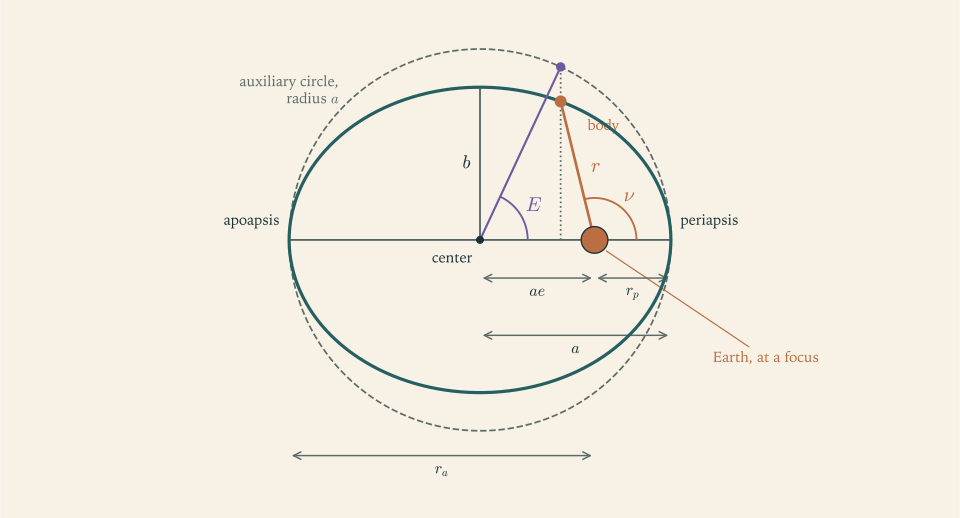
Figure 8.1 draws one orbit of each type through the same periapsis, and Figure 8.2 labels the parts of an ellipse.
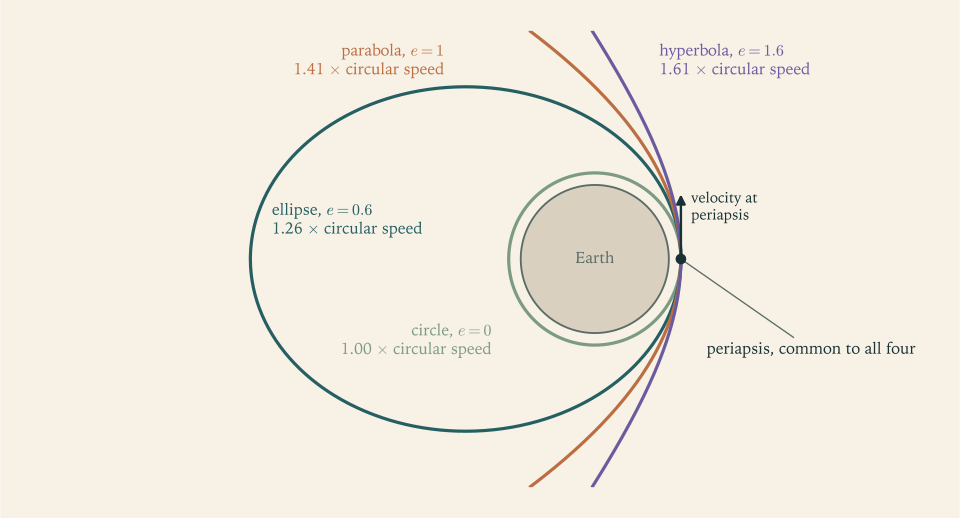
Theorem 8.3 ties the shape to the energy. Since \(e^2-1=2\mathcal E\ell^2/\mu^2\) :
| Eccentricity | Energy | Path | Fate |
|---|---|---|---|
| \(e=0\) | \(\mathcal E=-\mu^2/(2\ell^2)\) , the least possible for the given \(\ell\) | circle | bound |
| \(0<e<1\) | \(\mathcal E<0\) | ellipse | bound |
| \(e=1\) | \(\mathcal E=0\) | parabola | escapes, arriving at infinity with no speed left |
| \(e>1\) | \(\mathcal E>0\) | hyperbola | escapes with speed to spare |
A body is bound to the Earth exactly when its total energy is negative. The direction of its velocity plays no part in that question, provided the path does not hit the planet on the way.
8.6 Speed on an orbit: the vis-viva equation
For an ellipse, eliminate \(\ell\) between the two results \(\mathcal E=\mu^2(e^2-1)/(2\ell^2)\) and \(\ell^2=\mu a(1-e^2)\) :
The energy of an elliptical orbit depends only on its semi-major axis. It does not depend on the eccentricity. A circle of radius \(a\) and a needle-thin ellipse of the same major axis have the same energy; they differ in angular momentum. Energy fixes the size of an orbit and angular momentum, given the size, fixes its shape.
Setting this equal to \(v^2/2-\mu/r\) gives the relation between speed and distance that the chapter set out to find.
Theorem 8.4 (vis-viva equation). At radius \(r\) on an elliptical orbit of semi-major axis \(a\) the speed is given by
In particular the circular speed and the escape speed at radius \(r\) are
Proof. The first statement is \(v^2/2-\mu/r=-\mu/(2a)\) rearranged. A circle has \(a=r\) . Escape is the boundary case \(\mathcal E=0\) , where \(v^2/2=\mu/r\) ; formally it is the limit \(a\to\infty\) .
The name is historical: vis viva, “living force”, was an early term for kinetic energy. The equation is conservation of energy and nothing more, with the constant written in terms of the orbit’s size. It recovers the circular speed that Chapter 7 obtained from the balance of gravity and centripetal acceleration, and it adds the ceiling: at any radius, \(41\) percent more than circular speed is enough to leave for good. At the Earth’s surface the escape speed is \(\sqrt{2\mu_E/R_E}=11.18\ \mathrm{km/s}\) , matching the tabulated value (NASA Earth Fact Sheet; see sources).
For a hyperbola the same algebra goes through with \(a\) negative, and far from the Earth the speed tends to \(\sqrt{2\mathcal E}\) . This course goes no further with open orbits; they are the starting point of interplanetary mission design, which lies outside its scope.
Example 8.2: The ellipse between two circular orbits
Question. An ellipse has its perigee at \(200\ \mathrm{km}\) altitude and its apogee at \(400\ \mathrm{km}\) . Find its semi-major axis, eccentricity, energy, and the speeds at its two apsides, and compare them with the circular speeds at those altitudes.
Size and shape. \(r_p=6578.137\ \mathrm{km}\) and \(r_a=6778.137\ \mathrm{km}\) , so
Energy. \(\mathcal E=-\mu_E/(2a)=-3.986\times10^{14}/(1.3356274\times10^{7})=-29.84\ \mathrm{MJ/kg}\) , between the energies of the two circles in Example 8.1.
Speeds. From vis-viva,
Check. Angular momentum must be the same at both apsides, where the velocity is horizontal: \(r_pv_p=5.1588\times10^{10}\ \mathrm{m^2/s}\) and \(r_av_a=5.1588\times10^{10}\ \mathrm{m^2/s}\) .
Comparison. At perigee the ellipse is \(7842.3-7784.3=58.1\ \mathrm{m/s}\) faster than the circular orbit at that altitude. At apogee it is \(7668.6-7610.9=57.6\ \mathrm{m/s}\) slower than the circular orbit there. An orbit that is nearly circular differs from a circle by speeds of tens of metres per second out of nearly eight thousand. Those two differences will reappear in Chapter 9 as the cost of moving between the two circles.
Example 8.3: High enough, but is it in orbit?
Question. A vehicle reaches \(400\ \mathrm{km}\) altitude moving horizontally at \(7000\ \mathrm{m/s}\) and shuts down. It is above essentially all of the atmosphere. Is it in orbit?
Energy and size. \(\mathcal E=(7000)^2/2-3.986\times10^{14}/6.778137\times10^{6}=24.50-58.81=-34.31\ \mathrm{MJ/kg}\) , so
The semi-major axis is smaller than the radius of the Earth.
Where the cutoff point lies on the ellipse. The velocity is horizontal, so the cutoff point is an apsis. Its radius, \(6778\ \mathrm{km}\) , exceeds \(a\) , so it is the apogee. Then
which is \(1538\ \mathrm{km}\) below the surface.
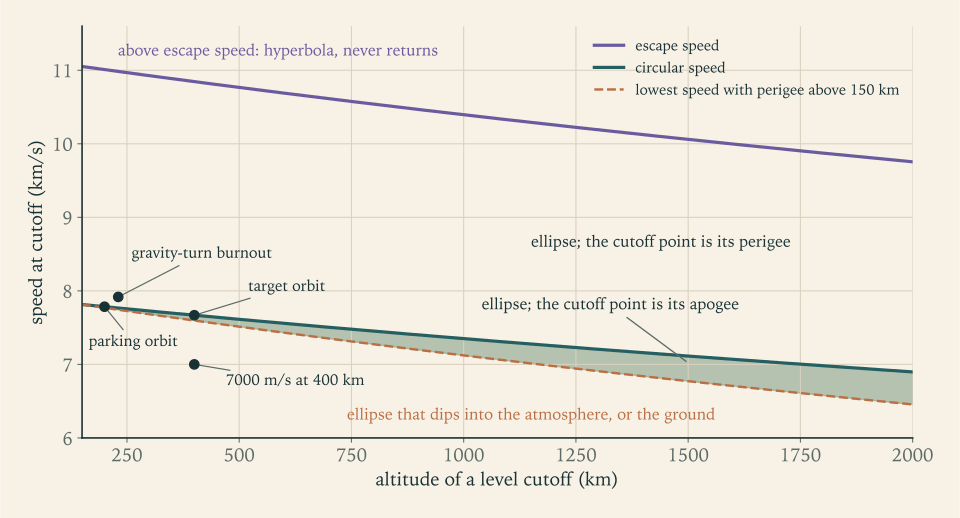
Answer. No. The vehicle is at the top of an ellipse that intersects the Earth. It meets the surface after travelling \(47^\circ\) around the Earth from the cutoff point, about an eighth of a revolution. Repeating the computation for other cutoff speeds at the same point:
| Horizontal speed at \(400\ \mathrm{km}\) | Semi-major axis | Perigee altitude |
|---|---|---|
| \(7000\ \mathrm{m/s}\) | \(5809\ \mathrm{km}\) | \(-1538\ \mathrm{km}\) |
| \(7500\ \mathrm{m/s}\) | \(6496\ \mathrm{km}\) | \(-165\ \mathrm{km}\) |
| \(7600\ \mathrm{m/s}\) | \(6660\ \mathrm{km}\) | \(+163\ \mathrm{km}\) |
| \(7668.6\ \mathrm{m/s}\) | \(6778\ \mathrm{km}\) | \(+400\ \mathrm{km}\) |
The last \(70\ \mathrm{m/s}\) raise the perigee by \(240\ \mathrm{km}\) . A shortfall of one percent in speed is the difference between a satellite and debris.
Common mistake. Thinking of orbit as a place. A vehicle carried to \(400\ \mathrm{km}\) and released at rest falls straight down. Orbit is a state of motion: enough horizontal speed, at whatever height, that the path misses the planet. A projectile shot straight up to the height of the space station comes straight back, about ten minutes after it left.
Figure 8.3 shows how narrow the band of acceptable speeds is at each altitude.
8.7 What a cutoff state becomes
At engine cutoff a guidance system knows three things: radius \(r\) , speed \(v\) , and flight-path angle \(\theta\) . The results so far turn those into an orbit in four steps.
- Compute the constants: \(\mathcal E=v^2/2-\mu/r\) and \(\ell=r\,v\cos\theta\) .
- If \(\mathcal E<0\) , compute the size, \(a=-\mu/(2\mathcal E)\) .
- Compute the shape, \(e=\sqrt{1+2\mathcal E\ell^2/\mu^2}\) .
- Compute the apsides, \(r_p=a(1-e)\) and \(r_a=a(1+e)\) , and compare \(r_p\) with the radius at which the atmosphere would capture the vehicle.
For near-circular low orbits this course takes a perigee altitude of \(150\ \mathrm{km}\) as the working threshold below which the atmosphere is assumed to capture the vehicle within a few revolutions. The figure is a round number adopted for the examples and exercises. It is not taken from a cited source, and it is not meant for strongly eccentric orbits, which spend little of each revolution near perigee.
Example 8.4: Two cutoff states from Chapter 7, and a tilted one
(a) The gravity-turn burnout. \(r=6608.743\ \mathrm{km}\) , \(v=7917.4\ \mathrm{m/s}\) , \(\theta=0\) , with \(\mathcal E=-28.971\ \mathrm{MJ/kg}\) and \(\ell=5.2324\times10^{10}\ \mathrm{m^2/s}\) from Example 8.1.
The burnout point is the perigee, at \(230.6\ \mathrm{km}\) altitude, and the apogee is at \(771.6\ \mathrm{km}\) . The \(151\ \mathrm{m/s}\) of excess speed did not make the orbit “faster”; it made it larger, lifting the far side by \(541\ \mathrm{km}\) . At that apogee the speed is \(\ell/r_a=7318\ \mathrm{m/s}\) , less than the circular speed there. This is a perfectly good orbit, but it is not the one that was asked for.
(b) The steered insertion. \(r=6578.137\ \mathrm{km}\) , \(v=7784.3\ \mathrm{m/s}\) , \(\theta=0\) . Here \(v^2=\mu_E/r\) , so \(a=r\) and \(e=0\) : a circle at \(200\ \mathrm{km}\) .
(c) The same speed, tilted. Suppose the vehicle of (b) cuts off at the right height and the right speed but with its path still inclined \(2^\circ\) above the horizontal. The energy is unchanged, so \(a=r=6578.137\ \mathrm{km}\) . The angular momentum is reduced to \(r\,v\cos2^\circ\) , and
an altitude of \(-29.6\ \mathrm{km}\) . With \(1^\circ\) the perigee is at \(+85\ \mathrm{km}\) ; with \(0.5^\circ\) , at \(+143\ \mathrm{km}\) .
Conclusion. At exactly circular speed, an error of one degree in direction puts the perigee inside the atmosphere. This is why the conditions for insertion in Section 7.9 were three, not one: a height, a speed, and a level path. Speed alone fixes only the energy, hence the size of the orbit. Direction decides how that size is divided between perigee and apogee.
8.8 Period and Kepler’s laws
The areal law gives the time for one revolution of an ellipse without solving for the motion. The radius sweeps area at rate \(\ell/2\) , and one revolution sweeps the whole ellipse, of area \(\pi ab\) . With \(b=a\sqrt{1-e^2}\) and \(\ell=\sqrt{\mu a(1-e^2)}\) ,
Theorem 8.5 (Kepler’s laws). For a body moving under \(\ddot{\mathbf r}=-\mu\mathbf r/r^3\) on a bound orbit: (1) the path is an ellipse with the centre of attraction at one focus; (2) the radius sweeps equal areas in equal times, at the rate \(\ell/2\) ; (3) the period depends only on the semi-major axis, through \(P_{\mathrm{orb}}=2\pi\sqrt{a^3/\mu}\) .
The three statements were proved in Section 8.5, Proposition 8.1, and the calculation above. The quantity \(n=2\pi/P_{\mathrm{orb}}=\sqrt{\mu/a^3}\) is the mean motion: the angular rate of a fictitious body that goes around uniformly in the same period.
Like the energy, the period is blind to eccentricity. Every orbit with the same major axis takes the same time. And because the period grows as the three-halves power of the size, higher orbits are slower in every sense: lower speed over a longer path.
Example 8.5: Periods, from the parking orbit to the Moon
The reference launcher’s orbits.
| Orbit | Semi-major axis | Period |
|---|---|---|
| Circular at \(200\ \mathrm{km}\) | \(6578.137\ \mathrm{km}\) | \(88.49\ \mathrm{min}\) |
| Ellipse \(200\) by \(400\ \mathrm{km}\) | \(6678.137\ \mathrm{km}\) | \(90.52\ \mathrm{min}\) |
| Circular at \(400\ \mathrm{km}\) | \(6778.137\ \mathrm{km}\) | \(92.56\ \mathrm{min}\) |
| Gravity-turn orbit of Example 8.4 | \(6879.2\ \mathrm{km}\) | \(94.64\ \mathrm{min}\) |
For the target, \(P_{\mathrm{orb}}=2\pi\sqrt{(6.778137\times10^{6})^3/3.986\times10^{14}}=5553.6\ \mathrm s\) .
A real spacecraft. The International Space Station is listed with perigee and apogee altitudes of \(413\) and \(422\ \mathrm{km}\) and a period of \(92.9\ \mathrm{min}\) (secondary compilation; see sources). Its semi-major axis is then \(6378.137+417.5=6795.6\ \mathrm{km}\) , and the formula gives \(92.92\ \mathrm{min}\) , or \(15.50\) revolutions per day against the listed \(15.5\) .
The geostationary radius. A satellite whose period equals the Earth’s rotation period, \(23.9345\ \mathrm h\) or \(86\,164\ \mathrm s\) (NASA Earth Fact Sheet; see sources), stays over one meridian. Inverting the period formula,
an altitude of \(35\,786\ \mathrm{km}\) , where the circular speed is \(3075\ \mathrm{m/s}\) . The right period is the rotation relative to the stars, not the \(24\ \mathrm h\) day relative to the Sun; using \(24\ \mathrm h\) would give \(42\,241\ \mathrm{km}\) .
The Moon. The Moon’s orbit has semi-major axis \(384\,400\ \mathrm{km}\) and a sidereal period of \(27.3217\ \mathrm{days}\) (NASA Moon Fact Sheet; see sources). With \(\mu_E\) alone the formula gives \(27.45\ \mathrm{days}\) , half a percent too long. Section 8.2 says the correct parameter is \(G(m_1+m_2)\) , and adding the Moon’s own \(4.90\times10^{12}\ \mathrm{m^3/s^2}\) gives \(27.28\ \mathrm{days}\) . The remaining \(0.14\) percent is the pull of the Sun, a third body that the two-body model leaves out.
What the examples show. Kepler’s third law fits a space station to four figures and the Moon to three once the reduction to one body is done properly. The misfit that remains has the size of the neglected effects.
8.9 Where along the orbit, and when
The orbit equation gives the radius at each angle but not the time at which the body is there. Because the areal rate is constant and the radius varies, the body does not sweep equal angles in equal times: it moves fastest at periapsis and slowest at apoapsis. Finding the time requires the area swept as a function of position, and for that a second angle is more convenient than the true anomaly.
The eccentric anomaly. Place the origin at the focus with the \(x\) -axis toward periapsis. The ellipse of Section 8.5 is centred at \((-ae,0)\) and can be written in parametric form
The parameter \(E\) is the eccentric anomaly: the angle at the centre of the ellipse to the point of the circumscribed circle of radius \(a\) directly above or below the body, as in Figure 8.2. It runs from \(0\) at periapsis to \(\pi\) at apoapsis. Squaring and adding, \(r^2=a^2(1-e\cos E)^2\) , so
The area swept. The area swept by the radius from periapsis is \(\tfrac12\int(x\,\mathrm dy-y\,\mathrm dx)\) , the sum of the thin triangles of Proposition 8.1. With the parametric form,
so the area swept up to eccentric anomaly \(E\) is \(\tfrac12ab\,(E-e\sin E)\) . By the areal law this equals \(\tfrac12\ell\,(t-t_p)\) , where \(t_p\) is the time of periapsis passage. Since \(\ell/(ab)=2\pi/P_{\mathrm{orb}}=n\) :
Theorem 8.6 (Kepler’s equation). On an elliptical orbit the eccentric anomaly \(E\) at time \(t\) satisfies
The right side is called the mean anomaly; it increases uniformly with time and equals \(2\pi\) after one period. Angles are in radians, without exception.
Going from position to time is direct: compute \(E\) from \(\nu\) and evaluate the left side. Going from time to position requires solving for \(E\) , and the equation is transcendental. Write \(f(E)=E-e\sin E-n(t-t_p)\) . Then \(f'(E)=1-e\cos E\ge1-e>0\) , so \(f\) is strictly increasing and has exactly one root. Newton’s iteration
converges quadratically from a starting value near enough to a root at which the derivative is nonzero (Numerical Analysis, math.numerical-analysis.newton-fixed-point). For moderate eccentricity the mean anomaly itself is near enough. For any \(e<1\)
and a mean anomaly between \(0\)
and \(\pi\)
, the start \(E_0=\pi\)
is safe: there \(f\ge0\)
, and \(f\)
is increasing and convex on that interval because \(f''=e\sin E\ge0\)
, so each Newton step moves left without passing the root.
Example 8.6: Solving Kepler’s equation
Question. A body is on an orbit of eccentricity \(e=0.3\) . Where is it when the mean anomaly is \(1.0\ \mathrm{rad}\) , that is, \(1/(2\pi)\) of a period after periapsis?
Iteration. Start from \(E_0=1.0\) . Then \(e\sin E_0=0.25244\) and \(1-e\cos E_0=0.83791\) , so
| Iterate | Value | Residual \(E-e\sin E-1\) |
|---|---|---|
| \(E_0\) | \(1.0000000\) | \(-0.2524\) |
| \(E_1\) | \(1.3012752\) | \(+0.0121\) |
| \(E_2\) | \(1.2881186\) | \(+2.5\times10^{-5}\) |
| \(E_3\) | \(1.2880913\) | \(+1.1\times10^{-10}\) |
The residual is roughly squared at each step, the mark of quadratic convergence.
Position. \(\cos E=0.27895\) , so \(r=a(1-0.3\cos E)=0.9163\,a\) , and
Reading the result. After a mean angle of \(57.3^\circ\) the body has actually travelled \(91.3^\circ\) around the focus. It is ahead of the uniform motion because it has just been through periapsis, where it moves fastest; it will fall behind again on the far side and the two agree at apoapsis.
Common mistake. Assuming equal angles in equal times, or evaluating Kepler’s equation with \(E\) in degrees. The term \(e\sin E\) is an angle in radians. With degrees the left side of the equation mixes units and the answer is meaningless, without any warning from the calculator.
A special case needs no iteration. Travel from periapsis to apoapsis takes exactly half a period, since \(E=\pi\) gives a mean anomaly of \(\pi\) . For the \(200\) by \(400\ \mathrm{km}\) ellipse of Example 8.2 that is \(45.26\ \mathrm{min}\) .
8.10 Checking the theory by integration
Chapter 7 integrated equations that had no closed-form solution. Here the roles are reversed: the solution is known, so the integrator can be tested against it, and the conserved quantities give a running measure of the error that needs no reference solution at all.
Example 8.7: Half a revolution, step by step
Setup. Integrate \(\ddot{\mathbf r}=-\mu_E\mathbf r/r^3\) in Cartesian coordinates in the orbital plane, with the state \((x,y,\dot x,\dot y)\) , starting at the perigee of the \(200\) by \(400\ \mathrm{km}\) ellipse: \(x=6578.137\ \mathrm{km}\) , \(y=0\) , \(\dot x=0\) , \(\dot y=7842.3225\ \mathrm{m/s}\) . Use the classical Runge-Kutta method of Section 1.7 for half a period, \(2715.59\ \mathrm s\) . Theory predicts arrival at \(r=6778.137\ \mathrm{km}\) on the negative \(x\) -axis at \(7610.922\ \mathrm{m/s}\) .
| Steps | Step size | Error in final radius | Relative change in energy | Relative change in angular momentum |
|---|---|---|---|---|
| \(25\) | \(108.6\ \mathrm s\) | \(-73.9\ \mathrm m\) | \(-3.0\times10^{-6}\) | \(-1.4\times10^{-6}\) |
| \(50\) | \(54.3\ \mathrm s\) | \(-3.99\ \mathrm m\) | \(-1.0\times10^{-7}\) | \(-4.3\times10^{-8}\) |
| \(100\) | \(27.2\ \mathrm s\) | \(-0.23\ \mathrm m\) | \(-3.6\times10^{-9}\) | \(-1.3\times10^{-9}\) |
| \(200\) | \(13.6\ \mathrm s\) | \(-0.014\ \mathrm m\) | \(-1.4\times10^{-10}\) | \(-4.2\times10^{-11}\) |
Reading the table. Each halving of the step cuts the radius error by a factor of \(17\) to \(19\) , consistent with fourth-order accuracy. With \(100\) steps, about one every half minute, the integration lands within a quarter of a metre of the predicted apogee after travelling \(21\,000\ \mathrm{km}\) , and the speed agrees with \(7610.922\ \mathrm{m/s}\) to better than a millimetre per second.
The conserved quantities as an error monitor. The exact solution keeps \(\mathcal E\) and \(\ell\) constant. The numerical one does not, and the drift is visible without knowing the answer: with \(25\) steps the energy has changed by three parts in a million, with \(100\) steps by four parts in a billion. In an integration with thrust and drag these quantities are no longer conserved, but a coasting phase always offers this test, and a simulation that fails it during coast cannot be trusted under power.
What the check establishes. The conic of Theorem 8.3, the speeds of Theorem 8.4, and the half-period of Theorem 8.5 were each derived by a different argument. One numerical experiment that never uses any of them agrees with all three.
8.11 Six numbers for an orbit in space
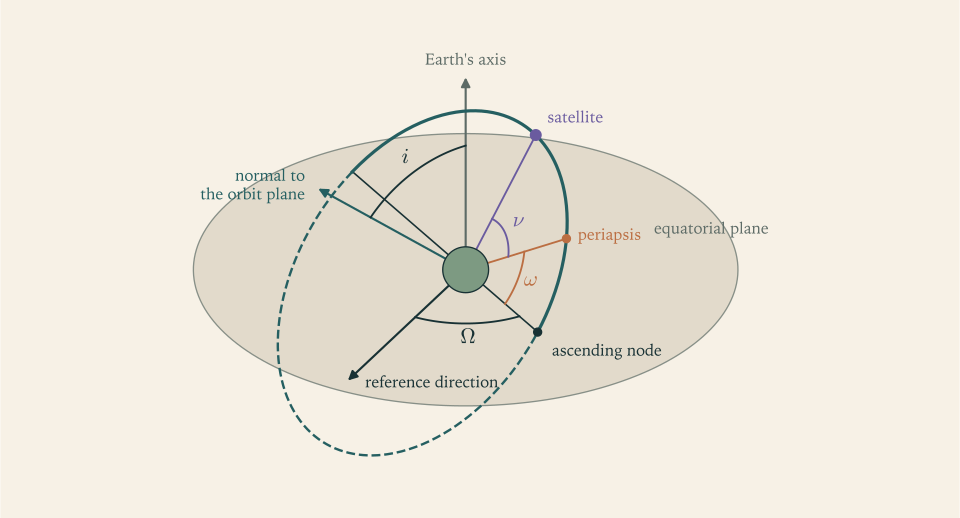
Within its plane an orbit needs two numbers for size and shape, \(a\) and \(e\) , and one for the body’s position at a stated time, for instance the true anomaly \(\nu\) at that time or the time of periapsis passage \(t_p\) . Three more numbers place the plane, and the ellipse within it, relative to the Earth. They are angles, defined with respect to the Earth’s equatorial plane and a fixed direction in it, conventionally the direction of the Sun as seen from the Earth at the March equinox. Figure 8.4 shows them.
Definition 8.3 (orientation elements). The inclination \(i\) is the angle between the orbital plane and the equatorial plane, from \(0\) to \(180^\circ\) ; values below \(90^\circ\) describe motion in the same sense as the Earth’s rotation. The ascending node is the point where the orbit crosses the equatorial plane going north, and the right ascension of the ascending node \(\Omega\) is the angle in the equatorial plane from the reference direction eastward to that node. The argument of periapsis \(\omega\) is the angle in the orbital plane from the ascending node to the periapsis, in the direction of motion.
Together \((a,e,i,\Omega,\omega,\nu)\) are the six orbital elements. They carry the same information as the six components of position and velocity at one instant, in a form where five of the six stay constant in the two-body model and only \(\nu\) changes.
Some elements lose their meaning in special cases. A circular orbit has no periapsis, so \(\omega\) is undefined and position is measured from the ascending node instead. An equatorial orbit has no node, so \(\Omega\) is undefined. These are defects of the coordinates, not of the orbits.
Two facts about inclination matter for launch. A satellite’s ground track reaches latitudes up to \(i\) north and south and no farther, when \(i\le90^\circ\) , because the orbital plane is tilted by exactly that angle from the equator. And since the plane of any orbit contains the Earth’s centre, an orbit that passes over a launch site at latitude \(\phi\) must be inclined by at least \(\lvert\phi\rvert\) . Chapter 9 turns the second fact into a relation between latitude, launch direction, and inclination. The space station’s inclination is \(51.64^\circ\) (secondary compilation; see sources), well above the latitude of every site in Chapter 9’s table of launch sites, so that all of them can reach it.
8.12 What two bodies leave out, and the launcher’s target
The two-body orbit is exact for two point masses and nothing else. For a satellite in low Earth orbit the neglected effects are, in order of size:
The Earth’s shape. The planet is flattened: its polar radius is \(21\ \mathrm{km}\) less than its equatorial radius, and the fact sheet lists the corresponding coefficient of its gravity field as \(J_2=1.0826\times10^{-3}\) (NASA Earth Fact Sheet; see sources). The resulting force is about a thousandth of the central attraction. It does not change \(a\) , \(e\) , or \(i\) on average, but it makes the plane of the orbit rotate slowly about the Earth’s axis and the periapsis rotate within the plane, faster for lower orbits.
Drag. Even at \(400\ \mathrm{km}\) there is enough gas to matter over months. The space station loses about \(2\ \mathrm{km}\) of altitude per month and is periodically boosted (secondary compilation; see sources). Drag removes energy, so by \(\mathcal E=-\mu/(2a)\) the orbit shrinks, and by vis-viva the satellite then moves faster: drag speeds a satellite up, a paradox that Exercise 19 untangles.
Other bodies. The Moon and Sun perturb high orbits noticeably, as the Moon’s own period showed in Example 8.5, and low ones very little.
This course names these effects and goes no further. Each is a small force added to the right side of \(\ddot{\mathbf r}=-\mu\mathbf r/r^3\) , and the six elements, constant in the two-body model, then drift slowly; that picture is the starting point of the theory of perturbations.
The reference launcher’s target. The requirement fixed in Chapter 1, a circular orbit at \(400\ \mathrm{km}\) , can now be stated as numbers.
| Quantity | Value |
|---|---|
| Semi-major axis \(a\) | \(6778.137\ \mathrm{km}\) |
| Eccentricity \(e\) | \(0\) |
| Inclination \(i\) | \(28.5^\circ\) , for a launch due east from latitude \(28.5^\circ\) (Chapter 9) |
| Speed | \(7668.6\ \mathrm{m/s}\) , level |
| Period \(P_{\mathrm{orb}}\) | \(92.56\ \mathrm{min}\) |
| Specific energy \(\mathcal E\) | \(-29.40\ \mathrm{MJ/kg}\) |
| Specific angular momentum \(\ell\) | \(5.198\times10^{10}\ \mathrm{m^2/s}\) |
The ascent of Revision A in Chapter 7 delivered something else: a circular orbit at \(200\ \mathrm{km}\) , with \(\mathcal E=-30.30\ \mathrm{MJ/kg}\) and a period of \(88.49\ \mathrm{min}\) . The two orbits differ in energy by \(0.89\ \mathrm{MJ/kg}\) , and Example 8.2 has already found the ellipse that touches both. What remains is to say what it costs, in the only currency a rocket has, to step from one orbit onto another, and to add that cost to everything else the launcher must pay for. That is Chapter 9.
Exercises
-
State Newton’s law of gravitation and define the gravitational parameter. Then: (a) compute the gravitational acceleration at \(400\ \mathrm{km}\) altitude as a fraction of its surface value; (b) explain in two or three sentences why an astronaut there is weightless; (c) find the altitude at which gravity has fallen to half its surface value.
Answer
Two point masses attract with a force \(Gm_1m_2/r^2\) along the line joining them; \(\mu_E=Gm_E\) . (a) \(g=\mu_E/r^2=8.676\ \mathrm{m/s^2}\) at \(r=6778.137\ \mathrm{km}\) , which is \(0.885\) of the surface value \(9.798\ \mathrm{m/s^2}\) . (b) The astronaut and the spacecraft have the same acceleration, \(g\) toward the Earth, so neither presses on the other; weight as felt is the force of a support, and in free fall there is none. (c) \(g\) halves when \(r=\sqrt2\,R_E\) , an altitude of \((\sqrt2-1)(6378.137)=2642\ \mathrm{km}\) .
-
A spacecraft is observed at position \(\mathbf r=(7000,\ 0)\ \mathrm{km}\) with velocity \(\mathbf v=(0.4,\ 7.6)\ \mathrm{km/s}\) in Cartesian coordinates in its orbital plane, origin at the Earth’s centre. Compute its radius, speed, flight-path angle, specific angular momentum, and specific energy, and then the semi-major axis, eccentricity, perigee and apogee altitudes, and period of its orbit.
Solution
State. \(r=7000\ \mathrm{km}\) . The speed is \(v=\sqrt{0.4^2+7.6^2}=7.6105\ \mathrm{km/s}\) . The position is along the \(x\) -axis, so the radial velocity component is \(0.4\ \mathrm{km/s}\) and the transverse one \(7.6\ \mathrm{km/s}\) , and the flight-path angle is \(\theta=\arctan(0.4/7.6)=3.013^\circ\) .
Constants. Only the transverse component contributes to angular momentum:
\[ \ell=r\,v\cos\theta=(7.0\times10^{6}\ \mathrm m)(7600\ \mathrm{m/s})=5.320\times10^{10}\ \mathrm{m^2/s}, \]\[ \mathcal E=\frac{(7610.5)^2}{2}-\frac{3.986\times10^{14}}{7.0\times10^{6}}=28.960-56.943=-27.983\ \mathrm{MJ/kg}. \]Size and shape. \(a=-\mu_E/(2\mathcal E)=7122.2\ \mathrm{km}\) and \(e=\sqrt{1+2\mathcal E\ell^2/\mu_E^2}=0.05528\) .
Apsides and period. \(r_p=a(1-e)=6728.5\ \mathrm{km}\) and \(r_a=a(1+e)=7515.9\ \mathrm{km}\) , altitudes of \(350.4\ \mathrm{km}\) and \(1137.8\ \mathrm{km}\) . The period is \(2\pi\sqrt{a^3/\mu_E}=99.70\ \mathrm{min}\) .
Check. The energy is negative, so the orbit is bound, and the perigee is well above the atmosphere. The observed radius of \(7000\ \mathrm{km}\) lies between the two apsidal radii, as it must, and the positive radial velocity says the spacecraft is on its way up from perigee.
-
(a) Show that \(\mathbf r\times\mathbf v\) is constant for motion under any force of the form \(f(r)\,\mathbf r\) , whatever the function \(f\) . (b) Deduce which of Kepler’s three laws holds for every central force. (c) Show that \(v^2/2+U(r)\) is constant when \(f(r)\,r=-\mathrm dU/\mathrm dr\) , and find \(U\) for the attractive force \(-k\,\mathbf r\) of an ideal spring. (d) By solving that case in Cartesian coordinates, show that its orbits are ellipses centred on the centre of force, and contrast this with Kepler’s first law.
Solution
(a) For \(\ddot{\mathbf r}=f(r)\,\mathbf r\) , the product rule gives \(\mathrm d(\mathbf r\times\mathbf v)/\mathrm dt=\mathbf v\times\mathbf v+\mathbf r\times f(r)\,\mathbf r=0\) , since the cross product of any vector with a multiple of itself vanishes. The function \(f\) never entered.
(b) The motion is therefore planar and the areal rate \(\ell/2\) is constant for every central force: Kepler’s second law. The first and third laws depend on the inverse-square form.
(c) \(\mathrm d(v^2/2)/\mathrm dt=\mathbf v\cdot\ddot{\mathbf r}=f(r)\,\mathbf r\cdot\mathbf v=f(r)\,r\,\dot r\) , using \(\mathbf r\cdot\mathbf v=r\dot r\) . If \(f(r)\,r=-\mathrm dU/\mathrm dr\) this is \(-\mathrm dU/\mathrm dt\) , so \(v^2/2+U\) is constant. For the spring, \(f=-k\) and \(\mathrm dU/\mathrm dr=kr\) , so \(U=\tfrac12kr^2\) .
(d) In Cartesian coordinates \(\ddot x=-kx\) and \(\ddot y=-ky\) are two independent harmonic oscillators with the same frequency \(\sqrt k\) : \(x=A\cos(\sqrt k\,t+\varphi_1)\) , \(y=B\cos(\sqrt k\,t+\varphi_2)\) . Such a pair traces an ellipse centred at the origin. So the spring force also gives closed elliptical orbits, but with the centre of force at the centre of the ellipse, whereas inverse-square gravity puts it at a focus. The body under a spring force is nearest the centre twice per revolution; a planet is nearest the Sun once.
-
Derive \(\mathcal E=-\mu/(2a)\) a second way. At the two apsides of an ellipse the velocity is perpendicular to the radius, so \(\ell=r_pv_p=r_av_a\) . Write the energy at each apsis in terms of \(\ell\) and the radius, eliminate \(\ell\) between the two expressions, and simplify using \(r_p+r_a=2a\) .
Solution
At an apsis \(v=\ell/r\) , so the energy there is \(\mathcal E=\ell^2/(2r^2)-\mu/r\) . Writing this at both apsides and multiplying by \(r^2\) :
\[ \mathcal E\,r_p^2=\tfrac12\ell^2-\mu r_p,\qquad \mathcal E\,r_a^2=\tfrac12\ell^2-\mu r_a . \]Subtracting eliminates \(\ell\) : \(\mathcal E\,(r_a^2-r_p^2)=-\mu\,(r_a-r_p)\) . For a non-circular orbit \(r_a\ne r_p\) , and dividing by \(r_a-r_p\) gives \(\mathcal E\,(r_a+r_p)=-\mu\) . With \(r_p+r_a=2a\) ,
\[ \mathcal E=-\frac{\mu}{2a}. \]The circular case follows by continuity, or directly from \(v^2=\mu/r\) . This route uses only the two conservation laws at two special points and never needs the orbit equation, which is why the result can be trusted independently of Section 8.4.
-
A transfer orbit has its perigee at \(200\ \mathrm{km}\) altitude and its apogee at the geostationary radius, \(42\,164\ \mathrm{km}\) . Compute its semi-major axis, eccentricity, speeds at perigee and apogee, and period, and the time taken to coast from perigee to apogee. Compare the apogee speed with the circular speed at that radius.
Solution
\(r_p=6578.137\ \mathrm{km}\) and \(r_a=42\,164\ \mathrm{km}\) , so
\[ a=\tfrac12(6578.137+42\,164)=24\,371.1\ \mathrm{km},\qquad e=\frac{42\,164-6578.137}{48\,742.137}=0.7301 . \]From vis-viva, \(v_p=\sqrt{\mu_E(2/r_p-1/a)}=10\,239\ \mathrm{m/s}\) and \(v_a=\sqrt{\mu_E(2/r_a-1/a)}=1597\ \mathrm{m/s}\) . The period is \(2\pi\sqrt{a^3/\mu_E}=10.52\ \mathrm h\) , and the coast from perigee to apogee takes half of it, \(5.26\ \mathrm h\) .
Comparison. Circular speed at the geostationary radius is \(3075\ \mathrm{m/s}\) (Example 8.5), so at apogee the vehicle is \(1477\ \mathrm{m/s}\) too slow to stay there and will fall back toward perigee. At perigee it was \(10\,239-7784=2455\ \mathrm{m/s}\) faster than the low circular orbit.
Check. \(r_pv_p=6.735\times10^{10}\ \mathrm{m^2/s}\) and \(r_av_a=6.735\times10^{10}\ \mathrm{m^2/s}\) : angular momentum agrees at the two apsides. The speed ratio \(v_p/v_a=6.41\) equals the radius ratio \(r_a/r_p\) .
-
A capsule is released at \(400\ \mathrm{km}\) altitude moving horizontally. (a) Find the lowest speed for which its perigee stays above \(150\ \mathrm{km}\) altitude, the working threshold of Section 8.7 (a round figure adopted in this course, not a sourced one). (b) Express the answer as a shortfall from circular speed, in metres per second and in percent. (c) A news report says a failed upper stage “reached space but not orbit, falling short by only one percent in speed”; say whether that is physically reasonable, using your answer.
Solution
(a) A capsule released horizontally below circular speed is at the apogee of its ellipse. The perigee is at \(150\ \mathrm{km}\) when \(a=\tfrac12(6528.137+6778.137)=6653.137\ \mathrm{km}\) , and vis-viva at the apogee gives
\[ v=\sqrt{\mu_E\Bigl(\frac{2}{6.778137\times10^{6}}-\frac{1}{6.653137\times10^{6}}\Bigr)}=7596.2\ \mathrm{m/s}. \](b) Circular speed at \(400\ \mathrm{km}\) is \(7668.6\ \mathrm{m/s}\) , so the shortfall is \(72.4\ \mathrm{m/s}\) , or \(0.94\) percent.
(c) The report is physically reasonable. A stage that reaches orbital altitude one percent short of circular speed has a perigee near or inside the atmosphere and will not complete many revolutions; “reached space but not orbit” is an accurate description. The margin between a satellite and a reentering object at this altitude is about \(70\ \mathrm{m/s}\) out of \(7670\) .
-
A vehicle cuts off at radius \(r\) with exactly the circular speed for that radius but with flight-path angle \(\theta\) . (a) Show that its orbit has \(a=r\) and \(e=\lvert\sin\theta\rvert\) . (b) Show that the cutoff point is neither apsis when \(\theta\ne0\) , and find the true anomaly there. (c) For cutoff at \(200\ \mathrm{km}\) altitude, find the largest \(\lvert\theta\rvert\) for which the perigee stays above \(120\ \mathrm{km}\) .
Solution
(a) The energy depends only on \(r\) and \(v\) : \(\mathcal E=v^2/2-\mu/r=\mu/(2r)-\mu/r=-\mu/(2r)\) , so \(a=-\mu/(2\mathcal E)=r\) . The angular momentum is \(\ell=rv\cos\theta\) , so \(\ell^2=\mu r\cos^2\theta\) , and
\[ e^2=1+\frac{2\mathcal E\ell^2}{\mu^2}=1-\cos^2\theta=\sin^2\theta . \](b) At an apsis the velocity is perpendicular to the radius, \(\theta=0\) ; here \(\theta\ne0\) . From the orbit equation with \(\ell^2/\mu=a(1-e^2)\) and \(r=a\) : \(1+e\cos\nu=1-e^2\) , so \(\cos\nu=-e\) . For small \(e\) the cutoff point is just past \(\nu=90^\circ\) when the vehicle is climbing: it sits at the end of the minor axis, where the radius equals \(a\) .
(c) The perigee radius is \(a(1-e)=r(1-\lvert\sin\theta\rvert)\) , so the perigee lies \(r\lvert\sin\theta\rvert\) below the cutoff altitude. For it to stay above \(120\ \mathrm{km}\) when cutoff is at \(200\ \mathrm{km}\) : \(\lvert\sin\theta\rvert\le80/6578.137=0.01216\) , that is \(\lvert\theta\rvert\le0.70^\circ\) . The true anomaly at cutoff for that case is \(\arccos(-0.01216)=90.7^\circ\) .
-
Compute the escape speed at the Earth’s surface and at \(400\ \mathrm{km}\) altitude, and the velocity increase needed to go from the \(400\ \mathrm{km}\) circular orbit to escape. Then show in general that the specific energy needed to escape from a circular orbit equals the orbit’s kinetic energy per unit mass.
Answer
\(v_{\mathrm{esc}}=\sqrt{2\mu_E/r}=11.18\ \mathrm{km/s}\) at the surface and \(10.84\ \mathrm{km/s}\) at \(400\ \mathrm{km}\) . From the circular orbit there the increase is \((\sqrt2-1)(7668.6)=3176\ \mathrm{m/s}\) . In general a circular orbit has \(\mathcal E=-\mu/(2r)\) and escape needs \(\mathcal E=0\) , so the energy to be added is \(\mu/(2r)=v_{\mathrm{circ}}^2/2\) , the orbit’s kinetic energy per unit mass.
-
On axes of \(1/r\) (horizontal) against \(v^2\) (vertical), every orbit about a given body is a segment of a straight line. (a) Find the slope and the intercept of the line in terms of \(\mu\) and \(a\) . (b) Describe where the lines for circular orbits of different radii, and the line for escape, lie on this diagram. (c) State which segment of its line an ellipse with apsides \(r_p\) and \(r_a\) occupies, and what distinguishes the lines of ellipses, parabolas, and hyperbolas.
Answer
(a) Vis-viva is \(v^2=2\mu\,(1/r)-\mu/a\) : slope \(2\mu\) , the same for every orbit, and intercept \(-\mu/a\) . (b) Circular orbits are the single points \((1/r,\ \mu/r)\) , which lie on the line \(v^2=\mu\,(1/r)\) of slope \(\mu\) through the origin; the escape condition is the line \(v^2=2\mu\,(1/r)\) through the origin. (c) An ellipse occupies the segment between \(1/r_a\) and \(1/r_p\) of a line with negative intercept, crossing the circular-orbit line at \(r=a\) . A parabola’s line passes through the origin; a hyperbola’s has a positive intercept, equal to the square of its speed far from the Earth.
-
Use Kepler’s third law with the constants of this course to compute (a) the period of a circular orbit grazing the Earth’s surface, ignoring the atmosphere, and its speed; (b) the altitude of a circular orbit with a period of exactly \(12\) sidereal hours, half of \(23.9345\ \mathrm h\) ; (c) the ratio of the periods of two orbits whose semi-major axes differ by \(1\) percent. Compare your answer to (a) with the \(84.4\ \mathrm{min}\) quoted in a set of lecture notes (MIT 16.07 notes; see sources).
Answer
(a) \(P_{\mathrm{orb}}=2\pi\sqrt{R_E^3/\mu_E}=84.49\ \mathrm{min}\) at \(7905\ \mathrm{m/s}\) ; the notes’ \(84.4\ \mathrm{min}\) and \(7910\ \mathrm{m/s}\) use slightly rounder constants. No satellite can have a shorter period. (b) \(a=\bigl[\mu_E(43\,082\ \mathrm s/2\pi)^2\bigr]^{1/3}=26\,562\ \mathrm{km}\) , an altitude of \(20\,184\ \mathrm{km}\) . (c) \(1.01^{3/2}=1.015\) : a one percent change in size changes the period by \(1.5\) percent.
-
The Moon’s orbit about the Earth has semi-major axis \(384\,400\ \mathrm{km}\) , the Moon’s gravitational parameter is \(4.90\times10^{12}\ \mathrm{m^3/s^2}\) , and its sidereal period is \(27.3217\ \mathrm{days}\) (NASA Moon Fact Sheet; see sources). (a) Compute the period from \(\mu_E\) alone and from \(\mu_E\) plus the Moon’s parameter. (b) Find the distance of the centre of mass of the pair from the Earth’s centre and compare it with the Earth’s radius. (c) Explain why the correction is negligible for an artificial satellite.
Answer
(a) \(27.45\ \mathrm{days}\) with \(\mu_E\) alone and \(27.28\ \mathrm{days}\) with the sum, against \(27.32\) observed. (b) The centre of mass is at \(384\,400\times4.90\times10^{12}/(3.986\times10^{14}+4.90\times10^{12})=4668\ \mathrm{km}\) from the Earth’s centre, \(0.73\) of the Earth’s radius: inside the Earth, but far from its centre. (c) For a satellite the same ratio is of order \(10^{-21}\) , so both the shift of the centre of mass and the change in \(\mu\) are far below anything measurable.
-
(Computation.) Write a program that solves Kepler’s equation by Newton’s method to a residual below \(10^{-12}\) and returns the true anomaly and the radius. For \(e=0.6\) and a mean anomaly of \(2.0\ \mathrm{rad}\) , report the iterates from the start \(E_0=\pi\) , the eccentric anomaly, the true anomaly in degrees, and \(r/a\) . Verify the answer by substituting it back.
Answer
From \(E_0=\pi\) the iterates are \(2.428097245\) , \(2.403738582\) , \(2.403657148\) , \(2.403657147\) , decreasing monotonically as the convexity argument of Section 8.9 predicts. Then \(E=2.4036571\ \mathrm{rad}\) , \(\nu=158.12^\circ\) , and \(r/a=1-0.6\cos E=1.4439\) . Substituting back, \(E-0.6\sin E=2.000000000\) .
-
For an orbit of eccentricity \(e\) , find the fraction of the period needed to travel from periapsis to the point where the true anomaly is \(90^\circ\) . Evaluate it for \(e=0.3\) and for \(e=0.7\) , check that it tends to one quarter as \(e\to0\) , and explain the direction of the departure from one quarter.
Solution
At \(\nu=90^\circ\) the relation \(\cos\nu=(\cos E-e)/(1-e\cos E)\) gives \(\cos E=e\) , so \(E=\arccos e\) and \(\sin E=\sqrt{1-e^2}\) . Kepler’s equation gives the mean anomaly, and dividing by \(2\pi\) gives the fraction of the period:
\[ \frac{t-t_p}{P_{\mathrm{orb}}}=\frac{\arccos e-e\sqrt{1-e^2}}{2\pi}. \]For \(e=0.3\) : \((1.2661-0.2862)/(2\pi)=0.1560\) . For \(e=0.7\) : \((0.7954-0.4999)/(2\pi)=0.0470\) . As \(e\to0\) , \(\arccos e\to\pi/2\) and the second term vanishes, giving \(1/4\) .
The fraction is below one quarter because the body is moving fastest near periapsis, and because on an eccentric orbit the point at \(\nu=90^\circ\) is close to the periapsis end of the ellipse: the first \(90^\circ\) of true anomaly is covered quickly. For small \(e\) the expansion is \(\tfrac14-e/\pi\) , a first-order effect; at \(e=0.7\) a quarter-turn around the focus takes less than a twentieth of the period.
-
A student solves Kepler’s equation for \(e=0.3\) and a mean anomaly of \(60^\circ\) on a calculator set to degrees, iterating \(E\leftarrow60+0.3\sin E\) and obtaining \(E=60.26^\circ\) . (a) Identify the error. (b) Find the correct eccentric anomaly in degrees. (c) Explain why the wrong answer looked plausible and how the size of the correction to the mean anomaly should have raised suspicion.
Solution
(a) The term \(e\sin E\) in Kepler’s equation is a number of radians. Adding \(0.3\sin E=0.26\) to a mean anomaly of \(60\) degrees adds \(0.26\) degrees where \(0.26\) radians, about \(15^\circ\) , was required.
(b) Work in radians: the mean anomaly is \(\pi/3=1.0472\) . Newton’s iteration from that starting value converges to \(E=1.3392\ \mathrm{rad}=76.73^\circ\) . The correction \(e\sin E\) is \(0.2920\ \mathrm{rad}=16.73^\circ\) .
(c) The wrong iteration converges smoothly, to \(60.26^\circ\) , so nothing in the arithmetic signals trouble. The warning is in the size of the answer. The eccentric anomaly differs from the mean anomaly by \(e\sin E\) radians, which for \(e=0.3\) can be as large as \(0.3\ \mathrm{rad}=17^\circ\) . A correction of a quarter of a degree for an orbit this eccentric is too small by the factor \(180/\pi\approx57\) , the conversion between the two units.
-
Show that the time a satellite spends farther from the focus than the distance \(a\) , as a fraction of its period, is \(\tfrac12+e/\pi\) . Evaluate the fraction for \(e=0.74\) , the eccentricity of some communications orbits that linger over high latitudes (illustrative value), and explain in a sentence why a satellite spends most of its time near apogee.
Solution
The radius is \(r=a(1-e\cos E)\) , which exceeds \(a\) exactly when \(\cos E<0\) , that is for \(\pi/2<E<3\pi/2\) . By Kepler’s equation the mean anomaly at the ends of this interval is
\[ \Bigl(\frac{3\pi}{2}-e\sin\frac{3\pi}{2}\Bigr)-\Bigl(\frac\pi2-e\sin\frac\pi2\Bigr)=\pi+2e, \]and the mean anomaly advances uniformly by \(2\pi\) per period, so the fraction of time is \((\pi+2e)/(2\pi)=\tfrac12+e/\pi\) .
For \(e=0.74\) the fraction is \(0.7355\) : the satellite spends nearly three quarters of each revolution in the outer half of its orbit. The reason is the areal law. Near apogee the radius is long, so sweeping area at the fixed rate \(\ell/2\) requires only a slow angular motion; the satellite loiters there and hurries through perigee.
-
(Computation.) Integrate the planar two-body equations with the classical Runge-Kutta method for an orbit with \(a=20\,000\ \mathrm{km}\) and \(e=0.5\) , starting at perigee. (a) Using Kepler’s equation, compute the position one quarter of a period after perigee. (b) Compare the integrated position at that time with it for \(100\) , \(200\) , and \(400\) steps per revolution. (c) Report the relative energy change after one full revolution for each step count, and state the order of convergence you observe.
Answer
The period is \(7.819\ \mathrm h\) and the perigee is at \(r=10\,000\ \mathrm{km}\) with speed \(7732.4\ \mathrm{m/s}\) . (a) A quarter period is a mean anomaly of \(\pi/2\) ; Kepler’s equation gives \(E=2.02098\ \mathrm{rad}\) , hence \(x=a(\cos E-e)=-18\,703\ \mathrm{km}\) , \(y=b\sin E=15\,595\ \mathrm{km}\) , \(r=24\,351\ \mathrm{km}\) . (b) Position errors at that time: about \(1300\ \mathrm m\) , \(74\ \mathrm m\) , and \(4.4\ \mathrm m\) for \(100\) , \(200\) , and \(400\) steps per revolution. (c) Relative energy changes after one revolution: about \(-2.9\times10^{-5}\) , \(-9.3\times10^{-7}\) , and \(-2.9\times10^{-8}\) . The position error falls about seventeenfold per halving, fourth order; the energy error falls about thirtyfold. Equal time steps are wasteful on an eccentric orbit, since the fast perigee passage needs small steps and the slow apogee does not.
-
For a hyperbolic orbit, \(e>1\) : (a) show that the true anomaly approaches \(\pm\arccos(-1/e)\) as \(r\to\infty\) ; (b) show that the speed far from the Earth is \(\sqrt{2\mathcal E}\) ; (c) a probe passes perigee at \(300\ \mathrm{km}\) altitude at \(12.0\ \mathrm{km/s}\) : compute \(\mathcal E\) , \(e\) , the limiting true anomaly, and the speed far from the Earth.
Answer
(a) \(r\to\infty\) requires \(1+e\cos\nu\to0\) . (b) As \(r\to\infty\) the potential term vanishes and \(v^2/2\to\mathcal E\) . (c) \(r_p=6678.137\ \mathrm{km}\) ; \(\mathcal E=72.00-59.69=12.31\ \mathrm{MJ/kg}\) ; \(e=r_pv_p^2/\mu_E-1=1.4126\) ; limiting true anomaly \(\arccos(-1/1.4126)=135.1^\circ\) ; speed far from the Earth \(\sqrt{2\mathcal E}=4962\ \mathrm{m/s}\) . The local escape speed is \(10.93\ \mathrm{km/s}\) , so only \(1.07\ \mathrm{km/s}\) above escape at perigee leaves nearly \(5\ \mathrm{km/s}\) at infinity, a preview of the effect discussed in Section 9.3.
-
For each of the six orbital elements say whether it describes the size, the shape, the orientation of the plane, the orientation within the plane, or the position of the body. Then state which elements are undefined for (a) a circular inclined orbit and (b) an elliptical equatorial orbit, and give the highest latitude overflown by a satellite with \(i=51.64^\circ\) and by one with \(i=120^\circ\) .
Answer
Size: \(a\) . Shape: \(e\) . Orientation of the plane: \(i\) and \(\Omega\) . Orientation within the plane: \(\omega\) . Position: \(\nu\) . (a) Circular inclined: \(\omega\) is undefined, and \(\nu\) with it; position is measured from the ascending node. (b) Elliptical equatorial: \(\Omega\) is undefined, and \(\omega\) must be measured from the reference direction instead of from a node. The highest latitude is \(51.64^\circ\) for \(i=51.64^\circ\) and \(180^\circ-120^\circ=60^\circ\) for \(i=120^\circ\) .
-
A satellite in a circular orbit of radius \(r\) loses a small amount of energy to drag and settles into a slightly smaller circular orbit. (a) Using \(\mathcal E=-\mu/(2r)\) and \(v=\sqrt{\mu/r}\) , show that a loss of specific energy \(\delta\) lowers the radius by \(2r^2\delta/\mu\) and raises the speed by \(\delta/v\) . (b) Account for the energy: show that the potential energy falls by \(2\delta\) and the kinetic energy rises by \(\delta\) . (c) For the space station at \(a=6795.6\ \mathrm{km}\) , which decays about \(2\ \mathrm{km}\) per month (secondary compilation; see sources), find the energy lost per kilogram per month and the monthly gain in speed.
Solution
(a) For circular orbits \(\mathcal E=-\mu/(2r)\) , so \(\mathrm d\mathcal E/\mathrm dr=\mu/(2r^2)\) . A loss \(\delta\) of energy is a change \(\mathrm d\mathcal E=-\delta\) , hence \(\mathrm dr=-2r^2\delta/\mu\) : the radius decreases. The speed is \(v=\sqrt{\mu/r}\) , so \(\mathrm dv/\mathrm dr=-v/(2r)\) and
\[ \mathrm dv=-\frac{v}{2r}\Bigl(-\frac{2r^2\delta}{\mu}\Bigr)=\frac{v\,r\,\delta}{\mu}=\frac{\delta}{v}, \]using \(\mu=v^2r\) . The speed increases.
(b) Potential energy per unit mass is \(-\mu/r\) ; its change is \((\mu/r^2)\,\mathrm dr=-2\delta\) . Kinetic energy is \(v^2/2\) ; its change is \(v\,\mathrm dv=+\delta\) . The total changes by \(-2\delta+\delta=-\delta\) , as required. Drag takes \(\delta\) ; the descent releases \(2\delta\) of potential energy; half pays the drag and half speeds the satellite up.
(c) With \(\mathrm dr=-2000\ \mathrm m\) and \(r=6.7956\times10^{6}\ \mathrm m\) : \(\delta=\mu_E\lvert\mathrm dr\rvert/(2r^2)=8631\ \mathrm{J/kg}\) per month. The speed, \(7658.7\ \mathrm{m/s}\) , rises by \(\delta/v=1.13\ \mathrm{m/s}\) per month. The paradox dissolves once the force along the path is examined: drag does slow the satellite momentarily, which drops it onto a lower orbit, where gravity has done more work on it than drag removed.
-
This exercise uses Chapter 7. With \(F=D=L=0\) the planar ascent equations of Proposition 7.1 describe coasting flight. (a) Show directly from those equations that \(r\,v\cos\theta\) is constant. (b) Show that \(v^2/2-\mu_E/r\) is constant. (c) The gravity turn of Example 7.5 ended level at \(r=6608.743\ \mathrm{km}\) and \(7917.4\ \mathrm{m/s}\) ; use the two constants to find the speed and flight-path angle when the vehicle next passes through a radius of \(6878.137\ \mathrm{km}\) (\(500\ \mathrm{km}\) altitude).
Solution
(a) With \(F=D=L=0\) Proposition 7.1 gives \(\dot v=-g\sin\theta\) , \(v\dot\theta=-(g-v^2/r)\cos\theta\) , and \(\dot r=\dot z=v\sin\theta\) . Then
\[ \frac{\mathrm d}{\mathrm dt}(r\,v\cos\theta)=\dot r\,v\cos\theta+r\,\dot v\cos\theta-r\,v\sin\theta\,\dot\theta =v^2\sin\theta\cos\theta-r\,g\sin\theta\cos\theta+r\sin\theta\Bigl(g-\frac{v^2}{r}\Bigr)\cos\theta=0 . \](b) With \(g=\mu_E/r^2\) ,
\[ \frac{\mathrm d}{\mathrm dt}\Bigl(\frac{v^2}{2}-\frac{\mu_E}{r}\Bigr)=v\,\dot v+\frac{\mu_E}{r^2}\,\dot r=-v\,g\sin\theta+g\,v\sin\theta=0 . \]So the ascent equations of Chapter 7, with the engine off, conserve exactly the two quantities of Chapter 8, as they must: they are the same equation of motion in different coordinates.
(c) From Example 8.1, \(\ell=5.2324\times10^{10}\ \mathrm{m^2/s}\) and \(\mathcal E=-28.971\ \mathrm{MJ/kg}\) . At \(r=6878.137\ \mathrm{km}\) , \(\mu_E/r=57.952\ \mathrm{MJ/kg}\) , so
\[ v=\sqrt{2(-28.971+57.952)\times10^{6}}=7613.2\ \mathrm{m/s},\qquad \cos\theta=\frac{\ell}{r\,v}=0.99923,\qquad\theta=2.25^\circ . \]The vehicle is climbing, on its way from the perigee at \(230.6\ \mathrm{km}\) to the apogee at \(771.6\ \mathrm{km}\) , and has traded \(304\ \mathrm{m/s}\) of speed for \(269\ \mathrm{km}\) of height. Integrating the coast with the Chapter 7 equations gives the same speed and angle at that radius.