A Falcon 9 carrying its heaviest payload leaves the pad with a mass of about \(567\ \mathrm{t}\) . A few minutes later about \(23\ \mathrm{t}\) of that, the payload, is in orbit (secondary compilation; see sources; Example 2.3 adds up the pieces). Roughly 96 percent of what lifted off was never going to arrive. Few machines are built to such a proportion, and the reason is not poor engineering. It is one line of mathematics,
which says that the velocity a rocket can gain is proportional to the logarithm of the ratio of its initial to its final mass. Read backward, the mass ratio grows exponentially with the velocity demanded.
Reaching that line honestly takes some care, because the obvious way to apply Newton’s second law to a rocket gives a wrong answer. A rocket is a body whose mass changes, and the familiar forms of the second law were stated for bodies whose mass does not. This chapter rebuilds the law for the case at hand, derives thrust and the rocket equation from it, adds gravity, and then asks what the result permits. The answer to that last question is the reason for Chapter 2.
1.1 Momentum belongs to a closed system
For a particle of constant mass \(m\) moving with velocity \(v\) along a line, Newton’s second law reads \(m\,\mathrm dv/\mathrm dt=F\) . The quantity \(mv\) is the particle’s momentum, with units \(\mathrm{kg\cdot m/s}\) , and the law says that force is the rate of change of momentum.
For a collection of particles, add the momenta: \(P=\sum_i m_iv_i\) . Each particle feels forces from outside the collection and forces from the other particles in it. Newton’s third law says the internal forces come in equal and opposite pairs, so they cancel when the equations for all the particles are added. What remains is
where \(F_{\mathrm{ext}}\) is the sum of forces exerted by things outside the collection. This statement is exact, but it is a statement about a fixed set of matter.
Definition 1.1 (closed system). A closed system is a fixed collection of matter: no mass enters or leaves it during the time considered. For a closed system with total momentum \(P\) and total external force \(F_{\mathrm{ext}}\) ,
A system whose boundary is crossed by mass is called open, and this equation does not apply to it as written.
A rocket vehicle, meaning the structure and whatever propellant is still on board, is an open system. Propellant crosses its boundary at the nozzle exit every instant the engine runs. Two tempting shortcuts ignore this, and both fail.
The first shortcut applies \(m\,\mathrm dv/\mathrm dt=F_{\mathrm{ext}}\) to the vehicle with its current mass. In deep space the external force is zero, so the vehicle should never accelerate. Rockets do accelerate in vacuum, so something is missing: the escaping gas pushes on the vehicle, and that push is external to the vehicle even though it is internal to the larger system of vehicle plus gas. To find the push we need the momentum principle for a system that is actually closed.
The second shortcut is subtler and more common.
Common mistake. Writing the second law for the vehicle alone as \(F_{\mathrm{ext}}=\mathrm d(mv)/\mathrm dt=m\,\mathrm dv/\mathrm dt+v\,\mathrm dm/\mathrm dt\) . Test it by changing observer. A second observer moving at constant velocity \(w\) relative to the first measures the vehicle’s velocity as \(v-w\) , and measures the same acceleration, the same mass, and the same forces. For that observer the proposed law reads \(F_{\mathrm{ext}}=m\,\mathrm dv/\mathrm dt+(v-w)\,\mathrm dm/\mathrm dt\) . The two versions differ by \(w\,\mathrm dm/\mathrm dt\) , which is not zero when mass is changing. A law that predicts different accelerations for different inertial observers cannot be right. Notice also that the speed of the exhaust appears nowhere in it.
The test used in that box will be used again. Newtonian mechanics looks the same to all observers who move at constant velocity relative to one another; such observers are called inertial, and the property is Galilean invariance. Any correct equation of motion must give every inertial observer the same acceleration. Quantities that all such observers agree on include masses, accelerations, forces, and relative velocities. The velocity \(v\) itself is not one of them.
The formula \(F_{\mathrm{ext}}=\mathrm d(mv)/\mathrm dt\) is not always wrong for a body of changing mass. It is right in the special case where the mass that joins or leaves carries no momentum in the frame being used, which Exercise 3 explores. A rocket is the opposite case: the whole point is that the departing mass carries momentum.
1.2 Throwing mass: a rocket in discrete steps
Before the calculus, a version of the problem with no calculus in it. A person sits on a sled on frictionless ice holding some heavy blocks and throws them backward. Nothing outside pushes on the sled, the person, and the blocks along the direction of travel, so together they form a closed system with \(F_{\mathrm{ext}}=0\) and their total momentum stays what it was at the start.
Example 1.1: Blocks thrown from a sled
Setup (illustrative values). The sled and rider have mass \(M=60\ \mathrm{kg}\) . They carry blocks of total mass \(40\ \mathrm{kg}\) . Each block is thrown backward so that, just after release, it moves at \(u=10\ \mathrm{m/s}\) relative to the sled. Everything starts at rest. The system is sled, rider, and all blocks; no horizontal external force acts, so total horizontal momentum remains zero. Find the final speed of the sled if the blocks are thrown (a) all at once, (b) as two \(20\ \mathrm{kg}\) throws, (c) as four \(10\ \mathrm{kg}\) throws.
One throw of mass \(m\) from a system of total mass \(M_{\mathrm{tot}}\) . Before the throw everything moves at \(V\) . Afterward the remaining mass \(M_{\mathrm{tot}}-m\) moves at \(V+\Delta V\) and the block moves at \(V+\Delta V-u\) . Momentum is conserved:
The velocity gain is the thrown momentum \(mu\) divided by the mass of everything that was on the sled just before the throw. The starting velocity \(V\) cancelled, as Galilean invariance requires.
(a) One throw. \(\Delta V=(40\ \mathrm{kg})(10\ \mathrm{m/s})/(100\ \mathrm{kg})=4.000\ \mathrm{m/s}\) .
(b) Two throws. The first acts on \(100\ \mathrm{kg}\) and the second on \(80\ \mathrm{kg}\) :
(c) Four throws. The masses before the throws are \(100\) , \(90\) , \(80\) , and \(70\ \mathrm{kg}\) :
Check. Units: \(\mathrm{kg\cdot(m/s)/kg}=\mathrm{m/s}\) . In case (b) the blocks end with ground velocities \(2.0-10=-8.0\ \mathrm{m/s}\) and \(4.5-10=-5.5\ \mathrm{m/s}\) , so their momentum is \(20(-8.0)+20(-5.5)=-270\ \mathrm{kg\cdot m/s}\) , and the sled’s is \(60(4.5)=+270\ \mathrm{kg\cdot m/s}\) . The total is zero, as it must be.
The same propellant, thrown at the same relative speed, gives more velocity when it is thrown in smaller pieces. The reason is visible in the denominators. Thrown all at once, every kilogram of block is thrown from a \(100\ \mathrm{kg}\) system. Thrown in sequence, later blocks are thrown from a lighter system, because the earlier blocks are already gone and no longer need to be accelerated.
For \(N\) equal throws of mass \(m\) from a sled of mass \(M\) , the pattern in Example 1.1 gives
Now let the pieces shrink while the total thrown mass \(m_p=Nm\)
stays fixed. The sum is a Riemann sum for \(\int u\,\mathrm dx/x\)
over the interval from \(M\)
to \(M+m_p\)
, with sample points at the right end of each subinterval. For a continuous function on a closed interval, such sums converge to the integral as the mesh goes to zero; this is the Riemann-sum definition of the integral from Calculus (math.calculus.riemann-sum-as-accumulation). The integrand \(u/x\)
is continuous on the interval because \(M\)
is positive. Therefore
For the sled, \(u\ln(100/60)=5.108\ \mathrm{m/s}\) , and the sequence \(4.000\) , \(4.500\) , \(4.790\) is climbing toward it. Exercise 12 asks you to compute how fast.
A rocket engine is this process with the pieces made as small as molecules. The limit already has the shape of the rocket equation: exhaust speed times the logarithm of initial mass over final mass.
1.3 The momentum balance over a short time
The continuous derivation follows the same logic as one throw, written for an infinitesimal piece.
The system. At time \(t\) , take everything inside the vehicle’s outer surface, with that surface closed across the nozzle exit plane: structure, payload, and all propellant still on board. Call its mass \(m\) and its velocity \(v\) , measured by an inertial observer along the direction of flight. This is a fixed collection of matter. An instant \(\mathrm dt\) later the same matter has two parts: the vehicle, now of mass \(m-\dot m\,\mathrm dt\) and velocity \(v+\mathrm dv\) , and a parcel of exhaust of mass \(\dot m\,\mathrm dt\) that has passed through the exit plane. Figure 1.1 shows both instants.
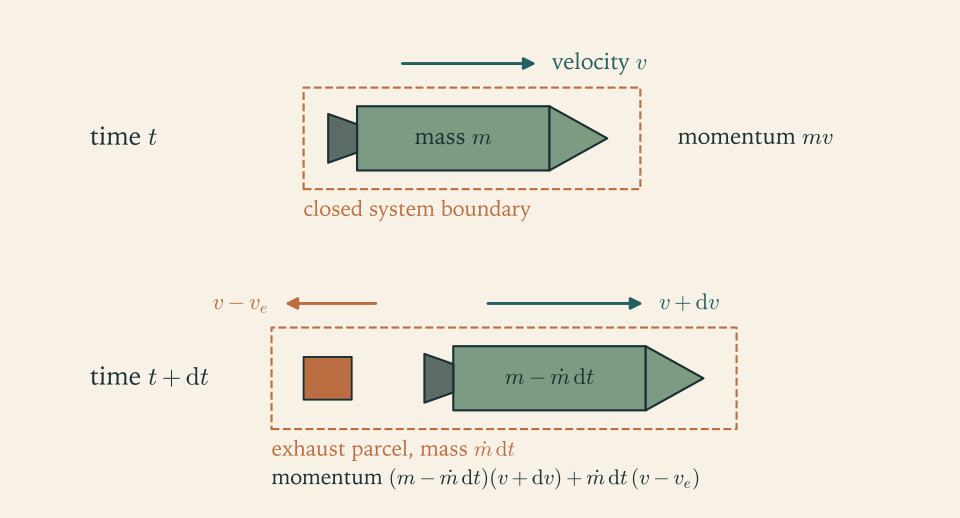
What is assumed. The exhaust leaves the exit plane with a single speed \(v_e\) relative to the vehicle, directed straight backward. The motion is along one line. \(v_e\) is positive, and so is \(\dot m\) .
The exhaust velocity seen by the inertial observer. The parcel left a vehicle moving at \(v\) (to first order) with relative speed \(v_e\) backward, so its velocity is \(v-v_e\) . If the vehicle is slow this is negative and the gas moves backward over the ground. If the vehicle is already faster than \(v_e\) , the gas trails behind the vehicle but still moves forward over the ground. Both cases are covered by the same expression.
The balance. The momentum of the system is \(mv\) at time \(t\) and
at time \(t+\mathrm dt\) . Expanding and subtracting \(mv\) , the change is
The last term is a product of two infinitesimals and vanishes relative to the others when we divide by \(\mathrm dt\) and let \(\mathrm dt\to0\) . Setting \(\mathrm dP/\mathrm dt=F_{\mathrm{ext}}\) for this closed system gives the equation of motion.
Proposition 1.1 (equation of motion of a rocket). A vehicle of instantaneous mass \(m\) and velocity \(v\) expels mass at rate \(\dot m\) with speed \(v_e\) relative to itself, directly backward. If \(F_{\mathrm{ext}}\) is the total external force along the direction of flight on the closed system of vehicle and just-expelled gas, then
Three checks. Dimensions: \(\dot m v_e\) has units \((\mathrm{kg/s})(\mathrm{m/s})=\mathrm{kg\cdot m/s^2}=\mathrm N\) , a force. Galilean invariance: the new term contains the relative speed \(v_e\) and not the vehicle’s velocity \(v\) , so every inertial observer computes the same thrust and the same acceleration. Limiting case: with \(\dot m=0\) the equation reduces to Newton’s law for a body of constant mass.
The term \(\dot m v_e\) acts on the vehicle exactly as a force would. It is the rate at which the engine sends momentum out through the exit plane, the momentum flux, and it is the main part of what is called thrust. The equation says that a rocket does not need anything to push against. It accelerates because it and its exhaust together conserve momentum, and the exhaust is being sent backward.
Compare this with the mistaken law of Section 1.1, which in the present notation reads \(m\,\mathrm dv/\mathrm dt=F_{\mathrm{ext}}+v\,\dot m\) . It has the vehicle’s own speed where the exhaust’s relative speed should be. The two agree only if \(v=v_e\) , which is a coincidence of one instant and one observer.
1.4 Thrust, effective exhaust velocity, and specific impulse
What is in \(F_{\mathrm{ext}}\) ? Gravity, which acts on all the matter in the system. Aerodynamic drag, which Chapter 7 treats. And one more force that is easy to miss: pressure on the system’s closed surface.
Suppose the vehicle sits in still air at pressure \(p_a\) . If that pressure acted on the entire closed surface, the net force would be zero, since a uniform pressure pushes equally on opposite sides of any closed shape. But across the nozzle exit plane, of area \(A_e\) , the system’s boundary cuts through the exhaust gas, and there the pressure is whatever the gas pressure is at that plane, \(p_e\) . The gas outside the boundary pushes forward on the system with force \(p_eA_e\) , where a uniform atmosphere would have pushed with \(p_aA_e\) . The net pressure force on the closed surface is therefore \((p_e-p_a)A_e\) , directed forward when \(p_e\) exceeds \(p_a\) . It belongs to the engine, not to the atmosphere’s resistance, so it is grouped with the momentum flux.
Definition 1.2 (thrust). The thrust of a rocket engine with mass flow rate \(\dot m\) , exit speed \(v_e\) , exit-plane pressure \(p_e\) , and exit area \(A_e\) , operating in surroundings at pressure \(p_a\) , is
The first term is the momentum thrust and the second the pressure thrust. Units: newtons.
This argument assumes uniform conditions over the exit plane and treats the air’s effect as a static pressure; Chapter 3 derives the same formula for a control volume fixed to the engine and examines where on the hardware the force acts. Two consequences are already visible. The engine’s thrust is largest in vacuum, where \(p_a=0\) , so the atmosphere reduces thrust; exhaust does not push against the air. And for fixed \(\dot m\) , \(v_e\) , and \(p_e\) , the thrust rises linearly as ambient pressure falls: \(F_{\mathrm{vac}}-F=p_aA_e\) .
Carrying two terms through every calculation is tedious, and for vehicle performance only their sum matters. Divide the thrust by the mass flow rate.
Definition 1.3 (effective exhaust velocity and specific impulse). The effective exhaust velocity of an engine is
in \(\mathrm{m/s}\) . The specific impulse is
in seconds.
With this definition \(F=\dot m c\) , and Proposition 1.1 becomes \(m\,\mathrm dv/\mathrm dt=\dot m c+F'_{\mathrm{ext}}\) , where \(F'_{\mathrm{ext}}\) now holds only gravity and aerodynamic forces. The effective exhaust velocity is the speed the exhaust would need to have if all of the thrust were momentum thrust. It equals \(v_e\) exactly when \(p_e=p_a\) .
Specific impulse is the same quantity in different units, and its definition explains the unit. The engine’s impulse is thrust multiplied by time, in \(\mathrm{N\cdot s}\) . Per kilogram of propellant the impulse is \(c\) , since \(F\,\mathrm dt=c\,\dot m\,\mathrm dt\) . Engineers historically divided by the propellant’s weight instead of its mass, and weight on what planet? By convention, weight under standard gravity, \(g_0\) . So \(I_{sp}\) is impulse per unit standard weight of propellant, \((\mathrm{N\cdot s})/\mathrm N=\mathrm s\) . The constant \(g_0\) is a conversion factor fixed by definition (NIST; see sources). It does not change with altitude and has nothing to do with where the engine operates.
A concrete reading: one kilogram of propellant can sustain a thrust equal to its own standard weight, \(9.80665\ \mathrm N\) , for \(I_{sp}\) seconds. That is not the engine’s burn time. An engine with twice the thrust and the same \(I_{sp}\) empties the same tank in half the time.
Measured values set the scale. The Rutherford engines of the Electron launcher, burning kerosene and liquid oxygen, are listed at \(311\ \mathrm s\) on the first stage and \(343\ \mathrm s\) on the second (Electron Payload User’s Guide; see sources). The Falcon 9’s Merlin engines, on the same propellants, are quoted at \(282\ \mathrm s\) at sea level and \(311\ \mathrm s\) in vacuum, with \(348\ \mathrm s\) for the large-nozzle vacuum version; the hydrogen-burning J-2 of the Saturn V is listed at \(421\ \mathrm s\) in vacuum (secondary compilation; see sources). In velocity units these run from about \(2.8\) to \(4.1\ \mathrm{km/s}\) . Why chemistry confines exhaust velocity to this range is the subject of Chapters 4 to 6. For now it is a given, and the important fact is how small it is compared with the speed an orbit requires.
Example 1.2: Mass flow and exit area of a real first stage
Data. The Falcon 9 first stage has nine Merlin 1D engines, each producing up to \(845\ \mathrm{kN}\) at sea level (Falcon User’s Guide; see sources), so \(F_{\mathrm{SL}}=7605\ \mathrm{kN}\) . A secondary compilation gives the stage’s vacuum thrust as \(8227\ \mathrm{kN}\) and its specific impulse as \(282\ \mathrm s\) at sea level and \(311\ \mathrm s\) in vacuum (see sources). Find the effective exhaust velocities, the mass flow, and the total nozzle exit area, and test whether the four numbers are mutually consistent.
Effective exhaust velocity.
Mass flow from the sea-level figures.
That is about \(306\ \mathrm{kg/s}\) per engine: each engine consumes a third of a tonne of propellant every second.
Consistency test. The flow through an engine is set inside it, upstream of the exit, and does not depend on the pressure outside (Chapter 5 shows why). So the vacuum figures should give the same flow: \(\dot m=8.227\times10^{6}\ \mathrm N/3049.9\ \mathrm{m/s}=2697\ \mathrm{kg/s}\) . The two values differ by \(1.9\) percent. For numbers gathered from different documents, possibly describing slightly different engine versions, that is reasonable agreement, and it is also a reminder of how far to trust the last digit of anything computed from them.
Exit area. With the same flow and exit conditions at both pressures, \(F_{\mathrm{vac}}-F_{\mathrm{SL}}=p_aA_e\) with \(p_a=101\,325\ \mathrm{Pa}\) , the standard sea-level pressure:
or \(0.682\ \mathrm{m^2}\) per engine, a circle of diameter \(0.93\ \mathrm m\) .
Check. Nine nozzles of \(0.93\ \mathrm m\) diameter fit comfortably under a stage \(3.66\ \mathrm m\) in diameter (Falcon User’s Guide; see sources) in a ring of eight around one, which is how the guide describes them. The estimate is the right size.
1.5 The rocket equation
Remove every external force and ask how much velocity the engine alone can supply.
Assumptions. (i) No external force along the path: no gravity, no drag. (ii) The effective exhaust velocity \(c\) is constant during the burn. (iii) Thrust acts along the direction of motion, so the problem is one-dimensional.
Under these assumptions Proposition 1.1 reads \(m\,\mathrm dv/\mathrm dt=\dot m c\) with \(\dot m=-\mathrm dm/\mathrm dt\) . Time can be eliminated: multiply by \(\mathrm dt\) to get \(m\,\mathrm dv=-c\,\mathrm dm\) .
Proposition 1.2 (rocket equation). Under assumptions (i) to (iii), a vehicle that burns from mass \(m_0\) to mass \(m_f\) changes its velocity by
Proof. The relation \(\mathrm dv/\mathrm dm=-c/m\)
is a first-order differential equation whose right side is a function of \(m\)
alone, continuous for \(m\)
positive. Such an equation is separable and is solved by direct integration; this is the separable case in the classification of first-order equations in Differential Equations (math.differential-equations.first-order-classification). Integrating from the initial state \((m_0,v_0)\)
to the final state \((m_f,v_f)\)
,
The constancy of \(c\) was used to take it outside the integral, and the absence of external force to write the equation of motion with a single term.
This is the equation published by Konstantin Tsiolkovsky in 1903 and it is usually named for him. Two dimensionless numbers describe a burn.
Definition 1.4 (mass ratio and propellant fraction). For a burn from \(m_0\) to \(m_f\) that consumes propellant \(m_p=m_0-m_f\) , the mass ratio is \(\mathcal R=m_0/m_f\) , a number greater than \(1\) , and the propellant fraction is \(\zeta=m_p/m_0\) , a number between \(0\) and \(1\) . They are related by
Be warned that some books call \(m_f/m_0\) the mass ratio. In this course \(\mathcal R\) is always initial over final.
Several properties follow at once, and each is worth a moment because each contradicts a natural expectation.
The burn rate does not matter. Time was eliminated before integrating. A given quantity of propellant gives the same \(\Delta v\) whether it is burned in ten seconds or ten hours, at high thrust or low, steadily or in bursts. (This is true only under assumption (i). With gravity present, time matters a great deal, as Section 1.6 shows.)
Burns add. If the vehicle burns from \(m_0\) to \(m_1\) , coasts, and later burns from \(m_1\) to \(m_2\) with the same \(c\) , the total is \(c\ln(m_0/m_1)+c\ln(m_1/m_2)=c\ln(m_0/m_2)\) . Only the overall mass ratio counts. For this reason \(\Delta v\) is used as a currency: a mission is a list of velocity changes, and their sum is what the propellant must buy.
\(\Delta v\) is an integral of thrust acceleration. Since \(\mathrm dv=(F/m)\,\mathrm dt\) in the absence of other forces, \(\Delta v=\int_0^{t_b}(F/m)\,\mathrm dt\) , where \(t_b\) is the burn time. When other forces are present, this integral is still equal to \(c\ln\mathcal R\) . It is then called the ideal velocity increment: what the engine contributed, as distinct from what the vehicle gained.
Small burns are linear; large ones are not. If \(m_p\) is much smaller than \(m_0\) , then \(\ln(m_0/m_f)=-\ln(1-\zeta)\approx\zeta\) and \(\Delta v\approx c\,m_p/m_0\) : the impulse \(c\,m_p\) divided by the mass, exactly as for a single throw in Example 1.1. Exercise 19 measures the error of this approximation.
The cost is exponential. Each additional \(c\) of velocity multiplies the required mass ratio by \(e\approx2.718\) . To gain \(\Delta v=c\) the vehicle must be \(63\) percent propellant. To gain \(2c\) , \(86\) percent. To gain \(3c\) , \(95\) percent.
That last property decides the architecture of every launch vehicle, because the velocity needed to reach orbit is about three times the exhaust velocity of a kerosene engine. Orbital speed at \(400\ \mathrm{km}\) altitude is \(7.67\ \mathrm{km/s}\) , a number that Section 7.3 derives from the equations of motion and Chapter 8 places in the theory of orbits. Getting there costs more than that, because gravity and the atmosphere take a share on the way up, and somewhat less, because the launch site is already moving eastward with the Earth. Chapters 7 and 9 work out each term. Until then this course uses a provisional total of \(\Delta v=9.4\ \mathrm{km/s}\) for a launch to low orbit. An independent set of lecture notes uses about \(9.0\ \mathrm{km/s}\) for an orbital speed of \(7.6\ \mathrm{km/s}\) (MIT 16.07 notes; see sources), so the figure is of the right size.
Example 1.3: The mass ratio for orbit
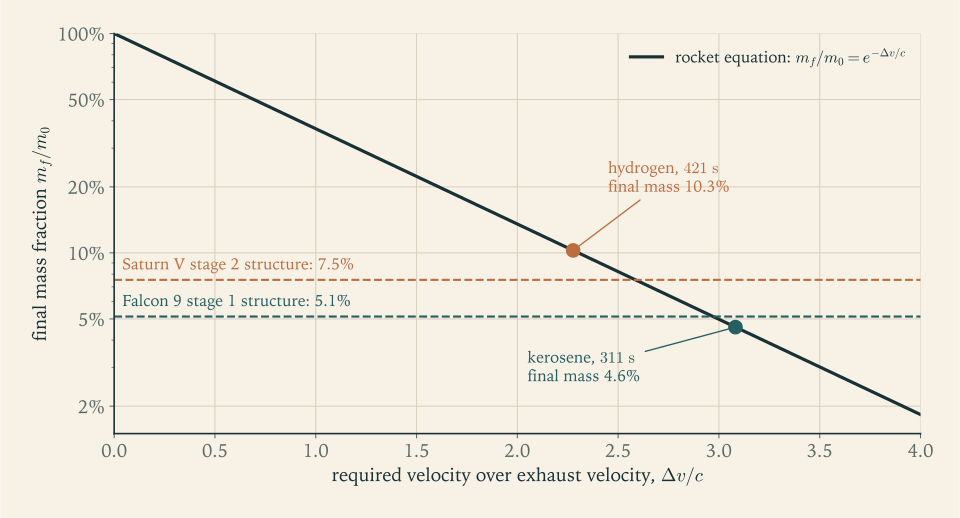
Question. What mass ratio does a single burn need to deliver \(\Delta v=9.4\ \mathrm{km/s}\) (provisional requirement) with a kerosene engine at \(I_{sp}=311\ \mathrm s\) and with a hydrogen engine at \(I_{sp}=421\ \mathrm s\) ? Both specific impulses are vacuum values (secondary compilation; see sources), which flatters the kerosene engine, since it must start at sea level.
Kerosene. \(c=3049.9\ \mathrm{m/s}\) , so \(\Delta v/c=9400/3049.9=3.082\) and
Hydrogen. \(c=(421)(9.80665)=4128.6\ \mathrm{m/s}\) , so \(\Delta v/c=2.2768\) and
Interpretation. With kerosene, everything that is not propellant, meaning tanks, engines, structure, guidance, and payload together, must fit in \(4.59\) percent of the liftoff mass. With hydrogen the allowance is \(10.26\) percent.
Compare with real hardware. The Falcon 9 first stage has an empty mass of \(22\,200\ \mathrm{kg}\) and a gross mass of \(433\,100\ \mathrm{kg}\) , so its structure alone is \(22\,200/433\,100=5.13\) percent of the stage. The hydrogen-fueled second stage of the Saturn V is listed with an empty mass of \(36\,150\ \mathrm{kg}\) (79,700 lb) and a loaded mass of \(479\,900\ \mathrm{kg}\) (1,058,000 lb): \(7.53\) percent (secondary compilation for both; see sources). The kerosene allowance of \(4.59\) percent is smaller than the structure of an excellent kerosene stage before any payload is added. The hydrogen allowance of \(10.26\) percent exceeds its stage’s structure by \(2.7\) percentage points.
Figure 1.2 puts these numbers on one graph.
1.6 Burning against gravity
A launch vehicle does not start in empty space. It starts on the ground, pointing up, with gravity pulling down on every kilogram.
The system and assumptions. The same closed system as before. The vehicle flies vertically. Drag is neglected. Gravity is uniform with acceleration \(g\) , and near the surface \(g\approx g_0\) ; Section 1.7 removes this last assumption. The thrust \(F\) and effective exhaust velocity \(c\) are constant, so the mass flow \(\dot m=F/c\) is constant too.
The external force is \(-mg\) , and the equation of motion is
Integrating from ignition at rest,
The first term is the rocket equation. The second is new and depends on time: every second the engine runs, gravity removes \(g\) from the vehicle’s speed.
Mass, time, and thrust-to-weight ratio. With constant flow, \(m(t)=m_0-\dot m t\) . Define the time \(\tau=m_0/\dot m\) in which the engine would consume the vehicle’s entire initial mass; then \(m(t)=m_0(1-t/\tau)\) . The engine actually stops when the propellant \(m_p=\zeta m_0\) is gone, at the burn time
Definition 1.5 (thrust-to-weight ratio). The thrust-to-weight ratio of a vehicle of mass \(m\) under thrust \(F\) is \(\psi=F/(m\,g_0)\) , with the weight evaluated at standard gravity. Its value at ignition is \(\psi_0=F/(m_0g_0)\) .
Because \(F=\dot m c\) , the characteristic time is \(\tau=m_0c/F=c/(\psi_0g_0)\) . A vehicle on the pad lifts off only if its thrust exceeds its weight, which for \(g=g_0\) means \(\psi_0\) greater than \(1\) .
Acceleration history. An accelerometer on board does not register gravity; it reads the thrust per unit mass,
which this text calls the sensed acceleration. It starts at \(\psi_0g_0\) and grows as the vehicle lightens, reaching \(\psi_0\mathcal R\,g_0\) at burnout. The vehicle’s actual acceleration is this minus \(g\) . A constant-thrust stage therefore accelerates gently at first and hardest at the very end, when it is nearly empty.
Altitude. Integrating \(v(t)=-c\ln(1-t/\tau)-gt\) once more (Exercise 9) gives
The loss. At burnout the speed is \(v_b=c\ln\mathcal R-g\,t_b\) . The ideal velocity increment has been reduced by \(g\,t_b\) .
Definition 1.6 (gravity loss). For a burn of duration \(t_b\) along a path whose direction makes angle \(\theta\) above the local horizontal, with thrust along the direction of motion and no drag, the gravity loss is
and the speed gained is \(c\ln\mathcal R-\Delta v_g\) . For a vertical burn in uniform gravity, \(\theta=90^\circ\) throughout and \(\Delta v_g=g\,t_b\) .
The general form comes from resolving the equation of motion along the direction of travel. Gravity has a component \(-g\sin\theta\) along the path, which changes the speed, and a component perpendicular to it, which changes only the direction. So \(\mathrm dv/\mathrm dt=F/m-g\sin\theta\) , and integrating gives the definition. The loss is an integral over time: it is paid for every second spent with the path tilted upward, and it stops accumulating once the vehicle flies horizontally. That is why launch vehicles pitch over soon after leaving the pad, a maneuver Chapter 7 analyzes. A purely vertical burn is the worst case.
For the vertical burn the loss can be written in terms of the design. With \(t_b=\zeta\tau\) and \(\tau=c/(\psi_0g_0)\) ,
Higher thrust-to-weight means a shorter burn and a smaller loss.
Example 1.4: A vertical burn with the numbers of a real stage
Setup. Suppose a Falcon 9 burned its first stage straight up, at full sea-level thrust and sea-level specific impulse throughout, with no drag and \(g=g_0\) . This is a thought experiment, since the real vehicle turns, throttles, and gains performance as the air thins. Data: liftoff mass \(m_0=549\,000\ \mathrm{kg}\) , the compilation’s quoted launch mass, which leaves only about \(4\ \mathrm t\) above the two stages for payload and fairing, and first-stage propellant \(m_p=433\,100-22\,200=410\,900\ \mathrm{kg}\) (secondary compilation; see sources); \(F=7605\ \mathrm{kN}\) (Falcon User’s Guide; see sources); \(c=2765.5\ \mathrm{m/s}\) and \(\dot m=2750\ \mathrm{kg/s}\) from Example 1.2.
Thrust-to-weight ratio.
The vehicle leaves the pad with a net acceleration of \((\psi_0-1)g_0=4.05\ \mathrm{m/s^2}\) .
Times. \(\tau=m_0/\dot m=549\,000/2750.0=199.6\ \mathrm s\) , and the propellant fraction of this burn is \(\zeta=410\,900/549\,000=0.7485\) , so
Velocity. The mass at burnout is \(m_f=138\,100\ \mathrm{kg}\) and \(\mathcal R=549\,000/138\,100=3.975\) .
Gravity took \(38\) percent of what the engines supplied.
Altitude at burnout. With \(1-t_b/\tau=0.25155\) , \(t_b=149.419\ \mathrm s\) , and \(\tau-t_b=50.219\ \mathrm s\) ,
Sensed acceleration at burnout. \(\psi_0\mathcal R\,g_0=(1.413)(3.975)\,g_0=5.62\,g_0\) , about \(55\ \mathrm{m/s^2}\) .
Checks. The computed burn time, \(149.4\ \mathrm s\) , can be set against the sample timelines in the manufacturer’s guide, which show main engine cutoff \(145\) and \(147\ \mathrm s\) after liftoff (Falcon User’s Guide; see sources). Agreement within a few percent says the mass, thrust, and specific-impulse figures hang together; it is partly fortuitous, because the real flight throttles the engines and, when the stage is recovered, keeps some propellant in reserve. The burnout acceleration of \(5.6\,g_0\) is higher than a real vehicle would allow, which is one reason real stages throttle down near the end of the burn. Finally, \(g\) at \(112\ \mathrm{km}\) is about \(3.4\) percent below its surface value, so treating it as constant was a small error; Section 1.7 measures it.
Example 1.5: Trading thrust-to-weight ratio against gravity loss
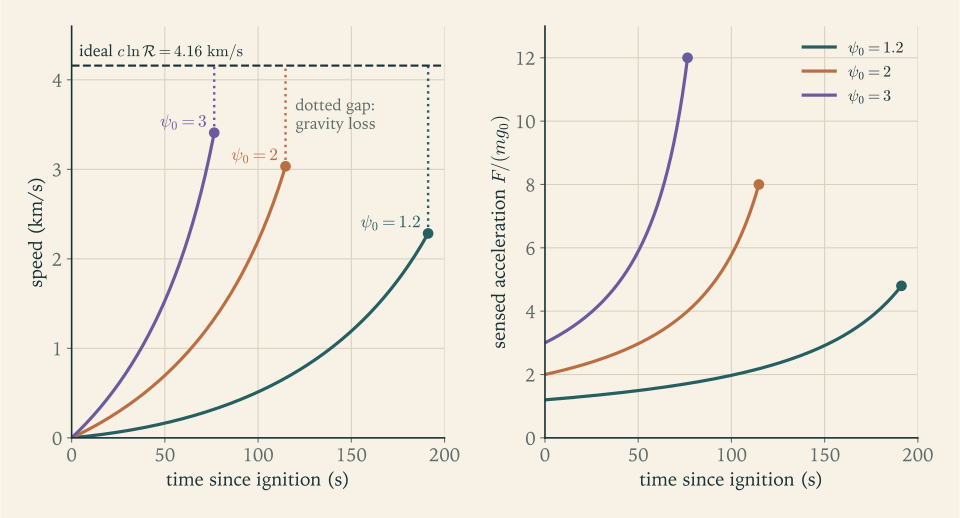
Question. A vertically launched stage (illustrative values) has \(c=3000\ \mathrm{m/s}\) and propellant fraction \(\zeta=0.75\) , hence \(\mathcal R=4\) and an ideal increment \(c\ln4=4159\ \mathrm{m/s}\) . Take \(g=g_0\) . How do gravity loss and burnout acceleration depend on the thrust-to-weight ratio chosen at ignition?
Formulas. \(t_b=\zeta c/(\psi_0g_0)\) , \(\Delta v_g=c\,\zeta/\psi_0\) , \(v_b=c\ln\mathcal R-\Delta v_g\) , and sensed acceleration at burnout \(\psi_0\mathcal R\,g_0\) .
| Thrust-to-weight ratio at ignition | Burn time | Gravity loss | Burnout speed | Sensed acceleration at burnout |
|---|---|---|---|---|
| \(1.2\) | \(191.2\ \mathrm s\) | \(1875\ \mathrm{m/s}\) | \(2284\ \mathrm{m/s}\) | \(4.8\,g_0\) |
| \(1.5\) | \(153.0\ \mathrm s\) | \(1500\ \mathrm{m/s}\) | \(2659\ \mathrm{m/s}\) | \(6.0\,g_0\) |
| \(2.0\) | \(114.7\ \mathrm s\) | \(1125\ \mathrm{m/s}\) | \(3034\ \mathrm{m/s}\) | \(8.0\,g_0\) |
| \(3.0\) | \(76.5\ \mathrm s\) | \(750\ \mathrm{m/s}\) | \(3409\ \mathrm{m/s}\) | \(12.0\,g_0\) |
Reading the table. Raising \(\psi_0\) from \(1.2\) to \(3.0\) recovers \(1125\ \mathrm{m/s}\) , more than a quarter of the ideal increment. It also raises the burnout acceleration from \(4.8\) to \(12\,g_0\) , and it requires engines two and a half times as powerful, which are heavier, on the same vehicle. At the other extreme the formula gives a definite limit: a stage that lifts off with \(\psi_0\) barely above \(1\) loses \(c\,\zeta=2250\ \mathrm{m/s}\) , which is \(54\) percent of the ideal increment, and still burns out at about \(1909\ \mathrm{m/s}\) , because its thrust-to-weight ratio climbs as the propellant goes. More than half of the engine’s work is spent holding the vehicle up. A stage with enormous thrust, on the other hand, would crush its payload and carry engines it cannot afford. The design sits between, and where exactly depends on effects not yet in the model: engine mass (Chapter 6), drag, which punishes high speed at low altitude (Chapter 7), and the fact that the vehicle does not fly vertically for long.
Figure 1.3 shows three of these burns as functions of time.
For comparison with real practice: the Falcon 9 figure computed in Example 1.4 is \(\psi_0=1.41\) , and the Saturn V’s listed first-stage thrust of \(33\,360\ \mathrm{kN}\) (7,500,000 lbf) at sea level and launch mass between \(2\,822\,000\) and \(2\,965\,000\ \mathrm{kg}\) give \(\psi_0\) between \(1.15\) and \(1.21\) (secondary compilation; see sources).
1.7 When gravity varies: integrating the equations numerically
Gravity weakens with distance from the Earth’s centre. For a spherical Earth with gravitational parameter \(\mu_E=3.986\times10^{14}\ \mathrm{m^3/s^2}\) and radius \(R_E=6378.137\ \mathrm{km}\) (NASA Earth Fact Sheet; see sources), the acceleration at altitude \(z\) is
which is \(9.798\ \mathrm{m/s^2}\) at the surface. (The small difference from \(g_0\) is because \(g_0\) is a conventional constant, not the result of this formula.) With \(g\) depending on \(z\) , and \(z\) depending on the motion, the vertical burn becomes a pair of coupled first-order equations,
for which the closed form of Section 1.6 no longer applies. This is the usual situation in flight mechanics: the equations are easy to write and have no formula for a solution. One integrates them numerically.
The standard tool is the classical fourth-order Runge-Kutta method. Write the system as \(\mathrm dy/\mathrm dt=f(t,y)\) with \(y=(z,v)\) . To advance from \(t\) to \(t+\Delta t\) , compute four slopes,
and set
When \(f\)
is smooth (four times continuously differentiable) on the region the solution visits, the error accumulated over a fixed time interval is proportional to \((\Delta t)^4\)
, so halving the step reduces it about sixteenfold. The method and this error estimate belong to Numerical Analysis (math.numerical-analysis.ode-initial-value). Here \(f\)
is smooth as long as \(t\)
stays below \(\tau\)
, where the mass would reach zero, and the burn ends well before that.
Example 1.6: The vertical burn with inverse-square gravity
Setup. Repeat Example 1.4 with \(g(z)=\mu_E/(R_E+z)^2\) in place of a constant. All other data are unchanged. So that every figure below can be reproduced, here are the inputs to the precision actually used: \(F=7.605\times10^{6}\ \mathrm N\) , \(m_0=549\,000\ \mathrm{kg}\) , \(\dot m=2749.98\ \mathrm{kg/s}\) , \(t_b=149.419\ \mathrm s\) , with \(\mu_E\) and \(R_E\) as given above.
First step in full. Divide the burn into \(10\) steps of \(\Delta t=14.9419\ \mathrm s\) . At \(t=0\) the state is \((z,v)=(0,0)\) . Each slope is a pair: the rate of change of \(z\) , in \(\mathrm{m/s}\) , and of \(v\) , in \(\mathrm{m/s^2}\) .
For \(k_2\) evaluate at \(t=\Delta t/2\) and the state \((0+\tfrac{\Delta t}2\cdot0,\ 0+\tfrac{\Delta t}2\cdot4.0542)=(0,\ 30.289)\) : the mass is \(549\,000-(2749.98)(7.47095)=528\,455\ \mathrm{kg}\) , so
Likewise \(k_3=(34.312,\ 4.5934)\) and \(k_4=(68.635,\ 5.1764)\) . The update is
After \(15\ \mathrm s\) the vehicle has climbed half a kilometre and is moving at about \(69\ \mathrm{m/s}\) .
The whole burn, and the effect of step size. Repeating the step to burnout, with the burn divided into equal steps:
| Number of steps | Step size | Burnout speed | Burnout altitude |
|---|---|---|---|
| \(10\) | \(14.94\ \mathrm s\) | \(2366.10\ \mathrm{m/s}\) | \(112.604\ \mathrm{km}\) |
| \(20\) | \(7.47\ \mathrm s\) | \(2366.06\ \mathrm{m/s}\) | \(112.606\ \mathrm{km}\) |
| \(40\) | \(3.74\ \mathrm s\) | \(2366.06\ \mathrm{m/s}\) | \(112.606\ \mathrm{km}\) |
The answers have settled to six significant figures by \(20\) steps. The converged result is \(v_b=2366.06\ \mathrm{m/s}\) at \(z_b=112.606\ \mathrm{km}\) .
Verifying the integrator. A numerical method should be tested on a problem with a known answer before it is trusted on one without. Run the same code with gravity held at its surface value \(\mu_E/R_E^2\) : with \(160\) steps it returns \(v_b=2352.62\ \mathrm{m/s}\) and \(z_b=112.167\ \mathrm{km}\) , and the formulas of Section 1.6 with the same \(g\) , the same inputs, and \(c=F/\dot m\) give \(2352.62\ \mathrm{m/s}\) and \(112.167\ \mathrm{km}\) . They agree to all digits shown.
Result. Allowing gravity to weaken with altitude raises the burnout speed by \(2366.06-2352.62=13.44\ \mathrm{m/s}\) and the burnout altitude by \(112.606-112.167=0.44\ \mathrm{km}\) . The gravity loss falls from \(1464\ \mathrm{m/s}\) to \(1451\ \mathrm{m/s}\) , a change of less than \(1\) percent. For a first-stage burn, uniform gravity is a good model. The numerical method matters less for this answer than for what it makes possible: the same few lines of code will integrate the full ascent in Chapter 7, with drag, a turning trajectory, and two stages.
1.8 What the exponential forbids
Return to the opening question with the tools now in hand.
A single stage that reaches orbit must supply about \(9.4\ \mathrm{km/s}\) . With kerosene and liquid oxygen at \(c\approx3.05\ \mathrm{km/s}\) , even granting the vacuum value from the moment of liftoff, its final mass can be no more than \(4.59\) percent of its initial mass. The structure of a very good kerosene stage is about \(5.1\) percent of the stage. The vehicle would have to weigh less empty than its own tanks and engines do. Nothing is left for payload, and in fact less than nothing.
The same conclusion can be reached from the other side. Take the Falcon 9 first stage alone, with no upper stage and no payload: \(\mathcal R=433\,100/22\,200=19.51\) , so at most \(\Delta v=(3049.9\ \mathrm{m/s})\ln19.51=9.06\ \mathrm{km/s}\) , short of the requirement before a single kilogram of payload is added (secondary compilation; see sources).
With hydrogen at \(c=4.13\ \mathrm{km/s}\) the allowance rises to \(10.26\) percent, against a structure fraction of \(7.53\) percent for the Saturn V’s second stage. On paper that leaves a payload of about \(3.0\) percent of liftoff mass, which falls to \(1.9\) percent if the requirement is \(9.8\ \mathrm{km/s}\) and to zero at \(10.7\ \mathrm{km/s}\) (Exercise 14). The paper figure is generous in two ways. That stage was built to start in vacuum: its listed thrust of \(4450\ \mathrm{kN}\) (1,000,000 lbf) is less than its own loaded weight at the surface, \(4706\ \mathrm{kN}\) , so it could not lift itself off a pad, and its engine’s specific impulse at sea level is listed as only \(200\ \mathrm s\) (secondary compilation; see sources). A hydrogen stage able to leave the ground would need at least a quarter more thrust, hence more engine mass, and would fly the first part of its burn at a lower exhaust velocity. Both effects come out of a margin of less than three percentage points. Single-stage-to-orbit is not forbidden by physics. It is forbidden, so far, by the combination of the exponential with the structural fractions and engine performance that hardware allows.
The exponential also explains why the conclusion is so sensitive. Since \(m_f/m_0=e^{-\Delta v/c}\) , a change of \(1\) percent in the exponent \(\Delta v/c\approx3\) changes the final mass fraction by about \(3\) percent of itself. When payload is the small difference between two nearly equal numbers, final mass and structure, such changes are magnified many times over. Small improvements in exhaust velocity or in structure are worth a great deal, and small shortfalls are ruinous.
Where the model of this chapter stops being accurate. Each assumption fails in a known order. The constancy of \(c\) fails first for a stage that starts at sea level: Example 1.2 showed a \(10\) percent rise from sea level to vacuum, and Chapter 3 treats it. The neglect of drag is next; for large vehicles it is small beside the gravity loss, one set of lecture notes estimating peak drag at about 2 percent of the vehicle’s weight (MIT 16.07 notes; see sources), and Chapter 7 computes it. The vertical path is replaced by a turning one, which lowers the gravity loss well below \(g\,t_b\) and introduces a steering loss. Uniform gravity, as Example 1.6 showed, is the least of the errors. None of these touches the logarithm, which is exact for the ideal increment.
What does touch it is the assumption, never stated because it seemed too obvious, that the vehicle arriving in orbit is the vehicle that left the pad, minus propellant. If the empty tanks and engines of the first part of the flight could be left behind, the remaining propellant would be accelerating less. Example 1.1 already showed the principle at work with blocks on a sled: mass that has been thrown away no longer needs to be accelerated. Applying that to structure instead of propellant is called staging, and it is how orbital launchers escape the verdict of this section; a single stage to orbit has yet to be engineered successfully (MIT 16.07 notes; see sources). How to divide a vehicle into stages, and how to do it best, is the subject of Chapter 2.
Exercises
-
State the momentum principle for a closed system. Then explain in a few sentences why a rocket vehicle by itself is not a closed system, say exactly what crosses its boundary and where, and name a closed system that contains the vehicle over a short time interval.
-
The Electron launcher’s second-stage engine produces \(5800\ \mathrm{lbf}\) of thrust in vacuum with \(I_{sp}=343\ \mathrm s\) (Electron Payload User’s Guide; see sources). Taking \(1\ \mathrm{lbf}=4.448\ \mathrm N\) , find (a) the thrust in kilonewtons, (b) the effective exhaust velocity, (c) the mass flow rate, and (d) the propellant consumed in a burn of \(300\ \mathrm s\) . The same guide says the stage carries “approximately” \(2000\ \mathrm{kg}\) of propellant and burns for about five minutes; comment on whether your answer to (d) is consistent with that.
Answer
(a) \(F=(5800)(4.448\ \mathrm N)=25.80\ \mathrm{kN}\) . (b) \(c=(343\ \mathrm s)(9.80665\ \mathrm{m/s^2})=3363.7\ \mathrm{m/s}\) . (c) \(\dot m=F/c=7.670\ \mathrm{kg/s}\) . (d) \((7.670\ \mathrm{kg/s})(300\ \mathrm s)=2301\ \mathrm{kg}\) . This is \(15\) percent above the quoted \(2000\ \mathrm{kg}\) . With both the propellant load and the burn time given only approximately, the figures are consistent at the level they are stated; a \(2000\ \mathrm{kg}\) load at this flow rate would last \(261\ \mathrm s\) , a little under five minutes.
-
A hopper car of mass \(m\) rolls without friction at speed \(v\) beneath a chute that drops sand straight down into it at rate \(\mathrm dm/\mathrm dt\) , so the sand has no horizontal velocity before it lands. (a) Choose a closed system for the interval from \(t\) to \(t+\mathrm dt\) and write its horizontal momentum at both instants. (b) Derive the car’s equation of motion. (c) Show that \(mv\) is constant. (d) Explain why the same reasoning does not make \(mv\) constant for a rocket.
Solution
(a) Take as the system the car, the sand already in it (together mass \(m\) , speed \(v\) ), and the sand that will land during \(\mathrm dt\) (mass \(\mathrm dm\) , horizontal velocity zero). This is a fixed set of matter and no horizontal external force acts on it, since the track is frictionless and gravity is vertical. Its horizontal momentum at time \(t\) is \(mv+\mathrm dm\cdot0=mv\) . At \(t+\mathrm dt\) all of it moves together: \((m+\mathrm dm)(v+\mathrm dv)\) .
(b) Conservation gives \((m+\mathrm dm)(v+\mathrm dv)=mv\) . Dropping the second-order term \(\mathrm dm\,\mathrm dv\) ,
\[ m\,\mathrm dv+v\,\mathrm dm=0\qquad\Longrightarrow\qquad m\,\frac{\mathrm dv}{\mathrm dt}=-v\,\frac{\mathrm dm}{\mathrm dt}. \]The car slows, because it must bring each grain of sand up to its own speed.
(c) The left side of the first equation is \(\mathrm d(mv)\) , so \(mv\) is constant.
(d) Here the arriving mass has zero horizontal velocity in the frame of the track, so it carries no momentum across the boundary of the car, and \(\mathrm d(mv)/\mathrm dt=F_{\mathrm{ext}}=0\) happens to be correct in that frame. In the general balance the term is the mass rate times the velocity of the transferred mass relative to the body, which here is \(-v\) . For a rocket the departing mass has relative velocity \(-v_e\) regardless of \(v\) , and it carries momentum \((v-v_e)\,\dot m\,\mathrm dt\) away, so the vehicle’s \(mv\) is not conserved.
-
A student argues: “In deep space \(F_{\mathrm{ext}}=0\) , so \(\mathrm d(mv)/\mathrm dt=0\) , so \(mv\) is constant and \(v=v_0m_0/m\) . A rocket that starts from rest therefore stays at rest however much propellant it burns.” (a) Identify the faulty step. (b) Show that the student’s formula gives different accelerations to two inertial observers. (c) Give the correct relation between \(v\) and \(m\) and evaluate it for \(m_0/m=3\) and \(c=3000\ \mathrm{m/s}\) , starting from rest.
Solution
(a) The faulty step is applying \(\mathrm d(mv)/\mathrm dt=F_{\mathrm{ext}}\) to the vehicle alone. That law holds for a closed system. The vehicle loses mass through its exit plane, and the lost mass carries momentum, so the vehicle’s momentum \(mv\) changes even when no external force acts.
(b) The student’s law expands to \(m\,\mathrm dv/\mathrm dt=-v\,\mathrm dm/\mathrm dt=v\,\dot m\) . An observer who sees the vehicle at velocity \(v\) predicts acceleration \(v\dot m/m\) ; an observer moving at velocity \(w\) relative to the first sees velocity \(v-w\) and predicts \((v-w)\dot m/m\) . The two differ by \(w\dot m/m\) , although both must measure the same acceleration. In particular the observer for whom \(v=0\) predicts no acceleration at all, which is the student’s absurd conclusion.
(c) For the closed system of vehicle plus expelled parcel, Proposition 1.1 with \(F_{\mathrm{ext}}=0\) gives \(m\,\mathrm dv=-c\,\mathrm dm\) , hence \(v-v_0=c\ln(m_0/m)\) . From rest with \(m_0/m=3\) :
\[ v=(3000\ \mathrm{m/s})\ln3=3296\ \mathrm{m/s}. \] -
A stage with effective exhaust velocity \(c=3.40\ \mathrm{km/s}\) must deliver \(\Delta v=5.50\ \mathrm{km/s}\) in free space to a burnout mass of \(26.8\ \mathrm t\) . Find the mass ratio, the propellant fraction, the ignition mass, and the propellant mass.
Solution
The burn is in free space with constant \(c\) , so the rocket equation applies directly. The mass ratio is
\[ \mathcal R=e^{\Delta v/c}=e^{5.50/3.40}=e^{1.6176}=5.041 . \]The propellant fraction is \(\zeta=1-1/\mathcal R=1-0.1984=0.8016\) . The ignition mass is \(m_0=\mathcal R\,m_f=(5.041)(26.8\ \mathrm t)=135.1\ \mathrm t\) , and the propellant is \(m_p=m_0-m_f=135.1-26.8=108.3\ \mathrm t\) .
Check. \(\zeta m_0=(0.8016)(135.1\ \mathrm t)=108.3\ \mathrm t\) , the same propellant mass. The exponent \(1.62\) lies between \(1\) and \(2\) , so the propellant fraction should lie between \(63\) and \(86\) percent, and it does.
-
The rocket equation can be drawn as a straight line on axes of \(\Delta v\) (horizontal) against \(\log_{10}(m_f/m_0)\) (vertical). (a) Find the slope of the line in terms of \(c\) . (b) Describe how the line changes when \(c\) rises from \(3.0\) to \(4.5\ \mathrm{km/s}\) . (c) For each value of \(c\) , find the \(\Delta v\) at which the final mass is \(10\) percent of the initial mass.
Answer
(a) \(\log_{10}(m_f/m_0)=-\Delta v/(c\ln10)\) , so the slope is \(-1/(c\ln10)=-1/(2.303\,c)\) . (b) Raising \(c\) makes the line shallower by the factor \(3.0/4.5=2/3\) ; it still passes through the origin. (c) The final mass is \(10\) percent when \(\Delta v=c\ln10\) : \(6.91\ \mathrm{km/s}\) for \(c=3.0\ \mathrm{km/s}\) and \(10.36\ \mathrm{km/s}\) for \(c=4.5\ \mathrm{km/s}\) .
-
A vehicle of mass \(m_0\) carries two engines with effective exhaust velocities \(c_A\) and \(c_B\) , where \(c_A\) exceeds \(c_B\) , and separate propellant supplies \(m_A\) and \(m_B\) for them. No hardware is dropped. (a) Write the total \(\Delta v\) if engine A burns first, and if engine B burns first. (b) Show that the difference between the two orders is \((c_A-c_B)\ln\bigl[m_0m_f/((m_0-m_A)(m_0-m_B))\bigr]\) with \(m_f=m_0-m_A-m_B\) , and determine its sign. (c) State in words which engine should burn last, and why that is plausible.
Solution
(a) Each burn obeys the rocket equation with its own exhaust velocity and its own initial and final masses, and the velocity changes add. With A first the vehicle goes from \(m_0\) to \(m_0-m_A\) and then to \(m_f\) ; with B first, from \(m_0\) to \(m_0-m_B\) and then to \(m_f\) :
\[ \Delta v_{AB}=c_A\ln\frac{m_0}{m_0-m_A}+c_B\ln\frac{m_0-m_A}{m_f},\qquad \Delta v_{BA}=c_B\ln\frac{m_0}{m_0-m_B}+c_A\ln\frac{m_0-m_B}{m_f}. \](b) Subtract and collect the terms multiplying \(c_A\) and \(c_B\) . The coefficient of \(c_A\) is \(\ln\frac{m_0}{m_0-m_A}-\ln\frac{m_0-m_B}{m_f}=\ln\frac{m_0m_f}{(m_0-m_A)(m_0-m_B)}\) , and the coefficient of \(c_B\) is its negative. So
\[ \Delta v_{AB}-\Delta v_{BA}=(c_A-c_B)\,\ln\frac{m_0\,m_f}{(m_0-m_A)(m_0-m_B)} . \]Expand the denominator: \((m_0-m_A)(m_0-m_B)=m_0(m_0-m_A-m_B)+m_Am_B=m_0m_f+m_Am_B\) , which exceeds \(m_0m_f\) . The logarithm is therefore negative, and since \(c_A-c_B\) is positive, \(\Delta v_{AB}\) is less than \(\Delta v_{BA}\) .
(c) The engine with the higher exhaust velocity should burn last. A burn’s mass ratio is larger when the vehicle is lighter, because the same propellant mass is then a larger fraction of what remains; the better engine should be the one working at the larger mass ratio. A numerical case: \(m_0=10\) , \(m_A=3\) , \(m_B=4\) (any mass unit), \(c_A=4\) , \(c_B=3\ \mathrm{km/s}\) gives \(\Delta v_{AB}=3.97\ \mathrm{km/s}\) and \(\Delta v_{BA}=4.31\ \mathrm{km/s}\) . This is one reason upper stages are given the engines with the highest specific impulse.
-
A sounding rocket (illustrative values) has ignition mass \(1200\ \mathrm{kg}\) including \(800\ \mathrm{kg}\) of propellant, effective exhaust velocity \(c=2400\ \mathrm{m/s}\) , and constant thrust giving \(\psi_0=2.5\) . It flies vertically with \(g=g_0\) and no drag. Find (a) the thrust and mass flow rate, (b) the burn time, (c) the gravity loss and burnout speed, (d) the burnout altitude, (e) the sensed acceleration at burnout, and (f) the peak altitude after coasting, still assuming constant gravity; say whether the constant-gravity assumption is reasonable for part (f).
Solution
The system is the rocket and its just-expelled gas; external force is gravity only, uniform at \(g_0\) ; thrust and \(c\) are constant.
(a) \(F=\psi_0m_0g_0=(2.5)(1200\ \mathrm{kg})(9.80665\ \mathrm{m/s^2})=29.42\ \mathrm{kN}\) , and \(\dot m=F/c=29\,420\ \mathrm N/2400\ \mathrm{m/s}=12.26\ \mathrm{kg/s}\) .
(b) \(t_b=m_p/\dot m=800/12.258=65.26\ \mathrm s\) . Equivalently \(\tau=c/(\psi_0g_0)=97.89\ \mathrm s\) and \(t_b=\zeta\tau\) with \(\zeta=2/3\) .
(c) The mass ratio is \(1200/400=3\) , so the ideal increment is \((2400)\ln3=2636.7\ \mathrm{m/s}\) . The gravity loss is \(g_0t_b=(9.80665)(65.26)=640.0\ \mathrm{m/s}\) , and \(v_b=2636.7-640.0=1997\ \mathrm{m/s}\) .
(d) With \(\tau-t_b=32.63\ \mathrm s\) and \(1-t_b/\tau=1/3\) ,
\[ z_b=(2400)\bigl[(32.63)\ln\tfrac13+65.26\bigr]-\tfrac12(9.80665)(65.26)^2=49.7\ \mathrm{km}. \](e) Sensed acceleration at burnout is \(\psi_0\mathcal R\,g_0=7.5\,g_0\) .
(f) Coasting upward from \(1997\ \mathrm{m/s}\) under constant \(g_0\) adds \(v_b^2/(2g_0)=203.3\ \mathrm{km}\) , for a peak of about \(253\ \mathrm{km}\) . At that altitude gravity is about \(7\) percent weaker than at the surface, so the true peak is somewhat higher; constant gravity is no longer a good assumption over a coast this long, and the answer should be quoted as “roughly \(250\) to \(270\ \mathrm{km}\) ” or computed with \(g(z)\) .
-
For a vertical constant-thrust burn in uniform gravity the speed is \(v(t)=-c\ln(1-t/\tau)-gt\) with \(\tau=m_0/\dot m\) . Integrate to derive the altitude \(z(t)=c[(\tau-t)\ln(1-t/\tau)+t]-\tfrac12gt^2\) , and verify your result by differentiating it and by checking that \(z\approx\tfrac12(\psi_0g_0-g)t^2\) for small \(t\) .
Hint
Substitute \(s=1-t/\tau\) , so that \(\mathrm dt=-\tau\,\mathrm ds\) and \(\int\ln s\,\mathrm ds=s\ln s-s\) . Fix the constant with \(z(0)=0\) . For the small-time check expand \(\ln(1-t/\tau)=-t/\tau-t^2/(2\tau^2)-\dots\) and recall \(c/\tau=\psi_0g_0\) .
-
For a vertical constant-thrust burn with \(g=g_0\) , fixed \(c\) , and fixed propellant fraction \(\zeta\) : (a) show that the burnout speed is \(v_b(\psi_0)=c\ln\mathcal R-c\zeta/\psi_0\) . (b) For \(\zeta=0.75\) , find the \(\psi_0\) at which the gravity loss equals \(20\) percent of the ideal increment. (c) Compute \(\mathrm dv_b/\mathrm d\psi_0\) at \(\psi_0=1.3\) for \(c=3000\ \mathrm{m/s}\) and state the gain in burnout speed from raising \(\psi_0\) by \(0.1\) . (d) Give two reasons a designer does not simply choose \(\psi_0=5\) .
Solution
(a) With constant thrust, \(\dot m=F/c\) and the burn lasts \(t_b=m_p/\dot m=\zeta m_0c/F=\zeta c/(\psi_0g_0)\) . A vertical burn in uniform gravity \(g=g_0\) loses \(g_0t_b=c\zeta/\psi_0\) , so \(v_b=c\ln\mathcal R-c\zeta/\psi_0\) with \(\mathcal R=1/(1-\zeta)\) .
(b) The loss is \(20\) percent of the ideal increment when \(\zeta/\psi_0=0.2\ln\mathcal R\) . For \(\zeta=0.75\) , \(\ln\mathcal R=\ln4=1.3863\) , so
\[ \psi_0=\frac{0.75}{(0.2)(1.3863)}=2.705 . \](c) \(\mathrm dv_b/\mathrm d\psi_0=c\zeta/\psi_0^2=(3000)(0.75)/(1.3)^2=1331\ \mathrm{m/s}\) per unit of \(\psi_0\) . Raising \(\psi_0\) from \(1.3\) to \(1.4\) gains about \(133\ \mathrm{m/s}\) (the exact difference is \(124\ \mathrm{m/s}\) , since the derivative falls as \(\psi_0\) rises).
(d) First, the sensed acceleration at burnout is \(\psi_0\mathcal R\,g_0=20\,g_0\) for \(\psi_0=5\) and \(\mathcal R=4\) , which few payloads or structures tolerate. Second, thrust costs engine mass: engines nearly four times as large as those for \(\psi_0=1.3\) add structure, which the next chapter shows is paid for in payload. A third reason, outside this chapter’s model, is that high acceleration means high speed low in the atmosphere and therefore high drag and aerodynamic load.
-
A lunar lander hovers at constant altitude in uniform gravity \(g\) by setting its thrust equal to its weight at every instant. Its effective exhaust velocity is \(c\) . (a) Show that its mass obeys \(\mathrm dm/\mathrm dt=-mg/c\) and solve for \(m(t)\) . (b) Show that it can hover for a time \((c/g)\ln\mathcal R\) . (c) Show that its gravity loss equals its entire ideal velocity increment. (d) Evaluate the hover time for \(c=3000\ \mathrm{m/s}\) , \(\mathcal R=2\) , and \(g=g_0\) .
Solution
(a) Hovering means zero acceleration, so thrust equals weight at every instant: \(\dot mc=mg\) . Since \(\mathrm dm/\mathrm dt=-\dot m\) , this is \(\mathrm dm/\mathrm dt=-(g/c)\,m\) , a linear equation with solution \(m(t)=m_0e^{-gt/c}\) . The thrust must be throttled down continuously as the vehicle lightens.
(b) The propellant is exhausted when \(m=m_f=m_0/\mathcal R\) , that is when \(e^{gt/c}=\mathcal R\) , so \(t_{\mathrm{hover}}=(c/g)\ln\mathcal R\) .
(c) The gravity loss of a burn with \(\theta=90^\circ\) is \(g\,t_{\mathrm{hover}}=c\ln\mathcal R\) , which is exactly the ideal velocity increment. The vehicle gained no speed, so all of the increment went to opposing gravity. Hovering is the limiting case of a gravity loss equal to everything the engine supplies.
(d) \(t_{\mathrm{hover}}=(3000\ \mathrm{m/s}/9.80665\ \mathrm{m/s^2})\ln2=212.0\ \mathrm s\) , and the increment spent is \((3000)\ln2=2079\ \mathrm{m/s}\) .
-
(Computation.) Write a short program that evaluates the sled’s final speed \(V_N=\sum_{i=1}^{N}mu/(M+im)\) of Example 1.1 for \(N=10\) , \(100\) , and \(1000\) equal throws, with \(M=60\ \mathrm{kg}\) , total block mass \(40\ \mathrm{kg}\) , and \(u=10\ \mathrm{m/s}\) . Tabulate \(V_N\) and its difference from the limit \(u\ln(100/60)\) , determine how the difference scales with \(N\) , and explain the scaling from the fact that \(V_N\) is a right-endpoint Riemann sum of a decreasing function.
Answer
\(V_{10}=4.9773\) , \(V_{100}=5.0949\) , \(V_{1000}=5.1069\ \mathrm{m/s}\) ; the limit is \(5.1083\ \mathrm{m/s}\) . The differences are \(0.1310\) , \(0.01331\) , and \(0.001333\ \mathrm{m/s}\) : each tenfold increase in \(N\) divides the error by ten, so the error is proportional to \(1/N\) , with \(N\) times the error approaching \(1.333\ \mathrm{m/s}\) . A right-endpoint sum of a decreasing function underestimates the integral on each subinterval by about half the width times the drop of the function across it; summing, the total error is about \(\tfrac12m\,u\,(1/M-1/(M+m_p))=(\tfrac12)(40/N)(10)(1/60-1/100)=1.333/N\) .
-
A brochure states: “Our new engine has a specific impulse of \(320\ \mathrm s\) , so it runs for \(320\ \mathrm s\) ; and because it has twice the thrust of the old one, it gives the vehicle twice the velocity change.” Identify both errors. Then, for a vehicle of initial mass \(3000\ \mathrm{kg}\) carrying \(1000\ \mathrm{kg}\) of propellant in free space, compute the velocity change and the burn time at thrust \(10\ \mathrm{kN}\) and at thrust \(20\ \mathrm{kN}\) .
Answer
Specific impulse is impulse per unit weight of propellant, not a duration; burn time is propellant mass divided by mass flow and depends on the thrust. And in free space the velocity change depends only on \(c\) and the mass ratio, not on thrust. Here \(c=(320)(9.80665)=3138.1\ \mathrm{m/s}\) and \(\Delta v=c\ln(3000/2000)=1272\ \mathrm{m/s}\) at either thrust. At \(10\ \mathrm{kN}\) the flow is \(3.187\ \mathrm{kg/s}\) and the burn lasts \(313.8\ \mathrm s\) ; at \(20\ \mathrm{kN}\) it lasts \(156.9\ \mathrm s\) .
-
A single-stage hydrogen vehicle has \(I_{sp}=421\ \mathrm s\) throughout and structure equal to \(7.53\) percent of the combined mass of structure and propellant (the Saturn V second-stage figures; secondary compilation; see sources). (a) For \(\Delta v=9.4\ \mathrm{km/s}\) , find the final mass fraction and then the payload as a fraction of liftoff mass. (b) Repeat for \(\Delta v=9.8\ \mathrm{km/s}\) . (c) Find the \(\Delta v\) at which the payload vanishes. (d) That stage’s thrust is \(4450\ \mathrm{kN}\) and its loaded mass \(479\,900\ \mathrm{kg}\) . What do your answers, together with its thrust-to-weight ratio at the surface, say about the practicality of the design?
Solution
(a) \(c=(421\ \mathrm s)(9.80665\ \mathrm{m/s^2})=4128.6\ \mathrm{m/s}\) , and the final mass fraction is \(e^{-9400/4128.6}=0.10261\) . Work per unit of liftoff mass. Let \(x\) be the payload fraction. Structure plus propellant is then \(1-x\) , and structure is \(0.0753(1-x)\) . The final mass is payload plus structure:
\[ x+0.0753\,(1-x)=0.10261\qquad\Longrightarrow\qquad x=\frac{0.10261-0.0753}{1-0.0753}=0.0295 . \]The payload is about \(3.0\) percent of liftoff mass.
(b) At \(9.8\ \mathrm{km/s}\) the final mass fraction is \(e^{-9800/4128.6}=0.09314\) and \(x=(0.09314-0.0753)/0.9247=0.0193\) , about \(1.9\) percent.
(c) The payload vanishes when the final mass is all structure, \(e^{-\Delta v/c}=0.0753\) , so \(\Delta v=c\ln(1/0.0753)=(4128.6\ \mathrm{m/s})(2.586)=10.68\ \mathrm{km/s}\) .
(d) A \(4\) percent increase in the velocity requirement removes about a third of the payload, and \(14\) percent more removes all of it; equivalently, at \(9.4\ \mathrm{km/s}\) the payload vanishes if the structure fraction grows from \(7.53\) to \(10.26\) percent. So on these figures a hydrogen single stage has a positive but small payload. The figures are generous, though. The specific impulse is a vacuum value that the engine would not reach near the ground. And the stage they describe has \(\psi_0=4.45\times10^{6}\ \mathrm N/\bigl((479\,900\ \mathrm{kg})(9.80665\ \mathrm{m/s^2})\bigr)=0.95\) : its thrust is less than its weight, so it could not lift off at all. Giving it enough engines to leave the pad adds structure, and a payload that is the difference of two nearly equal numbers has little margin to absorb that. This is the practical case against a single stage.
-
Let \(V_N=\sum_{i=1}^{N}mu/(M+im)\) with \(Nm=m_p\) fixed. Using only the fact that \(1/x\) is decreasing for positive \(x\) , prove the bounds \(u\ln\bigl[(M+m_p+m)/(M+m)\bigr]\le V_N\le u\ln\bigl[(M+m_p)/M\bigr]\) , and deduce that \(V_N\) converges to \(u\ln[(M+m_p)/M]\) as \(N\to\infty\) .
Hint
For each \(i\) compare the term \(m/(M+im)\) with the integral of \(1/x\) over the interval of width \(m\) ending at \(M+im\) (the integral is larger) and over the interval of width \(m\) starting there (the integral is smaller). Sum over \(i\) . For the limit, note that \(m=m_p/N\to0\) makes the lower bound converge to the upper bound.
-
In a frame where the vehicle of mass \(m\) is momentarily at rest, a parcel of mass \(\mathrm dm_e\) leaves at speed \(v_e\) and the vehicle gains speed \(\mathrm dv=v_e\,\mathrm dm_e/m\) . (a) Show that the kinetic energy of vehicle plus parcel has increased by \(\tfrac12v_e^2\,\mathrm dm_e\) to first order. (b) Repeat the calculation in a frame where the vehicle initially moves at speed \(v\) and show the increase is the same. (c) Conclude that the engine must release kinetic energy \(\tfrac12v_e^2\) per unit mass of propellant, and evaluate it in \(\mathrm{MJ/kg}\) for \(v_e=3.05\ \mathrm{km/s}\) .
Solution
(a) In the frame where the vehicle is at rest before the parcel leaves, the initial kinetic energy is zero. Afterward the parcel moves at \(-v_e\) (to first order) and the vehicle at \(\mathrm dv\) . The kinetic energy is \(\tfrac12\,\mathrm dm_e\,v_e^2+\tfrac12(m-\mathrm dm_e)(\mathrm dv)^2\) . The second term is of second order in small quantities, so the increase is \(\tfrac12v_e^2\,\mathrm dm_e\) .
(b) In a frame where the vehicle moves at \(v\) , the energy before is \(\tfrac12mv^2\) and after is \(\tfrac12(m-\mathrm dm_e)(v+\mathrm dv)^2+\tfrac12\,\mathrm dm_e\,(v-v_e)^2\) . Expanding to first order,
\[ \Delta E=mv\,\mathrm dv-\tfrac12v^2\,\mathrm dm_e+\tfrac12v^2\,\mathrm dm_e-v\,v_e\,\mathrm dm_e+\tfrac12v_e^2\,\mathrm dm_e =v\,(m\,\mathrm dv-v_e\,\mathrm dm_e)+\tfrac12v_e^2\,\mathrm dm_e . \]Momentum conservation gives \(m\,\mathrm dv=v_e\,\mathrm dm_e\) , so the bracket vanishes and \(\Delta E=\tfrac12v_e^2\,\mathrm dm_e\) again. The split of the energy between vehicle and exhaust depends on the observer; the total released does not.
(c) The kinetic energy that appears must come from the propellant, so the engine converts at least \(\tfrac12v_e^2\) per unit mass: \(\tfrac12(3050\ \mathrm{m/s})^2=4.65\times10^{6}\ \mathrm{J/kg}=4.65\ \mathrm{MJ/kg}\) . The unit check is \(\mathrm{m^2/s^2}=\mathrm{J/kg}\) .
-
A stage burns at constant thrust with \(\psi_0=1.4\) and mass ratio \(\mathcal R=4.0\) . (a) Find the sensed acceleration at burnout in multiples of \(g_0\) . (b) The payload tolerates at most \(5\,g_0\) . At what value of \(m/m_0\) is that limit reached, and what fraction of the burn time has elapsed? (c) If the engine then throttles so that \(F/m\) stays at \(5\,g_0\) , explain why the ideal velocity increment of the whole burn is unchanged in free space but the gravity loss of a vertical burn increases.
Hint
(a) Use \(\psi_0\mathcal R\) . (b) Sensed acceleration is \(\psi_0g_0\,m_0/m\) ; set it to \(5g_0\) and solve for \(m/m_0\) . The mass consumed up to then, divided by the total propellant fraction \(1-1/\mathcal R\) , is the fraction of burn time elapsed at constant flow. You should find \(m/m_0=0.28\) and \(96\) percent. (c) The rocket equation depends only on the mass ratio and \(c\) . Throttling lowers the flow rate, so the remaining propellant takes longer to burn, and gravity loss is an integral over time.
-
An engine produces \(F_{\mathrm{SL}}=845\ \mathrm{kN}\) at sea level with \(I_{sp}=282\ \mathrm s\) there, and has exit area \(A_e=0.68\ \mathrm{m^2}\) (an illustrative round value). Assume the mass flow and exit conditions do not depend on ambient pressure and take sea-level pressure as \(101.325\ \mathrm{kPa}\) . Find the thrust and specific impulse (a) at an altitude where the pressure is \(30\ \mathrm{kPa}\) and (b) in vacuum, and (c) express the sea-level thrust deficit as a percentage of vacuum thrust.
Answer
The mass flow is \(\dot m=845\,000/(282\times9.80665)=305.6\ \mathrm{kg/s}\) , and \(F=F_{\mathrm{SL}}+(p_{\mathrm{SL}}-p_a)A_e\) . (a) At \(30\ \mathrm{kPa}\) : \(F=845+(101.325-30)(0.68)=893.5\ \mathrm{kN}\) and \(I_{sp}=298.2\ \mathrm s\) . (b) In vacuum: \(F=913.9\ \mathrm{kN}\) and \(I_{sp}=305.0\ \mathrm s\) . (c) The sea-level deficit is \(68.9\ \mathrm{kN}\) , or \(7.5\) percent of vacuum thrust.
-
A \(2000\ \mathrm{kg}\) spacecraft makes a \(150\ \mathrm{m/s}\) maneuver with thrusters of \(I_{sp}=220\ \mathrm s\) (illustrative values). (a) Compute the propellant required exactly. (b) Compute it from the linear approximation \(m_p\approx m_0\Delta v/c\) . (c) Show by expanding the exponential that the relative error of the approximation is about \(\Delta v/(2c)\) , and compare with your numbers.
Answer
\(c=(220)(9.80665)=2157.5\ \mathrm{m/s}\) . (a) \(m_p=m_0(1-e^{-\Delta v/c})=134.3\ \mathrm{kg}\) . (b) \(m_0\Delta v/c=139.1\ \mathrm{kg}\) . (c) With \(x=\Delta v/c\) , \(1-e^{-x}=x-x^2/2+\dots\) , so the linear estimate is too large by the factor \(1+x/2\) to first order: a relative error of \(\Delta v/(2c)=3.5\) percent, matching \(139.1/134.3-1=3.5\) percent.
-
Suppose the reference launcher of this course, which must supply \(\Delta v=9.4\ \mathrm{km/s}\) (provisional), were built as a single kerosene stage with a flight-average effective exhaust velocity of \(3.2\ \mathrm{km/s}\) and structure equal to \(6\) percent of the combined mass of structure and propellant (illustrative values). (a) Find the required mass ratio and final mass fraction. (b) Find the payload as a fraction of liftoff mass and interpret its sign. (c) Find the effective exhaust velocity, and the corresponding specific impulse, at which the payload would be exactly zero.
Solution
(a) \(\mathcal R=e^{\Delta v/c}=e^{9.4/3.2}=e^{2.9375}=18.87\) , so the final mass is \(1/18.87=5.30\) percent of the liftoff mass.
(b) As in Exercise 14, let \(x\) be the payload fraction. Structure is \(0.06(1-x)\) and payload plus structure must equal the final mass fraction:
\[ x+0.06\,(1-x)=0.0530\qquad\Longrightarrow\qquad x=\frac{0.0530-0.06}{0.94}=-0.0074 . \]The payload fraction is negative, \(-0.74\) percent. No such vehicle exists: even with zero payload the structure alone (\(6\) percent) exceeds the final mass the rocket equation allows (\(5.30\) percent), so the stage cannot reach \(9.4\ \mathrm{km/s}\) .
(c) Zero payload means the final mass is all structure, \(1/\mathcal R=0.06\) , so \(\Delta v=c\ln(1/0.06)\) and
\[ c=\frac{9.4\ \mathrm{km/s}}{\ln(1/0.06)}=\frac{9.4}{2.8134}=3.341\ \mathrm{km/s},\qquad I_{sp}=\frac{3341\ \mathrm{m/s}}{9.80665\ \mathrm{m/s^2}}=340.7\ \mathrm s . \]A flight-average specific impulse of \(341\ \mathrm s\) is beyond a kerosene engine that starts at sea level, where the quoted values in this chapter are near \(282\ \mathrm s\) and reach \(311\ \mathrm s\) only in vacuum. The reference launcher must therefore be staged.