Two facts from the earlier chapters do not sit comfortably together. Kerosene and oxygen release enough energy to drive an exhaust at \(4.4\ \mathrm{km/s}\) , yet real kerosene engines deliver \(3.3\) to \(3.4\ \mathrm{km/s}\) in vacuum and about \(3\ \mathrm{km/s}\) at sea level, and even ideal calculations stop at \(3.5\ \mathrm{km/s}\) (Examples 3.3 and 3.7). And hydrogen engines beat kerosene engines by a third in exhaust velocity even though the hydrogen flame is the cooler of the two: ideal calculations put the chamber temperature near \(3000\ \mathrm K\) for hydrogen and oxygen and near \(3700\ \mathrm K\) for kerosene and oxygen (Wikipedia, “Liquid rocket propellant”; see sources).
Both puzzles are about what happens to energy inside the engine. The propellants react and the chamber fills with hot gas at high pressure. The gas then rushes out through the nozzle, cooling as it goes, and what was heat becomes directed motion. To say how much, three ideas are needed that this course has not yet used: what temperature measures, how energy is counted for a gas that flows, and what limits the conversion of heat into motion. This chapter builds each from the beginning, assuming no earlier course in thermodynamics, and it ends with one formula that gives the exit velocity \(v_e\) in terms of four numbers describing the gas and the nozzle. That formula resolves both puzzles.
4.1 What hot gas is
A gas is a very large number of molecules flying about at random, colliding with each other and with the walls of whatever contains them. Three measurable quantities describe a sample of it.
Density, \(\rho\) , is its mass per unit volume, in \(\mathrm{kg/m^3}\) .
Pressure, \(p\) , is the force per unit area that the gas exerts on a wall, in pascals, \(1\ \mathrm{Pa}=1\ \mathrm{N/m^2}\) . Section 3.1 used it as a given. It has a mechanical origin that is worth seeing once. Take a gas at rest in a box and one flat wall of area \(A\) perpendicular to the \(x\) direction. Consider the molecules whose velocity component toward the wall has a particular value \(u_{\mathrm{mol},x}\) . In a time \(\mathrm dt\) , those within a distance \(u_{\mathrm{mol},x}\,\mathrm dt\) of the wall reach it, so if such molecules made up all of the gas, half of them heading toward the wall and half away, the mass striking the wall would be \(\tfrac12\rho\,A\,u_{\mathrm{mol},x}\,\mathrm dt\) . Each molecule bounces back with its \(x\) velocity reversed, handing the wall twice its \(x\) momentum. The momentum delivered is \(2u_{\mathrm{mol},x}\) times that mass, \(\rho\,u_{\mathrm{mol},x}^2\,A\,\mathrm dt\) , and force is momentum per unit time. Averaging over all the molecules, with a bar for the average,
where the last step uses the fact that the three directions are equivalent, so each carries a third of the mean square speed. Pressure is the momentum that molecules deliver to a wall. The ratio \(p/\rho\) , which has units of \(\mathrm{m^2/s^2}\) , is one third of the mean square molecular speed.
Temperature, \(T\) , is what a thermometer reads, measured in kelvin from absolute zero. Experiments on gases that are not too dense show that \(p/\rho\) is proportional to \(T\) , and inversely proportional to the mass of the molecules.
Definition 4.1 (ideal gas). An ideal gas obeys
where \(R_u=8.314462618\ \mathrm{J/(mol\cdot K)}\) is the molar gas constant, the same for every gas, \(\mathcal M\) is the molar mass of the gas in \(\mathrm{kg/mol}\) , and \(R\) is its specific gas constant in \(\mathrm{J/(kg\cdot K)}\) . Temperature is absolute, in kelvin.
A mole is a fixed number of molecules, so \(\mathcal M\) is the mass of a molecule in different units; for a mixture it is the mass of the mixture divided by its total number of moles. The gas constant is a defined value (NIST; see sources).
Put the two results side by side. From the wall argument, \(p/\rho=\tfrac13\overline{u_{\mathrm{mol}}^2}\) . From the gas law, \(p/\rho=RT\) . Therefore
The left side is the kinetic energy of random straight-line motion per kilogram of gas. So temperature measures the energy of random molecular motion, and the constant \(R\) converts it to energy per kilogram. Per mole the energy is \(\tfrac32R_uT\) for every gas: at a given temperature all molecules have the same average kinetic energy, and light ones must therefore move faster. That one remark already contains the answer to the hydrogen puzzle, and the rest of the chapter makes it quantitative.
The model has limits. It treats molecules as points that interact only in collisions, which fails when a gas is so dense that the molecules crowd each other, as in a liquid. The chamber gas of a rocket engine is hot enough that it is well within the model’s range even at a hundred atmospheres, as the next example shows.
Throughout Chapters 4 to 6 the worked numbers use one model chamber gas: chamber temperature \(T_c=3600\ \mathrm K\) , molar mass \(\mathcal M=23\ \mathrm{g/mol}\) , and chamber pressure \(p_c=10\ \mathrm{MPa}\) , with one more property to be introduced in Section 4.3. These are illustrative round values chosen to resemble the products of kerosene and oxygen. For comparison, tabulated ideal calculations for that pair give \(3676\) to \(3701\ \mathrm K\) (Wikipedia, “Liquid rocket propellant”; see sources), and the Merlin engine’s chamber pressure is quoted as \(9.7\ \mathrm{MPa}\) (secondary compilation; see sources). The sources opened for this course do not state the molar mass of the products, so the value \(23\ \mathrm{g/mol}\) should be read as an assumption; Section 5.3 tests it against a published characteristic velocity.
Example 4.1: Gas constants and densities
The model chamber gas. With \(\mathcal M=0.023\ \mathrm{kg/mol}\) ,
At a hundred atmospheres the gas in the chamber is only about six times as dense as the air in a room, because it is twelve times hotter. Molecules that far apart interact only by colliding, which is what the ideal-gas model assumes.
A hydrogen-rich mixture. A set of lecture notes describes hydrogen burned with less oxygen than it could use, three moles of hydrogen to one of oxygen, giving two moles of water vapour and one of leftover hydrogen (MIT 16.50 notes, Lecture 6; see sources). Three moles of products have mass \(2(18)+1(2)=38\ \mathrm g\) , so
The same notes round this to \(13\ \mathrm{g/mol}\) and \(640\ \mathrm{J/(kg\cdot K)}\) in their own example.
Check against air. Dry air has mean molar mass \(28.97\ \mathrm{g/mol}\) , so \(R=287.0\ \mathrm{J/(kg\cdot K)}\) . At the surface conditions listed for Earth, \(1014\ \mathrm{mbar}\) and \(288\ \mathrm K\) , the gas law gives \(\rho=101\,400/\bigl((287.0)(288)\bigr)=1.227\ \mathrm{kg/m^3}\) . The same fact sheet lists \(1.217\ \mathrm{kg/m^3}\) (NASA Earth Fact Sheet; see sources). Agreement within one percent, from nothing but the molar mass.
Common mistake. Using the molar constant \(R_u\) where the specific constant \(R\) is needed. The two differ by the factor \(\mathcal M\) , about \(0.02\ \mathrm{kg/mol}\) , so the error is a factor of fifty in energy and seven in speed. The units give it away: \(R_u\) is per mole and every formula in this chapter needs energy per kilogram.
Example 4.2: How fast the molecules are already moving
Question. What is the root-mean-square molecular speed in the model chamber gas, and in air at \(288\ \mathrm K\) ?
Solution. From \(\overline{u_{\mathrm{mol}}^2}=3RT\) ,
Reading the numbers. In the chamber the molecules already move at about \(2\ \mathrm{km/s}\) , in all directions at once. The gas as a whole goes nowhere because the motions cancel. Seen this way, a nozzle does not have to create speed. Its job is to line up motion that is already there, and the exhaust velocities of real engines, \(3\) to \(4.5\ \mathrm{km/s}\) , are of the same order as these thermal speeds for that reason. In room air the speed is about \(500\ \mathrm{m/s}\) , somewhat faster than sound travels in it; Chapter 5 shows that this is no coincidence.
4.2 Energy inside a gas, and the first law
The random motion of Section 4.1 is a store of energy. Molecules made of more than one atom also rotate, and at high temperature their atoms vibrate against one another; these motions hold energy as well.
Definition 4.2 (internal energy). The specific internal energy \(e_{\mathrm{int}}\) of a gas is the energy per unit mass of the random motions of its molecules: translation, rotation, and vibration. Units: \(\mathrm{J/kg}\) . It does not include the kinetic energy of the gas moving as a whole.
For an ideal gas there is no energy of interaction between molecules, so \(e_{\mathrm{int}}\) depends on the temperature alone and not on how tightly the gas is packed. The translational part is \(\tfrac32RT\) , from Section 4.1. The other parts are also proportional to \(T\) over ranges where the same motions are active, which motivates a simple model.
Definition 4.3 (specific heat at constant volume; calorically perfect gas). The specific heat at constant volume is \(c_v=\mathrm de_{\mathrm{int}}/\mathrm dT\) , in \(\mathrm{J/(kg\cdot K)}\) . A gas is calorically perfect if \(c_v\) is constant, so that \(e_{\mathrm{int}}=c_vT\) .
There are two ways to change the internal energy of a fixed quantity of gas. One is to let energy flow in because something hotter is in contact with it; energy transferred this way is called heat. The other is to push on it. If a gas at pressure \(p\) is held in a cylinder by a piston of area \(A\) and the piston moves outward a distance \(\mathrm dx\) , the gas exerts the force \(pA\) through that distance and does work \(pA\,\mathrm dx\) , which is \(p\) times the increase in its volume. Per kilogram of gas the volume is \(1/\rho\) .
Proposition 4.1 (first law for a closed system). For a unit mass of gas forming a closed system, in a process slow enough that the gas has a single well-defined pressure,
where \(\delta q_{\mathrm{in}}\) is the heat added per unit mass and \(p\,\mathrm d(1/\rho)\) is the work the gas does on its surroundings as it expands.
This is conservation of energy and nothing more. The notation separates two kinds of quantity. The internal energy is a property of the state of the gas: fix \(T\) and \(e_{\mathrm{int}}\) is fixed, whatever happened before. Heat and work are not properties of a state. They are amounts transferred during a process, and they depend on the path taken between two states, which is why they are written with \(\delta\) and not as the differential of anything. A mathematically minded reader will recognize \(\mathrm de_{\mathrm{int}}\) as an exact differential and \(\delta q_{\mathrm{in}}\) as a differential form that is not exact. Section 4.4 returns to that distinction and gets something remarkable out of it.
If the gas is heated in a rigid container, its volume cannot change, no work is done, and all the heat goes into internal energy: \(\delta q_{\mathrm{in}}=c_v\,\mathrm dT\) . That is where the name of \(c_v\) comes from.
4.3 Energy carried by a stream
The gas in an engine is not a fixed quantity sitting in a cylinder. It streams through. The right tool is again a control volume, this time for energy.
Assumptions. System: a fixed control volume through which gas flows steadily, entering through one opening (station 1) and leaving through another (station 2) at mass flow rate \(\dot m\) . At each station the gas has uniform pressure, density, internal energy, and speed \(u\) across the opening. Heat enters the control volume at rate \(\dot Q\) ; a shaft passing through the surface extracts mechanical power \(\dot W_{\mathrm{shaft}}\) . Changes in gravitational potential energy between the stations are neglected.
Follow the matter that is inside the control volume at time \(t\) for a short time \(\mathrm dt\) , as in Section 3.1. A parcel of mass \(\dot m\,\mathrm dt\) leaves at station 2 and an equal mass enters at station 1; because the flow is steady, the energy stored inside the control volume itself does not change. The energy of the closed system therefore changes by
counting both the internal energy and the kinetic energy of bulk motion that each parcel carries.
Now the subtle part. The parcel that enters at station 1 does not drift in. The gas behind it pushes it in, against the pressure \(p_1\) . That gas exerts a force \(p_1A_1\) on the parcel and moves it through a distance \(u_1\,\mathrm dt\) , doing work \(p_1A_1u_1\,\mathrm dt\) on the system. The parcel’s volume is \(A_1u_1\,\mathrm dt\) and its mass is \(\dot m\,\mathrm dt\) , so the volume is \(\dot m\,\mathrm dt/\rho_1\) and the work done on the system is \((p_1/\rho_1)\,\dot m\,\mathrm dt\) . At station 2 the system pushes its own parcel out against \(p_2\) and does work \((p_2/\rho_2)\,\dot m\,\mathrm dt\) on the gas ahead. This work, \(p/\rho\) per unit mass, is called flow work. It is present whenever fluid crosses a boundary, and forgetting it is the classic error of the subject.
Conservation of energy for the closed system reads: change in energy equals heat added, plus flow work done on it at the inlet, minus flow work it does at the outlet, minus shaft work. The two flow-work terms have the same form as the internal energies, so absorb them.
Definition 4.4 (enthalpy). The specific enthalpy of a fluid is \(h=e_{\mathrm{int}}+p/\rho\) , in \(\mathrm{J/kg}\) .
Theorem 4.2 (steady-flow energy equation). Under the assumptions above,
In particular, for flow with no heat transfer and no shaft work, \(h+\tfrac12u^2\) has the same value at every station along the stream.
Enthalpy is not a new kind of energy stored in the gas. It is the internal energy plus the work that had to be done to push the gas into place, and it is the natural measure of the energy a stream carries. The theorem will be used three times in this course: for the nozzle, where there is neither heat nor shaft and enthalpy turns into kinetic energy; for the combustion chamber in Section 4.6, where chemical energy plays the part of heat; and in Chapter 6 for pumps and turbines, where the shaft term is the whole point.
For an ideal gas \(p/\rho=RT\) , so \(h=e_{\mathrm{int}}+RT\) also depends on temperature alone.
Definition 4.5 (specific heat at constant pressure and heat-capacity ratio). The specific heat at constant pressure is \(c_p=\mathrm dh/\mathrm dT\) . The heat-capacity ratio is \(\gamma=c_p/c_v\) . For an ideal gas,
and for a calorically perfect gas \(h=c_pT\) .
The first relation follows by differentiating \(h=e_{\mathrm{int}}+RT\) . The other two follow by eliminating one specific heat with \(\gamma\) . The name of \(c_p\) comes from heating at constant pressure: rewriting Proposition 4.1 with \(e_{\mathrm{int}}=h-p/\rho\) gives \(\delta q_{\mathrm{in}}=\mathrm dh-(1/\rho)\,\mathrm dp\) , so at constant pressure the heat added equals the rise in enthalpy. More heat is needed than at constant volume, by \(R\) per kelvin, because the gas expands as it warms and does work on whatever holds the pressure steady.
The ratio \(\gamma\) records how many kinds of molecular motion share the energy. Each active kind holds \(\tfrac12RT\) per kilogram, so \(c_v\) is \(\tfrac12R\) times the number of active kinds and \(\gamma\) is \(1\) plus \(2\) divided by that number. A single atom can only translate, in three directions: \(\gamma=5/3\) . A two-atom molecule near room temperature also rotates about two axes: \(\gamma=7/5=1.4\) , the value for air (NASA Glenn, “Specific Heats”; see sources). At flame temperatures the vibration of such a molecule becomes active and \(\gamma\) falls toward \(9/7=1.29\) , and molecules of three or more atoms, with more ways to rotate and vibrate, go lower still (MIT 16.50 notes, Lecture 11; see sources). Combustion products are mixtures of such molecules at high temperature; the value quoted for kerosene and oxygen is \(1.24\) (Wikipedia, “RP-1”; see sources). The model chamber gas of this course takes \(\gamma=1.2\) , which corresponds to ten active kinds of motion per molecule and gives
Treating \(\gamma\) as constant from \(3600\ \mathrm K\) down to exhaust temperatures is the main simplification of the model, and Section 4.7 returns to what it costs.
Example 4.3: Fast air is cold air
Question. Air at \(300\ \mathrm K\) , at rest, is accelerated without heat transfer or shaft work to \(300\ \mathrm{m/s}\) . By how much does its temperature change?
Solution. For air, \(\gamma=1.4\) and \(R=287.0\ \mathrm{J/(kg\cdot K)}\) , so \(c_p=(1.4)(287.0)/0.4=1004.5\ \mathrm{J/(kg\cdot K)}\) . Theorem 4.2 with no heat and no shaft gives \(c_pT_1=c_pT_2+\tfrac12u_2^2\) , so
The air cools by about \(45\ \mathrm K\) .
Check. Units: \((\mathrm{m^2/s^2})/(\mathrm{J/(kg\cdot K)})=\mathrm K\) , since \(1\ \mathrm{J/kg}=1\ \mathrm{m^2/s^2}\) . The effect also runs backward: air brought to rest from \(300\ \mathrm{m/s}\) warms by the same \(45\ \mathrm K\) , which is why the skin of a fast aircraft is hotter than the air it flies through.
The reverse process defines a useful reference.
Definition 4.6 (stagnation state). The stagnation temperature of a flowing gas is the temperature it would reach if brought to rest with no heat transfer and no shaft work. For a calorically perfect gas it is \(T+u^2/(2c_p)\) , and by Theorem 4.2 it is the same at every station of such a flow.
In a rocket engine the gas in the chamber moves slowly compared with what follows, so the chamber temperature \(T_c\) is, to a good approximation, the stagnation temperature of the whole flow, and the chamber enthalpy \(h_c=c_pT_c\) is the total that the stream has to spend. At any station downstream,
Kinetic energy is gained exactly as enthalpy is lost. The gas speeds up because it cools.
Example 4.4: Velocity from a temperature drop, and where flow work enters
Velocity. If the model chamber gas cools from \(3600\ \mathrm K\) to \(1800\ \mathrm K\) on its way through the nozzle,
That is the size of a real exhaust velocity, obtained from a temperature drop alone.
The limit. If the gas could be cooled all the way to absolute zero, every joule of enthalpy would become kinetic energy:
No nozzle reaches this, since it would have to expand the gas to zero pressure, but it is the ceiling for this chamber gas. It is exactly twice the root-mean-square molecular speed of Example 4.2, a ratio \(\sqrt{2\gamma/(3(\gamma-1))}\) that equals \(2\) when \(\gamma=1.2\) .
How much of the enthalpy is flow work. At chamber conditions the internal energy is \(c_vT_c=(1807)(3600)=6.51\ \mathrm{MJ/kg}\) and the flow work is \(p_c/\rho_c=RT_c=(361.5)(3600)=1.30\ \mathrm{MJ/kg}\) . Their sum is the enthalpy, \(7.81\ \mathrm{MJ/kg}\) . An energy balance that used internal energy alone would lose a sixth of the total, the fraction \((\gamma-1)/\gamma\) , and would predict a limiting velocity of \(\sqrt{2c_vT_c}=3607\ \mathrm{m/s}\) instead of \(3952\ \mathrm{m/s}\) .
4.4 How far the gas can cool: entropy
The energy equation says how fast the gas goes if it cools from \(T_c\) to a given \(T\) . It does not say what \(T\) will be at the end of a given nozzle. The nozzle sets the pressure at its exit, not the temperature, so a second relation is needed, between temperature and pressure as the gas expands.
The second relation cannot come from energy conservation, and one comparison shows why. Let gas escape from \(10\ \mathrm{MPa}\) to \(60\ \mathrm{kPa}\) through a porous plug or a nearly closed valve, emerging slowly. Theorem 4.2 with negligible kinetic energy on both sides says \(h_2=h_1\) , so for an ideal gas \(T_2=T_1\) : the gas comes out as hot as it went in and nothing has been gained. Send the same gas between the same two pressures through a well-shaped nozzle and it emerges cold and moving at \(3\ \mathrm{km/s}\) . Energy is conserved in both. Something else distinguishes them.
What distinguishes them is reversibility. The nozzle flow could, in principle, be run backward: a matching inlet could slow the jet and recompress it to the chamber state. The flow through the plug cannot be undone; the gas will not flow back to high pressure by itself. The quantity that keeps track of this is entropy, and for an ideal gas it can be constructed in three lines.
Take Proposition 4.1 for a slow process without friction, written as \(\delta q_{\mathrm{in}}=\mathrm de_{\mathrm{int}}+p\,\mathrm d(1/\rho)\) . The right side is not the differential of any function of the state. But divide by \(T\) , and use \(\mathrm de_{\mathrm{int}}=c_v\,\mathrm dT\) and \(p/T=\rho R\) :
Dividing by temperature has turned an inexact form into an exact one: \(1/T\) is an integrating factor for heat.
Definition 4.7 (entropy of an ideal gas). The specific entropy \(s\) is the function of state whose change in a slow frictionless process is \(\mathrm ds=\delta q_{\mathrm{in}}/T\) . For a calorically perfect ideal gas, measured from a reference state with subscript \(c\) ,
Units: \(\mathrm{J/(kg\cdot K)}\) .
The second form follows from the first by substituting \(\rho=p/(RT)\) and \(c_p=c_v+R\) . Being a function of state, entropy has a definite value in any state, however the gas got there.
The physical content is a law of nature that this course takes as given, in the form needed here.
Proposition 4.3 (second law for adiabatic flow). In a steady flow with no heat transfer, the entropy of the gas cannot decrease from one station to the next: \(s_2\ge s_1\) . Equality holds exactly when the process between them is reversible, meaning free of friction, of heat conduction within the gas, and of abrupt uncontrolled expansion or compression.
A process without heat transfer is called adiabatic; one that is adiabatic and reversible has constant entropy and is called isentropic. The valve of the comparison above is adiabatic but far from reversible: with \(T_2=T_1\) , the definition gives \(s_2-s_1=R\ln(p_1/p_2)\) , which is positive. The pressure that could have pushed the gas to high speed was squandered in friction inside the plug.
How good is the isentropic idealization for a nozzle? The gas crosses a nozzle in about a millisecond, far too quickly to lose much heat to the walls; friction is confined to a thin layer of gas next to the wall; and a well-shaped nozzle expands the gas smoothly. Chapter 5 puts the combined shortfall of real nozzles at a few percent of specific impulse. Setting \(s=s_c\) in Definition 4.7 gives the relation that was missing.
Proposition 4.4 (isentropic relations). In an isentropic process of a calorically perfect ideal gas starting from the state \((p_c,T_c,\rho_c)\) ,
Proof. Set \(s=s_c\) in the second form of Definition 4.7: \(c_p\ln(T/T_c)=R\ln(p/p_c)\) , so \(T/T_c=(p/p_c)^{R/c_p}\) , and \(R/c_p=(\gamma-1)/\gamma\) by Definition 4.5. The first form gives \(T/T_c=(\rho/\rho_c)^{R/c_v}\) in the same way, with \(R/c_v=\gamma-1\) . Eliminating \(T\) between the two gives the last relation.
The exponent \((\gamma-1)/\gamma\) is small, \(1/6\) for \(\gamma=1.2\) , so temperature falls slowly as pressure falls. That slowness is the reason nozzles need large pressure ratios.
Example 4.5: Expanding the model gas from 10 MPa to 60 kPa
Setup. The model chamber gas expands isentropically from \(p_c=10\ \mathrm{MPa}\) , \(T_c=3600\ \mathrm K\) to an exit pressure \(p_e=60\ \mathrm{kPa}\) (an illustrative exit pressure, a little below sea-level ambient, as for the engine of Example 3.1). The pressure ratio is \(p_c/p_e=166.7\) .
Exit temperature.
Exit velocity.
Exit density. \(\rho_e=p_e/(RT_e)=60\,000/\bigl((361.5)(1535)\bigr)=0.108\ \mathrm{kg/m^3}\) , seventy-one times less than in the chamber.
Energy accounts. Of the chamber enthalpy of \(7.81\ \mathrm{MJ/kg}\) , the jet carries \(\tfrac12v_e^2=4.48\ \mathrm{MJ/kg}\) as kinetic energy, a fraction \(1-T_e/T_c=0.574\) . The remaining \(3.33\ \mathrm{MJ/kg}\) leaves as the enthalpy of gas that is still at \(1535\ \mathrm K\) , hot enough to glow.
Check. A drop of \(166.7\) times in pressure produced a drop of only \(2.35\) times in temperature. The exhaust of a sea-level engine is visibly incandescent, which is consistent with an exit temperature well above \(1000\ \mathrm K\) .
4.5 The exit-velocity formula
Combining the energy equation with the isentropic relation gives the result the chapter was built for.
Theorem 4.5 (ideal exit velocity). Let a calorically perfect ideal gas with molar mass \(\mathcal M\) and heat-capacity ratio \(\gamma\) expand steadily, adiabatically, and reversibly from rest at temperature \(T_c\) and pressure \(p_c\) to pressure \(p_e\) . Its speed is then
Proof. By Theorem 4.2 with no heat, no shaft work, and negligible speed in the chamber, \(\tfrac12v_e^2=c_p(T_c-T_e)=c_pT_c\,(1-T_e/T_c)\) . Substitute \(c_p=\gamma R/(\gamma-1)\) with \(R=R_u/\mathcal M\) from Definitions 4.1 and 4.5, and \(T_e/T_c=(p_e/p_c)^{(\gamma-1)/\gamma}\) from Proposition 4.4.
Every symbol under the square root has a job. The group \(\gamma R_uT_c/\bigl((\gamma-1)\mathcal M\bigr)\) is the chamber enthalpy \(c_pT_c\) : the energy available per kilogram. The bracket is the fraction of it that the expansion converts, \(1-T_e/T_c\) , a number between \(0\) and \(1\) that depends only on the pressure ratio and \(\gamma\) . The formula inherits every assumption made on the way: ideal gas, constant specific heats, steady flow from a chamber at rest, no heat loss, no friction, and a composition that does not change during the expansion.
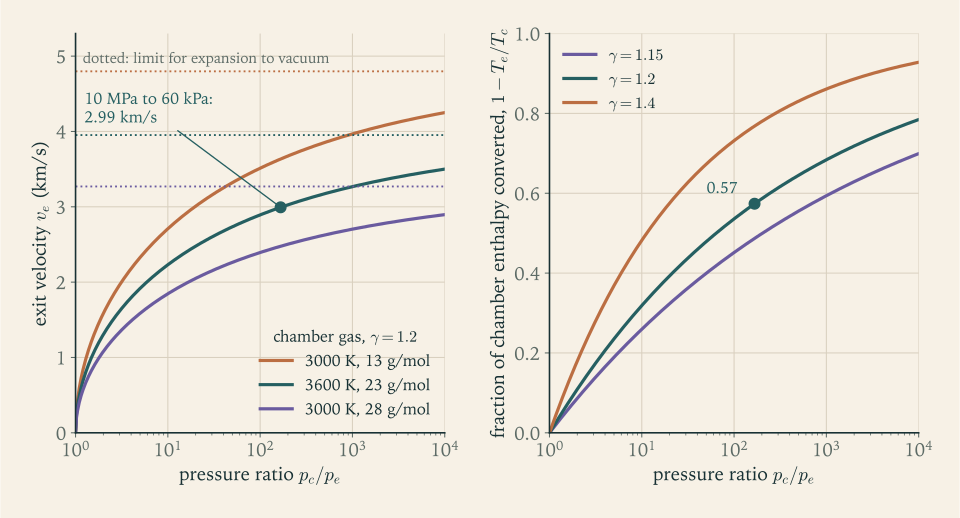
Four consequences follow by inspection, and Figure 4.1 shows them.
Temperature over molar mass. The velocity scales as \(\sqrt{T_c/\mathcal M}\) . A hot gas is good. A light gas is equally good, because at a given temperature a kilogram of light molecules contains more molecules, each holding the same energy, so the energy per kilogram is larger. The two enter only through their ratio.
Diminishing returns in pressure ratio. The bracket approaches \(1\) slowly. For \(\gamma=1.2\) it is \(0.32\) at a pressure ratio of \(10\) , \(0.54\) at \(100\) , and \(0.68\) at \(1000\) . Each further factor of ten buys less.
The limit. As \(p_e\to0\) the velocity tends to \(\sqrt{2c_pT_c}\) , the limiting value of Example 4.4.
The role of \(\gamma\) . At fixed \(T_c\) and \(\mathcal M\) , a smaller \(\gamma\) means a larger \(c_p\) , hence more energy per kilogram at the same temperature, but a smaller exponent and so a slower conversion. The first effect wins at any pressure ratio (Exercise 14).
Example 4.6: How sensitive the exit velocity is to each input
Baseline. The model gas expanded from \(10\ \mathrm{MPa}\) to \(60\ \mathrm{kPa}\) : \(v_e=2993\ \mathrm{m/s}\) .
One input at a time.
| Change from the baseline | Exit velocity | Change |
|---|---|---|
| \(T_c\) raised by \(10\) percent, to \(3960\ \mathrm K\) | \(3139\ \mathrm{m/s}\) | \(+4.9\) percent |
| \(\mathcal M\) lowered from \(23\) to \(18\ \mathrm{g/mol}\) | \(3384\ \mathrm{m/s}\) | \(+13.0\) percent |
| Pressure ratio doubled, to \(333\) | \(3112\ \mathrm{m/s}\) | \(+4.0\) percent |
| \(\gamma\) changed from \(1.2\) to \(1.25\) | \(2887\ \mathrm{m/s}\) | \(-3.6\) percent |
As logarithmic derivatives. From the formula, \(\partial\ln v_e/\partial\ln T_c=\tfrac12\) and \(\partial\ln v_e/\partial\ln\mathcal M=-\tfrac12\) exactly. For the pressure ratio, with \(T_e/T_c=(p_e/p_c)^{(\gamma-1)/\gamma}\) from Proposition 4.4,
One percent more temperature is worth eight times as much as one percent more pressure ratio.
Reading the table. Temperature and molar mass are the strong levers, and pressure ratio is a weak one. Raising the chamber temperature is limited by what the chamber walls survive (Chapter 6), so the cheapest large gain is a lighter exhaust.
Hydrogen. The lecture notes cited in Example 4.1 use a hydrogen-rich gas with \(\mathcal M=13\ \mathrm{g/mol}\) at \(3000\ \mathrm K\) and \(\gamma=1.2\) . At the same pressure ratio of \(166.7\) the theorem gives \(v_e=3635\ \mathrm{m/s}\) , faster than the model kerosene gas by the factor \(1.214\) , although it is \(600\ \mathrm K\) cooler. The factor is \(\sqrt{(3000/13)/(3600/23)}\) , nothing else. This is the resolution of the hydrogen puzzle from the chapter’s opening, and it agrees in size with published ideal figures: the tabulated sea-level exhaust velocities are \(3816\ \mathrm{m/s}\) for hydrogen and \(2941\ \mathrm{m/s}\) for kerosene, a ratio of \(1.30\) (Wikipedia, “Liquid rocket propellant”; see sources).
Common mistake. Reasoning that the hottest flame makes the best rocket. Exhaust velocity follows \(T_c/\mathcal M\) , not \(T_c\) . Hydrogen and oxygen burn about \(660\ \mathrm K\) cooler than kerosene and oxygen in the tabulated calculations and still win by \(30\) percent, because their products are less than half as heavy per mole.
4.6 Where the chamber temperature comes from
The exit-velocity formula takes \(T_c\) as given. What sets it?
Apply Theorem 4.2 to the combustion chamber. Propellants enter at some temperature \(T_{\mathrm{in}}\) with negligible speed, react, and leave toward the nozzle as hot gas with, still, negligible speed. No shaft crosses the boundary. The chemical reaction releases an energy \(q_R\) per kilogram of propellant, and to a first approximation this acts like heat added to the stream at the nearly constant pressure of the chamber: \(\dot Q=\dot m\,q_R\) . Then \(h_c-h_{\mathrm{in}}=q_R\) , and for constant \(c_p\)
Example 4.7: A first estimate of chamber temperature, and why it is too high
Estimate. Example 3.7 found \(q_R=9.71\ \mathrm{MJ/kg}\) for kerosene burned completely with just enough oxygen. With the model gas’s \(c_p=2169\ \mathrm{J/(kg\cdot K)}\) and \(T_{\mathrm{in}}=300\ \mathrm K\) (illustrative),
Comparison. Detailed calculations for kerosene and oxygen give about \(3676\ \mathrm K\) (Wikipedia, “Liquid rocket propellant”; see sources). The simple balance is too high by \(1100\ \mathrm K\) .
Why. Three things are missing from it. First, at temperatures above about \(3000\ \mathrm K\) the product molecules do not stay whole. Water and carbon dioxide partly break apart into smaller molecules and single atoms, a process called dissociation, and breaking chemical bonds absorbs energy that would otherwise have raised the temperature. The hotter the gas, the more it dissociates, so the effect acts as a brake that tightens as the temperature rises. Second, engines do not burn the mixture this estimate assumed. They run with less oxygen than complete combustion needs, for reasons the next paragraph gives, and a mixture short of oxygen releases less energy per kilogram. Third, the specific heat of the products is not constant: more kinds of molecular motion become active as the gas heats (Section 4.3), so no single value of \(c_p\) is right over a span of three thousand kelvin.
The same balance done carefully. A set of lecture notes carries out the calculation for hydrogen and oxygen at \(100\) atmospheres, first assuming complete reaction and then correcting for dissociation, and finds \(3480\ \mathrm K\) falling to \(3345\ \mathrm K\) (MIT 16.50 notes, Lecture 11; see sources). The correction is smaller there than for kerosene because that mixture is rich in hydrogen and cooler.
What the estimate is good for. It gives the right scale, a few thousand kelvin, from a heating value and a specific heat, and it bounds the answer from above. Accurate chamber temperatures come from equilibrium calculations that account for every species present; this course uses their published results as data. The model gas’s \(3600\ \mathrm K\) is such a value, rounded.
Dissociation also explains why the chamber cannot be made much hotter by choosing more energetic reactions. Past about \(3500\ \mathrm K\) at these pressures, added energy goes increasingly into pulling molecules apart instead of into temperature. Part of that energy returns: as the gas cools in the nozzle the fragments recombine and give back their bond energy, if the reactions are fast enough to keep up with the expansion. The two idealized extremes are called equilibrium flow, in which the composition readjusts instantly at every station, and frozen flow, in which it stays as it was in the chamber; real nozzles lie between them (MIT 16.50 notes, Lecture 12; see sources).
Now the reason for running short of oxygen. The quantity to maximize is not \(T_c\) but, by Theorem 4.5, close to \(T_c/\mathcal M\) . Complete combustion gives the highest temperature and products made entirely of water and carbon dioxide, with molar masses of \(18\) and \(44\ \mathrm{g/mol}\) . With extra fuel, some of the products are hydrogen at \(2\ \mathrm{g/mol}\) and carbon monoxide at \(28\ \mathrm{g/mol}\) : the temperature drops a little and the molar mass drops more. Chapter 6 puts numbers on this trade when it chooses a mixture ratio for the reference launcher.
Figure 4.2 collects the energy accounts of the last two chapters for one kilogram of kerosene and oxygen.

4.7 What the model leaves out
The model of this chapter has three layers, and it is worth being clear about which results depend on which.
The steady-flow energy equation, \(h+\tfrac12u^2\) constant, is conservation of energy and holds for any adiabatic steady flow, with real gas properties and with friction. If the true enthalpy drop is known, the velocity follows exactly.
The isentropic relation is an idealization. Friction and other irreversibilities raise the entropy, which by Definition 4.7 means that at the same exit pressure the gas ends hotter than Proposition 4.4 predicts, with less enthalpy converted. The ideal exit velocity is therefore an upper bound for a given gas and pressure ratio.
The calorically perfect gas with one value of \(\gamma\) is a fit. Real combustion gas has a \(\gamma\) that rises as it cools, from near \(1.2\) in the chamber toward \(1.3\) at the exit, and a composition that shifts, returning bond energy to the flow as fragments recombine. Published equilibrium calculations fold all of this in. With the parameters used in this course the single-\(\gamma\) model gives exhaust velocities about \(5\) percent below those calculations: for expansion from \(68\) atmospheres to one atmosphere it predicts \(2809\ \mathrm{m/s}\) where the tabulated ideal is \(2941\ \mathrm{m/s}\) (Wikipedia, “Liquid rocket propellant”; see sources). Real engines have losses that the equilibrium calculations ignore, so they land close to the simple model, a coincidence that Chapter 5 examines. What the model offers in exchange for the lost accuracy is that it shows which variable does what, as a table of computed results cannot. It is the first thing to replace if high accuracy is wanted.
One more piece of this chapter’s machinery is waiting to be used. Along an isentrope \(p\) is proportional to \(\rho^\gamma\) , so the derivative of pressure with respect to density at constant entropy is \(\gamma p/\rho=\gamma RT\) , a quantity with the units of a speed squared (Exercise 10). At the exit state of Example 4.5 its square root is \(816\ \mathrm{m/s}\) , and the gas is leaving \(3.7\) times faster than that. Chapter 5 shows that \(\sqrt{\gamma RT}\) is the speed of sound, and that the ratio of flow speed to it governs how a nozzle must be shaped.
4.8 The reference launcher’s exhaust, explained
Chapter 3 gave the reference launcher’s first-stage engines an assumed \(285\ \mathrm s\) at sea level and \(315\ \mathrm s\) in vacuum. This chapter supplies a chamber that can deliver them. Nothing here depends on the vehicle’s size, so the table holds for any revision of the launcher.
| Quantity | Value | Status |
|---|---|---|
| Chamber temperature \(T_c\) | \(3600\ \mathrm K\) | illustrative, near tabulated \(3676\ \mathrm K\) |
| Molar mass \(\mathcal M\) | \(23\ \mathrm{g/mol}\) | illustrative assumption |
| Heat-capacity ratio \(\gamma\) | \(1.2\) | illustrative, near quoted \(1.24\) |
| Chamber pressure \(p_c\) | \(10\ \mathrm{MPa}\) | design choice, near the Merlin’s quoted \(9.7\ \mathrm{MPa}\) |
| Specific gas constant \(R\) | \(361.5\ \mathrm{J/(kg\cdot K)}\) | computed |
| Specific heat \(c_p\) | \(2169\ \mathrm{J/(kg\cdot K)}\) | computed |
| Limiting velocity \(\sqrt{2c_pT_c}\) | \(3952\ \mathrm{m/s}\) | computed |
| Exit temperature at \(p_e=60\ \mathrm{kPa}\) | \(1535\ \mathrm K\) | computed |
| Ideal exit velocity at \(p_e=60\ \mathrm{kPa}\) | \(2993\ \mathrm{m/s}\) | computed |
The comparison with Chapter 3 is direct. If the first-stage nozzles do expand the gas to \(60\ \mathrm{kPa}\) , then with the exit area and mass flow of Example 3.2 the pressure term of the thrust equation is worth \(p_eA_e/\dot m=174\ \mathrm{m/s}\) in vacuum, and the assumed vacuum exhaust velocity of \(3089\ \mathrm{m/s}\) requires an actual exit speed of \(3089-174=2915\ \mathrm{m/s}\) . The ideal value is \(2993\ \mathrm{m/s}\) . The assumption of Chapter 3 thus asks the engine to deliver \(97.4\) percent of the ideal exit velocity, which is the kind of shortfall real nozzles show. The numbers \(285\) and \(315\) are no longer arbitrary: they are what a \(3600\ \mathrm K\) gas of molar mass \(23\ \mathrm{g/mol}\) gives when expanded to a little below sea-level pressure, less a few percent.
Two things are still borrowed. The exit pressure of \(60\ \mathrm{kPa}\) was simply stated, and so was the claim that the mass flow does not respond to the pressure outside. Both are properties of the nozzle’s shape. How wide must the exit be, relative to the throat, to bring the gas to \(60\ \mathrm{kPa}\) ? How much gas passes a throat of given size? Why is there a throat at all? Those are questions about a compressible gas moving through a passage of changing area, and they are the subject of Chapter 5.
Exercises
-
Define pressure, density, and temperature for a gas at the level of Section 4.1, state the ideal-gas law in terms of the specific gas constant and in terms of the molar gas constant, give the SI units of every symbol, and explain why the same temperature corresponds to different molecular speeds in different gases.
-
A gas generator produces a mixture of two moles of water vapour to one mole of hydrogen at \(3000\ \mathrm K\) and \(7.0\ \mathrm{MPa}\) . (a) Find the molar mass and specific gas constant of the mixture. (b) Find its density. (c) Find the mass fraction of hydrogen, and verify the molar mass from the mass fractions using the rule that \(1/\mathcal M\) is the mass-weighted average of \(1/\mathcal M\) of the components.
Solution
(a) The molar mass of a mixture is its mass divided by its number of moles. Three moles (two of water, one of hydrogen) have mass \(2(18)+2=38\ \mathrm g\) , so
\[ \mathcal M=\frac{38}{3}=12.67\ \mathrm{g/mol},\qquad R=\frac{R_u}{\mathcal M}=\frac{8.3145\ \mathrm{J/(mol\cdot K)}}{0.012667\ \mathrm{kg/mol}}=656.4\ \mathrm{J/(kg\cdot K)}. \](b) From the ideal-gas law,
\[ \rho=\frac{p}{RT}=\frac{7.0\times10^{6}\ \mathrm{Pa}}{(656.4)(3000)\ \mathrm{J/kg}}=3.55\ \mathrm{kg/m^3}. \](c) Hydrogen is \(2\ \mathrm g\) of every \(38\ \mathrm g\) , a mass fraction of \(0.0526\) ; water is \(0.9474\) . One kilogram of mixture then contains \(0.0526/0.002+0.9474/0.018=26.3+52.6=78.9\ \mathrm{mol}\) , so \(\mathcal M=1/78.9\ \mathrm{kg/mol}=12.67\ \mathrm{g/mol}\) , as before. Five percent of the mass is hydrogen, yet it supplies a third of the molecules, which is why a little excess fuel lowers the molar mass so effectively.
-
(a) Find the root-mean-square speed of hydrogen molecules (\(\mathcal M=2.016\ \mathrm{g/mol}\) ) and nitrogen molecules (\(\mathcal M=28.0\ \mathrm{g/mol}\) ) at \(300\ \mathrm K\) . (b) Show that for two gases at the same temperature the ratio of these speeds is the inverse square root of the ratio of molar masses. (c) Explain in one or two sentences why this fact favours light exhaust gases.
Answer
(a) \(\sqrt{3R_uT/\mathcal M}\) : hydrogen \(1927\ \mathrm{m/s}\) , nitrogen \(517\ \mathrm{m/s}\) . (b) At equal \(T\) the ratio of speeds is \(\sqrt{\mathcal M_2/\mathcal M_1}=\sqrt{28.0/2.016}=3.73\) , which matches \(1927/517\) . (c) A nozzle converts random molecular motion into directed motion, and at a given temperature lighter molecules have more speed to convert.
-
A student computes the specific heat of the model chamber gas as \(c_p=\gamma R/(\gamma-1)\) with \(R=8.314\) and obtains \(49.9\) , then finds an exit velocity of \(454\ \mathrm{m/s}\) for expansion from \(10\ \mathrm{MPa}\) to \(60\ \mathrm{kPa}\) . (a) Identify the error using units alone. (b) By what factor is the velocity wrong, and why is it that factor? (c) Give the correct values.
Answer
(a) \(8.314\) is \(R_u\) in \(\mathrm{J/(mol\cdot K)}\) ; a specific heat must be per kilogram, so the value should have been divided by \(\mathcal M=0.023\ \mathrm{kg/mol}\) . (b) The velocity is too small by the factor \(\sqrt{\mathcal M}\) with \(\mathcal M\) in \(\mathrm{kg/mol}\) , that is \(\sqrt{0.023}=0.152\) , because \(v_e\) is proportional to \(\sqrt{R}\) : \(454/2993=0.152\) . (c) \(c_p=2169\ \mathrm{J/(kg\cdot K)}\) and \(v_e=2993\ \mathrm{m/s}\) .
-
One kilogram of the model chamber gas receives \(100\ \mathrm{kJ}\) of heat. (a) Find its temperature rise if it is held in a rigid container. (b) Find the rise if it is instead held at constant pressure behind a free piston. (c) Account for the difference between the two cases in joules, and state where that energy went.
Solution
The system is one kilogram of gas, closed in both cases; the first law is Proposition 4.1.
(a) In a rigid container the volume is fixed, no work is done, and all of the heat raises the internal energy: \(\delta q_{\mathrm{in}}=c_v\,\mathrm dT\) . With \(c_v=1807\ \mathrm{J/(kg\cdot K)}\) ,
\[ \Delta T=\frac{100\times10^{3}\ \mathrm{J/kg}}{1807\ \mathrm{J/(kg\cdot K)}}=55.3\ \mathrm K . \](b) At constant pressure the heat added equals the enthalpy rise, \(\delta q_{\mathrm{in}}=c_p\,\mathrm dT\) , with \(c_p=2169\ \mathrm{J/(kg\cdot K)}\) :
\[ \Delta T=\frac{100\times10^{3}}{2169}=46.1\ \mathrm K . \](c) In case (b) the internal energy rises by \(c_v\Delta T=(1807)(46.1)=83.3\ \mathrm{kJ}\) . The other \(16.7\ \mathrm{kJ}\) is the work \(p\,\Delta(1/\rho)=R\,\Delta T=(361.5)(46.1)\) that the gas does in pushing the piston outward as it expands. The split is \(1/\gamma\) to internal energy and \((\gamma-1)/\gamma\) , one sixth, to work.
-
Starting from Definitions 4.3 to 4.5, (a) derive \(c_p-c_v=R\) for an ideal gas, (b) derive \(c_p=\gamma R/(\gamma-1)\) , (c) evaluate \(c_p\) and \(c_v\) for air with \(\gamma=1.4\) and \(\mathcal M=28.97\ \mathrm{g/mol}\) , and (d) find how many active kinds of molecular motion correspond to \(\gamma=1.4\) , \(1.24\) , and \(1.2\) .
Hint
For (a), differentiate \(h=e_{\mathrm{int}}+p/\rho\) after replacing \(p/\rho\) by \(RT\) . For (b), put \(c_v=c_p/\gamma\) into the result of (a). For (c) you should find \(c_p=1004.5\) and \(c_v=717.5\ \mathrm{J/(kg\cdot K)}\) . For (d), \(c_v\) is \(\tfrac12R\) times the number of active kinds of motion, so the number is \(2/(\gamma-1)\) : \(5\) , about \(8.3\) , and \(10\) . A non-integer value is an average over a mixture and over partly active vibration.
-
For gas at \(10\ \mathrm{MPa}\) and \(3600\ \mathrm K\) with the model properties, compute the flow work \(p/\rho\) per kilogram, the internal energy \(c_vT\) , and their ratio. Then explain to a reader who believes “enthalpy is the heat content of the gas” what the flow-work term represents and why an energy balance on a nozzle that omitted it would be wrong.
Answer
Flow work \(p/\rho=RT=(361.5)(3600)=1.30\ \mathrm{MJ/kg}\) ; internal energy \(c_vT=6.51\ \mathrm{MJ/kg}\) ; ratio \(\gamma-1=0.20\) . Each kilogram that crosses into a control volume is pushed in by the gas behind it, which does work \(p/\rho\) on the contents; the same happens in reverse at the outlet. Enthalpy is internal energy plus that work, not a quantity of heat. Omitting it would understate the energy entering the nozzle by a sixth and the limiting velocity by \(9\) percent.
-
A vehicle moves at \(1500\ \mathrm{m/s}\) through air whose temperature is \(250\ \mathrm K\) . Treating air as calorically perfect with \(\gamma=1.4\) , find the stagnation temperature of the air relative to the vehicle, and say what assumption of the model is most doubtful at the temperature you find.
Answer
\(c_p=1004.5\ \mathrm{J/(kg\cdot K)}\) , and the stagnation temperature is \(250+1500^2/(2\times1004.5)=250+1120=1370\ \mathrm K\) . At that temperature the vibration of the air molecules is becoming active, so \(c_p\) is no longer the room-temperature value and the constant-\(\gamma\) assumption is the doubtful one; the true stagnation temperature is somewhat lower.
-
Gas with the model properties leaks from \(10\ \mathrm{MPa}\) to \(60\ \mathrm{kPa}\) through a porous plug, with negligible speed on both sides and no heat transfer. (a) Show that its temperature does not change. (b) Compute its entropy change. (c) The same gas expanded through an ideal nozzle between the same pressures would reach \(2993\ \mathrm{m/s}\) ; state what became of that kinetic energy in the plug, and why the process cannot be reversed.
Solution
The system is a control volume around the plug, in steady flow, with one inlet and one outlet, no heat transfer, and no shaft.
(a) Theorem 4.2 gives \(h_1+\tfrac12u_1^2=h_2+\tfrac12u_2^2\) . With negligible speed on both sides, \(h_2=h_1\) , and for an ideal gas enthalpy depends on temperature alone, so \(T_2=T_1\) .
(b) From Definition 4.7 in its pressure form, with equal temperatures,
\[ s_2-s_1=c_p\ln\frac{T_2}{T_1}-R\ln\frac{p_2}{p_1}=R\ln\frac{p_1}{p_2}=(361.5)\ln(166.7)=1849\ \mathrm{J/(kg\cdot K)}. \](c) Inside the plug the pressure difference did accelerate the gas through each small passage, and friction against the passage walls and within the gas turned that motion back into random molecular motion at once. The kinetic energy the nozzle would have delivered, \(4.48\ \mathrm{MJ/kg}\) , is all still present as internal energy, which is why the temperature did not fall. The process cannot be reversed because that would require the entropy of an adiabatic flow to decrease by \(1849\ \mathrm{J/(kg\cdot K)}\) , which Proposition 4.3 forbids: gas at \(60\ \mathrm{kPa}\) does not gather itself back to \(10\ \mathrm{MPa}\) at the same temperature without work being supplied.
-
(a) Show from Proposition 4.4 that along an isentrope \(\mathrm dp/\mathrm d\rho=\gamma p/\rho=\gamma RT\) . (b) The model gas expands isentropically until its pressure is \(0.5645\,p_c\) . Find its temperature, its density as a fraction of \(\rho_c\) , and its speed. (c) Compare that speed with \(\sqrt{\gamma RT}\) at the same station and comment.
Solution
(a) Proposition 4.4 gives \(p=p_c(\rho/\rho_c)^\gamma\) along an isentrope. Differentiating,
\[ \frac{\mathrm dp}{\mathrm d\rho}=\gamma\,\frac{p_c}{\rho_c^{\gamma}}\,\rho^{\gamma-1}=\gamma\,\frac{p}{\rho}=\gamma RT , \]using the ideal-gas law in the last step. The units are \(\mathrm{Pa/(kg/m^3)}=\mathrm{m^2/s^2}\) .
(b) With \(p/p_c=0.5645\) and \(\gamma=1.2\) :
\[ T=3600\,(0.5645)^{1/6}=3273\ \mathrm K,\qquad \frac{\rho}{\rho_c}=(0.5645)^{1/1.2}=0.621,\qquad u=\sqrt{2c_p(T_c-T)}=\sqrt{2(2169)(327.2)}=1191\ \mathrm{m/s}. \](c) At that station \(\sqrt{\gamma RT}=\sqrt{(1.2)(361.5)(3273)}=1192\ \mathrm{m/s}\) . To the accuracy of the rounded pressure ratio the two speeds are equal. The pressure ratio \(0.5645\) is therefore special: it is where the gas, speeding up as it cools, reaches the speed \(\sqrt{\gamma RT}\) that is itself falling as the gas cools. Chapter 5 identifies that speed as the speed of sound and that station as the throat.
-
Use Theorem 4.5 for the hydrogen-rich gas of the MIT notes (\(T_c=3000\ \mathrm K\) , \(\mathcal M=13\ \mathrm{g/mol}\) , \(\gamma=1.2\) ) expanded through a pressure ratio of \(166.7\) . Find the exit temperature, the exit velocity, and the limiting velocity, and confirm that the ratio of exit velocities to the model kerosene gas equals the square root of the ratio of \(T_c/\mathcal M\) .
Answer
\(T_e=3000\,(166.7)^{-1/6}=1279\ \mathrm K\) ; \(v_e=3635\ \mathrm{m/s}\) ; limiting velocity \(\sqrt{2c_pT_c}=4798\ \mathrm{m/s}\) with \(c_p=6R=3837\ \mathrm{J/(kg\cdot K)}\) . Ratio to the model kerosene gas: \(3635/2993=1.214\) , and \(\sqrt{(3000/13)/(3600/23)}=1.214\) .
-
Two propellant combinations reach the same chamber temperature. One produces gas of molar mass \(12\ \mathrm{g/mol}\) and the other \(24\ \mathrm{g/mol}\) ; \(\gamma\) and the pressure ratio are equal. (a) Find the ratio of their exhaust velocities. (b) Find how much hotter the heavier gas would have to be to match the lighter one. (c) Use the result to explain why engines are run with excess fuel even though that lowers the chamber temperature.
Solution
(a) Theorem 4.5 with equal \(T_c\) , \(\gamma\) , and pressure ratio leaves only the factor \(1/\sqrt{\mathcal M}\) , so
\[ \frac{v_{e,12}}{v_{e,24}}=\sqrt{\frac{24}{12}}=\sqrt2=1.414 . \](b) The heavier gas matches the lighter one when \(T_c/\mathcal M\) is equal for both, that is at twice the absolute temperature. If the lighter gas is at \(3000\ \mathrm K\) the heavier would need \(6000\ \mathrm K\) , which no chamber wall or chemical reaction provides.
(c) Adding fuel beyond what the oxygen can burn leaves light molecules, mostly hydrogen, in the products. The reaction then releases somewhat less energy per kilogram and the temperature falls, but the molar mass falls proportionally more, so \(T_c/\mathcal M\) rises. The exhaust velocity peaks at a mixture richer in fuel than the one that gives the hottest flame. The underlying reason is in Section 4.1: at a given temperature every molecule has the same mean kinetic energy, so a kilogram of light molecules holds more energy than a kilogram of heavy ones.
-
For the model gas, (a) derive the logarithmic sensitivity of \(v_e\) to the pressure ratio given in Example 4.6, (b) evaluate it at pressure ratios of \(50\) , \(166.7\) , and \(1000\) , and (c) find the pressure ratio needed to raise \(v_e\) by \(5\) percent above its value at \(166.7\) . (d) What does the answer to (c) imply for an engine that must exhaust to sea-level pressure?
Solution
(a) Write \(v_e^2=2c_pT_c(1-T_e/T_c)\) with \(T_e/T_c=(p_e/p_c)^{(\gamma-1)/\gamma}\) , so \(\ln(T_e/T_c)=-\frac{\gamma-1}{\gamma}\ln(p_c/p_e)\) and \(\mathrm d(T_e/T_c)/\mathrm d\ln(p_c/p_e)=-\frac{\gamma-1}{\gamma}\,T_e/T_c\) . Then
\[ \frac{\partial\ln v_e}{\partial\ln(p_c/p_e)}=\frac12\cdot\frac{-1}{1-T_e/T_c}\cdot\frac{\mathrm d(T_e/T_c)}{\mathrm d\ln(p_c/p_e)}=\frac{\gamma-1}{2\gamma}\,\frac{T_e/T_c}{1-T_e/T_c}. \](b) For \(\gamma=1.2\) the prefactor is \(1/12\) . At a pressure ratio of \(50\) , \(T_e/T_c=0.521\) and the sensitivity is \(0.091\) ; at \(166.7\) , \(T_e/T_c=0.426\) and it is \(0.062\) ; at \(1000\) , \(T_e/T_c=0.316\) and it is \(0.039\) .
(c) A gain of \(5\) percent in \(v_e\) is a gain of \(10.25\) percent in \(1-T_e/T_c\) : from \(0.5737\) to \(0.6325\) , so \(T_e/T_c=0.3675\) and
\[ \frac{p_c}{p_e}=\Bigl(\frac{T_e}{T_c}\Bigr)^{-6}=(0.3675)^{-6}=406 . \]The pressure ratio must rise by a factor of \(2.44\) .
(d) With the exit near sea-level pressure, a pressure ratio of \(406\) means a chamber pressure of about \(24\ \mathrm{MPa}\) instead of \(10\ \mathrm{MPa}\) . A large increase in chamber pressure, with all it demands of pumps and walls, buys only \(5\) percent. In vacuum the same factor can be had by enlarging the nozzle instead, which is the cheaper route and the reason upper-stage nozzles are large.
-
Show that at fixed \(T_c\) , \(\mathcal M\) , and pressure ratio the ideal exit velocity increases as \(\gamma\) decreases toward \(1\) . A convenient route is to write \(v_e^2=2RT_c\,(1-e^{-BY})/Y\) with \(Y=(\gamma-1)/\gamma\) and \(B=\ln(p_c/p_e)\) , and to show that the function of \(Y\) is decreasing. Then explain why comparing gases “at the same \(T_c\) ” hides part of the story.
Solution
With \(Y=(\gamma-1)/\gamma\) and \(B=\ln(p_c/p_e)>0\) , the bracket of Theorem 4.5 is \(1-e^{-BY}\) and the factor \(\gamma/(\gamma-1)\) is \(1/Y\) , so
\[ v_e^2=2RT_c\,\frac{1-e^{-BY}}{Y}. \]As \(\gamma\) decreases toward \(1\) , \(Y\) decreases toward \(0\) , so it suffices to show that the quotient \((1-e^{-BY})/Y\) is a decreasing function of \(Y\) for \(Y>0\) . Differentiate:
\[ \frac{\mathrm d}{\mathrm dY}\left[\frac{1-e^{-BY}}{Y}\right]=\frac{BY\,e^{-BY}-(1-e^{-BY})}{Y^2}=\frac{e^{-BY}\,(1+BY-e^{BY})}{Y^2}. \]Since the exponential of a positive number exceeds one plus that number, \(e^{BY}>1+BY\) , the numerator is negative and the derivative is negative. Hence \(v_e\) increases as \(\gamma\) decreases, at any fixed pressure ratio. In the limit \(Y\to0\) the quotient tends to \(B\) and \(v_e^2\to2RT_c\ln(p_c/p_e)\) .
The comparison at the same \(T_c\) hides the fact that a gas with smaller \(\gamma\) holds more energy per kilogram at that temperature, because its molecules have more kinds of motion: \(c_p=R/Y\) grows without bound as \(Y\to0\) . Reaching the same \(T_c\) with such a gas requires a larger heat release. For a fixed heat release the comparison reverses. Then the chamber enthalpy \(c_pT_c\) is what is fixed, the velocity is \(\sqrt{2c_pT_c\,(1-e^{-BY})}\) , and the bracket grows with \(Y\) : the gas with the lower \(\gamma\) converts a smaller share of the same enthalpy and is slower.
-
Redo the estimate of Example 4.7 with the specific heat increased by \(15\) percent, and say how much of the \(1100\ \mathrm K\) gap this closes. Then give the two physical effects, other than the value of \(c_p\) , that lower the real chamber temperature, and say which of them an engine designer chooses deliberately.
Answer
With \(c_p=(1.15)(2169)=2494\ \mathrm{J/(kg\cdot K)}\) the rise is \(9.71\times10^{6}/2494=3893\ \mathrm K\) and \(T_c\approx4193\ \mathrm K\) , which closes \(584\ \mathrm K\) of the \(1100\ \mathrm K\) gap, a little over half. The other two effects are dissociation of the products, which absorbs energy, and the fuel-rich mixture, which releases less; the designer chooses the second deliberately to lower the molar mass.
-
A proposal claims: “Our new propellant burns \(400\ \mathrm K\) hotter than kerosene and oxygen, so it will have a higher specific impulse.” (a) State what additional information is needed to judge the claim. (b) If the new products have molar mass \(29\ \mathrm{g/mol}\) against \(23\ \mathrm{g/mol}\) , with the baseline at \(3600\ \mathrm K\) and equal \(\gamma\) and pressure ratio, compute the ratio of exhaust velocities. (c) State the conclusion.
Answer
(a) The molar mass of the products, and to a lesser degree \(\gamma\) . (b) \(\sqrt{(4000/29)/(3600/23)}=\sqrt{137.9/156.5}=0.939\) . (c) The hotter propellant is about \(6\) percent worse in exhaust velocity, because its products are heavier by more than its flame is hotter.
-
A test of the model engine measures an exit temperature of \(1600\ \mathrm K\) at an exit pressure of \(60\ \mathrm{kPa}\) , with chamber conditions as in Example 4.5. (a) Find the actual exit velocity from the energy equation. (b) Find the entropy rise between chamber and exit. (c) Express the velocity as a fraction of the ideal value. (d) Which step of the ideal analysis failed, and which did not?
Solution
(a) The energy equation holds whether or not the flow is reversible, so with the measured exit temperature
\[ v_e=\sqrt{2c_p(T_c-T_e)}=\sqrt{2(2169)(3600-1600)}=2945\ \mathrm{m/s}. \](b) From Definition 4.7 with \(p_e/p_c=1/166.7\) ,
\[ s_e-s_c=c_p\ln\frac{1600}{3600}-R\ln\frac{1}{166.7}=(2169)(-0.8109)+(361.5)(5.116)=90.5\ \mathrm{J/(kg\cdot K)}. \]Equivalently, \(c_p\ln(1600/1534.6)\) , since \(1534.6\ \mathrm K\) is the temperature an isentropic expansion would reach.
(c) \(2945/2993=0.984\) . In terms of energy, the enthalpy drop is \(2000/2065=0.968\) of the ideal one.
(d) The isentropic step failed: entropy rose, as Proposition 4.3 allows, and the gas left hotter than the ideal expansion predicts. The energy equation did not fail; it was used to find the velocity from the measured temperature. A real nozzle falls short of the ideal by converting less enthalpy, never by violating the energy balance.
-
On axes of \(\ln p\) (horizontal) against \(\ln T\) (vertical), describe the path of an isentropic expansion and give its slope. For \(\gamma=1.2\) and for \(\gamma=1.4\) , find the pressure ratio across which the temperature halves, and explain what the difference means for the length of nozzle needed to cool the two gases by the same factor. (Computation.) Then let \(\gamma\) rise linearly as the gas cools, from \(1.2\) at \(3600\ \mathrm K\) to \(1.3\) at \(1500\ \mathrm K\) and on along the same straight line below that, with \(R=361.5\ \mathrm{J/(kg\cdot K)}\) fixed and \(c_p=\gamma R/(\gamma-1)\) . Show from \(\delta q_{\mathrm{in}}=\mathrm dh-(1/\rho)\,\mathrm dp\) that an isentrope still obeys \(c_p\,\mathrm dT/T=R\,\mathrm dp/p\) , integrate that equation numerically from \(10\ \mathrm{MPa}\) to \(60\ \mathrm{kPa}\) with the Runge-Kutta method of Section 1.7, accumulate the enthalpy drop \(\int c_p\,\mathrm dT\) , and compare the exit temperature and velocity with the \(1535\ \mathrm K\) and \(2993\ \mathrm{m/s}\) of the constant-\(\gamma\) model.
Hint
Take logarithms of \(T/T_c=(p/p_c)^{(\gamma-1)/\gamma}\) : a straight line of slope \((\gamma-1)/\gamma\) , that is \(1/6\) or \(2/7\) . The temperature halves across a pressure ratio of \(2^{\gamma/(\gamma-1)}\) , which is \(64\) for \(\gamma=1.2\) and \(11.3\) for \(\gamma=1.4\) . A gas with many internal kinds of motion keeps feeding energy from them into translation as it expands, so it cools reluctantly and needs a much larger expansion. For the computation, set \(\delta q_{\mathrm{in}}=0\) and use \(1/\rho=RT/p\) to get \(c_p\,\mathrm dT=RT\,\mathrm dp/p\) ; then take \(\ln p\) as the independent variable and integrate \(\mathrm dT/\mathrm d\ln p=RT/c_p(T)\) with \(\gamma(T)=1.2+0.1\,(3600-T)/2100\) , the same line being used below \(1500\ \mathrm K\) , where it reaches \(1.312\) at the exit. Twenty steps are ample. You should find \(T_e=1246\ \mathrm K\) and an enthalpy drop of \(4.23\ \mathrm{MJ/kg}\) , hence \(v_e=2908\ \mathrm{m/s}\) , which is \(2.8\) percent below the constant-\(\gamma\) value: the gas cools further, but with \(\gamma\) rising it has less enthalpy to give at the cold end. Holding \(\gamma\) at \(1.3\) below \(1500\ \mathrm K\) instead moves the exit temperature to \(1249\ \mathrm K\) and leaves the velocity where it was. Real exhaust also recombines as it cools, which this computation leaves out and which works the other way (Section 4.7).
-
This exercise uses Chapter 3. With the ideal exit velocity of \(2993\ \mathrm{m/s}\) and exit pressure of \(60\ \mathrm{kPa}\) , and the first-stage exit area \(2.355\ \mathrm{m^2}\) and mass flow \(811.1\ \mathrm{kg/s}\) of Example 3.2, compute the ideal effective exhaust velocity and specific impulse at sea level and in vacuum. Express the \(285\ \mathrm s\) and \(315\ \mathrm s\) assumed in Chapter 3 as fractions of these ideals.
Solution
The thrust equation of Theorem 3.3 gives the effective exhaust velocity as \(c=v_e+(p_e-p_a)A_e/\dot m\) . The area-to-flow factor is \(A_e/\dot m=2.355/811.1=2.903\times10^{-3}\ \mathrm{m^2\cdot s/kg}\) .
In vacuum,
\[ c_{\mathrm{vac}}=2993+(60\,000)(2.903\times10^{-3})=2993+174=3167\ \mathrm{m/s},\qquad I_{sp}=323.0\ \mathrm s . \]At sea level,
\[ c_{\mathrm{SL}}=2993+(60\,000-101\,325)(2.903\times10^{-3})=2993-120=2873\ \mathrm{m/s},\qquad I_{sp}=293.0\ \mathrm s . \]The values assumed in Chapter 3 are \(315/323.0=0.975\) and \(285/293.0=0.973\) of these ideals. An engine that delivers \(97\) to \(98\) percent of the ideal performance of this chamber and nozzle would match the assumptions, and the two fractions are nearly equal, as they should be if the shortfall is in the gas velocity and not in the pressure term.
-
The reference launcher’s second-stage engine has the same chamber as the first but a much larger nozzle that expands the gas through a pressure ratio of \(2316\) (the value Chapter 5 arrives at). (a) Find the exit temperature, the ideal exit velocity, and the fraction of chamber enthalpy converted. (b) By what percentage does the exit velocity exceed the first stage’s \(2993\ \mathrm{m/s}\) ? (c) The pressure ratio is fourteen times larger; explain why the gain in velocity is so much smaller, and why this nozzle could not be used at sea level.
Solution
(a) With \(\gamma=1.2\) the exponent is \(1/6\) :
\[ T_e=3600\,(2316)^{-1/6}=(3600)(0.2749)=990\ \mathrm K,\qquad 1-\frac{T_e}{T_c}=0.725, \]\[ v_e=\sqrt{2(2169)(3600-990)}=3365\ \mathrm{m/s}. \](b) \(3365/2993=1.124\) , a gain of \(12.4\) percent.
(c) The conversion fraction rose from \(0.574\) to \(0.725\) , a factor of \(1.26\) , and velocity goes as its square root, \(1.12\) . The fraction is \(1-(p_e/p_c)^{1/6}\) , and a sixth root responds weakly to its argument: a fourteenfold change in pressure ratio changes \((p_e/p_c)^{1/6}\) only by the factor \(13.9^{-1/6}=0.645\) . The exit pressure of this nozzle is \(10\ \mathrm{MPa}/2316=4.3\ \mathrm{kPa}\) . At sea level that is less than one twentieth of the ambient pressure, so the pressure term of the thrust equation would be hugely negative and, as Section 3.5 warned, the flow would not stay attached to the wall.