How far apart are two functions? There is no single answer. One can take the largest value of \(\lvert f-g\rvert\) , which is sensitive to a discrepancy at a single point. One can take the integral of \(\lvert f-g\rvert\) , the area between the graphs, which hardly notices a tall narrow spike. One can take the square root of the integral of \(\lvert f-g\rvert^2\) , the choice behind least squares, which lies between the two. These are three members of a one-parameter family of measures of size,
in which small \(p\) is forgiving of height and unforgiving of spread, and large \(p\) the reverse. The spike \(n\mathbf 1_{(0,1/n)}\) of Chapter 5 has size \(n^{1-1/p}\) : bounded for \(p=1\) , unbounded for every larger \(p\) .
Each choice of \(p\) turns a space of functions into something with a geometry, in which one can speak of distance, convergence, and approximation. For that to work the size must behave like a length: it should vanish only for the zero function, scale correctly, and satisfy the triangle inequality. The first of these forces a change in what a “function” is. The third is a theorem, Minkowski’s inequality, and it rests on another, Hölder’s inequality, which controls the integral of a product. This chapter proves both, finds exactly when they are equalities, and works out how the spaces for different \(p\) sit inside one another, which depends entirely on the measure space.
7.1 Functions modulo null sets
Definition 7.1 (the spaces for finite exponent). Let \((X,\mathcal A,\mu)\) be a measure space and \(0<p<\infty\) . For a measurable function \(f\) put \(\lVert f\rVert_p=\bigl(\int\lvert f\rvert^p\,d\mu\bigr)^{1/p}\in[0,\infty]\) . The space \(L^p(\mu)\) consists of the measurable real-valued functions with \(\lVert f\rVert_p<\infty\) , where two functions that are equal almost everywhere are regarded as the same element.
The identification is not optional. By Proposition 4.7(b), \(\lVert f\rVert_p=0\) exactly when \(f=0\) a.e., so if distinct functions that agree a.e. were kept distinct, a nonzero function would have size zero. An element of \(L^p(\mu)\) is therefore an equivalence class of functions, though one writes \(f\) for the class and for any of its members. The price is that \(f(x)\) has no meaning for an individual \(x\) when points are null sets: the class of \(\mathbf 1_{\mathbb Q}\) in \(L^p(\lambda)\) is the zero element. Every operation performed on elements of \(L^p\) must give the same result for a.e.-equal functions. Integrals, sums, products, and a.e. limits do; “the value at \(0\) ” does not.
Definition 7.2 (essentially bounded functions). For a measurable \(f\) , the essential supremum of \(\lvert f\rvert\) is
with \(\inf\emptyset=\infty\) . The space \(L^\infty(\mu)\) consists of the measurable functions with \(\lVert f\rVert_\infty<\infty\) , again identified when equal a.e.
The infimum is attained: the set \(\{\lvert f\rvert>\lVert f\rVert_\infty\}\) is the union of the null sets \(\{\lvert f\rvert>\lVert f\rVert_\infty+\tfrac1n\}\) , so \(\lvert f\rvert\le\lVert f\rVert_\infty\) a.e. The essential supremum ignores null sets, as it must: the function equal to \(n\) at each positive integer \(n\) and to \(0\) elsewhere is unbounded, and it is the zero element of \(L^\infty(\lambda)\) .
Each \(L^p(\mu)\) is a vector space. Closure under scalar multiples is clear, and for sums, \(\lvert f+g\rvert\le2\max(\lvert f\rvert,\lvert g\rvert)\) gives
so \(f+g\in L^p\) when \(f\) and \(g\) are. For counting measure on \(\mathbb N\) the space is written \(\ell^p\) ; its elements are the sequences with \(\sum_k\lvert a_k\rvert^p<\infty\) , and there are no null sets to worry about.
Example 7.1: Powers of the variable near zero and near infinity
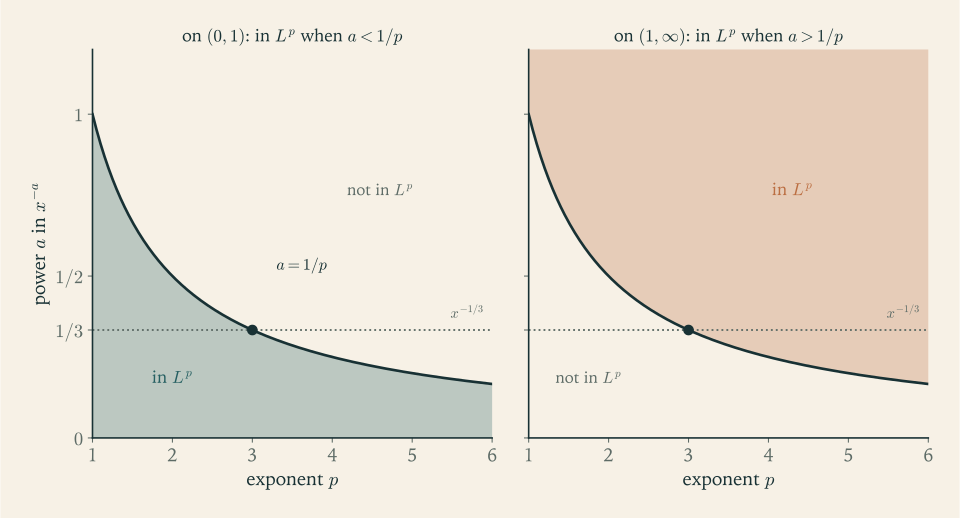
For \(a>0\) and \(0<p<\infty\) , the truncation argument of Example 4.3 gives
and both integrals are infinite otherwise. So \(x^{-a}\in L^p(0,1)\) exactly when \(p<\tfrac1a\) , and \(x^{-a}\in L^p(1,\infty)\) exactly when \(p>\tfrac1a\) .
Take \(a=\tfrac13\) . On \((0,1)\) the function \(x^{-1/3}\) belongs to \(L^p\) for \(p<3\) and to no other; for instance
On \((1,\infty)\) the same formula belongs to \(L^p\) for \(p>3\) only; for instance \(\lVert x^{-1/3}\rVert_{L^4(1,\infty)}=\bigl(\tfrac1{4/3-1}\bigr)^{1/4}=3^{1/4}\approx1.316\) . On \((0,\infty)\) it belongs to no \(L^p\) at all, since no exponent satisfies both conditions.
The two halves fail for opposite reasons. Near \(0\) the function is too tall, and raising it to a higher power makes that worse. Near infinity it decays too slowly, and raising it to a higher power helps. Figure 7.1 records the dividing curve \(a=\tfrac1p\) for both intervals.
7.2 Hölder’s inequality
Two exponents \(p,q\in[1,\infty]\) are conjugate if \(\tfrac1p+\tfrac1q=1\) , with the convention \(\tfrac1\infty=0\) . So \(2\) is conjugate to itself, \(1\) is conjugate to \(\infty\) , and for \(1<p<\infty\) the conjugate is \(q=\tfrac p{p-1}\) , which satisfies \((p-1)q=p\) .
Lemma 7.3 (Young’s inequality). Let \(1<p<\infty\) with conjugate \(q\) . For all real \(a,b\ge0\) ,
with equality if and only if \(a^p=b^q\) .
Proof. If \(a=0\) or \(b=0\) the claim is clear. Otherwise write \(s=\ln a^p\) and \(t=\ln b^q\) . The exponential function is strictly convex, and \(\tfrac1p+\tfrac1q=1\) , so
with equality exactly when \(s=t\) .
Theorem 7.4 (Hölder’s inequality). Let \(p,q\in[1,\infty]\) be conjugate and let \(f,g\) be measurable. Then
If \(1<p<\infty\) and both norms are finite and nonzero, equality holds if and only if \(\dfrac{\lvert f\rvert^p}{\lVert f\rVert_p^p}=\dfrac{\lvert g\rvert^q}{\lVert g\rVert_q^q}\) almost everywhere.
Proof. The endpoint. If \(p=1\) and \(q=\infty\) , then \(\lvert fg\rvert\le\lvert f\rvert\,\lVert g\rVert_\infty\) a.e., and integrating gives the claim. The case \(p=\infty\) is symmetric.
The main case. Let \(1<p<\infty\) . If one of the norms is \(0\) , then \(fg=0\) a.e. and both sides vanish. If one is \(\infty\) and the other is positive, the right side is \(\infty\) . So assume both are finite and positive, and put \(F=\lvert f\rvert/\lVert f\rVert_p\) and \(G=\lvert g\rvert/\lVert g\rVert_q\) , so that \(\int F^p\,d\mu=\int G^q\,d\mu=1\) . Young’s inequality at each point gives \(FG\le\tfrac1pF^p+\tfrac1qG^q\) , and integrating,
Multiplying by \(\lVert f\rVert_p\lVert g\rVert_q\) gives Hölder’s inequality.
Equality. Equality holds exactly when the nonnegative function \(\tfrac1pF^p+\tfrac1qG^q-FG\) has integral \(0\) , that is, when it vanishes a.e., which by the equality case of Lemma 7.3 means \(F^p=G^q\) a.e.
The device of the proof, dividing each function by its norm so that a pointwise inequality can simply be integrated, is called normalization, and it is how homogeneous inequalities are almost always proved. For \(p=q=2\) the theorem is the Cauchy–Schwarz inequality, \(\int\lvert fg\rvert\,d\mu\le\lVert f\rVert_2\lVert g\rVert_2\) . A consequence used constantly: if \(f\in L^p\) and \(g\in L^q\) with conjugate exponents, the product \(fg\) is integrable.
Example 7.2: Three Hölder bounds for one integral
On \([0,1]\) let \(f(x)=x\) and \(g(x)=x^2\) , so that \(\int fg\,dx=\int_0^1x^3\,dx=\tfrac14\) . Since \(\lVert x^c\rVert_r=(cr+1)^{-1/r}\) on \([0,1]\) , Hölder’s inequality gives a different upper bound for each conjugate pair.
With \(p=q=2\) : \(\lVert f\rVert_2\lVert g\rVert_2=3^{-1/2}\cdot5^{-1/2}=\tfrac1{\sqrt{15}}\approx0.2582\) .
With \(p=\tfrac32\) , \(q=3\) : \(\lVert f\rVert_{3/2}\lVert g\rVert_3=\bigl(\tfrac25\bigr)^{2/3}\cdot7^{-1/3}\approx0.2838\) .
With \(p=3\) , \(q=\tfrac32\) : \(\lVert f\rVert_3\lVert g\rVert_{3/2}=\bigl(\tfrac14\bigr)^{1/3}\cdot\bigl(\tfrac14\bigr)^{2/3}=\tfrac14\) .
All three are at least \(\tfrac14\) , as they must be, and the third is exact. The equality condition explains why: with \(p=3\) and \(q=\tfrac32\) we have \(\lvert f\rvert^p=x^3=\lvert g\rvert^q\) , so the normalized powers coincide. For the other two pairs the powers \(\lvert f\rvert^p\) and \(\lvert g\rvert^q\) are different functions and the inequality is strict. When an estimate obtained from Hölder’s inequality looks wasteful, the remedy is often a different split of the exponents.
7.3 Minkowski’s inequality
Theorem 7.5 (Minkowski’s inequality). Let \(1\le p\le\infty\) and \(f,g\in L^p(\mu)\) . Then \(\lVert f+g\rVert_p\le\lVert f\rVert_p+\lVert g\rVert_p\) .
Proof. For \(p=1\) integrate \(\lvert f+g\rvert\le\lvert f\rvert+\lvert g\rvert\) . For \(p=\infty\) , \(\lvert f+g\rvert\le\lVert f\rVert_\infty+\lVert g\rVert_\infty\) a.e. Let \(1<p<\infty\) , with conjugate \(q\) . We know \(f+g\in L^p\) , and we may assume \(\lVert f+g\rVert_p>0\) . Write
Apply Hölder’s inequality to each term. Since \((p-1)q=p\) , the function \(\lvert f+g\rvert^{p-1}\) has \(q\) -norm \(\bigl(\int\lvert f+g\rvert^p\bigr)^{1/q}=\lVert f+g\rVert_p^{p/q}\) . Hence
Divide by \(\lVert f+g\rVert_p^{p/q}\) , which is finite and positive, and note that \(p-\tfrac pq=1\) .
Corollary 7.6 (the spaces are normed). For \(1\le p\le\infty\) , \(\lVert\cdot\rVert_p\) is a norm on \(L^p(\mu)\) : it is finite and nonnegative, it vanishes only at the zero element, \(\lVert cf\rVert_p=\lvert c\rvert\lVert f\rVert_p\) , and it satisfies the triangle inequality.
So \(\lVert f-g\rVert_p\) is a distance on \(L^p(\mu)\) , and a sequence converges in \(L^p\) to \(f\) if \(\lVert f_n-f\rVert_p\to0\) . For \(p=1\) this is the convergence that the dominated convergence theorem delivers.
The restriction to \(p\ge1\) is essential, and the reason is visible in the proof: Young’s inequality needs the convexity that comes from \(\tfrac1p+\tfrac1q=1\) with both terms positive.
Example 7.3: The triangle inequality fails below one
Take \(p=\tfrac12\) on \([0,1]\) with Lebesgue measure, \(f=\mathbf 1_{[0,1/2]}\) , and \(g=\mathbf 1_{(1/2,1]}\) . Since the functions are indicators, \(\int\lvert f\rvert^{1/2}\,d\lambda=\tfrac12\) , so
Thus \(\lVert f+g\rVert_{1/2}=1>\tfrac12=\lVert f\rVert_{1/2}+\lVert g\rVert_{1/2}\) . The inequality runs the wrong way, by a factor of \(2\) .
Geometrically, the “unit ball” \(\{h:\lVert h\rVert_{1/2}\le1\}\) is not convex: the functions \(4f\) and \(4g\) lie on its boundary, and their midpoint \(2f+2g=2\cdot\mathbf 1_{[0,1]}\) has size \(2\) . For \(0<p<1\) the spaces \(L^p\) are still vector spaces, but \(\lVert\cdot\rVert_p\) is not a norm on them, and they are not used in this book.
7.4 How the spaces compare
Is a function in \(L^2\) necessarily in \(L^1\) ? Example 7.1 shows that the answer depends on where the function lives. There are two clean situations, with opposite conclusions.
Proposition 7.7 (finite measure: higher exponents are smaller spaces). Let \(\mu(X)<\infty\) and \(1\le p<q\le\infty\) . Then \(L^q(\mu)\subseteq L^p(\mu)\) and
Proof. For \(q=\infty\) , \(\int\lvert f\rvert^p\,d\mu\le\lVert f\rVert_\infty^p\mu(X)\) . For \(q<\infty\) apply Hölder’s inequality to the product \(\lvert f\rvert^p\cdot1\) with the conjugate exponents \(\tfrac qp\) and \(\tfrac q{q-p}\) :
Take \(p\) -th roots.
Proposition 7.8 (sequences: higher exponents are larger spaces). Let \(1\le p<q\le\infty\) . Then \(\ell^p\subseteq\ell^q\) and \(\lVert a\rVert_q\le\lVert a\rVert_p\) for every sequence \(a\) .
Proof. By homogeneity we may assume \(\lVert a\rVert_p=1\) . Then every \(\lvert a_k\rvert\le1\) , which settles \(q=\infty\) , and for \(q<\infty\) it gives \(\lvert a_k\rvert^q\le\lvert a_k\rvert^p\) , so \(\sum_k\lvert a_k\rvert^q\le\sum_k\lvert a_k\rvert^p=1\) .
The two propositions reflect the two ways a function can fail to be in \(L^p\) . On a finite measure space the only obstruction is local: the function is too large on a small set, and a larger exponent makes this worse. For sequences the only obstruction is at infinity: the terms decay too slowly, and a larger exponent makes this better; there is no local obstruction because each point has mass \(1\) . On \(\mathbb R\) with Lebesgue measure both obstructions are present and neither inclusion holds, as the two halves of Example 7.1 show.
Common mistake. Quoting “\(L^2\subseteq L^1\) ” on a space of infinite measure. The function \(\frac1{1+\lvert x\rvert}\) is in \(L^2(\mathbb R)\) and not in \(L^1(\mathbb R)\) . Before comparing two exponents, say what the total measure is.
What survives on every measure space is that the exponents for which a given function is in \(L^p\) form an interval.
Proposition 7.9 (interpolation). Let \(1\le p<q<r\le\infty\) and choose \(\theta\in(0,1)\) with \(\frac1q=\frac\theta p+\frac{1-\theta}r\) . If \(f\in L^p\cap L^r\) , then \(f\in L^q\) and
Proof. Suppose first \(r<\infty\) . Write \(\lvert f\rvert^q=\lvert f\rvert^{\theta q}\lvert f\rvert^{(1-\theta)q}\) and apply Hölder’s inequality with the exponents \(\frac{p}{\theta q}\) and \(\frac{r}{(1-\theta)q}\) , which are conjugate because \(\frac{\theta q}p+\frac{(1-\theta)q}r=1\) :
Taking \(q\) -th roots gives the claim. If \(r=\infty\) , then \(\theta=\tfrac pq\) and \(\lvert f\rvert^q\le\lvert f\rvert^p\lVert f\rVert_\infty^{q-p}\) a.e.; integrate and take \(q\) -th roots.
The notation \(\lVert\cdot\rVert_\infty\) is justified by the next result.
Proposition 7.10 (the supremum norm as a limit). If \(f\in L^{p_0}\cap L^\infty\) for some \(p_0<\infty\) , then \(\lVert f\rVert_p\to\lVert f\rVert_\infty\) as \(p\to\infty\) .
Proof. By Proposition 7.9 with the exponents \(p_0<p<\infty\) , for which \(\theta=\tfrac{p_0}p\) ,
so \(\limsup_p\lVert f\rVert_p\le\lVert f\rVert_\infty\) . For the lower bound let \(0<t<\lVert f\rVert_\infty\) . The set \(E_t=\{\lvert f\rvert>t\}\) has positive measure by the definition of the essential supremum, and finite measure by Markov’s inequality applied to \(\lvert f\rvert^{p_0}\) . Then \(\lVert f\rVert_p\ge\bigl(\int_{E_t}t^p\,d\mu\bigr)^{1/p}=t\,\mu(E_t)^{1/p}\to t\) . So \(\liminf_p\lVert f\rVert_p\ge t\) for every such \(t\) .
Example 7.4: The norms of one function as the exponent grows
Let \(f(x)=x\) on \([0,1]\) . Then \(\lVert f\rVert_p=(p+1)^{-1/p}\) and \(\lVert f\rVert_\infty=1\) . The values are
increasing towards \(1\) , as Proposition 7.7 (with \(\mu(X)=1\) ) and Proposition 7.10 predict. The approach is slow, because the set where \(f\) is within \(\varepsilon\) of its supremum has measure only \(\varepsilon\) , and \(\varepsilon^{1/p}\) needs \(p\) of order \(\ln(1/\varepsilon)\) to come near \(1\) .
Example 7.5: A function in exactly one of the spaces
On \((0,\infty)\) let
The substitution \(u=\ln x\) , under which \(dx/x=du\) , gives
so \(f\in L^2(0,\infty)\) with \(\lVert f\rVert_2=\sqrt2\) . For any other exponent the same substitution gives
If \(p<2\) the exponential grows as \(u\to+\infty\) , that is, as \(x\to\infty\) , and the integral diverges. If \(p>2\) it grows as \(u\to-\infty\) , that is, as \(x\to0\) , and again the integral diverges. So \(f\) belongs to \(L^2(0,\infty)\) and to no other \(L^p(0,\infty)\) . The interval of exponents promised by Proposition 7.9 can be a single point.
7.5 The norm as a supremum of integrals
Hölder’s inequality bounds \(\int fg\,d\mu\) by a product of norms. The bound is sharp in a strong sense: the norm of \(f\) can be recovered by testing \(f\) against all \(g\) of size one.
Proposition 7.11 (the norm by duality). Let \(1\le p<\infty\) with conjugate \(q\) , and let \(f\in L^p(\mu)\) . Then
Proof. By Hölder’s inequality \(\lvert\int fg\,d\mu\rvert\le\lVert f\rVert_p\lVert g\rVert_q\le\lVert f\rVert_p\) for every admissible \(g\) . It remains to find one \(g\) for which equality holds, and we may assume \(f\ne0\) . For \(p=1\) take \(g=\operatorname{sgn}f\) , which is \(1\) , \(-1\) , or \(0\) according to the sign of \(f\) ; then \(\lVert g\rVert_\infty\le1\) and \(\int fg\,d\mu=\int\lvert f\rvert\,d\mu\) . For \(1<p<\infty\) take
Since \((p-1)q=p\) , \(\int\lvert g\rvert^q\,d\mu=\lVert f\rVert_p^{-p}\int\lvert f\rvert^p\,d\mu=1\) , and \(\int fg\,d\mu=\lVert f\rVert_p^{1-p}\int\lvert f\rvert^p\,d\mu=\lVert f\rVert_p\) .
The extremal \(g\) is exactly the function that the equality case of Theorem 7.4 dictates. Read the other way, the proposition says that each \(g\in L^q\) defines a linear map \(f\mapsto\int fg\,d\mu\) from \(L^p\) to \(\mathbb R\) that is bounded by \(\lVert g\rVert_q\) times the norm of \(f\) . Whether every bounded linear map on \(L^p\) arises this way is a question about dual spaces; Section 9.4 indicates the answer, and the general theory belongs to Functional Analysis.
A normed space is useful for analysis only if its Cauchy sequences converge, as they do on the real line. If \(\lVert f_n-f_m\rVert_p\to0\) , is there a function in \(L^p\) to which the sequence converges, and in what sense does it converge to it?
Exercises
-
Show that \(\lVert\mathbf 1_A\rVert_p=\mu(A)^{1/p}\) for \(1\le p<\infty\) , and compute the norms of \(\varphi=2\cdot\mathbf 1_{[0,1]}+\mathbf 1_{(1,3]}\) in \(L^1\) , \(L^2\) , and \(L^\infty\) of the line.
Answer
\(\int\lvert\mathbf 1_A\rvert^p\,d\mu=\mu(A)\) , so \(\lVert\mathbf 1_A\rVert_p=\mu(A)^{1/p}\) . For \(\varphi\) : \(\lVert\varphi\rVert_1=2\cdot1+1\cdot2=4\) ; \(\lVert\varphi\rVert_2=(4\cdot1+1\cdot2)^{1/2}=\sqrt6\approx2.449\) ; \(\lVert\varphi\rVert_\infty=2\) .
-
Prove that \(\lVert\cdot\rVert_\infty\) satisfies the triangle inequality on \(L^\infty(\mu)\) and that \(\lVert f\rVert_\infty=0\) exactly when \(f=0\) a.e., keeping track of the null sets involved.
Hint
Let \(N_f\) and \(N_g\) be the null sets off which \(\lvert f\rvert\le\lVert f\rVert_\infty\) and \(\lvert g\rvert\le\lVert g\rVert_\infty\) . Off the null set \(N_f\cup N_g\) , \(\lvert f+g\rvert\le\lVert f\rVert_\infty+\lVert g\rVert_\infty\) , so that number is an admissible \(M\) for \(f+g\) . If \(\lVert f\rVert_\infty=0\) then \(\lvert f\rvert\le0\) off \(N_f\) .
-
Prove the Cauchy–Schwarz inequality without Hölder’s inequality, by expanding \(\int(\lvert f\rvert-t\lvert g\rvert)^2\,d\mu\ge0\) and choosing \(t\) , and determine when equality holds.
Solution
We may assume \(\lVert f\rVert_2\) and \(\lVert g\rVert_2\) are finite, since otherwise the right side is infinite or one function vanishes a.e. Then \(\lvert fg\rvert\le\tfrac12(f^2+g^2)\) shows that \(\int\lvert fg\rvert\,d\mu\) is finite. For every real \(t\) ,
\[ 0\le\int(\lvert f\rvert-t\lvert g\rvert)^2\,d\mu=\lVert f\rVert_2^2-2t\int\lvert fg\rvert\,d\mu+t^2\lVert g\rVert_2^2 . \]If \(\lVert g\rVert_2=0\) then \(g=0\) a.e. and the inequality reads \(0\le0\) . Otherwise choose \(t=\int\lvert fg\rvert\,d\mu\,/\,\lVert g\rVert_2^2\) , the value minimizing the quadratic. Substituting gives
\[ 0\le\lVert f\rVert_2^2-\frac{\bigl(\int\lvert fg\rvert\,d\mu\bigr)^2}{\lVert g\rVert_2^2}, \]which is the Cauchy–Schwarz inequality after rearranging and taking square roots.
Equality holds exactly when the integral of the nonnegative function \((\lvert f\rvert-t\lvert g\rvert)^2\) is \(0\) for this \(t\) , that is, when \(\lvert f\rvert=t\lvert g\rvert\) a.e. So, apart from the case \(g=0\) a.e., equality in \(\int\lvert fg\rvert\le\lVert f\rVert_2\lVert g\rVert_2\) means that \(\lvert f\rvert\) is a constant multiple of \(\lvert g\rvert\) , in agreement with the equality case of Theorem 7.4 for \(p=q=2\) .
-
Let \(p,q,r\in[1,\infty)\) with \(\frac1p+\frac1q=\frac1r\) . Prove that \(\lVert fg\rVert_r\le\lVert f\rVert_p\lVert g\rVert_q\) by applying Hölder’s inequality to \(\lvert f\rvert^r\lvert g\rvert^r\) .
Solution
Multiply the hypothesis by \(r\) : \(\frac rp+\frac rq=1\) , so \(P=\frac pr\) and \(Q=\frac qr\) are conjugate exponents, and both exceed \(1\) because each of \(\frac rp,\frac rq\) is positive and they sum to \(1\) . Apply Hölder’s inequality to the functions \(\lvert f\rvert^r\) and \(\lvert g\rvert^r\) with these exponents:
\[ \int\lvert f\rvert^r\lvert g\rvert^r\,d\mu\le\Bigl(\int\lvert f\rvert^{rP}\,d\mu\Bigr)^{1/P}\Bigl(\int\lvert g\rvert^{rQ}\,d\mu\Bigr)^{1/Q}=\Bigl(\int\lvert f\rvert^p\,d\mu\Bigr)^{r/p}\Bigl(\int\lvert g\rvert^q\,d\mu\Bigr)^{r/q}. \]The left side is \(\lVert fg\rVert_r^r\) and the right side is \(\lVert f\rVert_p^r\lVert g\rVert_q^r\) . Taking \(r\) -th roots gives \(\lVert fg\rVert_r\le\lVert f\rVert_p\lVert g\rVert_q\) . The case \(r=1\) is Hölder’s inequality itself, and the proof of Proposition 7.7 is the case \(g=1\) on a finite measure space.
-
For \(f(x)=x^{-1/2}(1+x)^{-1}\) on \((0,\infty)\) determine all \(p\in[1,\infty)\) with \(f\in L^p\) , and say which end of the half-line limits \(p\) from above and which from below.
Answer
Near \(0\) , \(f^p\) behaves like \(x^{-p/2}\) , integrable when \(p<2\) . Near infinity \(f^p\) behaves like \(x^{-3p/2}\) , integrable when \(p>\tfrac23\) . So \(f\in L^p(0,\infty)\) exactly for \(\tfrac23<p<2\) , that is, for \(1\le p<2\) within the stated range. The singularity at \(0\) limits \(p\) from above; the decay at infinity limits it from below, at \(\tfrac23\) , which is not binding for \(p\ge1\) .
-
For \(f(x)=e^{-x}\) on \((0,\infty)\) show that \(\lVert f\rVert_p=p^{-1/p}\) , and check Hölder’s inequality for the product \(f\cdot f\) with the exponents \(3\) and \(\tfrac32\) by computing both sides.
Solution
For \(p>0\) , \(\int_0^\infty e^{-px}\,dx=\tfrac1p\) , so \(\lVert f\rVert_p=p^{-1/p}\) .
The left side of Hölder’s inequality for the product \(f\cdot f\) is \(\int_0^\infty e^{-2x}\,dx=\tfrac12\) . The exponents \(3\) and \(\tfrac32\) are conjugate, since \(\tfrac13+\tfrac23=1\) , and the right side is
\[ \lVert f\rVert_3\,\lVert f\rVert_{3/2}=3^{-1/3}\cdot\bigl(\tfrac32\bigr)^{-2/3}\approx0.6934\times0.7631\approx0.5291 . \]So the inequality reads \(0.5\le0.5291\) , and it is strict. That is as the equality case predicts: the normalized powers are \(\lvert f\rvert^3/\lVert f\rVert_3^3=3e^{-3x}\) and \(\lvert f\rvert^{3/2}/\lVert f\rVert_{3/2}^{3/2}=\tfrac32e^{-3x/2}\) , which are different functions. With the pair \(p=q=2\) the two normalized powers coincide, and indeed \(\lVert f\rVert_2^2=\tfrac12\) exactly.
-
Let \(0<p<1\) , \(q=\tfrac p{p-1}<0\) , and let \(f\ge0\) , \(g>0\) be measurable. (a) Prove the reverse Hölder inequality \(\int fg\,d\mu\ge\lVert f\rVert_p\bigl(\int g^q\,d\mu\bigr)^{1/q}\) by applying Theorem 7.4 with exponents \(\tfrac1p\) and \(\tfrac1{1-p}\) to \((fg)^p\) and \(g^{-p}\) . (b) Deduce \(\lVert f+h\rVert_p\ge\lVert f\rVert_p+\lVert h\rVert_p\) for nonnegative \(f,h\) .
Hint
(a) The exponents \(\tfrac1p\) and \(\tfrac1{1-p}\) are conjugate and exceed \(1\) . Hölder gives \(\int f^p\,d\mu=\int(fg)^pg^{-p}\,d\mu\le\bigl(\int fg\,d\mu\bigr)^p\bigl(\int g^{-p/(1-p)}\,d\mu\bigr)^{1-p}\) , and \(-\tfrac p{1-p}=q\) ; take \(p\) -th roots and rearrange, noting \(\tfrac{1-p}p=-\tfrac1q\) . (b) Assume \(\lVert f+h\rVert_p\) is positive and finite. Write \((f+h)^p=f(f+h)^{p-1}+h(f+h)^{p-1}\) and apply (a) to each term with \(g=(f+h)^{p-1}\) , for which \(g^q=(f+h)^p\) . Then divide, exactly as in the proof of Theorem 7.5; the identity \(p-\tfrac pq=1\) still holds.
-
A student writes: “\(L^2\subseteq L^1\) by Hölder’s inequality with \(g=1\) , so every square-integrable function on \(\mathbb R\) is integrable.” Locate the error, give a counterexample with both integrals computed, and state the correct result.
Solution
Hölder’s inequality with \(g=1\) gives \(\int\lvert f\rvert\cdot1\,d\mu\le\lVert f\rVert_2\,\lVert1\rVert_2\) , and \(\lVert1\rVert_2=\mu(X)^{1/2}\) . On \(\mathbb R\) with Lebesgue measure this is \(\infty\) , so the inequality says \(\lVert f\rVert_1\le\infty\) , which is true and empty. The student used a bound whose right side is infinite as if it were finite.
Counterexample. Let \(f(x)=\dfrac1{1+\lvert x\rvert}\) on \(\mathbb R\) . Then
\[ \int_{\mathbb R}f^2\,dx=2\int_0^\infty\frac{dx}{(1+x)^2}=2,\qquad\int_{\mathbb R}f\,dx=2\int_0^\infty\frac{dx}{1+x}=\infty . \]So \(f\in L^2(\mathbb R)\) with \(\lVert f\rVert_2=\sqrt2\) , and \(f\notin L^1(\mathbb R)\) . The function is bounded; it fails to be integrable because it decays too slowly, and squaring improves decay.
Correct statement. If \(\mu(X)<\infty\) then \(L^2(\mu)\subseteq L^1(\mu)\) with \(\lVert f\rVert_1\le\mu(X)^{1/2}\lVert f\rVert_2\) (Proposition 7.7). On an infinite measure space no inclusion between \(L^1\) and \(L^2\) holds in general, and for sequences the inclusion is the opposite one.
-
For the sequence \(a_k=1/k\) decide membership in \(\ell^1\) and \(\ell^2\) , compute \(\lVert a\rVert_2\) , and explain how this sequence shows that the inclusion in Proposition 7.8 is strict.
Answer
\(\sum1/k=\infty\) , so \(a\notin\ell^1\) ; \(\sum1/k^2=\pi^2/6\) , so \(a\in\ell^2\) with \(\lVert a\rVert_2=\pi/\sqrt6\approx1.2825\) . Hence \(\ell^1\ne\ell^2\) and the inclusion \(\ell^1\subseteq\ell^2\) is strict.
-
A function satisfies \(\lVert f\rVert_1=1\) and \(\lVert f\rVert_4=8\) . Find the bound that Proposition 7.9 gives for \(\lVert f\rVert_2\) , and show it is attained by a suitable multiple of an indicator function.
Solution
The exponents are \(p=1\) , \(q=2\) , \(r=4\) , and \(\theta\) is determined by \(\tfrac12=\tfrac\theta1+\tfrac{1-\theta}4\) , which gives \(\theta=\tfrac13\) . Proposition 7.9 yields
\[ \lVert f\rVert_2\le\lVert f\rVert_1^{1/3}\,\lVert f\rVert_4^{2/3}=1\cdot8^{2/3}=4 . \]To see that the bound is attained, try \(f=c\,\mathbf 1_{[0,h]}\) on the line, for which \(\lVert f\rVert_s=c\,h^{1/s}\) . The two conditions are \(ch=1\) and \(ch^{1/4}=8\) . Dividing, \(h^{-3/4}=8\) , so \(h=8^{-4/3}=\tfrac1{16}\) and \(c=16\) . Then \(\lVert f\rVert_2=c\,h^{1/2}=16\cdot\tfrac14=4\) , the bound exactly.
That equality holds for multiples of indicators is no accident. Proposition 7.9 was proved by Hölder’s inequality applied to \(\lvert f\rvert^{\theta q}\) and \(\lvert f\rvert^{(1-\theta)q}\) , and equality there requires the two factors, suitably normalized, to be equal a.e. For a function taking a single nonzero value both factors are constants on the same set.
-
Let \(f(x)=\ln(1/x)\) on \((0,1)\) . Show that \(f\in L^p\) for every finite \(p\) with \(\lVert f\rVert_p^p=\Gamma(p+1)\) , that \(f\notin L^\infty\) , and compute \(\lVert f\rVert_p\) for \(p=1,2,10\) .
Solution
Substitute \(u=\ln(1/x)\) , so \(x=e^{-u}\) and \(dx=-e^{-u}\,du\) :
\[ \int_0^1\bigl(\ln(1/x)\bigr)^p\,dx=\int_0^\infty u^pe^{-u}\,du=\Gamma(p+1)<\infty \]for every \(p>0\) . So \(f\in L^p(0,1)\) for all finite \(p\) , with \(\lVert f\rVert_p=\Gamma(p+1)^{1/p}\) .
But \(f\notin L^\infty\) : for any \(M\) , the set \(\{f>M\}=(0,e^{-M})\) has positive measure \(e^{-M}\) , so no \(M\) bounds \(f\) almost everywhere.
The numerical values are \(\lVert f\rVert_1=1\) , \(\lVert f\rVert_2=\sqrt2\approx1.4142\) , and \(\lVert f\rVert_{10}=(10!)^{1/10}\approx4.5287\) . The norms increase without bound, roughly like \(p/e\) , consistent with Proposition 7.10 in spirit: the limit of \(\lVert f\rVert_p\) is the essential supremum, here \(\infty\) . This is the standard example showing that \(\bigcap_{p<\infty}L^p(0,1)\) is strictly larger than \(L^\infty(0,1)\) .
-
For a fixed measurable \(f\) let \(\phi(p)=\ln\int\lvert f\rvert^p\,d\mu\) on the set of \(p\) where the integral is finite and positive. Use Hölder’s inequality to prove that \(\phi\) is convex.
Hint
For \(p_0<p_1\) in the domain and \(s\in(0,1)\) , write \(\lvert f\rvert^{(1-s)p_0+sp_1}=\lvert f\rvert^{(1-s)p_0}\lvert f\rvert^{sp_1}\) and apply Hölder’s inequality with the exponents \(\tfrac1{1-s}\) and \(\tfrac1s\) . Take logarithms.
-
Let \(\mu(X)=1\) . Prove that \(p\mapsto\lVert f\rVert_p\) is nondecreasing on \([1,\infty]\) , and show by example that this fails when \(\mu(X)=2\) .
Hint
Proposition 7.7 with \(\mu(X)=1\) gives \(\lVert f\rVert_p\le\lVert f\rVert_q\) for \(p<q\) . For total mass \(2\) take \(f=1\) : \(\lVert f\rVert_p=2^{1/p}\) decreases in \(p\) .
-
Let \(f\in L^1(\mathbb R)\) and \(g\in L^p(\mathbb R)\) be Borel functions, \(1<p<\infty\) . Prove that \(f*g\) is defined a.e. and \(\lVert f*g\rVert_p\le\lVert f\rVert_1\lVert g\rVert_p\) , using Hölder’s inequality inside the integral and Tonelli’s theorem.
Solution
Let \(q\) be conjugate to \(p\) . For fixed \(x\) split \(\lvert f(x-y)\rvert=\lvert f(x-y)\rvert^{1/q}\lvert f(x-y)\rvert^{1/p}\) and apply Hölder’s inequality in the variable \(y\) :
\[ \int\lvert f(x-y)\rvert\,\lvert g(y)\rvert\,dy\le\Bigl(\int\lvert f(x-y)\rvert\,dy\Bigr)^{1/q}\Bigl(\int\lvert f(x-y)\rvert\,\lvert g(y)\rvert^p\,dy\Bigr)^{1/p}. \]By translation and reflection invariance of Lebesgue measure the first factor is \(\lVert f\rVert_1^{1/q}\) . Raise both sides to the power \(p\) and integrate in \(x\) . The function \((x,y)\mapsto\lvert f(x-y)\rvert\lvert g(y)\rvert^p\) is nonnegative and Borel on the plane, so by Tonelli’s theorem
\[ \int\Bigl(\int\lvert f(x-y)\rvert\lvert g(y)\rvert\,dy\Bigr)^pdx\le\lVert f\rVert_1^{p/q}\int\lvert g(y)\rvert^p\Bigl(\int\lvert f(x-y)\rvert\,dx\Bigr)dy=\lVert f\rVert_1^{p/q+1}\lVert g\rVert_p^p . \]The right side is finite. Therefore the inner integral on the left is finite for almost every \(x\) , which means that \((f*g)(x)\) is defined for almost every \(x\) ; it is measurable by Tonelli’s theorem applied to the positive and negative parts. Since \(\lvert(f*g)(x)\rvert\) is at most that inner integral and \(\tfrac pq+1=p\) , taking \(p\) -th roots gives \(\lVert f*g\rVert_p\le\lVert f\rVert_1\lVert g\rVert_p\) . Proposition 6.8 is the case \(p=1\) , where no splitting is needed.
-
Compute \(\sup\{\int_0^1x\,g(x)\,dx:\lVert g\rVert_{L^2(0,1)}\le1\}\) and find the function \(g\) at which it is attained.
Answer
By Proposition 7.11 with \(p=q=2\) the supremum is \(\lVert x\rVert_{L^2(0,1)}=3^{-1/2}\approx0.5774\) , attained at \(g=x/\lVert x\rVert_2=\sqrt3\,x\) .
-
For \(1<p<\infty\) determine when equality holds in Minkowski’s inequality, by tracing the two uses of Hölder’s inequality in the proof of Theorem 7.5.
Hint
Equality in Minkowski forces equality in both applications of Hölder and in the pointwise inequality \(\lvert f+g\rvert\le\lvert f\rvert+\lvert g\rvert\) . The first two say \(\lvert f\rvert^p\) and \(\lvert g\rvert^p\) are each proportional to \(\lvert f+g\rvert^p\) ; the third says \(f\) and \(g\) have the same sign a.e. Conclusion: one of \(f,g\) is a nonnegative constant multiple of the other.
-
Prove that \(\mu(\{\lvert f\rvert>t\})\le t^{-p}\lVert f\rVert_p^p\) for \(f\in L^p\) and \(t>0\) , and show that \(f(x)=x^{-1/p}\) on \((0,\infty)\) satisfies \(\lambda(\{f>t\})=t^{-p}\) although \(f\notin L^p(0,\infty)\) .
Solution
The inequality. On the set \(\{\lvert f\rvert>t\}\) we have \(\lvert f\rvert^p>t^p\) , so \(t^p\mathbf 1_{\{\lvert f\rvert>t\}}\le\lvert f\rvert^p\) everywhere. Integrating, \(t^p\mu(\{\lvert f\rvert>t\})\le\lVert f\rVert_p^p\) . This is Markov’s inequality (Proposition 4.7(a)) applied to \(\lvert f\rvert^p\) .
The example. For \(f(x)=x^{-1/p}\) on \((0,\infty)\) , the condition \(f(x)>t\) is \(x<t^{-p}\) , so \(\lambda(\{f>t\})=t^{-p}\) for every \(t>0\) : the distribution function has exactly the decay that membership in \(L^p\) would imply through the inequality just proved, with constant \(1\) . Yet \(\int_0^\infty f^p\,dx=\int_0^\infty\frac{dx}x=\infty\) , the integral diverging at both ends. The layer formula of Proposition 6.7 shows the same thing from the other side:
\[ \int f^p\,d\lambda=\int_0^\infty p\,t^{p-1}\cdot t^{-p}\,dt=p\int_0^\infty\frac{dt}t=\infty . \]So the tail bound \(\mu(\{\lvert f\rvert>t\})\le Ct^{-p}\) is necessary for \(f\in L^p\) but not sufficient. Functions satisfying it form a strictly larger space, called weak \(L^p\) , of which this \(f\) is the typical member; it will reappear in Chapter 10 as the natural home of the maximal function.